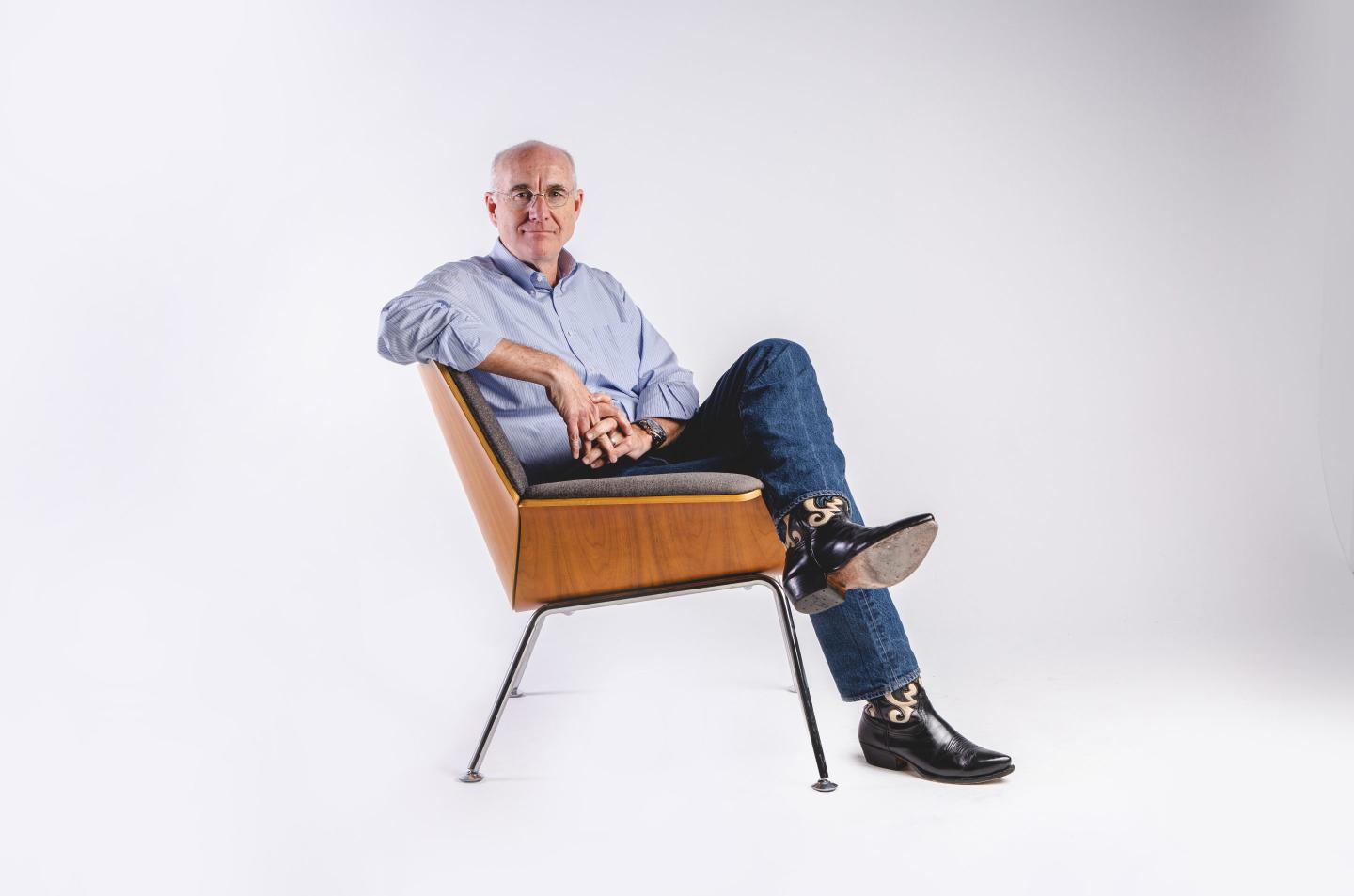
After IBM bought his startup in 2010, the Fortune 500 computer company asked Phil Gilbert to reinvigorate how its teams developed products. Gilbert became IBM’s general manager of design, and over the following decade, he brought design thinking—a philosophy that focuses on the experience of the end user—to the company’s 400,000 employees.
In his new book Irresistible Change: A Blueprint for Earning Buy-In and Breakout Success, Gilbert shares how he managed to get hundreds of thousands of employees to embrace change— and what other companies can learn as they take on their own next wave of transformation, whether sparked by AI, design, or the ever-changing workplace.
From Wall Street banks doubling down on return-to-office to tech giants restructuring teams around AI, leaders are once again asking employees to change how they work.
The present is far more fragile than we often realize. Technology is an ever-present disruptor that has a way of commoditizing what once felt unique, driving a kind of Moore’s law-like acceleration into every corner of our daily workflows. Accepting this reality opens the door to a powerful truth: market leadership tomorrow will be determined by your ability to embrace and direct change today.
That was my experience while leading IBM’s global transformation. Beginning in 2012, my colleagues and I helped thousands of interdisciplinary teams at IBM become more entrepreneurial, more agile, and more customer-focused.
For all those thousands of teams, we never had to mandate change, never had to beg anyone to join. In fact, we made the teams pay for the privilege. One-by-one, these teams utterly transformed their way of working because the entire design and execution of the program was based on delighting them and adding value at every touchpoint.
Those changes have stuck; they’ve become the cultural core for how IBM does business today.
Change is inevitable—that much is clear. But what sets great organizations apart is the intentionality and speed with which they navigate change. Contentment with the way you work in the present sets up disaster in the future. A much healthier approach was once expressed to me this way: “We must always look at the status quo with disdain.”
Organizations that adopt this mindset at scale in the coming years will be the true winners—in the marketplace, within their communities, and even on the battlefield. In every type of industry, companies must use this disdain for the status quo to cultivate cultures of curiosity, innovation, and adaptability. Over time, these organizations will develop something far more valuable and powerful: an institutional predisposition—almost an instinct— for provoking continuous meaningful change.
Through our change program, we rediscovered and unleashed an entrepreneurial spirit that had been buried at IBM over the decades. Everything we achieved at IBM was just a prototype, a proof of concept for what comes next. What began more than a decade ago is now a sturdy template that I hope others will build on and make their own at any organization, of any size.
Change as a product
So what can leaders elsewhere do to build their own repeatable, effective process for change? The same thing we did: design change as a product.
Change should be regarded as a high value-add product that deserves the same levels of resource support and operational rigor as any of your top-performing products. This means clear ownership, strategic leadership, and, above all, profit-and-loss accountability. Only when you treat change with this level of structure and discipline will you set it up for success.
In this model, change is your product, your organization is the marketplace, and its teams are your customers.
Think about the last product you loved enough to adopt. You discovered it, learned about it, tried it, bought it, used it, and if the company did its job right, you came back for more. Change follows the same arc. If your employees can’t discover it, can’t try it safely, or can’t get help when something goes wrong, they’ll retreat back to the old way.
Change as a user experience
It isn’t enough to design change as a product—you also have to deliver it like one. And that means focusing on the customer experience: how your people actually encounter and adopt change in their day-to-day work.
The people who participate in your change program are your customers, and you must always treat them as such. This is especially important among your early adopters. If they don’t stick with your program, you must assume it’s your fault and seek ways to fix what’s not working. Even the people at the other end of the spectrum, who are resisting the very idea of change, represent a customer service failure on your part. Why? Because no one hates improvement. Everyone who resists change perceives it as some kind of threat—to their career, their status or their authority. And at first glance the nature of that perceived threat may not seem obvious to you.
At IBM, our change program needed to address the needs of three critical stakeholders: senior executives, middle managers, and team members. Each of these three groups experience change very differently, and every detail of every experience you offer them must be tailored to address their distinct concerns.
Senior executives know that change is needed. Their chief concern is that change will either take too long or it will fail to scale. You will need to summon not only a strategic communications plan for them, but also develop meaningful “in process” metrics that provide evidence of momentum. At IBM, this meant quarterly one-on-ones between each senior executive and me. Our meetings were structured around how we were impacting each of the three contributors to culture and outcomes: changes to our people, our practices, and our places.
The unique problems of the middle manager tend to be overlooked in change programs. During the change program, these people must run their upline organization in the old culture even as they manage a mix of teams under them working in new and radically different ways. They sometimes don’t see the need for their operations to be upended by change. Addressing the rationale for change and how it would affect them is essential to cultivating their support.
Team members are always affected the most by old-fashioned work habits and inefficient operations— which cause the need for most transformation efforts. They know that change is needed, but they fear the changes won’t be radical enough to have an impact or that the organization won’t have the fortitude to see things through. A failing change program could also tarnish their careers. Your change program needs to provide team members with continuing evidence that the changes are working and spreading. These are the people you’ll get to know the best and spend the most time with, and their outcomes will reflect directly on your program’s early success.
It takes a disciplined customer service mentality to learn about these touchpoints and address them. You need to know your customers well enough to understand how to help them with their problems. Some of these problems may seem trivial to you, but they are as serious as your customer says they are. If you treat your customers with respect and take even their silliest-sounding concerns seriously, you will come up with no end of creative solutions to the problems at hand. That’s what we found, time and time again. Resistance and obstacles led us to one breakthrough solution after another because we never gave in to the idea that “they just don’t get it.”
Change as a luxury good
When you understand those anxieties and design for them, you can go beyond making change tolerable. You can make it desirable—something people actively seek out.
Begin with understanding that you are selling the ultimate luxury good. No one values economy-class change. Only a platinum-tier solution will spark the excitement and customer demand required to drive widespread adoption of change, and have it stick. Sustainable cultural change, like any other product in the luxury category, is rare, highly desirable, and above all, it deeply engages the emotions. Change is both difficult and powerful because it challenges people’s prior beliefs and assumptions about what is possible in their careers and their lives.The change product you offer will transform people’s lives for the better in ways that can’t be counted.
And start small, but make it whole. That’s one thing I knew from decades as a product guy. Do not raise expectations beyond what your offering is ready to provide now. A perfectly prepared cupcake is more satisfying than a half-baked wedding cake. Starting small, with just a few teams delivering exceptionally differentiated outcomes will ultimately scale more quickly than starting big with training and “enablement” that rarely leads to adoption.
Change is inevitable, so make it irresistible
Designing change this way—small but whole, premium in feel, and responsive to real needs—creates momentum that lasts. And momentum is critical, because the future isn’t slowing down.
The future will always surprise us, but one thing is certain: it will demand change. With AI reshaping industries and economic uncertainty rattling markets, change seems to be our only constant. Leaders who treat change not as a one-off initiative but as their most valuable product won’t just endure disruption—they’ll capitalize on it.
Adapted with permission from the publisher, Wiley, from Irresistible Change: A Blueprint for Earning Buy-In and Breakout Success by Phil Gilbert. Copyright © 2025 by John Wiley & Sons, Inc. All rights reserved. This book is available wherever books and eBooks are sold.
Fortune’s Brainstorm Design conference returns on Dec. 2 at the MGM Macau! Join speakers like Gilbert Workshop managing partner Phil Gilbert, IDEO CEO Mike Peng, and Samsung chief design officer Mauro Porcini for a day of deep discussions on this year’s theme: “Future Tense: Prototyping Tomorrow.” Register here!