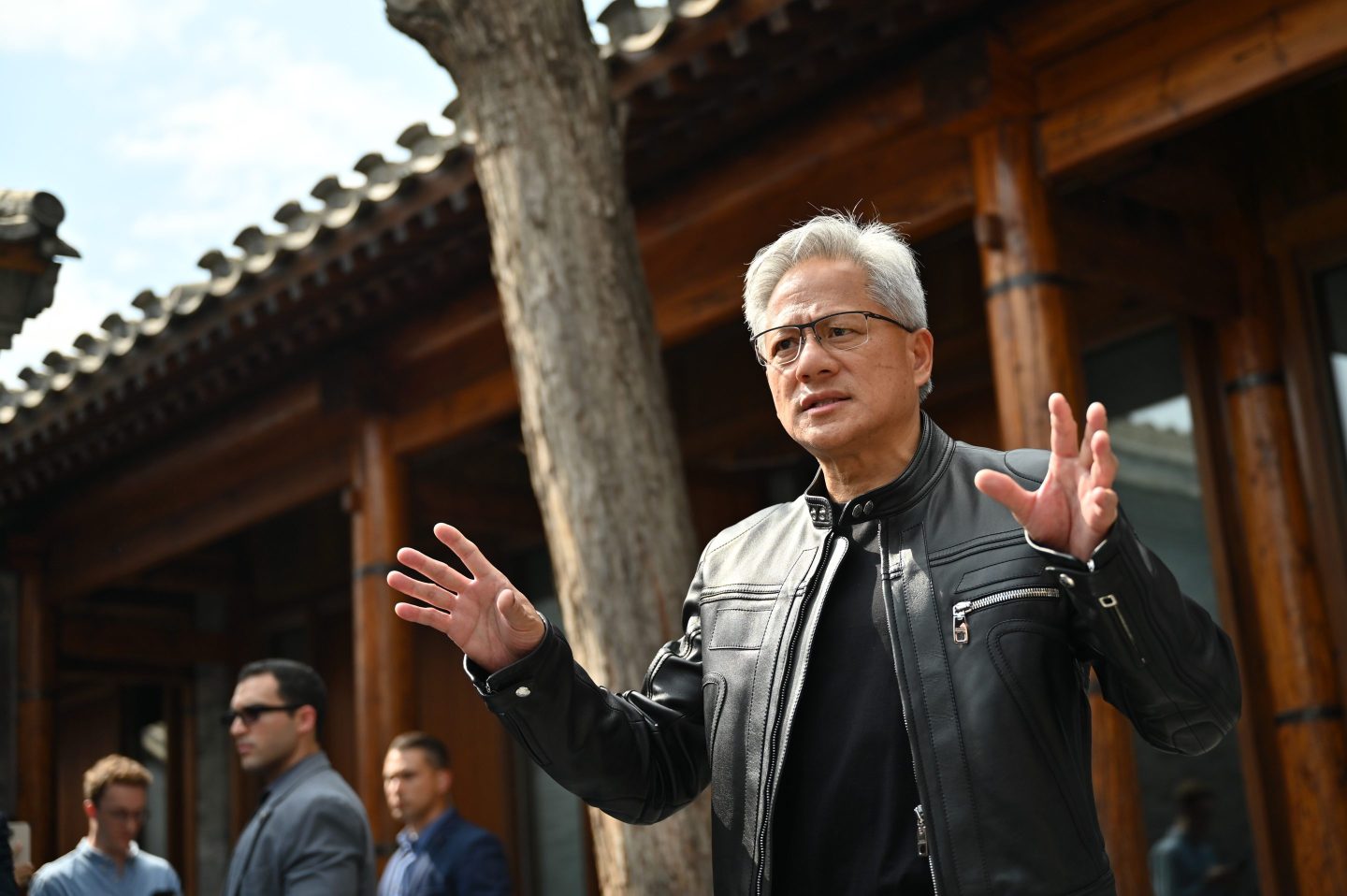
AI chipmaker Nvidia has increasingly found itself caught in a tug of war between Washington and Beijing. And on Monday, China gave a mighty pull—ruling that Nvidia had violated the country’s antitrust laws.
China’s State Administration for Market Regulation (SAMR) said, in a preliminary finding, that Nvidia had failed to fully comply with provisions it had imposed on the chipmaker in 2020 when the agency conditionally approved Nvidia’s acquisition of Mellanox Technologies, an Israeli-U.S. networking equipment maker.
The move is largely seen as a way for Chinese officials to signal their displeasure with Washington’s restrictions on the export of cutting edge technology, including Nvidia’s top-of-the-line AI chips, to China. The regulator began its antitrust probe of Nvidia’s $6.9 billion acquisition of Mellanox in December, just days after the U.S. unveiled tougher export restrictions on high-bandwidth memory chips, which are important for AI applications, as well as chipmaking equipment.
The move is also being viewed by analysts as a way for Beijing to gain additional leverage in trade talks happening this week between U.S. and Chinese diplomats in Madrid. A tariff truce agreed between the two countries in May, and then extended in August, is now set to expire in November.
Over the weekend, Beijing also announced an anti-dumping investigation into a different kind of computer chip made by several U.S. companies, including Texas Instruments and Analog Devices—a decision that was also widely viewed as an attempt to gain leverage in the ongoing tariff negotiations.
Following its preliminary finding, SAMR could fine Nvidia an amount equal to between 1% and 5% of its previous year’s sales in China. The regulator can also mandate changes to Nvidia’s business practices in the country.
Both Beijing’s and Washington’s policies regarding Nvidia have been, at times, schizophrenic. Chinese officials have expressed anger at Washington for restricting the sale of Nvidia’s most advanced chips to China as part of a deliberate policy to ensure the U.S. maintains a lead in AI capabilities over its geopolitical rival. They have also claimed offense at comments by U.S. Commerce Secretary Howard Lutnick that the U.S. only sells its “fourth-best” chips to China.
Yet, at the same time, Beijing has been eager to encourage the development of its own domestic AI chip industry, centered around Huawei, and upstart chipmakers such as Cambricon and Moore Threads. The country recently mandated that all publicly-owned datacenters will be required to source more than 50% of their chips from domestic producers.
In addition, Chinese internet giants Baidu and Alibaba, both of which have developed powerful AI models that rival those produced by U.S. companies such as OpenAI and Anthropic, have begun using chips that they designed in-house and had produced domestically to train some of their models, according to a story in The Information that cited unnamed sources familiar with the matter.
Meanwhile, the Trump administration has seemed torn between the idea of preventing China from gaining access to Nvidia’s technology and wanting to ensure Chinese companies build their AI models on U.S. chips. Keeping Chinese companies hooked on Nvidia’s graphics processing units (GPUs), the specialized chips used to run AI applications, gives the U.S. a strategic stranglehold with which to exercise leverage over China in both trade talks, and maybe, in the future, a potential armed conflict.
The Trump administration is also eager to profit from Nvidia’s chip sales to China. In an unprecedented move, as a condition of granting Nvidia and its rival AMD export licenses to sell some of their chips to China, the administration mandated that both companies share 15% of sales with the U.S. government.
The Biden administration first began to restrict the sale of Nvidia’s chips to China in October 2022, blocking sales of its A100 and H100 GPUs. At the time, the H100 was the most powerful GPU for training AI systems that could be bought outright. Then, a year later, it imposed further controls on the sale of Nvidia GPUs that had been modified to comply with the early restrictions. Following this, Nvidia designed a GPU, called the H20, specifically for the Chinese market that complies with U.S. export rules.
In April 2025, however, the Trump administration forced Nvidia to seek export licenses even for sales of H20s. In response, Nvidia announced a $5.5 billion charge to earnings to account for the loss of Chinese H20 sales. But in July, the Trump administration reversed course, saying it would grant these export licenses, provided Nvidia share a slice of the revenues with the U.S. government.
Still, the seesawing policy swings from both Washington and Beijing, have made life difficult for the San Jose-based chip company. In late August, Nvidia told investors it could not forecast its revenues from China due to the ongoing geopolitical uncertainty. CEO Jensen Huang told analysts that Chinese GPU sales were a “$50 billion opportunity” for the company over the next few years that would be lost if its access to the market continued to be cut off.
Nvidia shares fell slightly today on news of the antitrust investigation.