• Home
  • Latest
  • Fortune 500
  • Finance
  • Tech
  • Leadership
  • Lifestyle
  • Rankings
  • Multimedia
EnergyElectric vehicles

In China, EVs are now cheaper than gas cars. In the U.S., the Big Three still haven’t closed a premium that’s $14,000 per vehicle

By
Eva Roytburg
Eva Roytburg
Fellow, News
Down Arrow Button Icon
By
Eva Roytburg
Eva Roytburg
Fellow, News
Down Arrow Button Icon
August 26, 2025, 4:34 AM ET
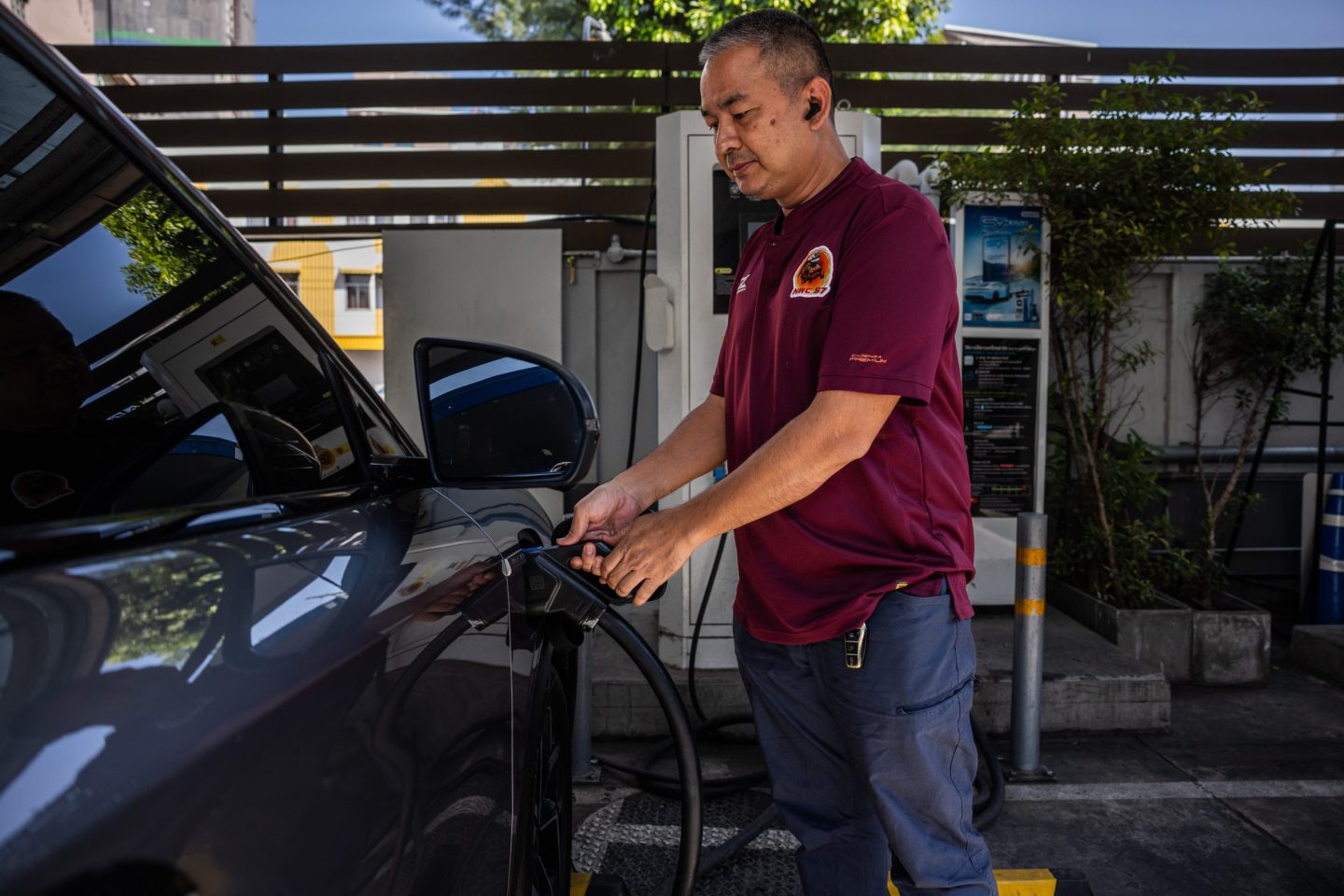
Man in red shirt charges his BYD car while wearing earbuds.
A BYD owner charges his car battery at an EV charging station at a PTT service station in central Bangkok on December 01, 2024 in Bangkok, Thailand. Lauren DeCicca/Getty Images
  • China has already made EVs cheaper than gas cars, while U.S. EVs carry a premium of about $14,000, though the gap has shrunk since 2019. Meanwhile, the Big Three remain unprofitable on EVs and slow to scale, a struggle tied to a lack of supportive policies from the federal government, according an expert.

China has now crossed a massive benchmark in the electric-car race: battery-powered vehicles are now cheaper than their gas counterparts. In the U.S., by contrast, EVs still face a steep premium; roughly $14,000 on average, according to new data from JATO dynamics, an automotive data analytics firm. 

Recommended Video

Dan Sperling, founding director of the UC Davis Institute of Transportation Studies, told Fortune he thought the $14,000 figure was overestimated – but conceded that there was a strong, real gap. 

That chasm reflects more than just consumer preferences, Sperling said. In China, there’s also been a “frenzy of competition” to make low-cost EVs, with the heads of different provinces trying to oust each other for the top spot. Labor and battery costs are also lower in China, thanks to its domestic supply chains. 

“People talk about subsidies, but at this point the subsidy effect is pretty minor,” he added.

The average price of a Chinese internal combustion engine is €22,500 (approximately $26,205), whereas a battery electric vehicle costs 3% less, or €21,900 ( $25,509) on average, according to JATO. That’s a big change from just five years ago, when gas EVs cost 10% more. 

The results are visible everywhere. Leading Chinese automaker BYD sold more than 4 million cars last year—10 times what it sold in 2020—and now dominates roads across the world, from Bogotá to Budapest. In Europe, its compact Dolphin model retails for under €20,000 ($23,200), roughly half the price of Tesla’s Model 3. 

BYD’s relentless pace of new launches, tight control of its battery supply chain, and willingness to sacrifice short-term profits are overwhelming legacy automakers, analysts previously told Fortune. China’s trade partners also argue that Beijing is fueling overproduction that’s flooding export markets with cut-rate EVs.

Meanwhile, Sperling warned that the U.S. is too caught up playing tariff games to develop its own EV industry. His words echoed the old adage that the best defense is offense. Tariffs of more than 100% have kept Chinese cars out of the American market, a protection that may buy time, but also risks making U.S. automakers complacent. 

“There’s a long history showing that absolute protectionism undermines an industry rather than supports it,” he said.

Without the pressure of direct competition, the Big Three of the automotive industry – GM, Ford and Stellantis – have less incentive to innovate with EVs, Sperling said. 

Still, the U.S. has also improved EV affordability relative to gas cars over the last five years, according to the JATO data. In 2019, gas cars were 44% cheaper than electric cars, and in 2024 the gap narrowed to 31%. 

But while progress is being made, Sperling said that the U.S. is missing the kind of structural policies – tax credits, purchase mandates, subsidies generally – that spur automakers to build EVs at scale. 

The struggles of the Big Three

To be sure, automakers are attempting large EV pushes, even as EV-related losses pile up. 

Ford announced a new $5 billion EV initiative this month, where the automaker will reconfigure its Kentucky plant to build a $30,000 electric pickup by 2027, an ambitious attempt to build EVs at scale. 

Analysts say it could either mark a historic reinvention or sink billions more into an already money-losing division: Ford’s EV arm has racked up more than $12 billion in losses since early 2023.

GM also announced in June that it’s investing $4 billion in domestic manufacturing, including its EV wing. In the last quarter of 2024, GM’s electric portfolio became “value profit positive,” meaning that for each electric vehicle sale, GM covers the costs of making each car (but not the fixed costs involved, such as the labor or the EV plants).

GM has the second most robust EV portfolio in the American market, sitting behind Tesla in terms of total sales. However, James Picariello, senior automotive research analyst at BNP Paribas Exane, previously told Fortune that he estimated GM lost some $2.5 billion on the 189,000 electric vehicles it built and sold to dealerships last year. 

Earlier this year, GM said on an earnings call that it hoped to bring about $2 billion in savings improvement for its EVs.  

Stellantis has also stumbled in its EV transition, posting a €2.3 billion net loss in the first half of 2025 as operating margins shrank to just 0.7%. The automaker has struggled to spark U.S. demand, slashing prices on electric models like the Jeep Wagoneer S to move inventory. 

At the same time, tariffs and weak demand have pushed Stellantis to extend furloughs at its Termoli site in Italy. Yet the company is still pressing forward: it unveiled the STLA Frame platform, a flexible architecture supporting gas, hybrid, EV, and hydrogen drivetrains. Additionally, Stellantis partnered with China’s Leapmotor in hopes of staying in the game, investing €1.5 billion for a 21% stake in the company. Stellantis hopes that its incumbent advantage and respected brand can combine with the Leapmotor’s innovation to deliver a more affordable EV. 

Industrial policy failures

For industry experts, part of the price gap is clearly attributable to the U.S. failure to promote electric vehicles with policies. President Donald Trump has flip-flopped on his opinion of EVs, but his Big, Beautiful Bill act ended tax credits for new, used and leased EVs. 

Meanwhile, China’s decades of forced joint ventures – requiring foreign automakers to partner with domestic automakers in EV manufacturing –  built a workforce fluent in EV technology and software, Sterling said. For America, he suggested a version of that approach: “encourage joint venture investments” to accelerate the know-how needed to catch up, like the one that Stellantis is doing with China.

“You create a whole cadre of technicians and engineers and workers that are adept with the technology,” Sterling said. “Detroit is badly lacking that.”

He rejected the idea that Detroit is doomed, but stressed it depends entirely on policy. In his view, legacy U.S. automakers are currently coasting on SUVs and pickups, without making the investments in EVs or software that Chinese rivals have already mastered.

“If the U.S. continues to keep out the Chinese and discourages electric vehicles, it will take decades to catch up,” Sterling said. “But if policies change, yes, it can catch up for sure.”

Join us at the Fortune Workplace Innovation Summit May 19–20, 2026, in Atlanta. The next era of workplace innovation is here—and the old playbook is being rewritten. At this exclusive, high-energy event, the world’s most innovative leaders will convene to explore how AI, humanity, and strategy converge to redefine, again, the future of work. Register now.
About the Author
By Eva RoytburgFellow, News

Eva is a fellow on Fortune's news desk.

See full bioRight Arrow Button Icon

Latest in Energy

Finance
Lorem ipsum dolor sit amet, consectetur adipiscing elit, sed do eiusmod tempor incididunt ut labore et dolore magna aliqua. Ut enim ad minim veniam
By Fortune Editors
October 20, 2025
Finance
Lorem ipsum dolor sit amet, consectetur adipiscing elit, sed do eiusmod tempor incididunt ut labore et dolore magna aliqua. Ut enim ad minim veniam
By Fortune Editors
October 20, 2025
Finance
Lorem ipsum dolor sit amet, consectetur adipiscing elit, sed do eiusmod tempor incididunt ut labore et dolore magna aliqua. Ut enim ad minim veniam
By Fortune Editors
October 20, 2025
Finance
Lorem ipsum dolor sit amet, consectetur adipiscing elit, sed do eiusmod tempor incididunt ut labore et dolore magna aliqua. Ut enim ad minim veniam
By Fortune Editors
October 20, 2025
Finance
Lorem ipsum dolor sit amet, consectetur adipiscing elit, sed do eiusmod tempor incididunt ut labore et dolore magna aliqua. Ut enim ad minim veniam
By Fortune Editors
October 20, 2025
Finance
Lorem ipsum dolor sit amet, consectetur adipiscing elit, sed do eiusmod tempor incididunt ut labore et dolore magna aliqua. Ut enim ad minim veniam
By Fortune Editors
October 20, 2025

Most Popular

Finance
Lorem ipsum dolor sit amet, consectetur adipiscing elit, sed do eiusmod tempor incididunt ut labore et dolore magna aliqua. Ut enim ad minim veniam
By Fortune Editors
October 20, 2025
Finance
Lorem ipsum dolor sit amet, consectetur adipiscing elit, sed do eiusmod tempor incididunt ut labore et dolore magna aliqua. Ut enim ad minim veniam
By Fortune Editors
October 20, 2025
Finance
Lorem ipsum dolor sit amet, consectetur adipiscing elit, sed do eiusmod tempor incididunt ut labore et dolore magna aliqua. Ut enim ad minim veniam
By Fortune Editors
October 20, 2025
Finance
Lorem ipsum dolor sit amet, consectetur adipiscing elit, sed do eiusmod tempor incididunt ut labore et dolore magna aliqua. Ut enim ad minim veniam
By Fortune Editors
October 20, 2025
Finance
Lorem ipsum dolor sit amet, consectetur adipiscing elit, sed do eiusmod tempor incididunt ut labore et dolore magna aliqua. Ut enim ad minim veniam
By Fortune Editors
October 20, 2025
Finance
Lorem ipsum dolor sit amet, consectetur adipiscing elit, sed do eiusmod tempor incididunt ut labore et dolore magna aliqua. Ut enim ad minim veniam
By Fortune Editors
October 20, 2025
Fortune Secondary Logo
Rankings
  • 100 Best Companies
  • Fortune 500
  • Global 500
  • Fortune 500 Europe
  • Most Powerful Women
  • Future 50
  • World’s Most Admired Companies
  • See All Rankings
Sections
  • Finance
  • Fortune Crypto
  • Features
  • Leadership
  • Health
  • Commentary
  • Success
  • Retail
  • Mpw
  • Tech
  • Lifestyle
  • CEO Initiative
  • Asia
  • Politics
  • Conferences
  • Europe
  • Newsletters
  • Personal Finance
  • Environment
  • Magazine
  • Education
Customer Support
  • Frequently Asked Questions
  • Customer Service Portal
  • Privacy Policy
  • Terms Of Use
  • Single Issues For Purchase
  • International Print
Commercial Services
  • Advertising
  • Fortune Brand Studio
  • Fortune Analytics
  • Fortune Conferences
  • Business Development
About Us
  • About Us
  • Editorial Calendar
  • Press Center
  • Work At Fortune
  • Diversity And Inclusion
  • Terms And Conditions
  • Site Map
Fortune Secondary Logo
  • About Us
  • Editorial Calendar
  • Press Center
  • Work At Fortune
  • Diversity And Inclusion
  • Terms And Conditions
  • Site Map
  • Facebook icon
  • Twitter icon
  • LinkedIn icon
  • Instagram icon
  • Pinterest icon

Latest in Energy

Form Energy CEO Mateo Jaramillo is pictured at Form Factory 1 in Weirton, West Virginia.
Energybatteries
Google is building a bevy of renewable energy in Minnesota—including the world’s largest battery system providing power for a whopping 100 hours
By Jordan BlumFebruary 28, 2026
3 hours ago
Aerial view of a data center under construction in Ohio.
EconomyEconomics
Before AI gains materialize, governments will have to deal with a ‘policy tradeoff,’ Moody’s says: How to handle the massive spending and debt risk
By Tristan BoveFebruary 27, 2026
15 hours ago
putin
CommentaryRussia
Exclusive analysis: we looked at the 400 western firms still in Russia. Their paltry size strips Putin’s bluff bare naked
By Jeffrey Sonnenfeld, Stephen Henriques, Jake Waldinger and Giuseppe ScottoFebruary 27, 2026
21 hours ago
shapiro
AIData centers
Why Pennsylvania sits at the center of the big data-center power problem
By Shixiang (Woody) Zhu and The ConversationFebruary 26, 2026
2 days ago
Asiaclean energy
Seatrium doubles its net profit on the back of a global energy boom
By Angelica AngFebruary 26, 2026
2 days ago
Photo of Stephan Winkelmann
EnergyAutos
Lamborghini CEO axes $300,000 luxury EV, chalking it up to an ‘expensive hobby’ with ‘close to zero’ demand
By Sasha RogelbergFebruary 24, 2026
4 days ago

Most Popular

placeholder alt text
Innovation
An MIT roboticist who cofounded bankrupt robot vacuum maker iRobot says Elon Musk’s vision of humanoid robot assistants is ‘pure fantasy thinking’
By Marco Quiroz-GutierrezFebruary 25, 2026
3 days ago
placeholder alt text
Success
Japanese companies are paying older workers to sit by a window and do nothing—while Western CEOs demand super-AI productivity just to keep your job
By Orianna Rosa RoyleFebruary 27, 2026
20 hours ago
placeholder alt text
Commentary
'The Pitt': a masterclass display of DEI in action 
By Robert RabenFebruary 26, 2026
2 days ago
placeholder alt text
Economy
It’s more than George Clooney moving to France: America is becoming the ‘uncool’ country that people want to move away from
By Nick LichtenbergFebruary 27, 2026
1 day ago
placeholder alt text
Success
Walmart exec says U.S. workforces needs to take inspiration from China where ‘5 year-olds are learning DeepSeek’
By Preston ForeFebruary 27, 2026
1 day ago
placeholder alt text
Law
China's government intervenes to show Michigan scientists were carrying worms, not biological materials
By Ed White and The Associated PressFebruary 26, 2026
2 days ago

© 2026 Fortune Media IP Limited. All Rights Reserved. Use of this site constitutes acceptance of our Terms of Use and Privacy Policy | CA Notice at Collection and Privacy Notice | Do Not Sell/Share My Personal Information
FORTUNE is a trademark of Fortune Media IP Limited, registered in the U.S. and other countries. FORTUNE may receive compensation for some links to products and services on this website. Offers may be subject to change without notice.