
• Home
  • News
  • Fortune 500
  • Tech
  • Finance
  • Leadership
  • Lifestyle
  • Rankings
  • Multimedia
Big TechFortune Intelligence

How AI darling Palantir became the S&P 500’s best and worst stock of 2025, climbing 144% before shedding value in 6 straight sessions

Nick Lichtenberg
By
Nick Lichtenberg
Nick Lichtenberg
Business Editor
Down Arrow Button Icon
Nick Lichtenberg
By
Nick Lichtenberg
Nick Lichtenberg
Business Editor
Down Arrow Button Icon
August 21, 2025, 11:53 AM ET
Alex Karp
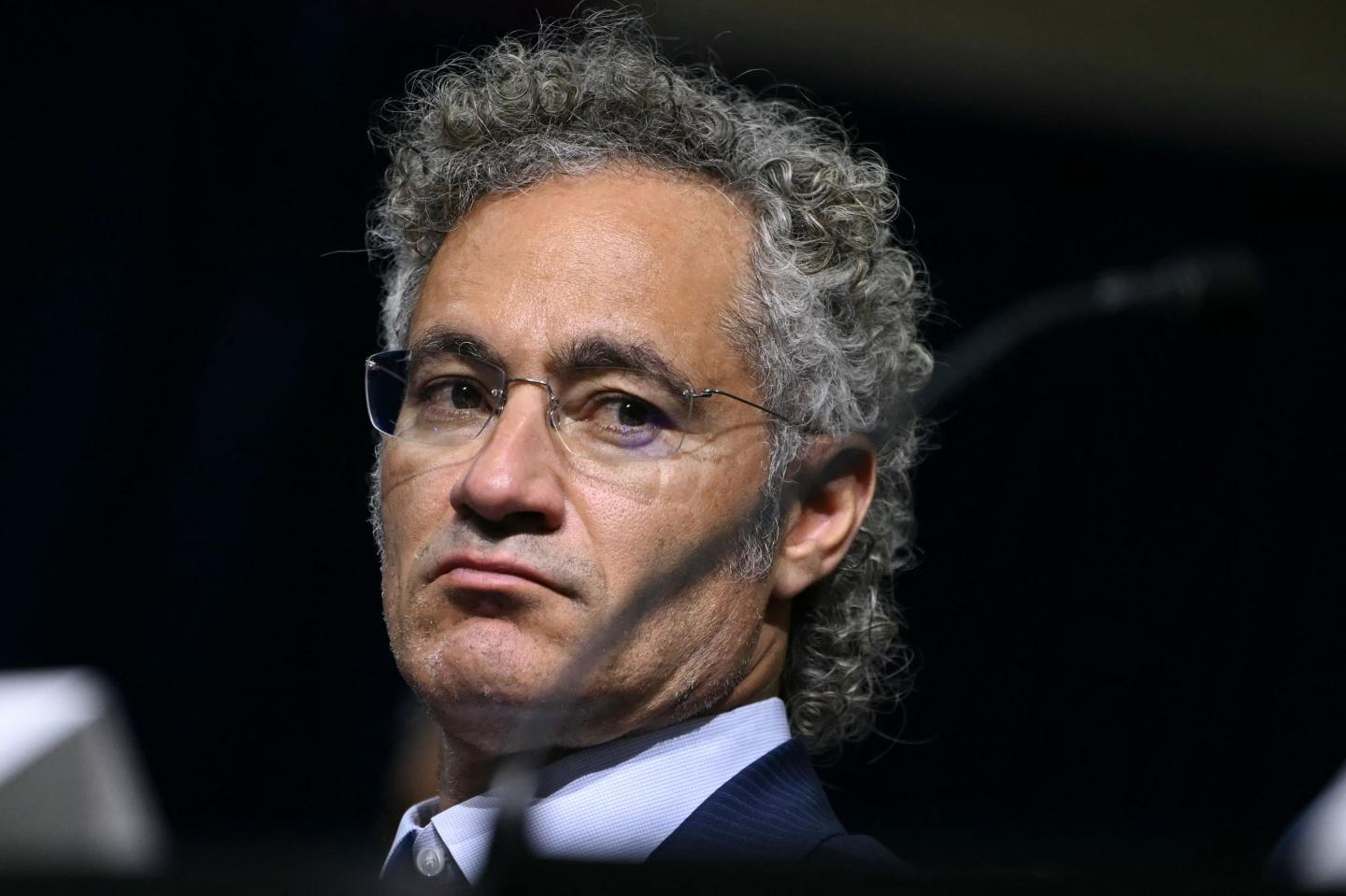
Palantir Technologies CEO Alex KarpANDREW CABALLERO-REYNOLDS—AFP/Getty Images

Palantir Technologies has created one of the most dramatic stories on Wall Street this year, defying conventional investment narratives. In 2025, it became the top-performing stock in the S&P 500, surging over 106% and at points climbing 144% from the start of the year—outpacing even AI heavyweights like Nvidia. This explosive growth was fueled by its robust financial performance, notching its first billion-dollar quarter with momentum from government and commercial AI contracts.

Recommended Video

However, Palantir’s meteoric rise has been followed by a brutal reversal. Over the past six trading sessions, Palantir shares plunged more than 17%, wiping out $73 billion in market capitalization and marking the largest drop since April. This tumble handed short-sellers $1.6 billion in profits, Bloomberg reported, citing data from S3 Partners. (That figure is still dwarfed by the $4.5 billion paper losses that shorts racked up earlier in the year, S3 says.) In recent days, Palantir has also been the worst performer in the S&P 500, illustrating an extreme swing from hero to villain in the market.

The vicious short-seller report

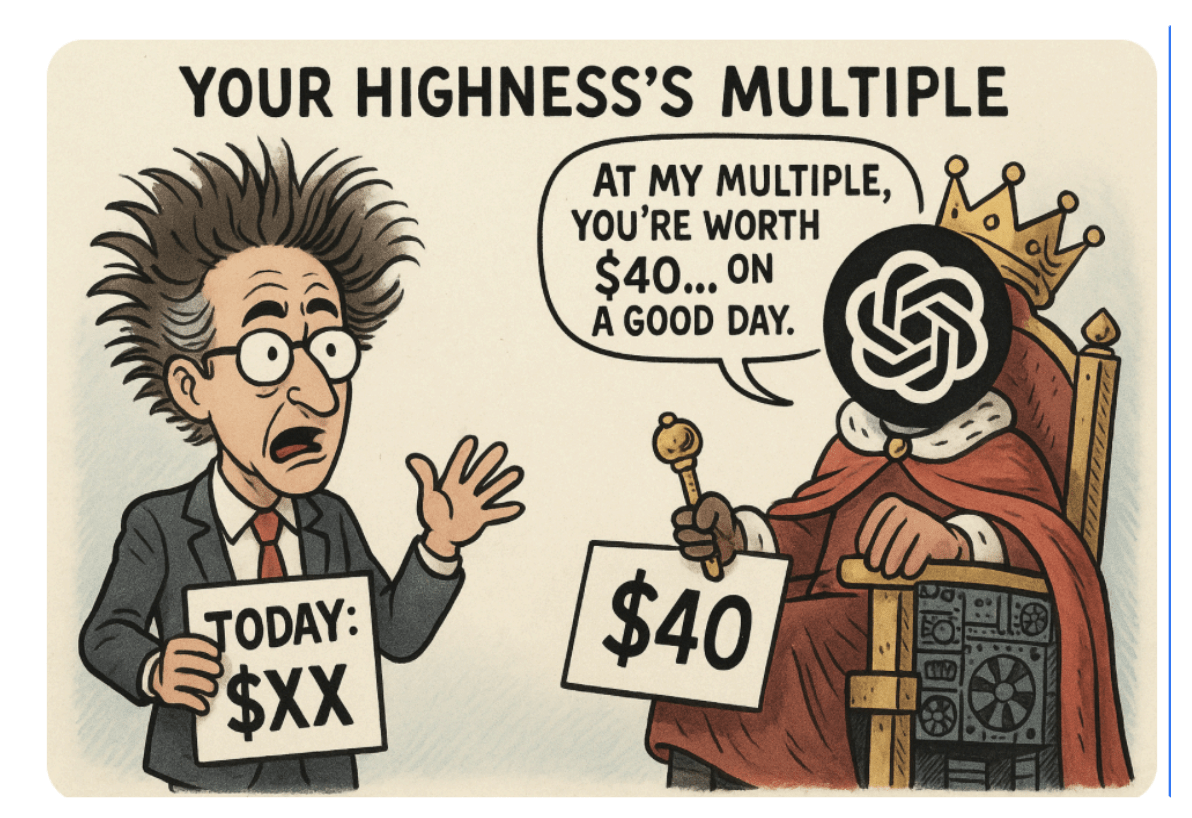
Palantir’s dramatic stock moves followed fresh fire from short-sellers, particularly Citron Research, led by Andrew Left. In a scathing report, Citron argued that Palantir’s stock was detached from its business fundamentals and sound analysis. It included a caricature of Palantir CEO Alex Karp in the royal court of OpenAI, titled, “Your highness’s multiple,” laying out the case for Palantir having much farther to fall.
Courtesy of Citron Research

Citron’s thesis is that OpenAI, widely recognized as the leader in AI, is about to receive a $500 billion valuation with projected revenue of $29.6 billion in 2026, resulting in a price-to-sales ratio of nearly 17. By contrast, Palantir is forecasted to deliver $5.6 billion in revenue in 2026. Applying OpenAI’s valuation multiple to Palantir would yield a stock price of just $40. (Citron showed its math, calculating that $5.6 billion multiplied by 17 would shoot up to a roughly $95 billion market cap, divided by 2.37 billion shares outstanding, yielding a $40-per-share valuation.) “It should be noted,” Citron writes, “that even at a 17x sales multiple, OpenAI has the highest multiple of any scaled SaaS stock in the world, and that number in itself is extreme. This means that at $40, PLTR would still be expensive.”

Short-sellers like Left insist that Palantir’s business isn’t as scalable or as subscription-based as Wall Street prefers, in stark contrast to OpenAI. Palantir’s dependence on government deals introduces uncertainty and volatility, leading Citron to claim that the stock is unjustifiably expensive even after recent losses.

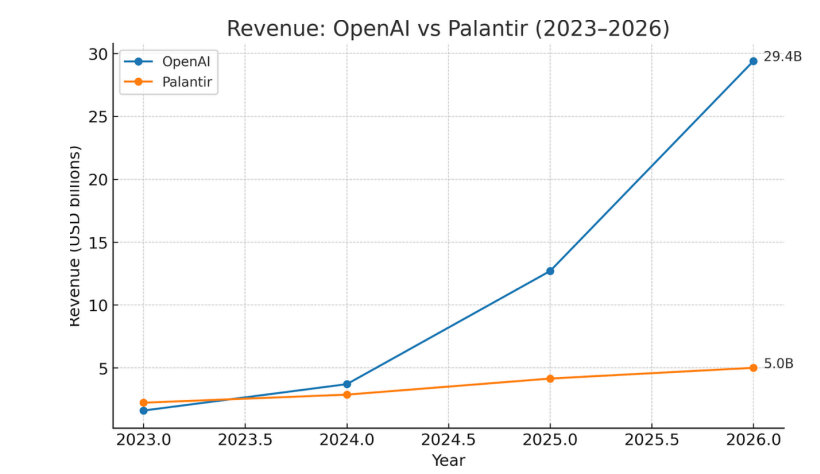
“OpenAI is creating a flywheel that Palantir lacks,” the report says, adding that the widening moat and cycle of growth, data, and scale is “reminiscent of Google in its prime.” Palantir, on the other hand, is more like a defense contractor, with real “stickiness” but growth hinging on slow, customized contracts that don’t compound. “OpenAI is a self-reinforcing growth engine, while Palantir is essentially locked-in consulting wrapped in software.” Citron contrasted a chart of Palantir’s impressive, steady revenue growth with OpenAI’s skyrocketing results.
Courtesy of Citron Research

Best of times, worst of times

Palantir’s story in 2025 is a case study in market euphoria versus valuation reality. Fueled by speculative optimism about AI, its share price rapidly baked in years of expected growth. But as profit-taking sets in, momentum evaporates, and critical reports highlight the mismatch between price and fundamental value, fortunes can reverse just as quickly.

Even now, contrarian trading remains high: If Palantir rebounds, short interest is expected to return as investors closely watch future earnings, contract renewals, and the sustainability of its growth strategy. This extraordinary volatility means that Palantir, in 2025, is the top-performing and worst-performing stock—at the same time.

Palantir’s swings also come against the backdrop of a wider tech selloff in markets following reports that the AI revolution isn’t materializing as planned. A sweeping MIT report found that despite tens of billions in investment, 95% of generative AI pilots at companies are failing.

OpenAI CEO Sam Altman himself rattled markets by using the B-word: bubble. Citron remarked with interest: “This morning, we read that Sam Altman stated the AI market is in a bubble. Altman isn’t shorting Palantir—he’s simply telling the truth. The market is frothy, and no one knows it better than the man who built the most valuable AI company in the world.”

Palantir did not immediately respond to a request for comment.

For this story, Fortune used generative AI to help with an initial draft. An editor verified the accuracy of the information before publishing. 

Fortune Brainstorm AI returns to San Francisco Dec. 8–9 to convene the smartest people we know—technologists, entrepreneurs, Fortune Global 500 executives, investors, policymakers, and the brilliant minds in between—to explore and interrogate the most pressing questions about AI at another pivotal moment. Register here.
About the Author
Nick Lichtenberg
By Nick LichtenbergBusiness Editor
LinkedIn icon

Nick Lichtenberg is business editor and was formerly Fortune's executive editor of global news.

See full bioRight Arrow Button Icon

Latest in Big Tech

AITech
IBM CEO warns there’s ‘no way’ hyperscalers like Google and Amazon will be able to turn a profit at the rate of their data center spending
By Marco Quiroz-GutierrezDecember 3, 2025
1 hour ago
MagazineMarkets
Why an AI bubble could mean chaos for stock markets—and how smart investors are protecting their portfolios
By Alyson ShontellDecember 3, 2025
4 hours ago
Rakesh Kumar
CommentarySemiconductors
China does not need Nvidia chips in the AI war — export controls only pushed it to build its own AI machine
By Rakesh KumarDecember 3, 2025
5 hours ago
CryptoCryptocurrency
Exclusive: Harvard grads raise $20 million for Ostium, a platform focused on a derivative popular with crypto traders
By Ben WeissDecember 3, 2025
5 hours ago
MagazineMedia
CoComelon started as a YouTube show for toddlers. It’s now a $3 billion empire that even Disney can’t ignore
By Natalie JarveyDecember 3, 2025
6 hours ago
MagazineFood and drink
A Chinese ice cream chain, powered by super-cheap cones, now has more outlets than McDonald’s
By Theodora YuDecember 3, 2025
9 hours ago

Most Popular

placeholder alt text
North America
Jeff Bezos and Lauren Sánchez Bezos commit $102.5 million to organizations combating homelessness across the U.S.: ‘This is just the beginning’
By Sydney LakeDecember 2, 2025
1 day ago
placeholder alt text
Economy
Ford workers told their CEO 'none of the young people want to work here.' So Jim Farley took a page out of the founder's playbook
By Sasha RogelbergNovember 28, 2025
5 days ago
placeholder alt text
Economy
Elon Musk says he warned Trump against tariffs, which U.S. manufacturers blame for a turn to more offshoring and diminishing American factory jobs
By Sasha RogelbergDecember 2, 2025
1 day ago
placeholder alt text
North America
Anonymous $50 million donation helps cover the next 50 years of tuition for medical lab science students at University of Washington
By The Associated PressDecember 2, 2025
1 day ago
placeholder alt text
Success
Warren Buffett used to give his family $10,000 each at Christmas—but when he saw how fast they were spending it, he started buying them shares instead
By Eleanor PringleDecember 2, 2025
1 day ago
placeholder alt text
C-Suite
MacKenzie Scott's $19 billion donations have turned philanthropy on its head—why her style of giving actually works
By Sydney LakeDecember 2, 2025
1 day ago
Rankings
  • 100 Best Companies
  • Fortune 500
  • Global 500
  • Fortune 500 Europe
  • Most Powerful Women
  • Future 50
  • World’s Most Admired Companies
  • See All Rankings
Sections
  • Finance
  • Leadership
  • Success
  • Tech
  • Asia
  • Europe
  • Environment
  • Fortune Crypto
  • Health
  • Retail
  • Lifestyle
  • Politics
  • Newsletters
  • Magazine
  • Features
  • Commentary
  • Mpw
  • CEO Initiative
  • Conferences
  • Personal Finance
  • Education
Customer Support
  • Frequently Asked Questions
  • Customer Service Portal
  • Privacy Policy
  • Terms Of Use
  • Single Issues For Purchase
  • International Print
Commercial Services
  • Advertising
  • Fortune Brand Studio
  • Fortune Analytics
  • Fortune Conferences
  • Business Development
About Us
  • About Us
  • Editorial Calendar
  • Press Center
  • Work At Fortune
  • Diversity And Inclusion
  • Terms And Conditions
  • Site Map

© 2025 Fortune Media IP Limited. All Rights Reserved. Use of this site constitutes acceptance of our Terms of Use and Privacy Policy | CA Notice at Collection and Privacy Notice | Do Not Sell/Share My Personal Information
FORTUNE is a trademark of Fortune Media IP Limited, registered in the U.S. and other countries. FORTUNE may receive compensation for some links to products and services on this website. Offers may be subject to change without notice.