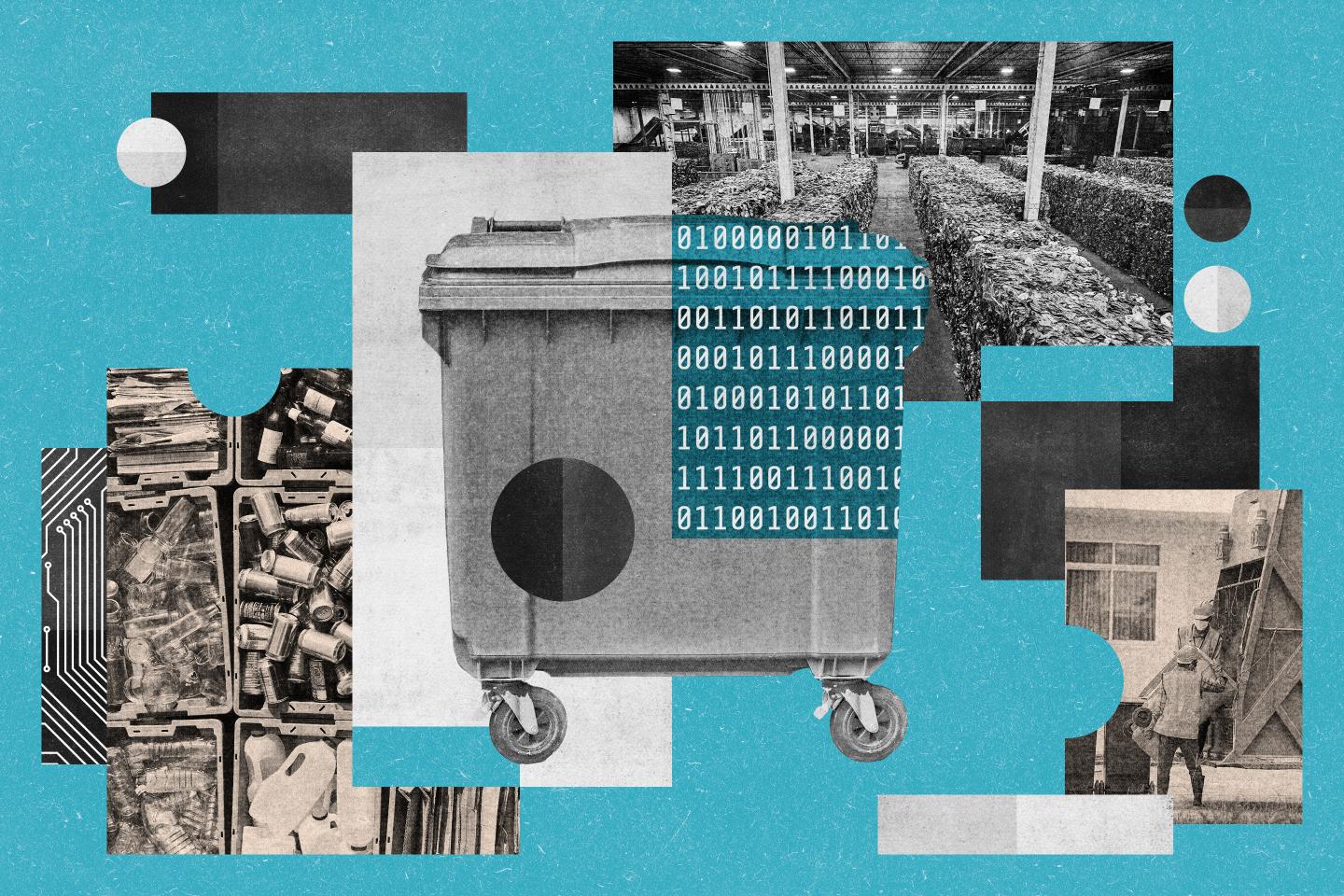
There’s an old English saying: Where there’s muck, there’s brass. Garbage isn’t sexy, but it can be lucrative, if handled correctly—especially when it comes to retrieving and reusing recyclable materials.
The problem is that developed countries, especially the U.S., have historically been dismal at doing that. The average American produces nearly five pounds of waste every day, Environmental Protection Agency data shows. And comparatively little of that gets recycled: around 43% of aluminum cans, 31% of glass, and just 5% of plastics.
Those numbers have remained relatively stagnant over the past decade or more, and they were the ones that Matanya Horowitz set out to change. Today, Horowitz’s startup, AMP, based in Louisville, Colo., has developed a technology that could move the needle—by using AI to pluck recyclables out of society’s vast tide of garbage far more quickly and efficiently.
“Recyclables really have value,” says Horowitz. “Somehow recycling was only touching a fraction of the waste stream.” The barrier, ultimately, was the cost of sorting it out of regular garbage and separating it to be reentered into the supply chain. Recycling sorting machines were large, bulky, and expensive, and required human oversight—including, often, forcing humans to wade through piles of trash to handle things that the machine had missed. (Sorting through garbage is also something you want people to avoid having to do. “You do not want people poking through hypodermic needles and diapers,” says Horowitz.)
“All of that cost meant that if you’re going to get $1 [worth of] aluminum out, you’re going to have to put $1 in,” says Horowitz. “It was kind of a marginal business.”
Horowitz, who had taught robotics at the University of Colorado at Boulder and went on to become a graduate fellow at the California Institute of Technology, thought that AI and robotics could help improve those margins. He launched AMP Robotics in September 2014 (the company rebranded last year as AMP). The premise was simple: “You can unlock the value of these recyclables by lowering the cost of pulling it out,” he says.
Progress was slow at first. It took a year or two for the company’s first robot, installed at its first client’s site in Denver, to successfully sort the metaphorical wheat from the chaff. At one point, “it picked, like, two cartons or something like that in a row, and it was just like, ‘Oh, my God, yes!’” recalls Horowitz.
Further installations followed, including AMP’s first “whole facilities”—stand-alone recycling plants—in 2020. The firm also raised a $16 million Series A in 2019, followed by its Series B round in 2021. Between those rounds, in 2020, AMP signed a long-term agreement with Waste Connections, a U.S.-based waste collection company that booked $8.9 billion in revenue last year. The initial agreement to deploy 24 robotics systems to sort through container, fiber, and residue lines owned by Waste Connections was expanded to include 50 facilities two years later. (AMP, which remains privately held, declined to share revenue or profitability figures.)
“The technology that they’re putting forth is just truly amazing … what they’re doing with AI right now,” says Mark Ceresa, division vice president at Waste Connections. “And as more and more equipment comes online for them, the overall AI gets better at figuring out what is a good target and what is a bad target.”
Smaller but more powerful sorters
The company’s modular recycling systems, powered by AI, are smaller and smarter than preexisting alternatives, which either sorted items poorly by comparison, or required humans to wade in afterward and sort out recyclable materials by hand. The core innovation is using computer vision and robotics to sort materials, particularly from raw garbage—a feat Horowitz calls the “holy grail for the industry.”
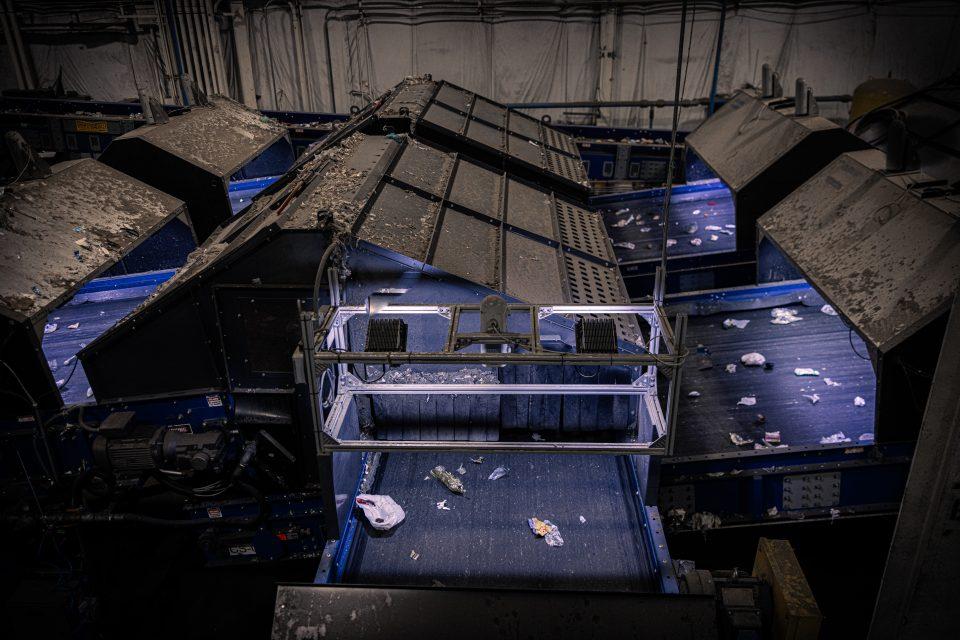
What Horowitz refers to as a “robot” looks to an observer more like a complex factory assembly line, with multiple conveyor belts looping through an intricate web of machinery. AMP systems use cameras to scan through waste as it moves along processing lines, tracking the output through its AI system. The system has been trained on 200 billion pieces of data gleaned from hundreds of millions of example images. Once it has pinpointed material that can be recycled, it fires a jet of air at the object, pushing it off the belt to be processed.
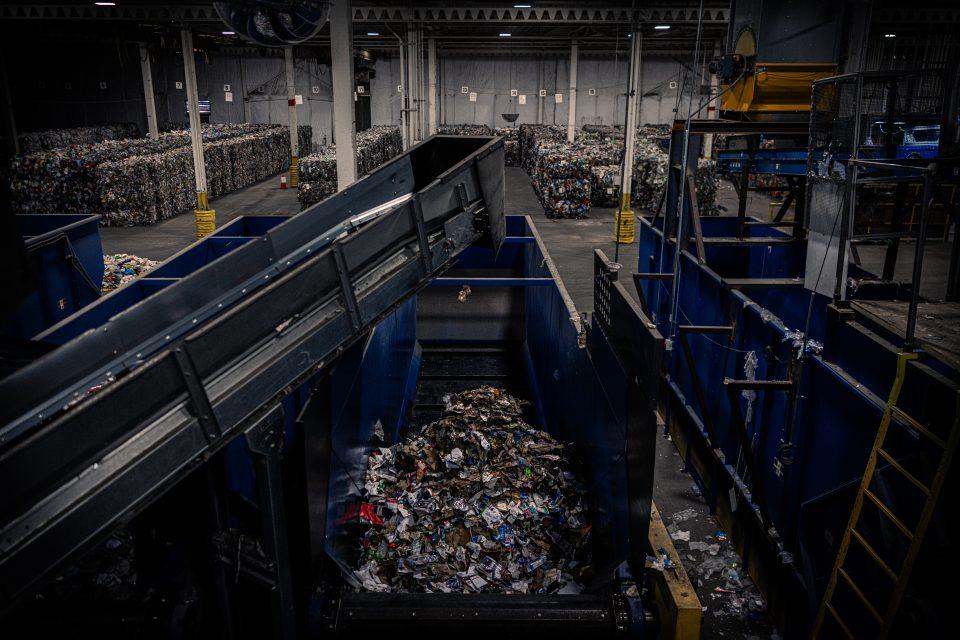
Those innovations allow AMP tools to operate less expensively, and in smaller spaces, than traditional alternatives. Horowitz says that his systems are consistently recovering more than 90% of reusable materials successfully, “and sometimes you are very close to 100%.” It’s all done at a cost of 30% to 50% less than a traditional recycling facility, which can cost $100 to $120 per ton of material to sort, he adds. The spatial footprint of a recycling system, meanwhile, can shrink by as much as 75%.
As AMP systems improve, they’re increasingly able to handle streams of garbage that traditional recycling facilities refuse to touch. The company’s tech can sort through food waste, and can identify mixed material products, where some parts can be recycled and some can’t. “It’s diapers, it’s doggie bags, it’s a lot of food waste,” he says. “It’s brake pads, pallets, all sorts of stuff.” It’s then up to the customer to decide what to do with those items—but the tech is at least increasing the odds that more of the mixed material gets recycled.
‘You just have to break robots’
In a sense, AMP has grown in tandem with the AI revolution. In 2014, GPT, the model underpinning ChatGPT, didn’t exist. Generative adversarial networks, or GANs, which power AI image generators, were just invented that year, and their outputs were small, blurry, and usually black-and-white. Today, AI has advanced exponentially. “Each incremental gain in performance becomes easier, faster, and cheaper,” Horowitz says.
Advances in AI prowess—in particular, improved neural network algorithms that learn more quickly and are more accurate—have made AMP’s computer-vision-based systems stronger, and have helped improve the quality of the materials they recycle. But it would be incorrect to say AMP’s sorting abilities have improved solely because tech got better on a curve, Horowitz says. “You have to pull all-nighters in these facilities,” he says. “You just have to, like, break robots.”
Perhaps the most important breakthrough: The combination of tech advances, plus long nights spent tweaking machines in factories, has meant the company has shifted from operating solely in stand-alone recycling facilities—where much of the material has been presorted by consumers—to sorting through straight-up garbage piles. That means eliminating more intermediary steps and further reducing the cost of the recycling effort. “We kind of feel like we’ve finally unlocked it in the last two years, [particularly] sorting directly through the garbage,” Horowitz says.
That’s benefiting AMP—and its more than 100 clients, who use more than 400 of the company’s AI systems deployed across North America, Asia, and Europe. AMP will equip and operate Waste Connections’ upcoming facility in Commerce City, Colo., which is due to open in 2026. The plant will be able to process 62,000 tons of recycling a year, according to Waste Connections.
AMP doesn’t have this field to itself, of course: Competitors using robotics to attack the recycling problem include Glacier, ZenRobotics, and EverestLabs. But AMP is scaling up rapidly, and has other, even larger facilities it’s soon to announce, Horowitz says. He declines to share details, but he has grand visions for the company: “We want every landfill to have our stuff on it—and that’s totally achievable,” he says.
Horowitz also believes that the tech could be used in other areas, including reverse logistics: handling the returns of clothing or other items. “We’ve held back because there’s a big enough opportunity in recycling,” he says. “But I think about it all the time.”
CLARIFICATION: AMP opened its first stand-alone recycling plants in 2020. An earlier version of this story cited a different date.
Explore Fortune's Special Digital Issue: AI at Work, a collection of Fortune AIQ stories detailing how companies in finance, law, agriculture, manufacturing, and more are using AI to their advantage.