• Home
  • Latest
  • Fortune 500
  • Finance
  • Tech
  • Leadership
  • Lifestyle
  • Rankings
  • Multimedia
FinanceTaxes

The first U.S. credit downgrade triggered a ‘flight to quality.’ Will the latest cut from Moody’s do the same? 

By
Greg McKenna
Greg McKenna
News Fellow
Down Arrow Button Icon
By
Greg McKenna
Greg McKenna
News Fellow
Down Arrow Button Icon
May 20, 2025, 4:43 AM ET
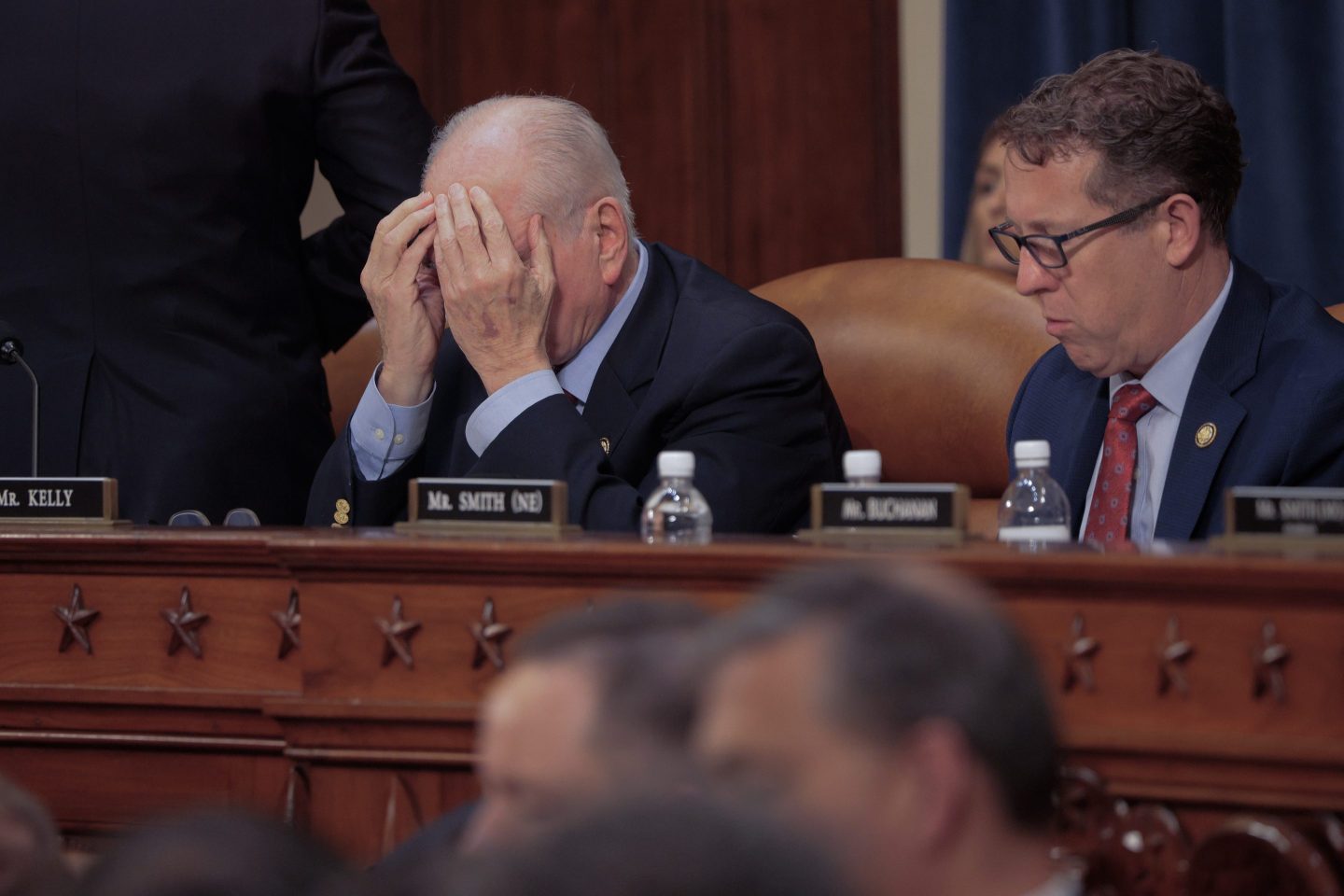
House Ways and Means Committee member Rep. Mike Kelly (R-PA) covers his face with his hands as Rep. Adrian Smith (R-NE) sits next to him at a markup hearing in the Longworth House Building on Capitol Hill on May 13, 2025 in Washington, DC.
Rep. Mike Kelly (R-PA) and Rep. Adrian Smith (R-NE) attend a markup hearing for the GOP's tax and immigration legislation. Chip Somodevilla—Getty Images
  • Long-term bond yields ticked higher after Moody’s became the last credit agency to remove the U.S. from its top rung of borrowers. Standard & Poor’s downgrade of U.S. debt in 2011 caused Treasuries to rally as investors paradoxically sought safety in government bonds. The situation today appears different, however, with fears about growing deficits and looming tax cuts intensifying.

Moody’s downgrade of the U.S. debt on Friday didn’t surprise many on Wall Street or Washington: Even Treasury Secretary Scott Bessent tried to downplay the credit agency’s move as a “lagging indicator.” It’s much less of a shock than 14 years ago, when Standard & Poor’s became the first credit agency to cut America’s credit rating—and paradoxically pushed investors to snap up Treasuries.

Recommended Video

Since Friday, however, bond markets have reacted more predictably, with a minor sell-off in long-dated Treasuries eventually mellowing on Monday. Long-term yields, which rise as the price of the bond falls, remain elevated amid worries about tax cuts in the GOP’s “big, beautiful” bill exacerbating an already ballooning federal deficit.

That legislation, which the Congressional Budget Office estimated will add $4.5 trillion to the deficit through 2034, proved to be the final straw for Moody’s. The credit agency had previously kept the U.S. in its top rung of borrowers since it first issued ratings for government bonds in 1919.

The ratings hit means Republican fiscal hawks are likely to get more of a say as the bill heads to the House floor and eventually the Senate.

“One thing stands out though, and that is that at this stage there are no signs of any serious deficit restraint,” Jim Reid, head of global macro and thematic research at Deutsche Bank, wrote in a note with colleagues Monday morning.

It’s no secret the national debt is on an unsustainable path, particularly after the lavish spending of the first Trump and Biden administrations. According to the Congressional Budget Office, the federal deficit for the 2025 fiscal year is $1.9 trillion, or 6.2% of GDP, the deepest shortfall in the country’s history outside of a war or recession. Moody’s, meanwhile, expects debt held by the public to account for 134% of America’s GDP by 2035, compared to 98% today.  

“The big unknown is when it all tips over,” Reid wrote in a separate note. “Our view is that Liberation Day has likely brought that reckoning forward. The U.S.’s exorbitant privilege—its ability to borrow well below fair value—is gradually eroding.”

In other words, because of the dollar’s status as the world’s reserve currency and confidence from investors that America’s government will always pay its bills, the U.S. borrows at much better rates than its underlying finances would normally allow. Experts commonly refer to this state of affairs as “exorbitant privilege.” 

Deutsche Bank estimates this ability has shaved around 70 basis points off America’s borrowing costs. That spread could tighten, however, if political instability or burgeoning deficits makes investors increasingly doubt the reputation of Treasuries as the ultimate safe-haven. That would put upward pressure on interest rates for mortgages, small business loans, and other common types of borrowing throughout the economy.

Debt ceiling standoffs 

The effect of a credit downgrade on American debt, however, has not always been straightforward.

In 2011, Standard & Poor’s became the first of the three big credit agencies to issue a downgrade after a bitter standoff over the debt ceiling, which allows the U.S. government to increase its borrowing to fund spending already appropriated by Congress.

Once a perfunctory exercise, hand wringing over the debt ceiling has become a convenient political weapon. That’s because if an agreement to raise the threshold isn’t reached eventually, the Treasury Department would not be able to make payments to creditors on-time. Global markets would likely go haywire, at least momentarily. 

In 2011, an 11th-hour agreement averted such a scenario, but Wall Street had to reckon with a new reality.

“It was definitely Earth-shattering for a lot of investors,” Gennadiy Goldberg, head of U.S. rates strategy at TD Securities, told Fortune, “because no investor had ever considered U.S. Treasury debt as potentially risky in the form of non-payment.”

In the aftermath of the crisis, however, bonds rallied amid a stock market sell-off in a so-called “flight to quality.” 

“People bought U.S. Treasuries as the risk-free asset because of uncertainty about Treasuries as the risk-free asset,” Goldberg said. “That sounds circular and ironic and crazy, but that’s exactly what happened. But you also had very wild price action. You had rates moving 30, 40, 50 basis points per day.”

In 2023, Fitch Ratings also downgraded U.S. debt after another debt ceiling kerfuffle, but movements in the Treasury market were much more orderly. Moody’s recent cut is distinct from the previous two, however, and not just because it’s now a Republican administration’s spending plans that are in focus.

Rather than driven by the debt ceiling, this cut is centered on the scale of U.S. borrowing. Even as deficits skyrocket, America won’t default on its debt, Jay Hatfield, the CEO of Infrastructure Capital Advisors, told Fortune. The government can always print more money to pay its bills, but that poses huge risks of higher inflation and a weaker dollar, decreasing the value of payments to bondholders in real terms. 

“I think what Moody’s is doing is more an investment rating than a default-risk downgrade,” said Hatfield, who manages ETFs and a series of hedge funds. 

Technically, though, Moody’s downgrade only reflects the risk of the U.S. not paying its debt, rather than accounting for inflation’s ability to dent returns, billionaire hedge fund manager Ray Dalio said in a social media post Monday.  

“Said differently, for those who care about the value of their money,” the Bridgewater founder wrote, “the risks for U.S. government debt are greater than the rating agencies are conveying.” 

Join us at the Fortune Workplace Innovation Summit May 19–20, 2026, in Atlanta. The next era of workplace innovation is here—and the old playbook is being rewritten. At this exclusive, high-energy event, the world’s most innovative leaders will convene to explore how AI, humanity, and strategy converge to redefine, again, the future of work. Register now.
About the Author
By Greg McKennaNews Fellow
LinkedIn icon

Greg McKenna is a news fellow at Fortune.

See full bioRight Arrow Button Icon

Latest in Finance

Finance
Lorem ipsum dolor sit amet, consectetur adipiscing elit, sed do eiusmod tempor incididunt ut labore et dolore magna aliqua. Ut enim ad minim veniam
By Fortune Editors
October 20, 2025
Finance
Lorem ipsum dolor sit amet, consectetur adipiscing elit, sed do eiusmod tempor incididunt ut labore et dolore magna aliqua. Ut enim ad minim veniam
By Fortune Editors
October 20, 2025
Finance
Lorem ipsum dolor sit amet, consectetur adipiscing elit, sed do eiusmod tempor incididunt ut labore et dolore magna aliqua. Ut enim ad minim veniam
By Fortune Editors
October 20, 2025
Finance
Lorem ipsum dolor sit amet, consectetur adipiscing elit, sed do eiusmod tempor incididunt ut labore et dolore magna aliqua. Ut enim ad minim veniam
By Fortune Editors
October 20, 2025
Finance
Lorem ipsum dolor sit amet, consectetur adipiscing elit, sed do eiusmod tempor incididunt ut labore et dolore magna aliqua. Ut enim ad minim veniam
By Fortune Editors
October 20, 2025
Finance
Lorem ipsum dolor sit amet, consectetur adipiscing elit, sed do eiusmod tempor incididunt ut labore et dolore magna aliqua. Ut enim ad minim veniam
By Fortune Editors
October 20, 2025

Most Popular

Finance
Lorem ipsum dolor sit amet, consectetur adipiscing elit, sed do eiusmod tempor incididunt ut labore et dolore magna aliqua. Ut enim ad minim veniam
By Fortune Editors
October 20, 2025
Finance
Lorem ipsum dolor sit amet, consectetur adipiscing elit, sed do eiusmod tempor incididunt ut labore et dolore magna aliqua. Ut enim ad minim veniam
By Fortune Editors
October 20, 2025
Finance
Lorem ipsum dolor sit amet, consectetur adipiscing elit, sed do eiusmod tempor incididunt ut labore et dolore magna aliqua. Ut enim ad minim veniam
By Fortune Editors
October 20, 2025
Finance
Lorem ipsum dolor sit amet, consectetur adipiscing elit, sed do eiusmod tempor incididunt ut labore et dolore magna aliqua. Ut enim ad minim veniam
By Fortune Editors
October 20, 2025
Finance
Lorem ipsum dolor sit amet, consectetur adipiscing elit, sed do eiusmod tempor incididunt ut labore et dolore magna aliqua. Ut enim ad minim veniam
By Fortune Editors
October 20, 2025
Finance
Lorem ipsum dolor sit amet, consectetur adipiscing elit, sed do eiusmod tempor incididunt ut labore et dolore magna aliqua. Ut enim ad minim veniam
By Fortune Editors
October 20, 2025
Rankings
  • 100 Best Companies
  • Fortune 500
  • Global 500
  • Fortune 500 Europe
  • Most Powerful Women
  • Future 50
  • World’s Most Admired Companies
  • See All Rankings
Sections
  • Finance
  • Leadership
  • Success
  • Tech
  • Asia
  • Europe
  • Environment
  • Fortune Crypto
  • Health
  • Retail
  • Lifestyle
  • Politics
  • Newsletters
  • Magazine
  • Features
  • Commentary
  • Mpw
  • CEO Initiative
  • Conferences
  • Personal Finance
  • Education
Customer Support
  • Frequently Asked Questions
  • Customer Service Portal
  • Privacy Policy
  • Terms Of Use
  • Single Issues For Purchase
  • International Print
Commercial Services
  • Advertising
  • Fortune Brand Studio
  • Fortune Analytics
  • Fortune Conferences
  • Business Development
About Us
  • About Us
  • Editorial Calendar
  • Press Center
  • Work At Fortune
  • Diversity And Inclusion
  • Terms And Conditions
  • Site Map

Latest in Finance

An elderly man prepares ingredients, grating carrots on a plate in a home setting, emphasizing independence and routine.
North Americaaging
More Americans will die than be born in 2030, CBO predicts—leaving immigrants as the only source of population growth
By Eva RoytburgJanuary 7, 2026
7 hours ago
Delta plane flying
North AmericaAir Travel
These are the 10 most on-time airlines in the world, and only one American company made the cut
By Jacqueline MunisJanuary 7, 2026
9 hours ago
corner office
Future of WorkJobs
AI layoffs are looking more and more like corporate fiction that’s masking a darker reality, Oxford Economics suggests
By Nick LichtenbergJanuary 7, 2026
10 hours ago
Real EstateHousing
Trump threatens to ban Wall Street from buying the house next door, saying ‘American Dream is increasingly out of reach for far too many people’
By Nick LichtenbergJanuary 7, 2026
11 hours ago
trump
Economynational debt
The $38 trillion national debt is one thing 82% of Americans agree on: ‘Voters are understandably concerned,’ watchdog says
By Nick LichtenbergJanuary 7, 2026
11 hours ago
Real EstateHousing
Americans missed out on a ‘once-in-a-lifetime’ chance to buy a house—the 3 shifts it would take to make housing affordable are ‘very unlikely’
By Sydney LakeJanuary 7, 2026
11 hours ago

Most Popular

placeholder alt text
Law
Amazon is cutting checks to millions of customers as part of a $2.5 billion FTC settlement. Here's who qualifies and how to get paid
By Sydney LakeJanuary 6, 2026
1 day ago
placeholder alt text
Economy
Mark Cuban on the $38 trillion national debt and the absurdity of U.S. healthcare: we wouldn't pay for potato chips like this
By Nick LichtenbergJanuary 6, 2026
2 days ago
placeholder alt text
Future of Work
'Employers are increasingly turning to degree and GPA' in hiring: Recruiters retreat from ‘talent is everywhere,’ double down on top colleges
By Jake AngeloJanuary 6, 2026
2 days ago
placeholder alt text
Personal Finance
Janet Yellen warns the $38 trillion national debt is testing a red line economists have feared for decades
By Eva RoytburgJanuary 5, 2026
2 days ago
placeholder alt text
Success
The college-to-office path is dead: CEO of the world’s biggest recruiter says Gen Z grads need to consider trade and hospitality jobs that don't even require degrees
By Orianna Rosa RoyleJanuary 6, 2026
2 days ago
placeholder alt text
Personal Finance
Current price of silver as of Tuesday, January 6, 2026
By Joseph HostetlerJanuary 6, 2026
2 days ago

© 2025 Fortune Media IP Limited. All Rights Reserved. Use of this site constitutes acceptance of our Terms of Use and Privacy Policy | CA Notice at Collection and Privacy Notice | Do Not Sell/Share My Personal Information
FORTUNE is a trademark of Fortune Media IP Limited, registered in the U.S. and other countries. FORTUNE may receive compensation for some links to products and services on this website. Offers may be subject to change without notice.