• Home
  • Latest
  • Fortune 500
  • Finance
  • Tech
  • Leadership
  • Lifestyle
  • Rankings
  • Multimedia
FinanceTaxes

Bond vigilantes killed Trump’s reciprocal tariffs—and they’re weighing in on GOP’s push for tax cuts

By
Greg McKenna
Greg McKenna
News Fellow
Down Arrow Button Icon
By
Greg McKenna
Greg McKenna
News Fellow
Down Arrow Button Icon
May 16, 2025, 7:02 AM ET
Updated May 16, 2025, 9:54 AM ET
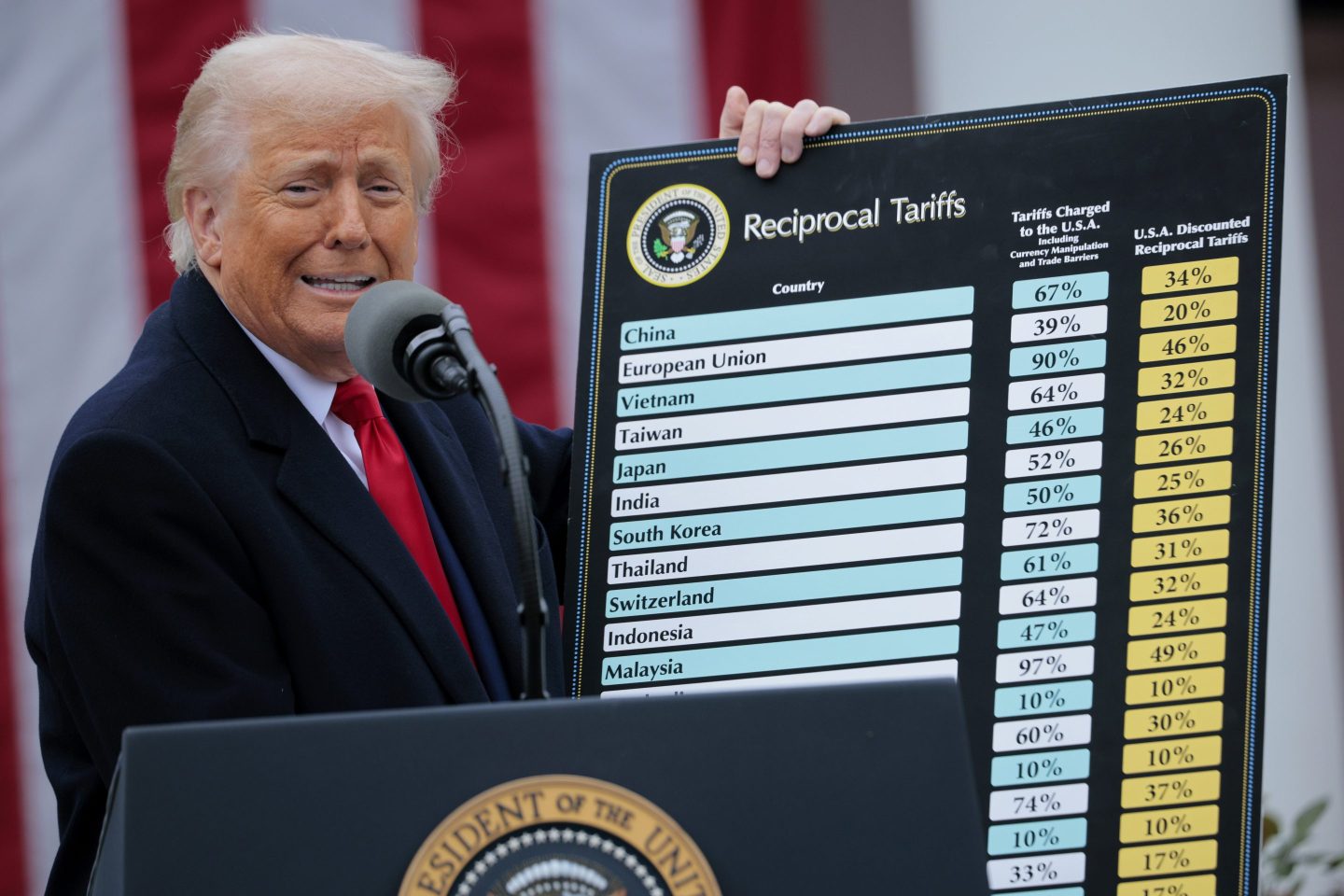
President Donald Trump holds up a chart of "reciprocal tariffs" while speaking during a “Make America Wealthy Again” trade announcement event in the Rose Garden at the White House on April 2, 2025 in Washington, DC.
Bond vigilantes may have forced President Donald Trump to pause his reciprocal tariffs. Chip Somodevilla—Getty Images
  • Long-term yields spiked earlier this week as traders scaled back their bets on rate cuts by the Federal Reserve and reacted to the new tax bill advanced by House Republicans. Bond vigilantes, who can bring fiscally irresponsible politicians to heel by unloading a country’s debt, may rear their head if Congress doesn’t show any appetite to bring the federal deficit under control.

Chaos in the bond market may have forced President Donald Trump to back off the reciprocal tariffs he initially unveiled on “Liberation Day” in early April. Another sell-off ensued this week as House Republicans moved forward on a “big, beautiful” bill of tax cuts, which would likely exacerbate an already ballooning deficit.

Recommended Video

As the bill moves through Congress, however, so-called “bond vigilantes”—or investors who encourage fiscal discipline by unloading a country’s debt—could have a say. The yield on the benchmark 10-year Treasury, which rises as the price of the bond falls, closed above 4.5% for the first time since February on Wednesday. 

The 30-year yield, meanwhile, almost touched the 5% mark, which it briefly hit the evening before Trump announced the 90-day pause on reciprocal tariffs last month. The president acknowledged he made the move after fixed-income investors had gotten “yippy.” 

“So we are now reaching yield levels that previously seemed to trigger sensitivity from the U.S. administration,” Deutsche Bank strategists wrote in a note Thursday morning, “though the recent moves are much more orderly than they were in early April.”

Yields retreated markedly on Thursday, with the 10-year falling more than 10 basis points as inflation data came in cooler than expected and bond investors seized on a buying opportunity. Trump, of course, has been clear he wants to see long-term borrowing costs come down.

But yields primarily declined earlier this month because of recession fears, Rob Haworth, a senior investment strategist at U.S. Bank Wealth Management, told Fortune. Investors then reversed course and piled out of bonds after an agreement with China to pause tariffs buoyed markets, with investors scaling back their bets on rate cuts by the Federal Reserve.

Then, Haworth said, long-term yields also began reacting to tax bill developments.

“I think the bond market has some concern that this is not quite as deficit friendly as they’d like,” he said.

The Biden administration spent its way out the COVID-19 pandemic, but it never shut off the fiscal pump. According to the Congressional Budget Office, the federal deficit for the 2025 fiscal year is $1.9 trillion, or 6.2% of GDP, the deepest shortfall in the country’s history outside of a war or recession.

Now, Trump’s promised tax cuts could send that number soaring. As written, the bill advanced by the House Ways and Means Committee would increase deficits by an estimated $3.8 trillion through 2034, according to the Congressional Joint Committee on Taxation.

“As things [stand],” Deutsche Bank strategists wrote, “it looks improbable that the eventual package will deliver any meaningful reduction of the elevated U.S. fiscal deficit.”

Proponents of the bill argue lost revenue will be made up for by economic growth resulting from lower taxes and deregulation, but bond investors might not be convinced. After all, Haworth said, a boost to growth from tax cuts may fight to solely offset a slowdown due to tariffs.

The most expensive parts of the new bill come from extending and expanding provisions in the Tax Cuts and Jobs Act, which Trump signed into law in 2017. The Committee for a Responsible Federal Budget found the TCJA did not pay for itself, as its backers claimed, though it did stimulate economic growth. 

“Once again, the experts are wrong, just as they were about the impact of Trump’s tariffs, which have yielded trillions in investments, record job growth, and no inflation,” White House Deputy Press Secretary Harrison Fields said in a statement to Fortune. “These experts should be embarrassed to share their ‘expertise,’ considering the egg still on their faces. MAGAnomics transcends conventional wisdom, and the President’s One Big Beautiful Bill will continue to prove the haters wrong.”

Who are bond vigilantes?

A bigger budget deficit means more government borrowing. That increases the supply of Treasury debt, which makes existing bonds less attractive and causes investors to drive up yields.

Thus, a major bond sell-off can bring fiscally irresponsible politicians to heel by forcing the government to borrow at higher rates, which pushes up its interest rate payments. In 1983, economist Ed Yardeni famously coined the term “bond vigilantes” to describe these investors who, he said, can fight against policies they deem inflationary or fiscally irresponsible.

“Perpetually running a deficit and raising the debt ceiling is probably an unsustainable way to run the government,” Miguel Laranjeiro, investment director for municipal debt at Aberdeen Investments, told Fortune.

One famous example of bond vigilante success came in the 1990s, when President Bill Clinton scaled back his economic agenda following a bond market riot and instead turned his focus to balancing the budget.

The makeup of the bond market has changed a lot since then, Haworth said. Trading desks at big banks no longer keep huge inventories of Treasuries, he said, due to rules instituted following the Global Financial Crisis. That stash has been somewhat replaced, he said, by hedge funds looking for trends and arbitrage opportunities or wealth managers seeking the best long-term options for clients.

“So to some extent, they exist,” Haworth said of bond vigilantes, “but their nature is very, very different.”

There’s recent precedent for such investors putting a kibosh on planned tax cuts. Even Nobel laureate Paul Krugman, a longtime skeptic of the bond vigilante concept, acknowledged the role of fixed-income traders in the fall of former U.K. prime minister Liz Truss in 2022.

Bond vigilantes revolted after Truss announced £45 billion, or $50 billion, in unfunded tax cuts, inciting a mini-financial crisis as interest rates skyrocketed and the pound plunged to historic lows against the dollar. Truss resigned after 49 days in office, the shortest stint at 10 Downing Street in the country’s history.

Trump’s position as president, of course, is much less vulnerable. The bond market, however, may be one of the few things he must answer to.

Update: This story was updated to reflect late movement in the 10-year yield on Thursday.

Join us at the Fortune Workplace Innovation Summit May 19–20, 2026, in Atlanta. The next era of workplace innovation is here—and the old playbook is being rewritten. At this exclusive, high-energy event, the world’s most innovative leaders will convene to explore how AI, humanity, and strategy converge to redefine, again, the future of work. Register now.
About the Author
By Greg McKennaNews Fellow
LinkedIn icon

Greg McKenna is a news fellow at Fortune.

See full bioRight Arrow Button Icon

Latest in Finance

Finance
Lorem ipsum dolor sit amet, consectetur adipiscing elit, sed do eiusmod tempor incididunt ut labore et dolore magna aliqua. Ut enim ad minim veniam
By Fortune Editors
October 20, 2025
Finance
Lorem ipsum dolor sit amet, consectetur adipiscing elit, sed do eiusmod tempor incididunt ut labore et dolore magna aliqua. Ut enim ad minim veniam
By Fortune Editors
October 20, 2025
Finance
Lorem ipsum dolor sit amet, consectetur adipiscing elit, sed do eiusmod tempor incididunt ut labore et dolore magna aliqua. Ut enim ad minim veniam
By Fortune Editors
October 20, 2025
Finance
Lorem ipsum dolor sit amet, consectetur adipiscing elit, sed do eiusmod tempor incididunt ut labore et dolore magna aliqua. Ut enim ad minim veniam
By Fortune Editors
October 20, 2025
Finance
Lorem ipsum dolor sit amet, consectetur adipiscing elit, sed do eiusmod tempor incididunt ut labore et dolore magna aliqua. Ut enim ad minim veniam
By Fortune Editors
October 20, 2025
Finance
Lorem ipsum dolor sit amet, consectetur adipiscing elit, sed do eiusmod tempor incididunt ut labore et dolore magna aliqua. Ut enim ad minim veniam
By Fortune Editors
October 20, 2025

Most Popular

Finance
Lorem ipsum dolor sit amet, consectetur adipiscing elit, sed do eiusmod tempor incididunt ut labore et dolore magna aliqua. Ut enim ad minim veniam
By Fortune Editors
October 20, 2025
Finance
Lorem ipsum dolor sit amet, consectetur adipiscing elit, sed do eiusmod tempor incididunt ut labore et dolore magna aliqua. Ut enim ad minim veniam
By Fortune Editors
October 20, 2025
Finance
Lorem ipsum dolor sit amet, consectetur adipiscing elit, sed do eiusmod tempor incididunt ut labore et dolore magna aliqua. Ut enim ad minim veniam
By Fortune Editors
October 20, 2025
Finance
Lorem ipsum dolor sit amet, consectetur adipiscing elit, sed do eiusmod tempor incididunt ut labore et dolore magna aliqua. Ut enim ad minim veniam
By Fortune Editors
October 20, 2025
Finance
Lorem ipsum dolor sit amet, consectetur adipiscing elit, sed do eiusmod tempor incididunt ut labore et dolore magna aliqua. Ut enim ad minim veniam
By Fortune Editors
October 20, 2025
Finance
Lorem ipsum dolor sit amet, consectetur adipiscing elit, sed do eiusmod tempor incididunt ut labore et dolore magna aliqua. Ut enim ad minim veniam
By Fortune Editors
October 20, 2025
Rankings
  • 100 Best Companies
  • Fortune 500
  • Global 500
  • Fortune 500 Europe
  • Most Powerful Women
  • Future 50
  • World’s Most Admired Companies
  • See All Rankings
Sections
  • Finance
  • Leadership
  • Success
  • Tech
  • Asia
  • Europe
  • Environment
  • Fortune Crypto
  • Health
  • Retail
  • Lifestyle
  • Politics
  • Newsletters
  • Magazine
  • Features
  • Commentary
  • Mpw
  • CEO Initiative
  • Conferences
  • Personal Finance
  • Education
Customer Support
  • Frequently Asked Questions
  • Customer Service Portal
  • Privacy Policy
  • Terms Of Use
  • Single Issues For Purchase
  • International Print
Commercial Services
  • Advertising
  • Fortune Brand Studio
  • Fortune Analytics
  • Fortune Conferences
  • Business Development
About Us
  • About Us
  • Editorial Calendar
  • Press Center
  • Work At Fortune
  • Diversity And Inclusion
  • Terms And Conditions
  • Site Map
  • Facebook icon
  • Twitter icon
  • LinkedIn icon
  • Instagram icon
  • Pinterest icon

Most Popular

placeholder alt text
Economy
Elon Musk warns the U.S. is '1,000% going to go bankrupt' unless AI and robotics save the economy from crushing debt
By Jason MaFebruary 7, 2026
2 days ago
placeholder alt text
Economy
Russian officials are warning Putin that a financial crisis could arrive this summer, report says, while his war on Ukraine becomes too big to fail
By Jason MaFebruary 8, 2026
15 hours ago
placeholder alt text
Success
Gen Z Patriots quarterback Drake Maye still drives a 2015 pickup truck even after it broke down on the highway—despite his $37 million contract
By Sasha RogelbergFebruary 7, 2026
2 days ago
placeholder alt text
Commentary
America marks its 250th birthday with a fading dream—the first time that younger generations will make less than their parents
By Mark Robert Rank and The ConversationFebruary 8, 2026
24 hours ago
placeholder alt text
Future of Work
Anthropic cofounder says studying the humanities will be 'more important than ever' and reveals what the AI company looks for when hiring
By Jason MaFebruary 7, 2026
2 days ago
placeholder alt text
Commentary
We studied 70 countries' economic data for the last 60 years and something big about market crashes changed 25 years ago
By Josh Ederington, Jenny Minier and The ConversationFebruary 8, 2026
24 hours ago

© 2026 Fortune Media IP Limited. All Rights Reserved. Use of this site constitutes acceptance of our Terms of Use and Privacy Policy | CA Notice at Collection and Privacy Notice | Do Not Sell/Share My Personal Information
FORTUNE is a trademark of Fortune Media IP Limited, registered in the U.S. and other countries. FORTUNE may receive compensation for some links to products and services on this website. Offers may be subject to change without notice.


Latest in Finance

US President Donald Trump speaks with reporters before departing from the White House in Washington, DC, on February 6, 2026.
EconomyBonds
China might be beginning to back away from U.S. debt as investors get nervy about over-exposure to American assets
By Eleanor PringleFebruary 9, 2026
28 minutes ago
InvestingMarkets
Don’t get comfortable with the global stock rally today: Goldman’s Panic Index is approaching ‘max fear’
By Jim EdwardsFebruary 9, 2026
1 hour ago
NewslettersTerm Sheet
Meta expands its already massive Louisiana data center project
By Allie GarfinkleFebruary 9, 2026
1 hour ago
Personal FinanceReal Estate
Current ARM mortgage rates report for Feb. 9, 2026
By Glen Luke FlanaganFebruary 9, 2026
4 hours ago
Personal FinanceReal Estate
Current refi mortgage rates report for Feb. 9, 2026
By Glen Luke FlanaganFebruary 9, 2026
4 hours ago
Personal Financemortgages
Current mortgage rates report for Feb. 9, 2026
By Glen Luke FlanaganFebruary 9, 2026
4 hours ago