• Home
  • Latest
  • Fortune 500
  • Finance
  • Tech
  • Leadership
  • Lifestyle
  • Rankings
  • Multimedia
FinanceMarkets

Inside the bond market’s $800 billion ‘murder mystery.’ Here’s why the basis trade could be a time bomb—and what the Fed can do to stop it

By
Greg McKenna
Greg McKenna
News Fellow
Down Arrow Button Icon
By
Greg McKenna
Greg McKenna
News Fellow
Down Arrow Button Icon
April 11, 2025, 6:00 AM ET
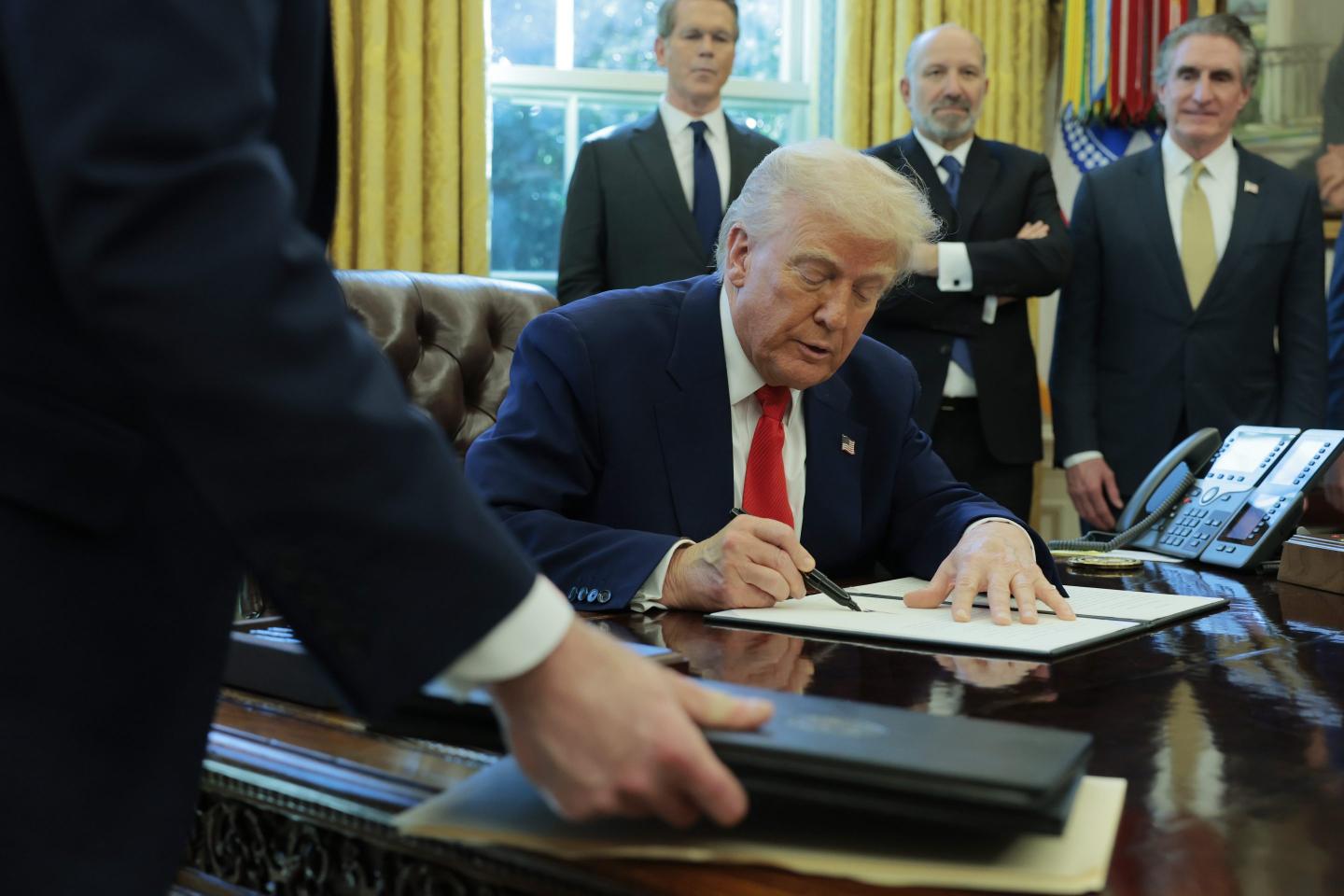
President Donald Trump signs a executive order as (left-to-right) U.S. Treasury Secretary Scott Bessent, Secretary of Commerce Howard Lutnick and Interior Secretary Doug Burgum look on in the Oval Office of the White House on April 09, 2025 in Washington, DC.
The Trump administration wants to see a lower 10-year Treasury yield. Anna Moneymaker—Getty Images
  • In normal times, hedge funds help keep money markets humming by profiting handsomely from tiny price discrepancies between Treasuries and futures linked to those bonds. When the $800 billion trade unwinds, however, the Federal Reserve may need to step in—as it did during the pandemic—to prevent the type of disastrous credit crunch exemplified by the 2008 financial crisis. 

Investors are looking to pick up the pieces after President Donald Trump announced a 90-day pause to the sweeping “reciprocal tariffs” that sent stocks plunging, but many on Wall Street suspect chaos in the bond market truly forced the administration’s hand. A confounding spike in yields sparked fears of a liquidity crisis, and the collapse of the so-called basis trade may have been one of the main culprits.

Recommended Video

In normal times, hedge funds borrow heavily to take advantage of tiny price discrepancies between Treasuries and futures linked to those bonds. They profit handsomely and, in turn, help keep money markets humming. The COVID-19 pandemic and recent trade policy upheaval have shown what can happen when the $800 billion trade unwinds, however, and some experts think the Federal Reserve needs to be better equipped to handle the next potential crisis in, say, three months or so.  

After all, fixed-income markets can be fickle. Investors initially piled into Treasuries last week as stocks plunged, but the tide soon shifted—even as the carnage in equity markets continued. Yields, which represent an investor’s annual return, rise as bond prices fall, and they spiked early this week as a selloff in U.S. debt raised questions about its typical safe-haven status.

Treasury Secretary Scott Bessent has said the Trump administration wants to see a lower 10-year Treasury yield, the benchmark for mortgage rates, car loans, and other types of borrowing costs throughout the economy. It spiked above 4.5% on Wednesday morning, and while the stock market soared after Trump’s “pause,” the reaction in bonds was more muted. As of Thursday afternoon, the 10-year yield had again surged past the 4.4% mark, even though stocks shed part of their gains from Wednesday’s historic rebound.

Shortly after Trump announced import taxes on goods from most countries (excluding China) would be reduced to a baseline 10% charge, Bessent denied bond market volatility was behind the president’s flip-flop. But Kevin Hassett, Trump’s head of the U.S. National Economic Council, told CNBC Thursday movements in the Treasury market had added “perhaps a little more urgency” to the decision to temporarily scrap the reciprocal tariffs. The White House did not respond to Fortune’s request for comment. 
Fortune Special Report — The Economy in Crisis
Read more of our coverage via the linked image above.
Photo illustration by Fortune; Original photo by Andrew Harnik—Getty Images

Whatever the case, the unusual increase in long-term interest rates amid an equity selloff has been akin to a “murder mystery,” said Torsten Sløk, chief economist at private equity giant Apollo.

“That’s telling me that there [are] some distressed, forced sellers out there,” he told Fortune. “Someone who’s selling not because they think the economy is good or bad, or inflation is good or bad, or [that] the Fed is going to hike or not hike [interest rates].”

To be sure, many commentators have also cited foreign selling as a possible cause. Trump has announced a 145% tariff on goods from China, the second-largest foreign holder of Treasuries, leading to questions about whether Beijing might retaliate by dumping some of its roughly $770 billion of U.S. debt—or simply have less reason to buy American assets as bilateral trade decreases.  

However, if that had been a major factor this week, Sløk said, he would have expected to see a more significant weakening in the U.S. dollar (which did fall more noticeably on Thursday). Goldman Sachs researchers William Marshall and Bill Zu agreed.

“We would not rule out a diversification away from dollar assets over time,” they wrote in a note Wednesday, “but the near-term behavior appears more consistent with some anticipatory concern about that possibility in conjunction with unwinds of levered longs.”

In other words, this is what can happen when hedge funds are forced to dump Treasuries en masse. In extreme cases, liquidity can dry up—posing a threat to the broader economy if the Fed doesn’t step in.

How the ‘basis trade’ works 

Hedge funds are presented with an arbitrage opportunity in the first place, experts say, because of a fundamental imbalance in credit markets. Many asset managers of mutual funds, pension funds, and insurance companies have long-term liabilities—like payouts to retirees decades down the road—and want to buy assets with similar exposure to interest rates, or duration, over that span.

The classic way of doing that often involves buying large amounts of Treasury futures contracts, but someone needs to take the other side of the trade. That’s where hedge funds and other broker-dealers step in, selling those derivatives while hedging that “short” position by buying cash Treasuries.

In return, hedge funds profit off the spread between the value of the bond and the slightly overpriced futures contract: As the latter approaches expiry, its price falls and the short bet pays off. The profit comes from the price difference—the “basis”—between the futures contract and the underlying Treasury. 

But “this arrangement is inherently fragile,” according to a recent Brookings Institution paper by Harvard economist and former Fed governor Jeremy Stein along with the University of Chicago’s Anil Kashyap, Harvard’s Jonathan Wallen, and Columbia’s Joshua Younger. 

To make the trade worthwhile, hedge funds need to borrow heavily, sometimes using as much as 50- to 100-times leverage. When markets start going haywire, however, they can be vulnerable to margin calls or otherwise be pressured to liquidate their position when they sustain losses on other trades (especially as stock prices plummet) and investors pull their money.

A better solution for the Fed 

When the market struggles to absorb a massive increase in the supply of Treasuries, a broader credit crunch à la the 2008 financial crisis looms as a worst-case scenario. When yields spiked this week, many Wall Street analysts watched closely for signs the Fed would be forced to intervene. The central bank was quick to prevent such a situation at the onset of the COVID-19 pandemic, buying $1.6 trillion in Treasuries over several weeks.

Kashyap and his coauthors claim this solution is less than ideal, though. It may just be an effort to keep money markets stable, but it also looks a lot like quantitative easing—when the central bank buys financial assets to push down long-term interest rates.

“Without a clear upfront distinction between bond-buying for market-function purposes, versus for monetary-policy purposes, the initial round of Treasury purchases in the spring of 2020 morphed into a broader monetary policy effort that eventually saw the Fed add over $4 trillion to its combined holdings of Treasuries and agency mortgage-backed securities by mid-2022,” the authors noted.

Therefore, they call for a more “surgical” approach to such a crisis: help hedge funds unwind by purchasing Treasuries and selling futures. While the prospect of bailing out hedge funds might raise some eyebrows, the authors claim their solution might be more effective at preventing reckless behavior than blunt-force Treasury purchases.

There are complementary solutions, of course. It’s hard to find buyers during a Treasury selloff, in part, because banks and broker-dealers are limited by capital requirements strengthened after the Global Financial Crisis and the subsequent Dodd-Frank reform legislation. They were temporarily loosened during the pandemic to help lenders buy more U.S. debt, however, and Bessent said Wednesday those changes should be made permanent as part of a broader deregulatory push.

Even if the Treasury secretary gets his wish, though, markets may eventually need the Fed to take much more drastic action.

Join us at the Fortune Workplace Innovation Summit May 19–20, 2026, in Atlanta. The next era of workplace innovation is here—and the old playbook is being rewritten. At this exclusive, high-energy event, the world’s most innovative leaders will convene to explore how AI, humanity, and strategy converge to redefine, again, the future of work. Register now.
About the Author
By Greg McKennaNews Fellow
LinkedIn icon

Greg McKenna is a news fellow at Fortune.

See full bioRight Arrow Button Icon

Latest in Finance

Finance
Lorem ipsum dolor sit amet, consectetur adipiscing elit, sed do eiusmod tempor incididunt ut labore et dolore magna aliqua. Ut enim ad minim veniam
By Fortune Editors
October 20, 2025
Finance
Lorem ipsum dolor sit amet, consectetur adipiscing elit, sed do eiusmod tempor incididunt ut labore et dolore magna aliqua. Ut enim ad minim veniam
By Fortune Editors
October 20, 2025
Finance
Lorem ipsum dolor sit amet, consectetur adipiscing elit, sed do eiusmod tempor incididunt ut labore et dolore magna aliqua. Ut enim ad minim veniam
By Fortune Editors
October 20, 2025
Finance
Lorem ipsum dolor sit amet, consectetur adipiscing elit, sed do eiusmod tempor incididunt ut labore et dolore magna aliqua. Ut enim ad minim veniam
By Fortune Editors
October 20, 2025
Finance
Lorem ipsum dolor sit amet, consectetur adipiscing elit, sed do eiusmod tempor incididunt ut labore et dolore magna aliqua. Ut enim ad minim veniam
By Fortune Editors
October 20, 2025
Finance
Lorem ipsum dolor sit amet, consectetur adipiscing elit, sed do eiusmod tempor incididunt ut labore et dolore magna aliqua. Ut enim ad minim veniam
By Fortune Editors
October 20, 2025

Most Popular

Finance
Lorem ipsum dolor sit amet, consectetur adipiscing elit, sed do eiusmod tempor incididunt ut labore et dolore magna aliqua. Ut enim ad minim veniam
By Fortune Editors
October 20, 2025
Finance
Lorem ipsum dolor sit amet, consectetur adipiscing elit, sed do eiusmod tempor incididunt ut labore et dolore magna aliqua. Ut enim ad minim veniam
By Fortune Editors
October 20, 2025
Finance
Lorem ipsum dolor sit amet, consectetur adipiscing elit, sed do eiusmod tempor incididunt ut labore et dolore magna aliqua. Ut enim ad minim veniam
By Fortune Editors
October 20, 2025
Finance
Lorem ipsum dolor sit amet, consectetur adipiscing elit, sed do eiusmod tempor incididunt ut labore et dolore magna aliqua. Ut enim ad minim veniam
By Fortune Editors
October 20, 2025
Finance
Lorem ipsum dolor sit amet, consectetur adipiscing elit, sed do eiusmod tempor incididunt ut labore et dolore magna aliqua. Ut enim ad minim veniam
By Fortune Editors
October 20, 2025
Finance
Lorem ipsum dolor sit amet, consectetur adipiscing elit, sed do eiusmod tempor incididunt ut labore et dolore magna aliqua. Ut enim ad minim veniam
By Fortune Editors
October 20, 2025
Fortune Secondary Logo
Rankings
  • 100 Best Companies
  • Fortune 500
  • Global 500
  • Fortune 500 Europe
  • Most Powerful Women
  • World's Most Admired Companies
  • See All Rankings
  • Lists Calendar
Sections
  • Finance
  • Fortune Crypto
  • Features
  • Leadership
  • Health
  • Commentary
  • Success
  • Retail
  • Mpw
  • Tech
  • Lifestyle
  • CEO Initiative
  • Asia
  • Politics
  • Conferences
  • Europe
  • Newsletters
  • Personal Finance
  • Environment
  • Magazine
  • Education
Customer Support
  • Frequently Asked Questions
  • Customer Service Portal
  • Privacy Policy
  • Terms Of Use
  • Single Issues For Purchase
  • International Print
Commercial Services
  • Advertising
  • Fortune Brand Studio
  • Fortune Analytics
  • Fortune Conferences
  • Business Development
  • Group Subscriptions
About Us
  • About Us
  • Press Center
  • Work At Fortune
  • Terms And Conditions
  • Site Map
  • About Us
  • Press Center
  • Work At Fortune
  • Terms And Conditions
  • Site Map
  • Facebook icon
  • Twitter icon
  • LinkedIn icon
  • Instagram icon
  • Pinterest icon

Latest in Finance

bessent
Personal FinanceFinancial Literacy
Scott Bessent on financial literacy: ‘it drives me crazy’ to see young men in blue-collar construction jobs playing the lottery
By Fatima Hussein and The Associated PressMay 1, 2026
1 hour ago
Top CD rates from major banks May 1, 2026: Chase CDs, Bank of America CDs, Citibank CDs, and more
Personal FinanceCertificates of Deposit (CDs)
Top CD rates from major banks on May 1, 2026: Chase CDs, Bank of America CDs, Citibank CDs, and more
By Joseph HostetlerMay 1, 2026
1 hour ago
Current price of Ethereum for May 1, 2026
Personal FinanceEthereum
Current price of Ethereum for May 1, 2026
By Joseph HostetlerMay 1, 2026
2 hours ago
Current price of Bitcoin for May 1, 2026
Personal FinanceCryptocurrency
Current price of Bitcoin for May 1, 2026
By Joseph HostetlerMay 1, 2026
2 hours ago
Current price of gold as of May 1, 2026
Personal Financegold prices
Current price of gold as of May 1, 2026
By Danny BakstMay 1, 2026
2 hours ago
Current price of oil as of May 1, 2026
Personal FinanceOil
Current price of oil as of May 1, 2026
By Joseph HostetlerMay 1, 2026
2 hours ago

Most Popular

China dominates the world's lithium supply. The U.S. just found 328 years' worth in its own backyard
North America
China dominates the world's lithium supply. The U.S. just found 328 years' worth in its own backyard
By Jake AngeloApril 30, 2026
20 hours ago
Apple cofounder Ronald Wayne—whose stake would be worth up to $400 billion had he not sold it in 1976—says that at 91, he has no regrets
Success
Apple cofounder Ronald Wayne—whose stake would be worth up to $400 billion had he not sold it in 1976—says that at 91, he has no regrets
By Preston ForeApril 27, 2026
4 days ago
Accenture's Julie Sweet blew up 50 years of company history. She says the hardest part is still ahead
Conferences
Accenture's Julie Sweet blew up 50 years of company history. She says the hardest part is still ahead
By Nick LichtenbergApril 29, 2026
2 days ago
America shot its arsenal empty in 2 wars. Now it needs Beijing's permission to reload
Commentary
America shot its arsenal empty in 2 wars. Now it needs Beijing's permission to reload
By Steve H. Hanke and Jeffrey WengApril 30, 2026
21 hours ago
Google Cloud revenue is now 18% of Alphabet's business. Is this the beginning of the end of Google's search identity?
Big Tech
Google Cloud revenue is now 18% of Alphabet's business. Is this the beginning of the end of Google's search identity?
By Alexei OreskovicApril 29, 2026
2 days ago
Exclusive: America's largest Black-owned bank launches podcast with mission to unlock hidden shame holding back generational wealth
Banking
Exclusive: America's largest Black-owned bank launches podcast with mission to unlock hidden shame holding back generational wealth
By Nick LichtenbergApril 29, 2026
2 days ago

© 2026 Fortune Media IP Limited. All Rights Reserved. Use of this site constitutes acceptance of our Terms of Use and Privacy Policy | CA Notice at Collection and Privacy Notice | Do Not Sell/Share My Personal Information
FORTUNE is a trademark of Fortune Media IP Limited, registered in the U.S. and other countries. FORTUNE may receive compensation for some links to products and services on this website. Offers may be subject to change without notice.