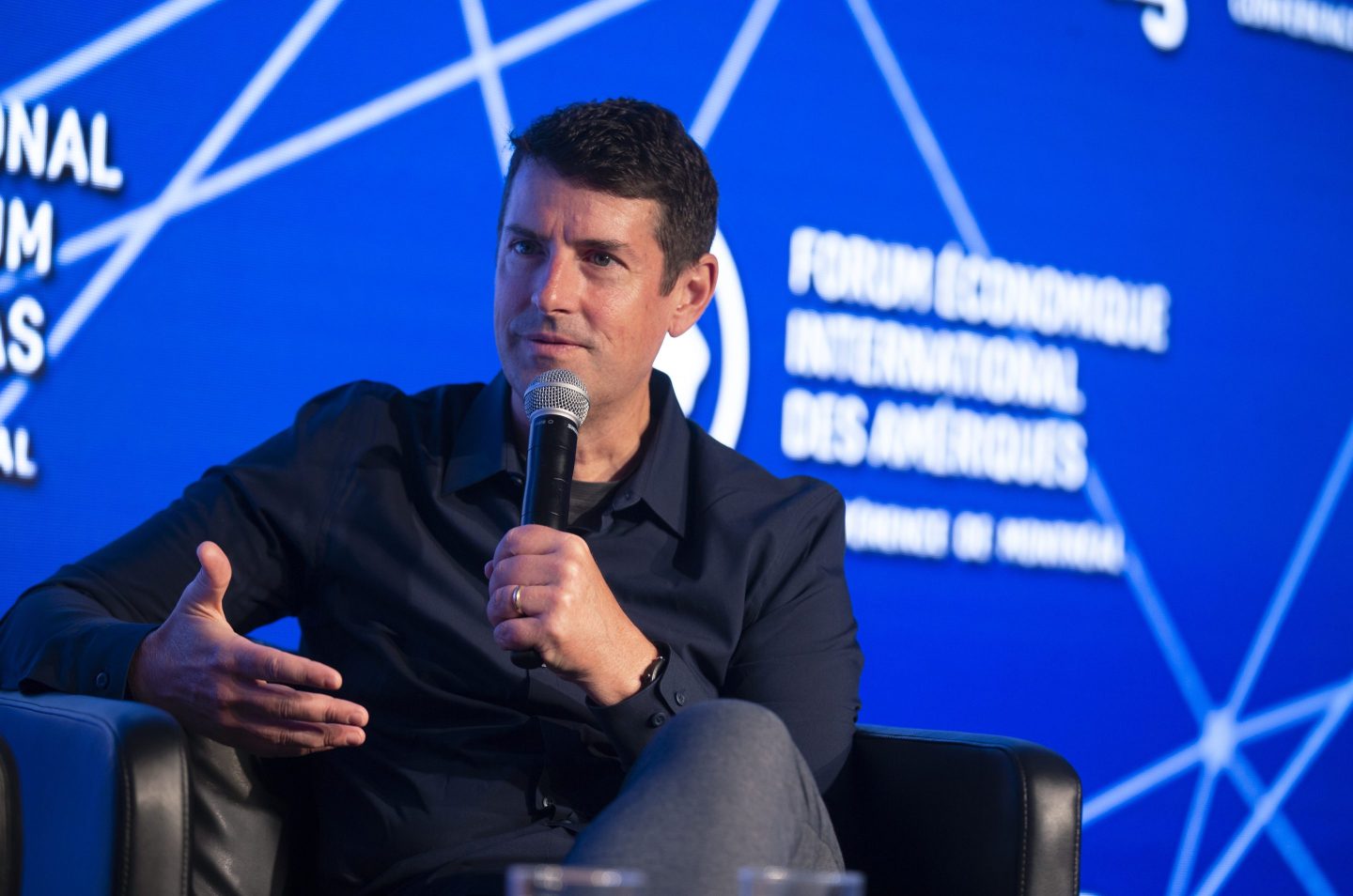
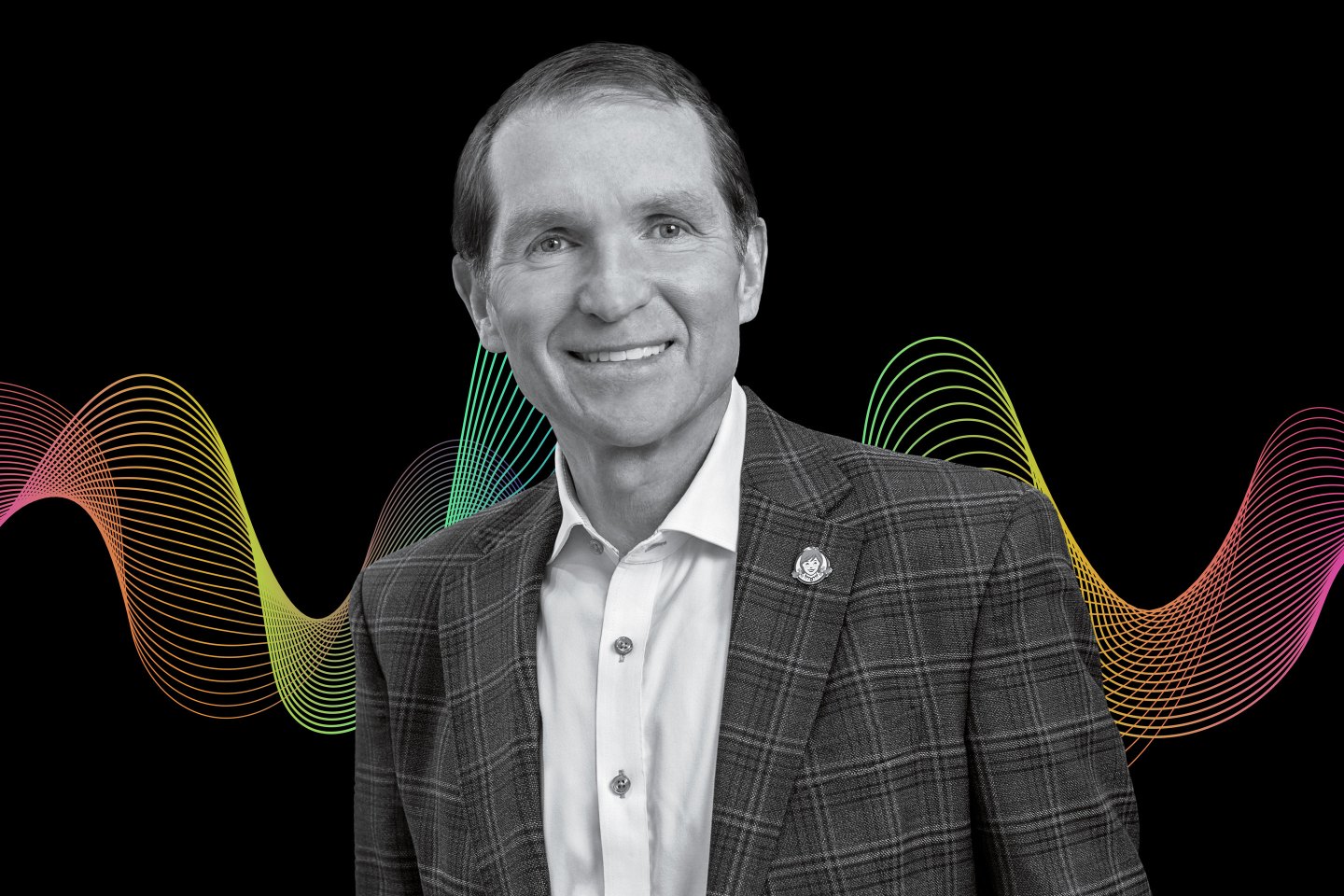
On this episode of Fortune’s Leadership Next podcast, cohosts Diane Brady, executive editorial director of the Fortune CEO Initiative and Fortune Live Media, and editorial director Kristin Stoller talk to Wendy’s CEO Kirk Tanner. They talk about Tanner’s previous experience at PepsiCo; how the chain is leveraging breakfast and international expansion for growth; and why it’s better to look at consumers’ actions than their words.
Listen to the episode or read the transcript below.
Kirk Tanner: Being locally relevant and designing the Wendy’s experience—it’s so important to do that from a local angle, because you know that you got to be meaningful in the market you’re operating in. It’s understanding what the customer wants in those markets and what’s on trend, so that, you know, you have to execute against that. The base menu is there. It’s there to enjoy. So the fresh burgers, the chicken sandwiches, the salads, those things are there, but there are unique local items on the menu.
Diane Brady: Hi, everyone. Welcome to Leadership Next, the podcast about the people…
Kristin Stoller: …and trends…
Brady: …that are shaping the future of business. I’m Diane Brady.
Stoller: And I’m Kristin Stoller.
Brady: We are just coming off the high of eating a meal at Wendy’s.
Stoller: It was momentous, Diane, because it was my first Wendy’s trip in my life.
Brady: That is sad. That is very sad.
Brady: Do you remember yours?
Brady: Well, my first was that my sister worked there, and she is a shapeshifter, so Wendy’s, therefore, is good for—I think she’s had 43 jobs, much more stable in recent years, of course, and she’s built a career. But I do remember hanging out at Wendy’s, getting free food because of her.
Stoller: What would you get?
Brady: Do you know the burger? That’s what I had this time. I’m a burger and fries girl. I’m not a Frosty milkshake person, but…
Stoller: …which we tried today…
Brady: …fresh, never frozen. That’s always been the case.
Stoller: That is. I wish I had it more but I’m from a tiny town in Connecticut where they don’t allow fast-food restaurants unless they’re in like an old colonial brick building.
Brady: What is up with that? We put Wendy’s in a colonial…ye olde Wendy’s? Well, that tells you something about the vilification of fast food.
Stoller: Absolutely.
Brady: In this, you know, much mocked part of—but very popular part of—the food industry, Wendy’s is winning.
Stoller: They are. And it seems, I mean, I’m curious about how many people are going there versus McDonald’s versus Burger King, what they’re doing differently—the baked potato, it seems like they’re leaning into heavily based on our lunch today. But I’m also interested in Kirk and his background too.
Brady: Yeah. Well, he came from PepsiCo. And PepsiCo, for those of you who think about academy companies, which is basically the training school for CEOs of America, PepsiCo is definitely one of them up there, previously with GE, P&G, Google. So he spent more than three decades there, and he ran the North American operation, so guaranteed that’s got to have had an impact in how he’s running Wendy’s.
Stoller: It makes you wonder what these companies are doing to incubate all these CEOs.
Brady: Well, part of it is you get to run a business unit, you get to deal with all the different issues that you deal with as a CEO on a [unintelligible] level when you’re at a company like that. But we’ll find out.
Stoller: I want to brag again about my Japan trip and say, I saw Wendy’s First Kitchens all over Japan. That’s what they call them there, and they looked beautiful, way more beautiful than Wendy’s here in the U.S., and I’m wondering about their global strategy.
Brady: Well, I think that’s a good point. And one of the things I will say is, those of you who travel outside the U.S., you’ll notice that fast-food restaurants tend to be often three-star restaurant experiences there. I’ve noticed that with KFC and others. It’s a big deal. You can take a date to Wendy’s or some of these fast-food restaurants.
Stoller: Never happened to me, but there’s always time for a first.
Brady: Maybe less, less likely here. But let’s face it, this is how a lot of people eat, and especially if we’re heading into hard times, it’s how a lot more people will eat, too, because you do get value for money, but it’s big food. And of course, there are questions about nutrition, health, and things like animal welfare, because sometimes those cheap prices come at a cost.
Stoller: 100%.
Brady: So we will address all of that with Kirk when we come right back.
Brady: We’re entering an era of innovation unlike any we’ve witnessed before. You all see it: The pace of technological change is staggering, and it’s challenging for any leader to keep up. We spoke with Jason Girzadas, the CEO of Deloitte US, which is the longtime sponsor of this podcast. Here’s his advice for leaders on how to navigate this new world.
Jason Girzadas: There’s probably nothing more important for CEOs, no matter what organization they’re leading, to really be thinking about technology’s impact on our workforce. It’s really a function of, how do you think about technology in concert with your workforce? We at Deloitte talk about it as the age of width, the age of technology with your workforce, and really embracing this idea of the codependency of technology and workforce. We’re also an environment of a very tight workforce where there’s a scarcity of top talent. That’s going to be the challenge for organizations, to demonstrate to top talent that they can grow and evolve the work that they do, working with leading technology in a very aligned way. Finally, it’s what top talent really wants in an organization, is to learn and grow and to be part of an organization that’s supportive of them actually embedding technology in their work.
Brady: Well, Kirk, I have to first give our apologies, because I know we made you take your Wendy’s drink off camera, but you do in fact, I’m not gonna say eat what you kill, but you definitely drink what you sell.
Stoller: So, good for you.
Tanner: Well thank you. I’m having a Coke Zero from Wendy’s.
Stoller: Oooh, what’s your Wendy’s order?
Tanner: My Wendy’s order, typically, is an apple pecan salad. Chili as a side, small chili. And I generally get a Coke Zero Cherry. But, you know, we have freestyle machines in the restaurant so you can get hundreds of different flavors. And I usually—cherry is my go-to.
Stoller: How often do you eat at Wendy’s?
Tanner: Uh, probably three or four times a week. Now, I guess, because I’m having fun…
Brady: Due diligence, it’s called due diligence.
Tanner: So we have, by our office, we have fresh AI in a restaurant right across the street, and so I’ve been using it and testing it out and seeing how it works. It’s really fun. Wendy, she greets you when you walk, when you drive up. She’s hospitable. She always asks you if you want something else. It builds on your order. So she’s very reliable. So I’m, you know, I mean,
Brady: Sounds like you’re falling in love with your operating system, there…
Tanner: …yes…
Brady: That’s a dangerous trend. But you point out something interesting, which is, you have a salad, you have a chili, you have a Coke Zero. There’s a certain vilification of fast food as being unhealthy. So give us—correct that impression. My sister worked at Wendy’s, by the way, as a teenager, so I’ve always known about the fresh, not frozen. Take us a little beyond that.
Tanner: Yeah. We have, we are so passionate about the freshest, quality ingredients at Wendy’s. So our beef is fresh, never frozen. It’s locally sourced in the U.S. We use the freshest ingredients across building our sandwiches. That I think is really important today and will be important for the future, but doubling down on that is really important to us, and so our messaging around fresh, highest quality, we have options across the menu that allow you to, you know, build what you want. So anything that you want, we build for you. So personalization is also really important. So when you walk in, Diane, and want…
Brady: …a baked potato…
Tanner: … a baked potato!
Stoller: Yep, we got that today.
Tanner: We’ve got it, or if you want a Single, well, you can build it over 1,000 different ways, because we make it fresh just for you, which I think is really unique in the industry.
Brady: Obviously there’s some behemoths in the industry, and Wendy’s is a brand we all know.
Tanner: Yes.
Brady: Give us a sense of—what don’t we know. I mean, how are you trying to position the brand. You are a brand builder. You came from PepsiCo. What did you see in the brand, and how do you want to change it?
Tanner: Well, that’s why I came because the growth potential of the brand, the equity in the brand, the opportunity for growth, was the exciting part of Wendy’s. Being able to build more restaurants in more places was really enticing. We have Wendy’s in 33 countries outside the U.S., but we only have 1,300 restaurants. So the opportunity is grand. Many of our competitors have more restaurants outside the US than they do inside the U.S.
Brady: …I can think of a fried chicken brand that comes to mind…
Tanner: That might be, it could be, yeah. So that was such a compelling, I think, motivator for me to come to Wendy’s was: We have such a fresh proposition that plays well around the world, could we build more restaurants internationally? And then in the U.S., we are a challenger, but we’re the second largest QSR burger in the U.S.
Brady: …quick-service restaurant, for those who don’t know QSR…
Tanner: …I am so sorry, If I use an acronym, just shut me down…
Brady: It’s just just letting people know.
Tanner: So, quick-service restaurants. In the U.S., we have one Wendy’s for every 56,000 people. Our competitor has one for every 36,000 people. So that gives us runway for growth…
Brady: …there’s never enough…
Tanner: There’s never enough! But we want to bring a Wendy’s closer to you. So that was a big idea. And I love, kind of, the challenger mindset in a competitive space, right? So challengers are always looking for ways to, you know, beat competition by delivering great customer experience…
Brady: …okay, we call them underdogs in Canada, where I’m from…
Tanner: Underdogs, okay.
Brady: I mean, like the challenger mindset.
Tanner: Oh, yeah.
Brady: Give us a sense of your market share. I mean, I’ve got it in front of me here, but let’s tell people, because also in the different categories of the day, you have a different market share.
Tanner: Yeah, so we’re the second-largest in the U.S. from a burger category standpoint, we’re growing our breakfast business. And so if you thought about our fair share of breakfast, we would measure it against that share of burger quick-service restaurants, and that would say: We could double our breakfast business over the coming years. And so that’s how we look at it. We look at, kind of, our share of opportunity, and breakfast is a big opportunity for us. We started in 2020. We continue to build our breakfast platform. It did grow faster than the rest of our business. Last year, it grew at 6% and gave us a tailwind for growth, and we see that continuing for the future.
Stoller: Do you think that the breakfast is what’s setting you apart from these competitors? Or what do you think is giving you the edge in a space where you’re all serving, you know, very similar foods?
Tanner: Yeah, I think it’s the quality of the food, right? It goes back to—at breakfast, we have the freshest. We have great food at breakfast. So driving awareness is the big idea for us at breakfast, just making people aware that we have a breakfast. Our competitor started in 1977. We started in 2020, right during COVID. That’s when we launched.
Brady: [Intelligible] We were talking to the CEO of Chipotle recently. We asked him, “Why don’t you do breakfast?” And he said, “You know, it’s kind of a distraction, and it’s the kind of thing that brands do when they’re mature and they’re looking for new ways to grow.” I would, I think those—talk about fighting words. Those are fighting words for somebody like you as to why you’re growing in that area.
Tanner: Yeah, let me look. I mean, this is how I think about it, is: You have a restaurant that has employees in it in the morning, prepping for lunch. You have consumers that are on the go and post-COVID, are on the go more. Traffic. And as consumers and customers, we’re looking for convenience. We’re looking for quality and convenience, and that’s what Wendy’s delivers. So if you take the opportunity of: Customers are looking for solutions, they’re on the go, we have the highest quality food already in the restaurants. We have labor in the restaurants. We have an opportunity to have incremental day-part that doesn’t take away from lunch or dinner. I think that’s compelling.
Brady: Why not? Why not?
Tanner: Yeah.
Tanner: You know, when I think breakfast, I’m thinking of eggs, and when I think eggs, I think, you know, the high price that we’re all paying right now, which makes me think, well, how do you feel about, you know, inflation, tariffs. How are you looking at your eggs in general?
Brady: I line up for eggs in the morning.
Stoller: Yes, I love my breakfast sandwich.
Brady: How are you doing on that front?
Tanner: We’re doing really well on eggs, some of the commodities we forward by, you know, so that gives us some advantage for a time period…
Brady: Unless they kill the chickens. There’s that. There’s that, Kirk.
Tanner: Those are different chickens.
Brady: Those are different chickens. You’re absolutely right. Shame on me. You’re running Wendy’s I’m not.
Tanner: I didn’t know we were going to talk chickens. But, you know, the opportunity at breakfast, the food cost is lower at breakfast than it is in the rest of the day-part. So it is, there’s profitability upside. I didn’t talk about it, but now that brings, brings that into focus.
Brady: You know, one thing, I grew up with Wendy’s. As I said, my sister worked there, I’ve got very fond memories of the Wendy figure staring at me as I went to school. Kristen did not. They actually put yours in some sort of weird colonial…
Stoller: Yeah, the closest Wendy’s to me, so I’m from a tiny town in Connecticut. The closest one was 25 minutes away, because if you want to build a fast-food restaurant in our town, you got to put it in like a brick, old, New England building.
Tanner: Yeah. Yeah.
Stoller: So I’d never experienced it until this morning.
Brady: I want to know about your experience growing up with it, but also just how do we feel about fast food these days? Why would we, you know, again, it was just ubiquitous in my neighborhood, not so much in Kristin’s. What was it like in your neighborhood growing up? Did you have many?
Tanner: Yeah, I had a Wendy’s right by, right by our house. It was actually my grandma’s favorite place. When we, you know, I’m, I’m getting, I’m getting up there. But, you know, it was a real treat to go out to a Wendy’s, and my grandma loved it. Actually, when I got this job, I got all these texts like, congratulations, this and that, and my brother sent me this text like, Grandma Brazier would be so excited.
Brady: I thought you were going to say your grandma sent you a text, in which case we’ll talk about longevity.
Stoller: That would be amazing, yeah. She was eating Wendy’s, she lasted forever. This opportunity of being in the right neighborhood, I think is interesting. In Canada, we, 50 years ago…
Stoller: Her hometown.
Brady: My home country, yep.
Tanner: Right, so we have over 400 restaurants in Canada. We source everything Canadian. So the beef is Canadian beef.
Brady: Lucky you in a time of tariffs.
Tanner: So everything is very you know, we talk about “globally, great. Locally, even better.” And I think that comes to life in Canada and some of the markets that we’re in, you want to be local as well, right? You want to be relevant to…
Brady: …increasingly, you have to be, right…
Tanner: [Unintelligible]
Stoller: I have to say, as the millennial in the room, my first exposure to Wendy’s, since I did not have it in my hometown, was on Twitter and via the viral tweets and all the marketing.
Tanner: Oh yeah, yeah.
Stoller: And I know that was prior to your stint as CEO now, but how are you looking at the marketing for that? Because I thought it was so funny and brilliant, and I loved it.
Tanner: Yeah, I think, well, our social personality is definitely sassier, right?
Brady: Okay wait, unpack this for me, because I don’t what, what exactly was so great about it, Kristin?
Stoller: It was just so—I think it was the sassiness. It was the fact that they were willing to just call out competitors, other people and it was just funny. It made me laugh, and I engaged with it.
Tanner: It’s engaging. It’s young. It’s, you know, if you think underdog or challenger mindset, it’s like attitude, I think is a great way to describe it.
Stoller: Have you scaled it back? Were you worried about the attitude?
Tanner: No. No, because I think it really works. I think it’s very young. Part of what we’re trying to do is, you know, be very attractive for generations, right? And being young is really important because you’re bringing in the next generation into creating love for Wendy’s. And being young is so important. So that’s—we look at the most important customer groups that we’re trying to bring into Wendy’s, and Gen Z is one of those groups. To be fresh, relevant, sassy if you need to be. Yeah, I think that’s important.
Brady: Gen X not so much, you know what, we’ll eat anything. You know. But you mentioned something earlier about the Wendy’s experience, and I have to say, I’ve spent a lot of my career overseas in Africa and Asia. I’ve always noticed that fast-food restaurants overseas, and Kristin mentioned this about being in Japan, they’re always more of a three-star, almost, experience. You can take a date there, not so much necessarily in the U.S. What do you make of that disconnect? You would also have seen it at PepsiCo too.
Tanner: Yeah, absolutely. No, I think you have to be locally relevant. I’ll give you an example. So I was just in Japan as well. The in-dining experience is so important in Japan. So setting up the dining room, padded chairs, those kinds of things are really important. Same in the Philippines, same in the U.K. People come in and they dine in. In the U.S., we do a lot of drive-thru. We’re hustling and bustling around.
Brady: No padded chairs for you.
Tanner: We’re hustling through the drive-thru. But being locally relevant and designing the Wendy’s experience is so important to do that from a local angle. Because you know that you got to be meaningful in the market you’re operating in. And those are the differences that we, you know, how we operate across the 33 countries that are outside the U.S.
Stoller: Do [you] have any unique, really interesting menu items overseas that you’re testing out, maybe to bring here, or just that…
Brady: …Wendy’s sushi, for example…
Stoller: …that would be great.
Tanner: Yeah, no, we don’t have that.
Brady: And never will.
Stoller: See, this is why she might work at Wendy’s one day.
Tanner: In Canada, what’s unique in…
Brady: Probably some form of poutine somewhere. How can you not have cheese, fries, and gravy, right? Get booted from the country,
Tanner: Absolutely, yes. We have unique differences in Australia. We just launched a restaurant in Australia, and we did, you know, some chicken tenders with the local sauces and things like that that are unique to that market. It’s understanding what the customer wants in those markets and what’s on trend, so that you know you have to execute against that. The base menu is there. It’s there to enjoy. So the fresh burgers, the chicken sandwiches, the salads, those things are there, but there are unique local items on the menu.
Brady: I’m not going to call you a canary in the coal mine, but, but you know, obviously we’re in unpredictable times, and some of the extreme optimism I’ve seen from CEOs has switched to perhaps a concern about a possible recession, and certainly we’ve seen some hesitation in the markets, if that’s an easy way to put it. What are you seeing? Because I think, you know, when times get tough, that is generally good for a business like yours. Sometimes.
Tanner: Yeah. Consumers, a lot’s been talked about consumer sentiment, consumer confidence. At Wendy’s, it’s our job, my job, and the senior leadership team, the leadership team, to control what we can control. Like, what is it about the customer right now that they are looking for, that we want, that Wendy’s can deliver in good times and in bad times, but in tough times, you think about what you can offer to the customer to bring them into Wendy’s. There are solutions that we have, that we are focused on that, I think, deliver exactly what the customer wants. So on a value standpoint, a lot’s been talked about value.
Brady: Which is a surrogate for lower prices?
Tanner: Well at Wendy’s, we have, we have what we call a Biggie bag. It’s branded Biggie. So you come in and say, oh, you know, I’ll have a Biggie. That is an everyday value, and that comes in $5, $6, and $7 so it’s a tremendous value that’s every day, but it’s through the lens of quality. So just to go out and have a value message, it doesn’t serve the purpose of what Wendy’s wants to accomplish. We want to talk about the quality of our ingredients at a great value. And that’s there every day. So you can count on us there. One other thing I’ve found in this market is innovation. And I saw this in my last job, innovation would always work if you got it right. It doesn’t always work, but if you get it right, it works. Because customers are looking for those little moments of joy that are pretty easy to access.
Brady: Okay, what’s a moment of joy?
Tanner: Frosty.
Stoller: Fries dipped in the Frosty, that’s what I hear.
Tanner: You are catching up!
Stoller: Only two hours and I already know.
Brady: That does not sound like something I’d like, but then I’m from the land of fried Mars bars.
Stoller: Of poutine as well.
Tanner: So, were you a Girl Scout?
Stoller: I was a Girl Scout, I’ve heard about the…
Tanner: …okay, we sell Thin Mint [Frostys]. Thin Mints, is that the number one seller?
Stoller: A man outside told me I needed to buy it. He was very…
Tanner: Really?
Stoller: …although we just got vanilla because we thought, got to get the original…
Brady: A man outside—are you stationing people outside your restaurant, telling young women to buy Thin Mint shakes?
Tanner: It sounds suspicious.
Brady: Sounds like a man on the street.
Tanner: But I can tell you, the Thin Mint frosty is amazing.
Stoller: Okay, I gotta try it next time.
Tanner: Get back. Get back!
Brady: You know, you mentioned PepsiCo, I have to say it is one of those companies I associate, in addition to being just a great brand builder and innovator, to your point, it is a, it is also an academy company for future CEOs in other industries.
Stoller: And I’m going to jump in with a stat that we have, that we love. 16 former PepsiCo executives are now Fortune 500 CEOs, yeah, which we think is impressive. So Diane and I are wondering: how, what are they doing? Like, how are they incubating all these future CEOs?
Tanner: Real experience. Yeah, real experiences. At PepsiCo, you get jobs, maybe even before you’re ready. And you get those experiences, and you think, Well, is it management training? Is it well, it’s actual jobs. You are given these jobs, and they’re big jobs that have P-and-L and people responsibilities, and you thrive in that market, and people pick you up if you fall down, so you’re able to fail forward, I believe, in that culture, and then, you know, just this passion for building a business and growing in the consumer environment. So, you know, I think one of the capabilities that I’ve built over the years was this kind of obsession with where the customer is, and how do you meet, exceed a customer’s expectation. That lives inside that culture. But, you know, it’s a competitive culture. It’s a culture that…
Brady: …yeah, one of your former CEOs was a former Marine. Steve Reinemund.
Tanner: Yes, Steve Reinemund. I’m a big fan of Steve.
Brady: So, you know, very athletic. Indra Nooyi, of course, with her, you know, with regard to passion and purpose.
Tanner: Yep.
Brady: So I feel like we hear about these things on a macro level. Give us a story on sort of a formative moment in your career at PepsiCo that you think shaped you as a leader. Good and bad. You know, failure is welcome here.
Tanner: Yeah. Early on, I had mentors, and we talked about a servant leadership model, and I was in the trenches growing up in the early days and leading the front line. And, you know, day-to-day, it’s very physical what we do, you know, be at PepsiCo, you control basically all the aspects from: If you’re at Frito-Lay, when the potato comes out of the ground, you make it, you distribute it, you merchandise it at the store. Like it’s…
Brady: Vertical integration.
Tanner: Yeah, vertical integration, so you own it. And that mindset of being taught this idea of servant leadership was really helpful for me at a time I needed it, because I was thinking about doing everything myself.
Tanner: I was pulled aside by a mentor and we were in a meeting, and I had my team in there, and I was answering all the questions, because I wanted to be good, do good, and all those things. And he pulled me aside and says, Let your team answer, let others get results through others. And then we went through this servant leadership model, which is kind of an upside-down pyramid right that has the CEO at the bottom and the front line at the top, because the customer is above the organization, and everything is in service of the customer, and everyone in the company should be in service of removing obstacles for those that are at the front line. That was so—and I needed it at that time. And so I like, wow, okay, that changed my perspective on how I led, how I got results through people. It didn’t have to be me. And then, you know, later in my career, I started talking a lot about and trying to teach this idea of selflessness, meaning it’s more important for the team to win than you individually to win. And that’s challenging. Not everybody listens to those in a competitive market.
Brady: Well it’s the “what got you here won’t get you there” mentality, right?
Tanner: Yeah.
Brady: All of the traits that get you into that top job, don’t serve you well once you’re there, necessarily.
Brady: …Oh let’s mention dynamic pricing, I’m intrigued. What’s that?
Stoller: And I like what you said, too, the phrase “fail forward,” because I think a lot of CEOs are scared to talk about those failures and what makes them a better leader. And I think that’s what a lot of people come to, hopefully, this podcast for. So Kirk, is there ever a failure that you had? I know I’m hesitant to mention the dynamic pricing, you know, situation that happened. But is there anything that you, you learned…
Tanner: 100%.
Stoller: Yeah, and how do you, how do you move on from something like that?
Tanner: Yeah, we said dynamic pricing. We didn’t say surge pricing. That was made up. And that’s what went viral.
Brady: Oh, so it’s lower costs during off hours.
Tanner: So yeah, it was. you think about, you know, the afternoon, day-part, or happy hour, and advertising it through digital menu boards and being able to move and drive traffic. Okay, that’s that, yeah, that’s what happened. It turned into something that was absolutely not true, and it went, it went a different way. But, you know those are, those are behind us. Failures, generally, for me, have been in the product space when you’re thinking about doing all the right things for the customer or the consumer. You’ve talked to the consumer, they’ve told you, hey, they love this idea, and you execute against what consumers say. Well, consumers often do not tell you the truth. They tell you what they think you want to do.
Brady: We want healthy food.
Tanner: We want healthy food.
Brady: But, not really.
Tanner: Yeah, so, made a big product change. That product change tasted the flavor slightly, and that product was so important to customers out there that had three or four of them a day, they loved that taste. Well, we changed that taste.
Brady: Sounds like New Coke, but you never worked there, so…
Tanner: It was a similar one, just a Pepsi version of that. And it was a mistake, because when you go back and say, well, understand the customers that love this brand, if you change it, will they still love it? The answer is no, right? If you take something that you love and the person that provides that changes it and it changes how you love the brand, it’s not going to be successful. Those things are really important, and a lot of innovation works and is incremental, and some innovation doesn’t work. Regardless of how many calories you put into it, effort you put into it, sometimes you get it wrong, and you have to be able to fail forward, right, because you you lose all those those lessons when you fail forward, and it’s important not to fall in love with your ideas, sometimes, right?
Brady: Or you might be too wedded to the data, to your point, because it’s hard—I think about the fact it’s, it’s hard to crowdsource the hot color and socks for fall, because, like, I don’t know, you tell me, or nobody would have predicted Harry Potter would have been a success. I mean, there’s a, there’s a limit, perhaps, to looking not just at what customers say, but also backward data for forward innovation. I mean, how do you think about that? Because you’re in a company now, but also in your previous career, where it’s all about innovation, multiple innovations, and then multiple killing of those innovations.
Tanner: I think you said it brilliantly. If you look at the way consumers vote, not what they say, their actions, the transactions they make, the decisions they make, the behaviors they demonstrate, that is where you make decisions versus what they say. A lot of consumer research is done on, you know, direct surveys and focus groups and all those things. They’re not as important to me. When I’m looking at historical data, transaction data, behavioral studies, watching what people do and how they vote and they vote with their wallets, those are the most powerful insights. Again, we tell people what we think they want to hear. It’s human nature to do that. It’s cautious.
Stoller: What have you heard from consumers recently that they want? Is it more healthy options? Because I did order a Caesar salad today at Wendy’s.
Brady: She’s not your target demo, it turns out. This woman did not grow up with one, but she did enjoy it.
Tanner: We’re breaking her in. We’re trying to create one, we’re creating a customer. Look. Customers want choice. I think that’s really important. And if you think about the world, we have so many more choices today than we did 20 years ago. Even if you went into a store, how many items were in a store 20 years ago? How many varieties of something you can get today? So we’ve, we’ve driven this choice. On a menu, having choice is really important. If it’s salads or baked potatoes or the healthy ingredients we put on our hamburgers, etc, we give, we give customers choice, and we engage them in that way. And clarity. You know, if you go on our website or on our app, you get clarity on the ingredient content, the calorie content. I think that’s really important. Transparency is really important for customers today,
Brady: But not too much choice. I think about the paradox of choice. You know, where you put out two jars of jam, and people will buy a jar, but if you put out six jars, they’re just like, I can’t be bothered choosing between strawberry rhubarb and strawberry right now. So is there a magic formula for how much choice you give people? Because you also need to be efficient. You need to like, again, you give me 17 types of burgers, I’m like, ugh.
Tanner: Absolutely.
Stoller: You can’t have a million different things.
Tanner: Look, if you look at any consumer, if it’s a restaurant or a CPG company, a consumer packaged goods company.
Brady: Thank you for explaining that.
Stoller: I like the no jargon over here.
Tanner: I’m learning, I’m coming along.
Brady: Kirk Tanner, man of the people.
Tanner: There’s always a tail, right, the 80/20 rule, all those kinds of things, or Pareto, it’s called. This idea of, you know, the most popular SKUs do about 80% of the business, and there’s a long tail. I think it’s important when you’re talking about efficiency and simplicity versus complexity, you always have to be looking at the tail and taking it out of the business. And so we constantly look at what’s on our menu that’s not relevant. What do we take off? What can we bring in? That’s important, especially with store operations. For sure, complexity is important to focus on.
Stoller: What are those most popular items? Is it burger? Frosty? I’m trying to guess what the third might be.
Tanner: So we have a large chicken sandwich business as well.
Stoller: Oh, right. Okay.
Tanner: And so our chickens—our burgers are number one, our chicken sandwiches are number two, and then we have amazing things like Frosty and baked potatoes; chicken nugs are also very important. You know, those are many of the popular things on the menu. We are innovating on our chicken. Chicken is growing. It’s important as a consumer dynamic. Young people, multicultural consumers, are looking for chicken. We are innovating on our chicken platform. We’re doing this partnership with Takis. I don’t know if you’ve heard of Takis.
Stoller: I have definitely heard of Takis.
Tanner: Okay, now you’re in. Here you go.
Stoller: Big Takis fan.
Brady: I’ve never heard of Takis.
Stoller: Diane, we gotta taste-test those on the next one.
Tanner: So, Diane, I got asked this question, at the investor day,
Brady: Takis? Did they stump you on that one?
Tanner: No.
Brady: Oh, you knew it?
Tanner: I studied snacks for like, 30 years. No, but a Gen Xer stood up in the audience and says, Does anyone in the Gen X generation eat Takis? And I was like, Absolutely. Anyway.
Stoller: They are like these little, rolled corn chip things.
Tanner: So we’re doing a Takis chicken sandwich and we’re doing Takis fries. So we’re taking our hot, crispy fries, and covering them in the Taki seasoning.
Brady: Sounds like a Canadian thing to do. Take a good fry and cover it with all kinds of things.
Tanner: Gen Z loves this.
Brady: I’m sure they [do]. Can I ask about Gen Z for a second, because I started my career at the age of 15 in Ponderosa, you know, which I consider fast food, maybe a little more slightly upscale, because you could have mushrooms or mushroom sauce with your steak. But tell me about the opportunities you see for… I don’t know what your first job was. First, tell us. But I feel a little wistful. It seems harder to get jobs in fast-food restaurants now and that next generation coming up, there’s a lot of discussion about labor and how they’re being disintermediated by technology. What do you see? Let’s start with, what were you doing as a teenager?
Tanner: My first job was at Sardinias. This is an Italian sandwich shop in Fashion Place Mall in Salt Lake City. That’s where I started. I loved it. It taught me a great deal, you know, making sandwiches and preparing. Again, it was made with fresh ingredients. We cut—the steak would come in and you would slice the steak and create this, you know, it was a great job. It was a great job. And I did it through high school. So I can—you grew in the restaurants, your responsibilities grew, right?
Brady: Fast food now seems to be more the realm of adult workers as opposed to kids.
Tanner: I think it’s a combination of both. I think Wendy’s is still a really great place to get your first job, and, or a summer job, and build your skills. I think that’s really important that you get that first opportunity. And I think Wendy’s is that place to do that. Think that we can still play a role in that environment. I think that’s a great place to start your career, because you learn responsibilities, and you learn about taking care of a customer. I think that customer mindset is one of the most powerful things you can teach a young person, because that will spill over to any job that you do, being able to resolve conflicts, engage with customers, deliver what they want. Those are all so valuable skills for whatever you’re gonna do in life.
Brady: That’s fair enough.
Stoller: What advice would you give to those young Gen Zs who see where you’re at, going from the sandwich shop to C-suite? What would you, what would you tell them?
Tanner: Get started. I think the thing is, like, get started. Get a job. I think it’s so important when you get a job as a young person, immediately you get independence. If you ask a young person, what do you value most? I bet independence is one of those things.
Stoller: When you’re 16, for sure.
Tanner: And then the next thing is, well, what’ll give you independence? Well, your own money. Getting your own money allows you to do—now, the flexibility that you want. No one likes to go to their parents and go, “Hey, Dad, Mom, can I have 20 bucks?” But come on, when you have, when you have your own money, it is so liberating, and it drives independence. And then once you have it, you want to keep building on it. And I think that’s an important thing.
Brady: That’s the hope and dream. You know, unless your kid basically gets a job, buys an e-bike, gets it stolen twice, and then you’re like, you know what? Get another job.
Stoller: Just a hypothetical, not from experience.
Brady: A hypothetical that happened this week.
Tanner: From a friend.
Brady: From a friend, but he does work, and so he’s, there’s always more money to be made. In terms of, I want to, just because this is about Leadership Next, I’d love to hear your thoughts just on the state of leadership right now and what you found to be particularly effective, because I’m assuming both from your customers, but also your employees: These are turbulent times, without getting into politics. We’ve got issues around immigration, tariffs, now the outlook for the economy, what have you found to be most effective? Because I’m sure a lot of them are being impacted by this, directly or indirectly.
Tanner: Look, culture drives strategy, and a business for sure. And so this idea of creating a culture where everyone can feel valued, engaged, and they can operate at their very best self. I think that’s really important to create in high performing companies. Generally, when you walk in the door of the company, you’re valued, you’re respected, your voice is heard, and you bring your best to work. That is really important, regardless of what’s going on in the outside environment, if you can create that on the inside. I think that’s really important. When I talk to young people growing their careers, I talk to them about: get the first job right, or the job that you’re in. A lot of young people come to me and go, I want to talk to you about the three next jobs. I’m like, three next jobs…what are you doing today? And how do you do a great job and be recognized for your leadership: how you take people with you and how you perform in the job? And then I believe your career acts like a vacuum, and it sucks you along, you know? So if you do a great job, people see that you’re doing a great job…
Brady: I’ve not heard the vacuum analogy before, that’s a good one.
Tanner: And then you get sucked along. And I found that to be true. I never asked for another job. I never went saying, Hey, boss, I would really like that job. Usually it was, someone came and said, ‘Hey, we’d like you to do this job.’ And you know, some of those times you weren’t even thinking about that opportunity. But someone pointed it out and said, ‘You could do that. You should do that.’ That I think is really powerful today, because I see a lot of young people trying to map it out, like it’s a clear road map with no bumps in the road and no turns in the road. And you’re like, No, man, yeah, there are bumps, there’s potholes, and there’s S turns, and, you know, things are unpredictable, so you just gotta be great in the job you’re in, and you’ll get pulled along.
Stoller: Is there any one moment that you can look back on and think, you know, this is the moment that got me that CEO job?
Tanner: Probably when I moved to the U.K. I thought I was, you know, relatively young, but I had done the same level in the company. This was my third time doing that, so another lateral move, but I took it to go to the U.K. to have a different experience and to learn. And I showed up as the rah-rah American can do anything, high-fiving everybody.
Brady: That goes over really well over there.
Tanner: High-fiving everyone, charging the hill. And it was, yeah.
Stoller: Ted Lasso approach right there.
Tanner: Yeah. It went over like a lead balloon. It was not great.
Brady: What are the cultural, you know, I grew up in Scotland until I was 9, and so I have a sense of the cultural differences. What do you think we underappreciate as Americans about how things work differently over there, in terms of what you learned?
Tanner: Yeah. Debating an issue, being able to take one side and take another side and come up with what is a third way. So, what I learned right off the bat was: discussion was important. You could have strong debates that were not personal, but if we were Americans, we’d take that stuff personal. Sometimes. I think that’s changing, but having those debates taught me how to think. So I would go into every meeting thinking about a position of why it was important versus just do it. And that taught me how to think, and my thought leadership grew. And then I got more curious about it, and that changed kind of the trajectory of what I wanted to do and how I wanted to think, and how I wanted to study the business, because I’d be more prepared, because you were going to go into every meeting and there was going to be a …
Brady: Like a house of commons every boardroom meeting.
Tanner: Yeah.
Brady: You know, one of the toughest things about your industry in general, and it’s not something you, I think you would have encountered much at PepsiCo, but the whole pressure for low cost, and I know there’s been discussions in Wendy’s and elsewhere around animal welfare and concern over all those chickens, etc. How do you think about that? Because you came in, it was an existing debate that you came into. How have you thought about that debate in terms of where you’re going?
Tanner: Understanding what the customer wants from us and expects and will, you know, embrace with is the most important thing that we focus on at Wendy’s, and in any of these matters, it’s what’s critical to our customer. The other thing I think about is supply chain, sustainability, so optionality, insurance policy you know, being able to source multiple places, being able to have insurance in your supply chain, so that when something happens, like right now with eggs, you have a sustainable supply chain that can deliver against what we need. Those are important. So when I think about these complex situations. I think about: First, I think, what does the customer want? What does the customer expect? How do we exceed that? Whatever the topic is. The second thing I think about is the supply chain. How solid is it? What solutions can we build in to have redundancy, so that we’re protected. And that’s how you know you should run, you know, I believe you should run a business.
Stoller: And I know you have a whole web page about it, too. So has transparency always been a super important thing? And, yeah, how, how open are you with, with the consumers and with staff as well?
Tanner: Very open. I think it’s important to be very transparent. There’s nothing hidden, you know, these—why would you? What we’re trying to accomplish is right in front of the customer because that’s our number one mission, actually, our promise at Wendy’s is to deliver against that. And the first behavior is put the customer first. The second behavior is make every restaurant a star, and it kind of goes back to…
Brady: That’s a high bar.
Tanner: Yes, I know.
Brady: Good luck with that. You know, you mentioned culture shock. What was the culture shock for you? Coming from three decades, you know, plus at PepsiCo to Wendy’s. What was different about just the way people think and operate? Obviously a different industry, but on a more 30,000-foot level,.
Tanner: I think the passion was very similar. I was actually surprised how much love there was for the company inside the company, the love for Wendy’s at Wendy’s is tremendous.
Brady: Dave [Thomas], I’m sure, beloved figure.
Tanner: Yeah, for sure. His legacy rings true. People still talk about how it started, the values that he established. That love for the brand was really powerful. I think that, you know, Pepsi is a very competitive place. You know, we pick an enemy and, you know, we go…
Brady: You’ve got enemies.
Tanner: Of course. At Wendy’s, we want to be hypercompetitive, and we’re building that performance culture, but it comes from a very similar love for the company. The cultures are very strong. And when you have passion for what you do, you get the most out of people. And we have that at Wendy’s, people are incredibly passionate about delivering for the customer every day. That is true.
Stoller: Now I’m going to ask a fun one, because I see you’ve joined Diane and I with the…
Tanner: Oura ring, yeah.
Brady: They’re going to have to start paying for endorsements.
Tanner: This is my second generation, too.
Stoller: You’ve had it for a while.
Brady: I have the third and she’s got the latest.
Stoller: [Unintelligible] Tell us your routine. When do you wake up? What do you do? What time do you start work? End work?
Tanner: Yeah, I’m an early riser, and so obviously, if you’re…
Brady: …What’s that mean, 5 a.m., 6 a.m.?
Tanner: It’s like 5:45. Get ready. Get ready for action.
Brady: You’re not suited to journalism.
Tanner: Yeah. Yeah, well, could be some late nights, but sleep is important. You know, this idea of measuring your energy and your resilience. Oura talks about your recovery, so it measures your sleep. And I think you know, as a leader in a business, you want to be your best, and you know those moments where you didn’t get a good night’s sleep, or you ate late, you know that you just don’t feel like razor sharp in the morning. So I think these things help us just kind of shape when we know we’re at our best. And sometimes you don’t need an Oura ring to tell you, because you know, right? You don’t need, you know you didn’t get sleep last night, or you ate late and you don’t feel that great, but I think it’s important to take care of yourself. And you know, this gives you information that I think helps. Certainly, my whole family is on the Oura ring.
Brady: Are they? Oh, you get to share your data.
Tanner: I don’t share.
Brady: Well, no need.
Tanner: I don’t need any more feedback.
Brady: You already have to be public enough. Is there anything else that is on your radar you want to put on ours with regard to how to think about Wendy’s, but also just leadership? I’m always interested. There’s no easy hack for what you do, but there are certainly tactics you’ve learned that make you more effective.
Tanner: Yeah, from a Wendy standpoint, I think that our differentiator is our food and the quality of service that we are building. I think that’s the thing, that’s the takeaway and that fuels the growth for us to build more restaurants. That’s as simple as I can make it. We have the opportunity to do it, and we will reach our potential. From a leadership standpoint, I think it’s important to be human and be, you know, be a real person. And you know, sometimes that’s described as be down to earth, but I think being approachable and being real and authentic is so important. Instead of putting on a shield, I think a lot of times we put shields up because we think that’s what we should do, and I think it prevents us from being our best self. So as being as approachable and as human, as real as you can, I think is an important leadership skill and capability, and it just makes us more approachable and it makes us more relevant in what’s going on in the world.
Brady: Connect as human beings. Thank you.
Tanner: Yeah, thank you.
Tanner: Tanner, I suggest Wendy’s. I hope Kristin will soon too.
Stoller: After I get the Thin Mint, got to try that.
Brady: Thank you for joining us.
Stoller: Thank you.
Tanner: Thank you so much.
Brady: Leadership Next is produced and edited by Ceylan Ersoy.
Stoller: Our executive producer is Adam Banicki. Our theme is by Jason Snell.
Brady: Our studio producer is Natasha Ortiz.
Stoller: Leadership Next is a production of Fortune Media.
Brady: I’m Diane Brady.
Stoller: And I’m Kristin Stoller.
Brady: See you next time.
Leadership Next episodes are produced by Fortune‘s editorial team. The views and opinions expressed by podcast speakers and guests are solely their own and do not reflect the opinions of Deloitte or its personnel. Nor does Deloitte advocate or endorse any individuals or entities featured on the episodes.