
• Home
  • News
  • Fortune 500
  • Tech
  • Finance
  • Leadership
  • Lifestyle
  • Rankings
  • Multimedia
SuccessNASA

The Boeing Starliner astronauts have returned to Earth after nine long months stuck in space—but their $150,000 salary won’t come with overtime

Emma Burleigh
By
Emma Burleigh
Emma Burleigh
Reporter, Success
Down Arrow Button Icon
Emma Burleigh
By
Emma Burleigh
Emma Burleigh
Reporter, Success
Down Arrow Button Icon
March 19, 2025, 12:26 PM ET
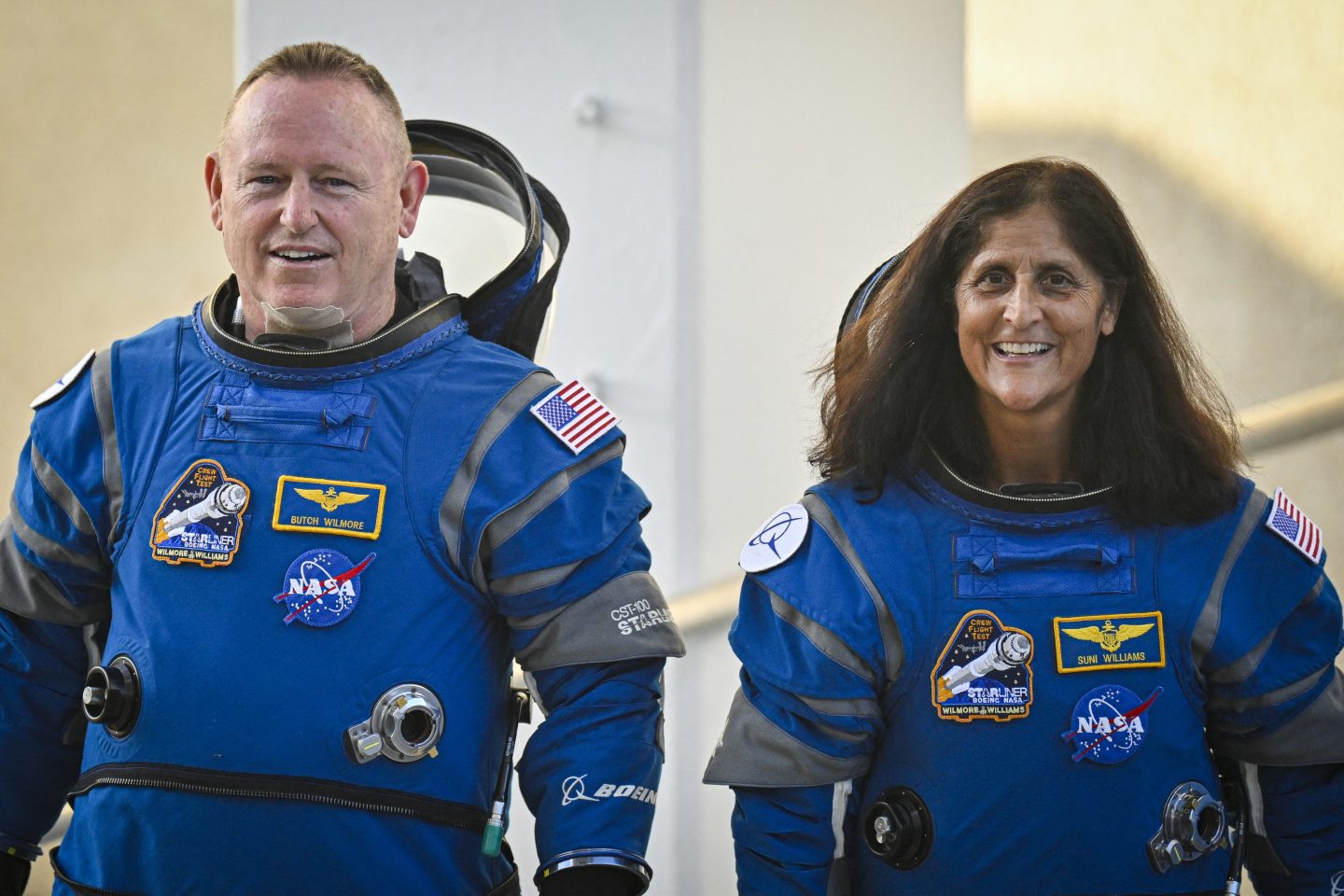
NASA astronauts Butch Wilmore (L) and Suni Williams (R).
The two astronauts make just over $150,000 a year, despite the risks of being stranded in the dark abyss of space. But money probably isn’t their main motivator. MIGUEL J. RODRIGUEZ CARRILLO / Getty Images
  • Two Boeing Starliner astronauts just touched down on Earth after an unexpected nine-month stay at the International Space Station. Most people wouldn’t risk a life of eternal darkness in space for a million dollars—but the astronauts did so for far less: just over $150,000 yearly without overtime or hazard pay. 

The internet has been rife with secondhand anxiety over the Boeing Starliner astronauts being stranded in space for nine months. They initially launched their test flight in June 2024, anticipating the trip would only take over a week. But after several of Boeing’s Starliner capsule Calypso’s thrusters failed during docking, the two astronauts were stuck in orbit until yesterday, March 18, 2025. 

Recommended Video

It’s an existential nightmare to most—and no amount of money would convince some people to take the risk of the job. But NASA astronauts like the Boeing Starliner’s Suni Williams and Butch Wilmore brave the profession for quite little: They make an annual salary of $152,258, according to NASA’s 2024 pay rates. 

Plus, they don’t get overtime or any pay bump for the danger of the situation.

“[There’s] no hazard pay, there’s no overtime, there’s no comp time,” Mike Massimino, a veteran of two Space Shuttle missions, previously toldMarketWatch. “There’s no financial incentive to stay in space longer.”

A NASA spokesperson confirmed with Fortune that they’re paid a 40-hour-per-week salary, with no additional pay for holiday or weekends—despite the fact that they’re literally at work after work.

They added that the astronauts receive incidental amounts for each day they’re in space—but since they’re on long-term temporary duty, it’s only about $5 per day. That’s about $1,430 for the entire 286-day stay. 

“When NASA astronauts are aboard the International Space Station, they receive regular 40-hour workweek salaries,” NASA told Fortune in a statement. “While in space, NASA astronauts are on official travel orders as federal employees, so their transportation, lodging, and meals are provided.”

The salary would be adjusted to reflect wage increases in 2025, but the Boeing Starliner astronauts spent most of their nine months in orbit during 2024. In comparison to other high-paying jobs with little to zero danger, this wage can feel disproportionate to the risk. 

But Williams and Wilmore knew that risks like their nine-month hiccup came with the territory, and actually refuted the notion that they were left out to dry. It’s a part of their job that they’ve comfortably settled into.

“That’s been the rhetoric. That’s been the narrative from day one: stranded, abandoned, stuck—and I get it. We both get it,” Wilmore said in an interview with CNN last month. “But that is, again, not what our human spaceflight program is about. We don’t feel abandoned, we don’t feel stuck, we don’t feel stranded.”

It’s a dangerous job—but astronauts have their own motivation

When most people think of six-figure jobs, they think of cushy white-collar gigs in temperature-controlled offices. It might be a no-brainer to go into law, consulting, or banking—seeing as there’s no bodily risk on the table for those careers. 

By comparison, bankers in New York make an average of $111,000 annually, without the risk of being exposed to an indefinite stay in dark, noiseless, uninhabited space. Consultants in the same area could rake in $137,000, providing advice to clients from the comfort of their offices or couches. And even the average sales professional in the city can make over $200,000 with no inherent risk of harm in generating leads and selling products.

But astronauts probably aren’t motivated by money.It’s been a long-held dream career for many—despite new professions like YouTubers and video game creators taking flight, over 10% of U.K. and U.S. kids still dream of becoming astronauts. That role was one of the top five career aspirations for U.S. children, according to a 2019 study from Lego.

Read more from Fortune

  • This entrepreneurial couple cashed out their 401(k)s and sold a $126 million company—now, they run a U.K. soccer team
  • Trump’s 25% tariffs are backfiring and threatening Gen Z’s trade career aspirations—putting car manufacturing jobs in peril
  • Gen Z women are being sold a risky dream: the realities behind ‘investing’ in designer bags like the Hermès Birkin
  • Like Tim Cook and Gen Z, AEG’s top exec eats the same lunch most days and wears the same outfit
  • Warren Buffett reveals the unique education strategy he took in school—and eventually paid off with a $170 billion fortune
  • Astronauts like Williams and Wilmore are veterans of their craft—and the nine months they’ve spent at the space station have been dedicated to upkeep and research. They’ve been busy inspecting hardware, arranging cargo, aiding in science tests, performing tech demonstrations, and checking in on the Starliner. Wilmore helped configure a new airlock, and Williams has been testing out athleticism in low-orbit’s zero gravity. Their work at the International Space Station is improving NASA’s knowledge base—and helping upkeep an essential destination for astronauts. 

    Their passion for space exploration makes a $150,000 salary seem worth it. It’s a once-in-a-lifetime opportunity to go to space and be the universe traveler many people have fantasized about becoming. While the Boeing Starliner fiasco may seem like a nightmare to some, for astronauts it simply means going even longer on the job they love.

    As Ken Bowersox, space operations mission chief and former NASA astronaut, saidlast week: “Every astronaut that launches into space, we teach them don’t think about when you’re coming home. Think about how well your mission’s going and if you’re lucky, you might get to stay longer.”

    Fortune Brainstorm AI returns to San Francisco Dec. 8–9 to convene the smartest people we know—technologists, entrepreneurs, Fortune Global 500 executives, investors, policymakers, and the brilliant minds in between—to explore and interrogate the most pressing questions about AI at another pivotal moment. Register here.
    About the Author
    Emma Burleigh
    By Emma BurleighReporter, Success

    Emma Burleigh is a reporter at Fortune, covering success, careers, entrepreneurship, and personal finance. Before joining the Success desk, she co-authored Fortune’s CHRO Daily newsletter, extensively covering the workplace and the future of jobs. Emma has also written for publications including the Observer and The China Project, publishing long-form stories on culture, entertainment, and geopolitics. She has a joint-master’s degree from New York University in Global Journalism and East Asian Studies.

    See full bioRight Arrow Button Icon

    Latest in Success

    Man on private jet
    SuccessWealth
    CEO of $5.6 billion Swiss bank says country is still the ‘No. 1 location’ for wealth after voters reject a tax on the ultrarich
    By Jessica CoacciDecember 2, 2025
    10 hours ago
    Man working on laptop puts hand on face
    SuccessColleges and Universities
    Harvard MBA grads are landing jobs paying $184K—but a record number are still ditching the corporate world and choosing entrepreneurship instead
    By Preston ForeDecember 2, 2025
    10 hours ago
    Ayesha and Stephen Curry (L) and Arndrea Waters King and Martin Luther King III (R), who are behind Eat.Play.Learn and Realize the Dream, respectively.
    Commentaryphilanthropy
    Why time is becoming the new currency of giving
    By Arndrea Waters King and Ayesha CurryDecember 2, 2025
    11 hours ago
    Google CEO Sundar Pichai
    SuccessCareers
    As AI wipes jobs, Google CEO Sundar Pichai says it’s up to everyday people to adapt accordingly: ‘We will have to work through societal disruption’
    By Emma BurleighDecember 2, 2025
    11 hours ago
    North Americaphilanthropy
    Jeff Bezos and Lauren Sánchez Bezos commit $102.5 million to organizations combating homelessness across the U.S.: ‘This is just the beginning’
    By Sydney LakeDecember 2, 2025
    12 hours ago
    Amar Subramanya
    AIApple
    Meet Amar Subramanya, the 46-year-old Google and Microsoft veteran who will now steer Apple’s supremely important AI strategy
    By Dave SmithDecember 2, 2025
    12 hours ago

    Most Popular

    placeholder alt text
    Economy
    Ford workers told their CEO 'none of the young people want to work here.' So Jim Farley took a page out of the founder's playbook
    By Sasha RogelbergNovember 28, 2025
    4 days ago
    placeholder alt text
    Success
    Warren Buffett used to give his family $10,000 each at Christmas—but when he saw how fast they were spending it, he started buying them shares instead
    By Eleanor PringleDecember 2, 2025
    16 hours ago
    placeholder alt text
    Economy
    Elon Musk says he warned Trump against tariffs, which U.S. manufacturers blame for a turn to more offshoring and diminishing American factory jobs
    By Sasha RogelbergDecember 2, 2025
    10 hours ago
    placeholder alt text
    Success
    Forget the four-day workweek, Elon Musk predicts you won't have to work at all in ‘less than 20 years'
    By Jessica CoacciDecember 1, 2025
    1 day ago
    placeholder alt text
    C-Suite
    MacKenzie Scott's $19 billion donations have turned philanthropy on its head—why her style of giving actually works
    By Sydney LakeDecember 2, 2025
    17 hours ago
    placeholder alt text
    AI
    More than 1,000 Amazon employees sign open letter warning the company's AI 'will do staggering damage to democracy, our jobs, and the earth’
    By Nino PaoliDecember 2, 2025
    18 hours ago
    Rankings
    • 100 Best Companies
    • Fortune 500
    • Global 500
    • Fortune 500 Europe
    • Most Powerful Women
    • Future 50
    • World’s Most Admired Companies
    • See All Rankings
    Sections
    • Finance
    • Leadership
    • Success
    • Tech
    • Asia
    • Europe
    • Environment
    • Fortune Crypto
    • Health
    • Retail
    • Lifestyle
    • Politics
    • Newsletters
    • Magazine
    • Features
    • Commentary
    • Mpw
    • CEO Initiative
    • Conferences
    • Personal Finance
    • Education
    Customer Support
    • Frequently Asked Questions
    • Customer Service Portal
    • Privacy Policy
    • Terms Of Use
    • Single Issues For Purchase
    • International Print
    Commercial Services
    • Advertising
    • Fortune Brand Studio
    • Fortune Analytics
    • Fortune Conferences
    • Business Development
    About Us
    • About Us
    • Editorial Calendar
    • Press Center
    • Work At Fortune
    • Diversity And Inclusion
    • Terms And Conditions
    • Site Map

    © 2025 Fortune Media IP Limited. All Rights Reserved. Use of this site constitutes acceptance of our Terms of Use and Privacy Policy | CA Notice at Collection and Privacy Notice | Do Not Sell/Share My Personal Information
    FORTUNE is a trademark of Fortune Media IP Limited, registered in the U.S. and other countries. FORTUNE may receive compensation for some links to products and services on this website. Offers may be subject to change without notice.