- Jellycat has been a smash hit with Gen Z consumers in recent years, making $252 million in revenue between 2022 and 2023. A part of this rise is plain luck, driven by young adults’ Jellycat hype during a lonely lockdown, but experts say the toy company leveraged other key marketing strategies.
Sitting on the shelves of many Gen Z households around the U.S. are plush toys with little soft dangly feet. And their owners are proud to show them off.
British toy company Jellycat has exploded in the plush-animal scene in recent years, propelled by popularity among Gen Z consumers. Selling everything from stuffed baseballs to fluffy cauliflower, the heritage brand is winning big—especially in America.
Jellycat sales in the U.S. grew by 41% while general stuffed-animal sales rose only 2%, from the first half of 2023 to the same time in 2024. And the company is raking it in all over the world: Annual global income increased eight times between 2013 to 2022, from about $7 million up to $57 million. And between the end of 2022 to December 2023, revenue rose 37% to about $252 million, with pretax profits up 24%. This coincided with an explosion of the plush-toy market, which was estimated at $11.76 billion in 2023.
Although Jellycat is currently having a moment in America, the company’s toys are long-standing British playroom staples. Jellycat was founded in 1999 by brothers Thomas and William Gatacre, and became notable for selling its signature bunny plushie. However, the brand’s traditional stuffed animal looks much different than the products it sells today. This shift reflects the popularity it’s having among young-adult consumers, roused by the COVID-19 pandemic.
Fortune spoke with several marketing experts on why the kids toy brand is so popular among young adults today, and whether its magic is replicable. They say pandemic lockdowns brought about a desire for comfort through play, and that the stuffies are mental health comforts in hard times. But the brand also builds community in a unique way, and its popularity emerged during the right moment for a buying boom.
“Jellycat grew in this perfect storm of a post-pandemic need for escape, a need for comfort,” Bia Bezamat, a cultural expert for global marketing data company Kantar, told Fortune. “Some of which was unintentional, because they had been around for a while. It just so happened that now was the moment for their brand to get really big.”
Gen Z’s Jellycat obsession: comfort through play
Young people go crazy for their plush companions. Consumer interest in Jellycat has skyrocketed by 171% over the past year, according to consumer trend tool Glimpse.
A huge part of the brand’s resurgence hinges on enthusiastic Gen Z consumers—especially those who share their collections on TikTok. The social media app became a staple during the COVID-19 pandemic, when people were stuck inside and isolated from others. Experts told Fortune people were getting lonely and wanted comfort, so they turned to stuffed animals.
“When we talk about comfort, we’re thinking about how the world right now is a really scary place,” Bezamat says. “There is a lot of uncertainty and volatility, and people are trying to find the tools, spaces, and brands that give them that sense of comfort.”
Videos of Gen Z content creators sharing their Jellycat collections on TikTok took off, gaining millions of views and hundreds of thousands of likes. People liked that they could purchase a little comfort in whatever style they wanted. From fruits and veggies, to dragons and dinosaurs, to coffee mugs and espresso cups, Jellycat carried it all—in plushie form. It felt more personal. Gen Z was “treating itself” and using nostalgia to ignite a sense of comfort.
“A factor to consider is the undoing of the stigma of owning toys past a certain age. We really saw that shift take place during the pandemic, when a lot of people were seeking out that comfort through play,” Jennifer Lynch, communications specialist at the Toy Association, told Fortune. “We’ve kind of taken down those barriers that we imposed upon ourselves in terms of tweens, teens, and grownups.”
Experts said comfort items like Jellycat also reflect Gen Z’s prioritization of mental health. As one of the generations with the worst emotional well-being, they’re deeply aware and outspoken on the issue. Jared Watson, associate professor of marketing at NYU Stern, told Fortune young people will embrace whatever makes them feel better. From Pokémon trading cards to video games, he says people are cashing out for toys.
“This cultural turning point started with millennials, but really came to light with Gen Z. It came down to mental wellness at a very simple level,” Watson said. “We’re extending the market value for these child categories, as people are aging and saying, ‘It’s okay for me to enjoy this. It provides me some level of comfort or relief or support.’”
Jellycat has also created community among its consumers—a draw for Gen Zers seeking togetherness. Subreddit r/Jellycatplush has over 46,000 members, who discuss topics ranging from new toy drops to showing off their vast collections. Experts say that’s a huge part of the appeal.
“It really is not just a physical object, it is about the whole world that comes with it, and people’s needs for finding that bonding and belonging,” Bezamat said. “Jellycat is all about sharing. That’s what makes it so interesting and the community side of it so important.”
Marketing tactics: scarcity, trendiness, and adult pop-ups
Jellycat’s recent fame feels serendipitous—and a part of it is. But experts said the brand also leveraged a few key marketing strategies to keep their stuffies flying off the shelves.
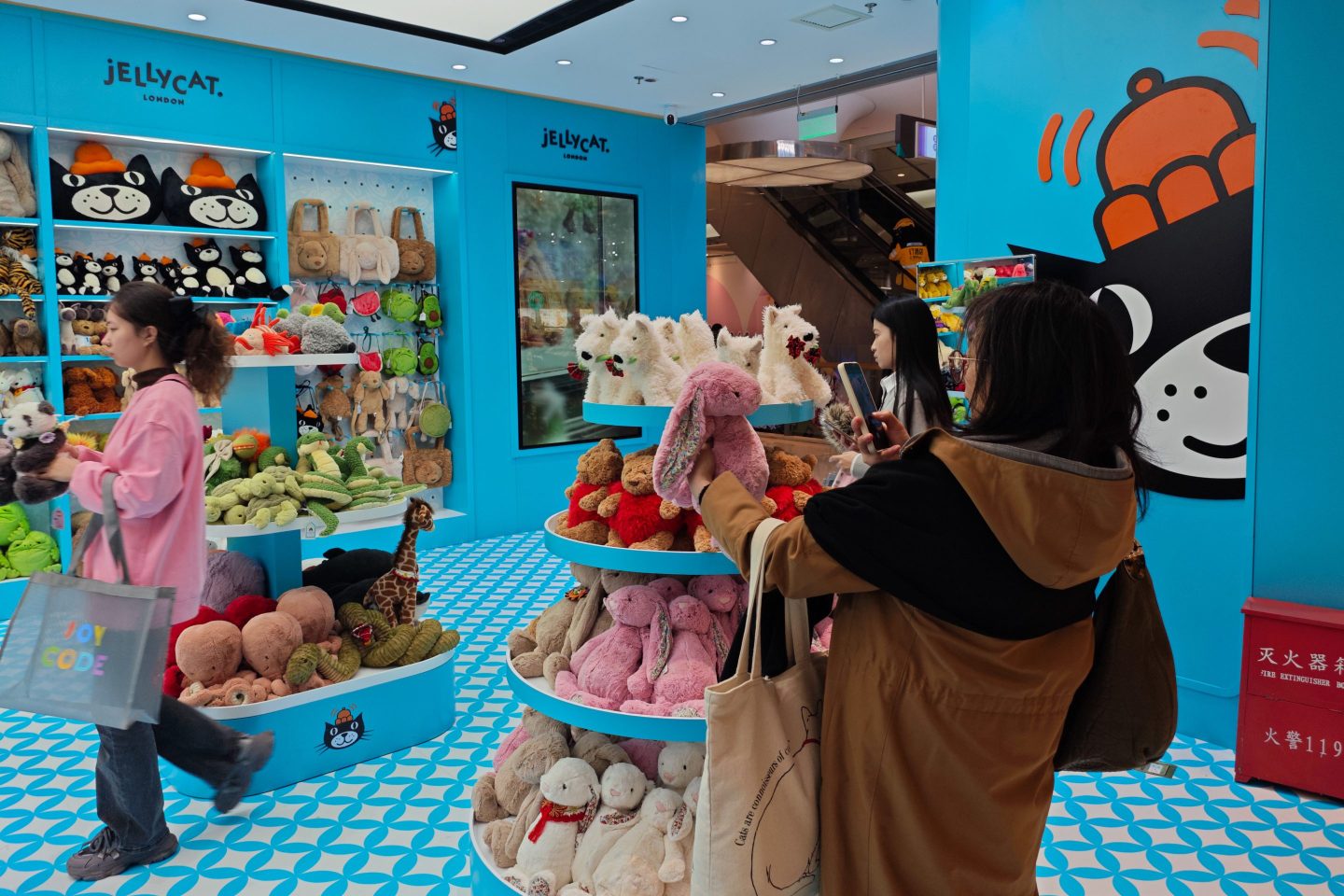
When young adults started buying up the company’s plush toys and posting them online, Jellycat decided to lean in. It opened up several experience stands, including a fish-and-chips stand in a London Selfridges, and a diner location inside the famous New York City toy store FAO Schwarz. Workers will put on a show, flipping a Jellycat burger or packing a toy box of fries before checking out customers. Their efforts blew up on TikTok, with videos reeling in as many as 22 million views.
Read more from Fortune
Bezamat said the choice to put an experience in Selfridges was interesting: The department store is very adult, especially compared to toy locales like FAO Schwarz. Grownups were their target audience, and they were feeding into their want for play.
Jellycat’s choice in where to sell products is also deliberate. In major consumer countries like the U.S. and U.K., the stuffies can mostly be found at stationery stores and children’s shops. They’re a bit harder to track down, and even when shoppers find them, stock can be sparse. Jellycat is known for constantly selling out and switching out its plush designs. It creates a buyer experience that feels like a chase.
“They play in scarcity really well. And they also tapped into the adult market by finding the quirky things that people are really into,” Bezamat said.
But there is also something irreplicable about this strategy, according to marketing experts. A huge part of Jellycat’s rise was pure luck: Buyers chose to turn to Jellycat stuffed animals specifically when yearning for toys in lockdown. Its initial appeal could be attributed to the toy’s high quality, experts said, but Gen Z really took the lead on choosing the “it” plush. Watson said others are already trying to hop on the bandwagon.
“When we’re looking to other spaces that might be able to capture this magic, we’ve seen some of this with trading cards,” he said. “Pokémon recently released the original card set from millennials’ childhood.”
Bezamat said less established brands might have a better shot at emulating that success. They have fewer constraints, and can run free with their ideas.
“It’s harder for an established brand to try to replicate Jellycat success, because they will have their legacy, ways of working, business model, distribution, etc. They have a lot more barriers,” she said. “But if you’re a new brand coming into the toy business, you have a lot more room to play. It’s just about whether it will have the lasting power that Jellycat has had, or if it will be another trendy TikTok-hype brand.”