• Home
  • News
  • Fortune 500
  • Tech
  • Finance
  • Leadership
  • Lifestyle
  • Rankings
  • Multimedia
EnvironmentNatural disasters

Deadly LA wildfires to cost over $50 billion in damages, becoming one of the worst natural disasters in U.S. history

Christiaan Hetzner
By
Christiaan Hetzner
Christiaan Hetzner
Senior Reporter
Down Arrow Button Icon
Christiaan Hetzner
By
Christiaan Hetzner
Christiaan Hetzner
Senior Reporter
Down Arrow Button Icon
January 9, 2025, 1:12 PM ET
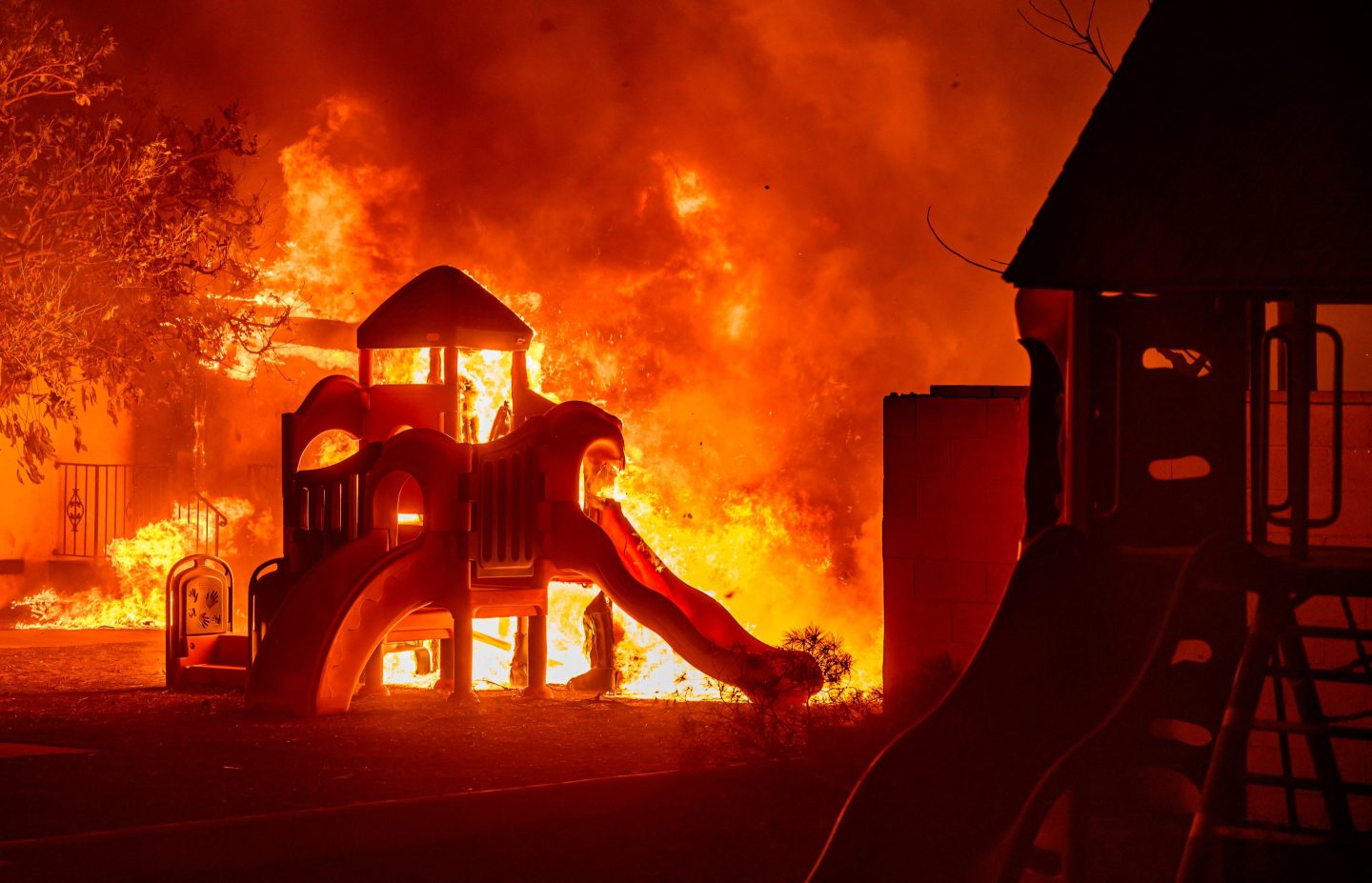
A children's playground on fire in Pasadena.
A children's playground is set ablaze in a residential neighborhood of Pasadena, California. The L.A. wildfires are set to be among the costliest ever recorded in American history.Josh Edelson—AFP via Getty Images
  • AccuWeather estimates the LA blaze will far exceed the $16 billion in economic losses from Maui’s wildfires two years ago. Weather-related catastrophes now make up almost all of the $320 billion in global damages last year, with geophysical events like earthquakes only amounting to 7% of that figure.

The deadly inferno sweeping across Los Angeles and consuming some of the city’s most affluent homes will likely be one of the most expensive natural disasters on record. 

Recommended Video

An initial estimate by AccuWeather forecasts damages will reach a minimum of $52 billion, and potentially top out at $57 billion. This would place it in the top ten catastrophes by property losses otherwise dominated chiefly by hurricanes like this summer’s Helene, which cost $250 billion.

“This is already one of the worst wildfires in California history,” said chief meteorologist Jonathan Porter.

Should a large number of additional structures be burned in the coming days, he warned it may become the worst wildfire on state record, based on the number of structures burned and the economic loss.

“This is a terrible disaster. We’re just starting to get a clear look at the magnitude of the destruction and loss,” Porter added.

'Just complete and utter devastation'

By comparison the wildfire that captured headlines the world over by incinerating parts of Hawaii’s Maui island in 2023 topped out at $16 billion. 

A chief cause of AccuWeather’s high estimate is the value of the underlying property set ablaze. According to Zillow, the average price of a home in the badly hit Pacific Palisades area is estimated at approximately $3.5 million. 

Beyond the sheer economic impact, the fires have also claimed at least five lives, according to California’s Gavin Newsom, with likely more to be reported in the coming days. 

On hand to assess the situation personally, the governor was struck by “just [the] complete and utter devastation” left behind in the fire’s wake.

Roughly $300 billion in annual damages just from extreme weather

While climate change sceptics continue to assert the conflagration could have been avoided through better forest management and controlled burning, a multinational corporation whose profits depend on how accurate they model property risks warned there is a clear trend. 

“The destructive forces of climate change are becoming increasingly evident,” said Munich Re’s Thomas Blunck. He runs the world’s largest reinsurance business by premiums, which underwrites risks for primary providers like Allstate and Nationwide.

On Thursday, Blunck’s company issued its annual statement estimating the amount of property damage caused by natural disasters worldwide soared by nearly a fifth in 2024. 

Munich Re’s message was simple: weather was to blame for almost all of it. And severe thunderstorms and wildfires were fueling the trend in rising losses more so than major disasters like tropical cyclones.

By comparison, geophysical events like earthquakes made up just 7% of this year’s $320 billion in losses. The previous year, when natural catastrophe damages hit $268 billion in today’s dollars, these non-weather related phenomena still accounted for roughly a quarter.  

Frequency and scale of property damages causing insurance rates to soar

Whether it was the flash flooding in the desert oasis of Dubai, the torrents of mud sweeping cars through the streets of Spain’s Valencia, or the destruction wreaked by the twin hurricanes of Milton and Helene in the Gulf—climate change can be ignored, but the extreme effects of climate change cannot. 

“Societies need to prepare for more severe weather catastrohpes,” Blunck warned bluntly. “Accordingly, Munich Re is expanding and adapting its risk models to address these developments.”

Put simply, bills are set to go up. So while homeowners are free to believe climate change is a hoax, when it comes to their property they’ll find the companies selling them insurance most definitely do not.

For example, Allstate hiked rates in California by 34% in November after receiving earlier approval from state regulators. 

That is assuming they can even find a provider willing to cover them. In some hard-hit states like Florida, many homeowners are forced to resort on a state-backed insurers of last resort such as the Citizens Property Insurance.

Fortune Brainstorm AI returns to San Francisco Dec. 8–9 to convene the smartest people we know—technologists, entrepreneurs, Fortune Global 500 executives, investors, policymakers, and the brilliant minds in between—to explore and interrogate the most pressing questions about AI at another pivotal moment. Register here.
About the Author
Christiaan Hetzner
By Christiaan HetznerSenior Reporter
Instagram iconLinkedIn iconTwitter icon

Christiaan Hetzner is a former writer for Fortune, where he covered Europe’s changing business landscape.

See full bioRight Arrow Button Icon

Latest in Environment

data center
EnvironmentData centers
The rise of AI reasoning models comes with a big energy tradeoff
By Rachel Metz, Dina Bass and BloombergDecember 5, 2025
24 minutes ago
Jaguar
EnvironmentArizona
‘This species is recovering’: Jaguar spotted in Arizona, far from Central and South American core
By Susan Montoya Bryan and The Associated PressDecember 5, 2025
6 hours ago
Steve Jobs holds up the first iPod Nano
Big TechApple
Apple is experiencing its biggest leadership shake-up since Steve Jobs died, with over half a dozen key executives headed for the exits
By Dave SmithDecember 5, 2025
7 hours ago
Paul Atkins
CommentaryCorporate Governance
Turning public companies into private companies: the SEC’s retreat from transparency and accountability
By Andrew BeharDecember 5, 2025
8 hours ago
Four years ago, BKV started buying up the two Temple power plants in Texas—located between Austin and Dallas—which now total 1.5 gigawatts of electricity generation capacity—enough to power more than 1.1 million homes, or a major data center campus. There is room to expand.
Energypower
How a Texas gas producer plans to exploit the ‘megatrend’ of power plants for AI hyperscalers
By Jordan BlumDecember 5, 2025
14 hours ago
satellite
AIData centers
Google’s plan to put data centers in the sky faces thousands of (little) problems: space junk
By Mojtaba Akhavan-TaftiDecember 3, 2025
2 days ago

Most Popular

placeholder alt text
Economy
Two months into the new fiscal year and the U.S. government is already spending more than $10 billion a week servicing national debt
By Eleanor PringleDecember 4, 2025
1 day ago
placeholder alt text
Success
‘Godfather of AI’ says Bill Gates and Elon Musk are right about the future of work—but he predicts mass unemployment is on its way
By Preston ForeDecember 4, 2025
1 day ago
placeholder alt text
Success
Nearly 4 million new manufacturing jobs are coming to America as boomers retire—but it's the one trade job Gen Z doesn't want
By Emma BurleighDecember 4, 2025
1 day ago
placeholder alt text
Success
Nvidia CEO Jensen Huang admits he works 7 days a week, including holidays, in a constant 'state of anxiety' out of fear of going bankrupt
By Jessica CoacciDecember 4, 2025
1 day ago
placeholder alt text
Real Estate
‘There is no Mamdani effect’: Manhattan luxury home sales surge after mayoral election, undercutting predictions of doom and escape to Florida
By Sasha RogelbergDecember 4, 2025
1 day ago
placeholder alt text
Economy
Tariffs and the $38 trillion national debt: Kevin Hassett sees ’big reductions’ in deficit while Scott Bessent sees a ‘shrinking ice cube’
By Nick LichtenbergDecember 4, 2025
1 day ago
Rankings
  • 100 Best Companies
  • Fortune 500
  • Global 500
  • Fortune 500 Europe
  • Most Powerful Women
  • Future 50
  • World’s Most Admired Companies
  • See All Rankings
Sections
  • Finance
  • Leadership
  • Success
  • Tech
  • Asia
  • Europe
  • Environment
  • Fortune Crypto
  • Health
  • Retail
  • Lifestyle
  • Politics
  • Newsletters
  • Magazine
  • Features
  • Commentary
  • Mpw
  • CEO Initiative
  • Conferences
  • Personal Finance
  • Education
Customer Support
  • Frequently Asked Questions
  • Customer Service Portal
  • Privacy Policy
  • Terms Of Use
  • Single Issues For Purchase
  • International Print
Commercial Services
  • Advertising
  • Fortune Brand Studio
  • Fortune Analytics
  • Fortune Conferences
  • Business Development
About Us
  • About Us
  • Editorial Calendar
  • Press Center
  • Work At Fortune
  • Diversity And Inclusion
  • Terms And Conditions
  • Site Map

© 2025 Fortune Media IP Limited. All Rights Reserved. Use of this site constitutes acceptance of our Terms of Use and Privacy Policy | CA Notice at Collection and Privacy Notice | Do Not Sell/Share My Personal Information
FORTUNE is a trademark of Fortune Media IP Limited, registered in the U.S. and other countries. FORTUNE may receive compensation for some links to products and services on this website. Offers may be subject to change without notice.