• Home
  • Latest
  • Fortune 500
  • Finance
  • Tech
  • Leadership
  • Lifestyle
  • Rankings
  • Multimedia
CommentaryHealth

It’s time to hold corporations accountable for the plastics crisis—and the bill could exceed $20 billion in the U.S. alone

By
Leonardo Trasande
Leonardo Trasande
Down Arrow Button Icon
By
Leonardo Trasande
Leonardo Trasande
Down Arrow Button Icon
November 21, 2024, 11:53 AM ET
Professor Leonardo Trasande is the director of the New York University Grossman School of Medicine Division of Environmental Paediatrics.
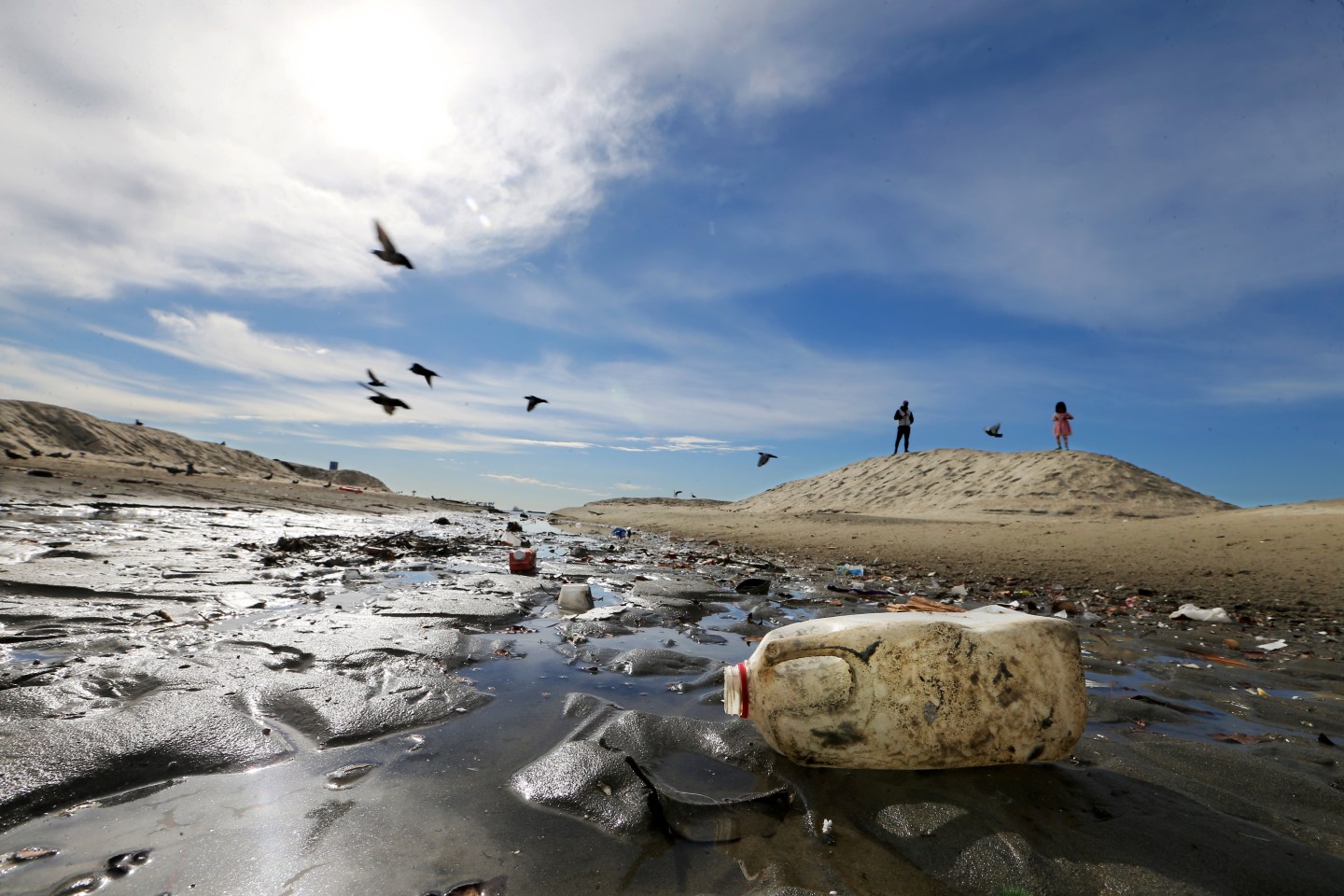
Plastic debris litters Junipero Beach in Long Beach, California.
Plastic debris litters Junipero Beach in Long Beach, California.Luis Sinco—Los Angeles Times/Getty Images

For decades, scientists have published peer-reviewed studies on hazardous chemicals in plastics and have called out for action, all to no avail. Now medical practitioners on the front line of this plastic crisis are sounding the alarm ahead of the final round of UN negotiations for a Global Plastic Treaty. The urgent message cannot be overlooked: Plastic is a threat to human health.

The lack of transparency around the plastics industry has led academics and campaigners to search for facts—and those facts are startling. Some 16,000 chemicals are used in plastic and yet only 6% are currently subject to international regulation. Of those 16,000 chemicals, many are endocrine disruptors, meaning our hormones and bodily functions are under constant attack when exposed. With a new chemical being produced every 1.4 minutes, our exposure is only set to rise.

The impact of such wholesale disruption cannot be understated. A toxic soup of endocrine disruptors, polyfluoroalkyl substances (PFAS), and phthalates present in plastic cause cancer, infertility, heart disease, and more. One study has estimated that 50,000 people a year die in the U.S. because of the level of phthalates lowering their hormones. Recycling, the fix-all solution purported by industry, can actually magnify exposure to these chemicals.

The impact on the economy is seemingly even less known to those with the power to action change. The associated social costs of the tide of plastic chemicals amount to 1.22% of the U.S. gross domestic product—a $250 billion bill for the healthcare systems of the nation.  

Perhaps a corporation or financier may think that this number is not their problem for another as their profits will be protected. This is not the case. Near-term exposure (2022-30) to corporate liabilities from plastic-related pollution, including chemical additives, is likely to exceed $20 billion in the U.S. alone. It is this risk to profit that should ring alarm bells in every finance house on Wall Street.

As the world fully awakens to the plastics crisis, litigation will be filed, legislation will be enacted, and perhaps it is this risk to the bottom line that will move the needle. As a scientist, I’m used to writing peer-reviewed papers thinking it should make a difference, but the reality is that no matter how shocking the science, it only has an impact if action is taken.

We are now starting to see the beginning of what could ensure the next generations are protected. California’s Attorney General, Rob Bonta, could have not been clearer as he stood in NYU Langone at our Plastics and Human Health Symposium and stated that “the public has been manipulated and the consumer lied to.” It’s a warning to those in the industry who choose to ignore the science and endeavor to disrupt UN negotiations for a desperately needed Global Plastics Treaty.  

A weakened treaty that prioritizes recycling and non-binding targets risks failing to address the astounding cost to human health. In response, leading global doctors alongside the Plastic Health Council have expressed their deep concern, warning of the risk of failure if the Treaty is not strengthened. Mandatory testing of all chemicals, funding for truly natural alternatives to be scaled, and a (now U.S.-backed) limit on the production of plastic. These provisions are foundational—and mean real change for future generations. Only the creation of accountability and corporate risk can protect our health and ultimately our economy.  

In this pivotal moment, the choice is ours. Where once the science on plastic and its component chemicals was suppressed, it is now mainstream. We don’t know everything—but we know enough to recognize the need to act. After working in this field for decades, I see momentum building and recognize the power policymakers and consumers have. Let us not squander this opportunity to reshape our relationship with plastic and protect the health of our planet and its inhabitants. It’s time to act.

More must-read commentary published by Fortune:

  • Shell’s Pyrrhic victory may well set the stage for more corporate climate accountability
  • Demis Hassabis-James Manyika: AI will help us understand the very fabric of reality
  • British fintech founder who moved to U.S.: U.K. tech’s problem isn’t taxes—it’s ambition
  • The next wave of AI won’t be driven by LLMs. Here’s what investors should focus on instead

The opinions expressed in Fortune.com commentary pieces are solely the views of their authors and do not necessarily reflect the opinions and beliefs of Fortune.

Join us at the Fortune Workplace Innovation Summit May 19–20, 2026, in Atlanta. The next era of workplace innovation is here—and the old playbook is being rewritten. At this exclusive, high-energy event, the world’s most innovative leaders will convene to explore how AI, humanity, and strategy converge to redefine, again, the future of work. Register now.
About the Author
By Leonardo Trasande
See full bioRight Arrow Button Icon

Latest in Commentary

student
CommentaryEducation
International students skipped campus this fall — and local economies lost $1 billion because of it
By Bjorn MarkesonDecember 10, 2025
18 hours ago
jobs
Commentaryprivate equity
There is a simple fix for America’s job-quality crisis: actually give workers a piece of the business 
By Pete StavrosDecember 9, 2025
2 days ago
Jon Rosemberg
CommentaryProductivity
The cult of productivity is killing us
By Jon RosembergDecember 9, 2025
2 days ago
Trump
CommentaryTariffs and trade
AI doctors will be good at science but bad at business, and big talk with little action means even higher drugs prices: 10 healthcare predictions for 2026 from top investors
By Bob Kocher, Bryan Roberts and Siobhan Nolan ManginiDecember 9, 2025
2 days ago
Google.org
CommentaryTech
Nonprofits are solving 21st century problems—they need 21st century tech
By Maggie Johnson and Shannon FarleyDecember 8, 2025
3 days ago
Will Dunham is President and Chief Executive Officer of the American Investment Council
CommentaryRetirement
Private equity is being villainized in the retirement debate — even as it provides diversification and outperforms public markets long-term
By Will DunhamDecember 8, 2025
3 days ago

Most Popular

placeholder alt text
Success
At 18, doctors gave him three hours to live. He played video games from his hospital bed—and now, he’s built a $10 million-a-year video game studio
By Preston ForeDecember 10, 2025
22 hours ago
placeholder alt text
Politics
Exclusive: U.S. businesses are getting throttled by the drop in tourism from Canada: ‘I can count the number of Canadian visitors on one hand’
By Dave SmithDecember 10, 2025
20 hours ago
placeholder alt text
Economy
‘Be careful what you wish for’: Top economist warns any additional interest rate cuts after today would signal the economy is slipping into danger
By Eva RoytburgDecember 10, 2025
14 hours ago
placeholder alt text
Economy
‘Fodder for a recession’: Top economist Mark Zandi warns about so many Americans ‘already living on the financial edge’ in a K-shaped economy 
By Eva RoytburgDecember 9, 2025
1 day ago
placeholder alt text
Uncategorized
Transforming customer support through intelligent AI operations
By Lauren ChomiukNovember 26, 2025
15 days ago
placeholder alt text
Economy
Fed’s expected rate cut today is less about stimulating the economy and more about protecting the job market from ‘shattering’
By Eleanor PringleDecember 10, 2025
20 hours ago
Rankings
  • 100 Best Companies
  • Fortune 500
  • Global 500
  • Fortune 500 Europe
  • Most Powerful Women
  • Future 50
  • World’s Most Admired Companies
  • See All Rankings
Sections
  • Finance
  • Leadership
  • Success
  • Tech
  • Asia
  • Europe
  • Environment
  • Fortune Crypto
  • Health
  • Retail
  • Lifestyle
  • Politics
  • Newsletters
  • Magazine
  • Features
  • Commentary
  • Mpw
  • CEO Initiative
  • Conferences
  • Personal Finance
  • Education
Customer Support
  • Frequently Asked Questions
  • Customer Service Portal
  • Privacy Policy
  • Terms Of Use
  • Single Issues For Purchase
  • International Print
Commercial Services
  • Advertising
  • Fortune Brand Studio
  • Fortune Analytics
  • Fortune Conferences
  • Business Development
About Us
  • About Us
  • Editorial Calendar
  • Press Center
  • Work At Fortune
  • Diversity And Inclusion
  • Terms And Conditions
  • Site Map

© 2025 Fortune Media IP Limited. All Rights Reserved. Use of this site constitutes acceptance of our Terms of Use and Privacy Policy | CA Notice at Collection and Privacy Notice | Do Not Sell/Share My Personal Information
FORTUNE is a trademark of Fortune Media IP Limited, registered in the U.S. and other countries. FORTUNE may receive compensation for some links to products and services on this website. Offers may be subject to change without notice.