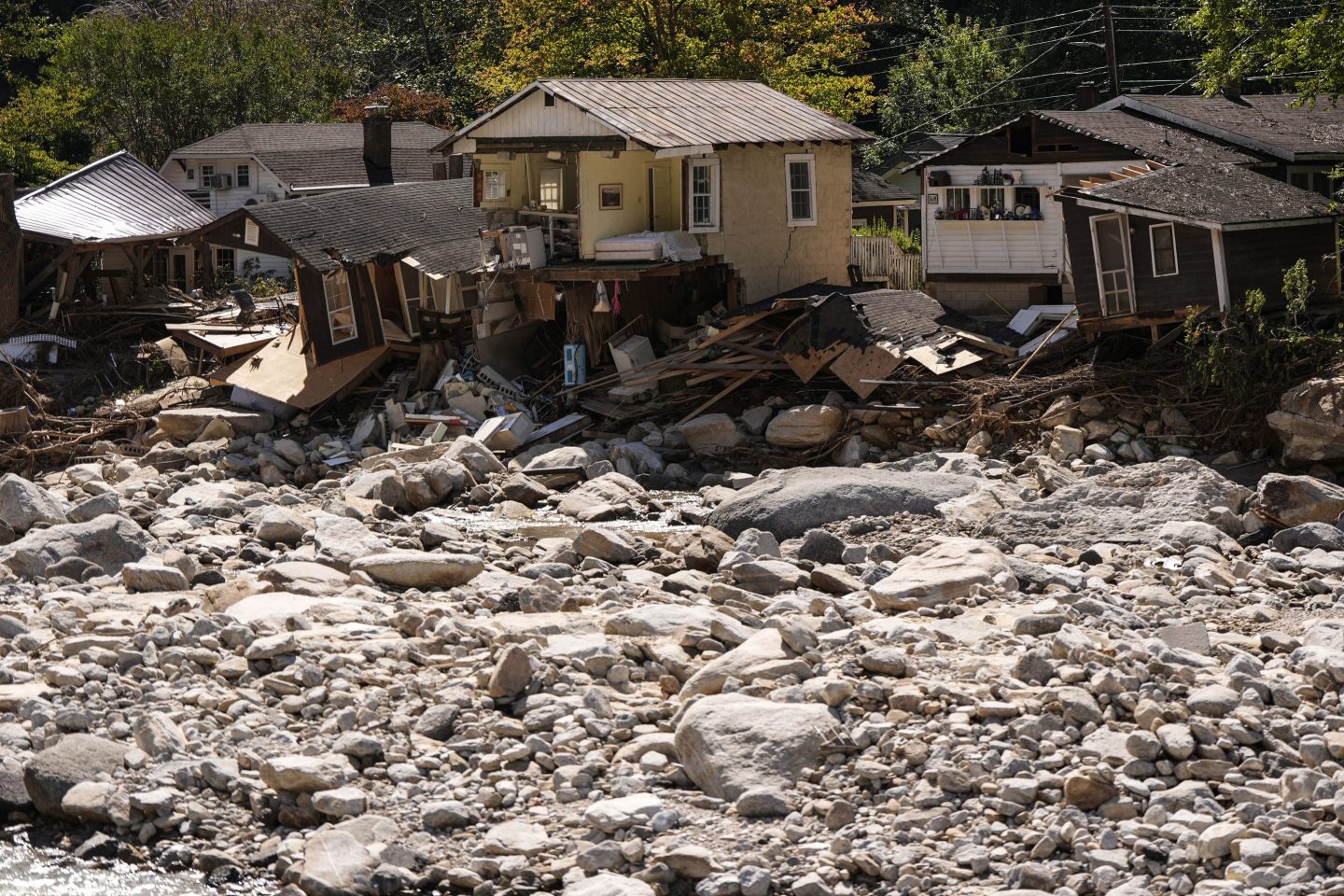
A week after Hurricane Helene overwhelmed the Southeastern U.S., homeowners hit the hardest are grappling with how they could possibly pay for the flood damage from one of the deadliest storms to hit the mainland in recent history.
The Category 4 storm that first struck Florida’s Gulf Coast on September 26 has dumped trillions of gallons of water across several states, leaving a catastrophic trail of destruction that spans hundreds of miles inland. More than 200 people have died in what is now the deadliest hurricane to hit the mainland U.S. since Katrina, according to statistics from the National Hurricane Center.
Western North Carolina and the Asheville area were hit especially hard, with flooding that wiped out buildings, roads, utilities and land in a way that nobody expected, let alone prepared for. Inland areas in parts of Georgia and Tennessee were also washed out.
The Oak Forest neighborhood in south Asheville lives up to its name, with trees towering over 1960s era ranch-style houses on large lots. But on Sept. 27, as Helene’s remnants swept through western north Carolina, many of those trees came crashing down, sometimes landing on houses.
Julianne Johnson said she was coming upstairs from the basement to help her 5-year-old son pick out clothes that day when her husband began to yell that a giant oak was falling diagonally across the yard. The tree mostly missed the house, but still crumpled part of a metal porch and damaged the roof. Then, Johnson said, her basement flooded.
On Friday, there was a blue tarp being held on the roof with a brick. Sodden carpet that the family torn out lay on the side of the house, waiting to go to the landfill. With no cell phone service or internet access, Johnson said she couldn’t file a home insurance claim until four days after the storm.
“It took me a while to make that call,” she said. “I don’t have an adjuster yet.”
Roof and tree damage are likely to be covered by the average home insurance policy. But Johnson, like many homeowners, doesn’t have flood insurance and she’s not certain how she’ll pay for that part of the damage.
Those recovering from the storm may be surprised to learn flood damage is a completely separate thing. Insurance professionals and experts have long warned that home insurance typically does not cover flood damage to the home, even as they espouse that flooding can happen anywhere that rains. That’s because flooding isn’t just sea water seeping into the land – it’s also water from banks, as well as mudflow and torrential rains.
But most private insurance companies don’t carry flood insurance, leaving the National Flood Insurance Program run by the Federal Emergency Management Agency as the primary provider for that coverage for residential homes. Congress created the federal flood insurance program more than 50 years ago when many private insurers stopped offering policies in high-risk areas.
North Carolina has 129,933 such policies in force, according to FEMA’s latest data, though most of that protection will likely be concentrated on the coast rather than in the Blue Ridge Mountains area where Helene caused the most damage. Florida, in comparison, has about 1.7 million flood policies in place statewide.
Charlotte Hicks, a flood insurance expert in North Carolina who has led flood risk training and educational outreach for the state’s Department of Insurance, said the reality is that many Helene survivors will never be made whole. Without flood insurance, some people may be able to rebuild with the help of charities but most others will be left to fend for themselves.
“There will absolutely be people who will be financially devasted by this event,” Hicks said. “It’s heartbreaking.”
Some may go into foreclosure or bankruptcy. Entire neighborhoods will likely never be rebuilt. There’s been water damage across the board, Hicks said, and for some, mudslides have even taken the land upon which their house once stood.
Meanwhile, Helene is turning out to be a fairly manageable disaster for the private home insurance market because those plans generally only serve to cover wind damage from hurricanes.
That’s a relief for the industry, which has been under increasing strain from other intensifying climate disasters such as wildfires and tornadoes. Nowhere is the shrinking private market due to climate instability more evident than in Florida, where many companies have already stopped selling policies — leaving the state-backed Citizens Property Insurance Corporation now the largest home insurer in the state.
Mark Friedlander, spokesman for the Insurance Information Institute, an industry group, said Helene is a “very manageable loss event,” and estimates insurer losses will range from about $5 billion to $8 billion. That’s compared to the insured losses from the Category 4 Hurricane Ian in September 2022 that was estimated in excess of $50 billion.
Friedlander and other experts point out that less than 1% of the inland areas that sustained the most catastrophic flood damage were protected with flood insurance.
“This is very common in inland communities across the country,” Friedlander said. “ Lack of flood insurance is a major insurance gap in the U.S., as only about 6% of homeowners carry the coverage, mostly in coastal counties.”
Amy Bach, executive director of the consumer advocacy group United Policyholders, said the images of the flood destruction in North Carolina shook her despite decades of seeing challenging recovery faced by victims of natural disasters.
“This is a pretty serious situation here in terms of people disappointed. They are going to be disappointed in their insurers and they are going to be disappointed in FEMA,” Bach said. “FEMA cannot match the kind of dollars private insurers are supposed to be contributing to the recovery.”
This week, FEMA announced it could meet the immediate needs of Helene but warned it doesn’t have enough funding to make it through the hurricane season, which runs June 1 to Nov. 30 though most hurricanes typically occur in September and October.
Even if a homeowner does have it, FEMA’s National Flood Insurance Program only covers up to $250,000 for single-family homes and $100,000 for contents.
Bach said that along with homeowners educating themselves about what their policies do and don’t cover, the solution is a national disaster insurance program that does for property insurance what the Affordable Care Act did for health insurance.
After Hurricane Floyd in 1999, the state of North Carolina started requiring insurance agents to take a flood insurance class so they could properly advise their clients of the risk and policies available, Hicks said. The state also requires home insurance policies to clearly disclose that it does not cover flood.
“You can’t stop nature from doing what nature is going to do,” Hicks said. “For us to think it’s never going to be this bad again would be a dangerous assumption. A lot of people underestimate their risk of flooding.”