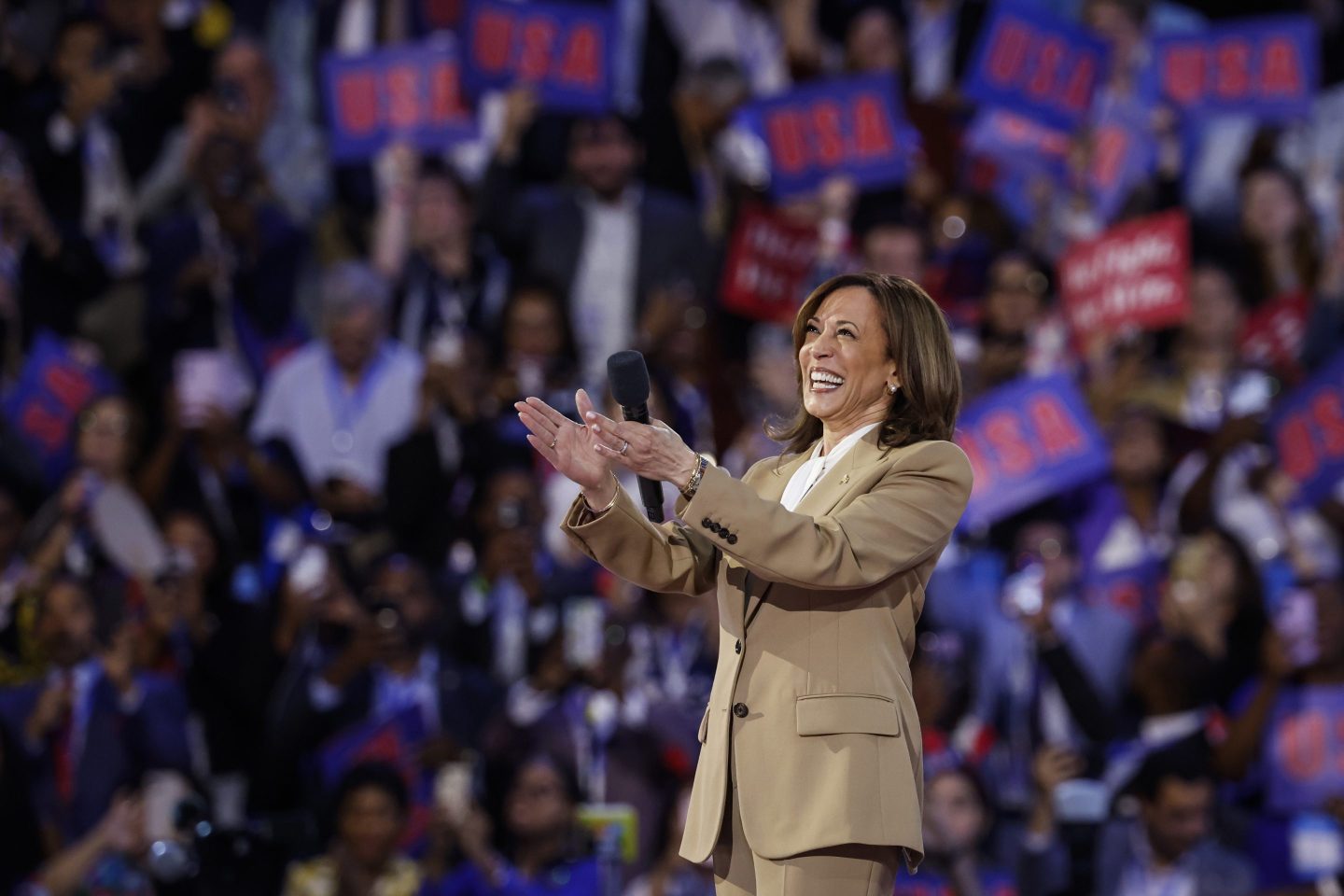
It’s the eve of the final day of the Democratic National Convention and there’s, ironically, a couple of elephants in the room.
One of the weightiest is none other than the ultra-wealthy, a growing cohort that the party seemingly wants to court, but one that it can’t quite figure its messaging on.
That tension is all leading to a whiplash not unlike Jennifer Lopez and Ben Affleck every odd decade or so. For instance, on Tuesday, Bernie Sanders (I-VT) took to the DNC stage to call out the 1%.
“At a time of massive income and wealth inequality, giving more tax breaks to billionaires is radical,” he said. He also called for a ceasefire in Gaza; an end to funding cuts on Social Security, Medicare and Medicaid; and action on mitigating climate change.
After Sanders spoke, a billionaire came on with a different, though equally applauded, message. “Donald Trump thinks we should trust him on the economy because he claims to be very rich, but take it from an actual billionaire,” Illinois Gov. J.B. Pritzker said. “Trump is rich in only one thing—stupidity,” he continued, amid cheers. If it feels a bit like a K-turn, that’s because Democrats aren’t really ready to go in on their billionaires, experts said.
“This has been such a unique election cycle, but a large part of the Democrat’s strategy has been to distance themselves from the perception that they are the party of the wealthy with a softened populism,” Lily Geismer, professor of history at Claremont McKenna College told Fortune. Geismer noted that the party is trying to “win over disaffected working-class and middle-class voters who are worried about pocketbook issues and they seem more responsive.”
In that sense, the flip-flopping isn’t a slip-up as much as it is a reveal of the system as it stands. The Sanders to Pritzker gaffe is more a reveal behind the curtain as it “speaks to a deeper issue within American politics right now,” per Geismer.
She adds that despite the “increased economic populism” of Republican figures like vice presidential candidate JD Vance and Missouri Sen. Josh Hawley, who have positioned themselves as “champions [of] the working class,” Vance has been revealed to have “a series of ties to billionaires in the tech sector.”
Democrats have a history of taxing the wealthy more than Republicans, she pointed out. Championing the middle class has been a long-time strategy of the Dems, but something new this cycle is “a far stronger emphasis on unions and the working class,” said Geismer. It seems that Democrats are scrambling to appeal to the working-class voting block which they have at times lost by not addressing their concerns, she adds.
This mixed messaging on the rich is, in part, fueled by the nation’s ambivalence toward billionaires and rising calls to check their power. The people themselves don’t know what to do with these figures, because as holes pierce the American Dream, belief in the innate value of rich people dwindles.
And 59% of Americans believe billionaires are making a more unfair society, per a Harris Poll’s recently released survey of more than 2,100 U.S. adults. While many (69%) suggest taxing the wealthy, and blame them for stoking inflation (58%), a large portion (61%) still look up to billionaires and view them as good for the economy (61%) and society (62%).
Part of the flip-flopping is because Democrats are trying “to reconcile the two disparate aspects of their coalition—the wealthy and middle-and working-class voters,” said Geismer. In playing both sides, they seem to make no one completely happy. “It’s an emotional and moral rollercoaster,” said late-night talk show host Stephen Colbert of the Sanders and Pritzker lineup that read just as disjointed as the Billy Joel and Stevie Nicks tour. Both have the effect of leaving many wondering, who is the target audience?
Grappling with how to position themselves in the modern age of ballooning wealth inequality, the Democrats are now forced to address their past stance on the rich to see if they can, or want, to move the goalposts.
“The Democratic Party’s stance on taxing the wealthy has shifted only slightly in recent years,” Vanessa Williamson, senior fellow in Governance Studies at Brookings and the Urban-Brookings Tax Policy Center, told Fortune. “Since [Bill] Clinton, the party has consistently promised to only raise taxes on high earners.” That once meant those making more than $250,000; now the figure stands at $400,000.
“What is new, however, is the increasing interest in the possibility of a tax on very high wealth—generally those with hundreds of millions or billions of dollars,” said Williamson, noting that the policy was a part of the 2016 campaigns for Sanders and Sen. Elizabeth Warren (D-Mass.) that “found very strong public support.” The center has taken note, as President Biden has proposed taxes on billionaires as well, she added.
A wrinkle in wealth
The Democratic presidential nominee, current Vice President Kamala Harris, received a record-breaking $81 million in fundraising within 24 hours of Biden’s announcement that he would step down. Billionaires from both sides of the aisle back Harris’s and Trump’s campaigns. However, most (73%) of Americans report to Harris Poll they wish billionaires played a smaller role in U.S. politics.
Though, as Geismer explains, Harris distances herself from these backers and highlighted “that a majority of the funding comes from small dollar donation[s].” Emphasizing these donations as a sign of success “reinforces a message that campaign donations, rather than canvassing, etc, is the most effective way to support a candidate and engage in the democratic process,” she adds. In other words, money, even from a billionaire, is still key.
Williamson doesn’t see Sanders’ and Pritzker’s messages “at odds, per se,” but sees some diverging mentalities behind policies regarding billionaires.
“The Democratic party straddles two messages on taxing the wealthy, arguing both that these taxes are fair because the very wealthy can afford to pay, and sometimes suggesting that extreme wealth is dangerous to the broader economy or to the functioning of democracy. These messages are not mutually exclusive, however,” she says.
In an attempt to appeal to a swath of voters, Democrats have divided their billionaires into categories. Democrats “promote meritocratic values, thus it is more acceptable to be a wealthy [person] if it came from hard work and intelligence rather than inherited wealth,” said Williamson, pointing to Michelle Obama’s speech as a testament to the shift away from extolling generational wealth. Of course, “it is admittedly an odd position for Pritzker, whose wealth is inherited,” Williamson noted of the heir to the Hyatt Hotels fortune.
Indeed, Michelle Obama was regarded as stealing the show when she noted the racial inequality rooted in the task of building wealth, and praised Harris as someone who is aware of that disparity. “She understands that most of us will never be afforded the grace of failing forward,” she said of Harris. “We will never benefit from the affirmative action of generational wealth.”
Even if the DNC rings of past democratic campaigns, there is a marked shift in which billionaires the party has emphasized and shrunk from. Meta Platforms CEO Mark Zuckerberg isn’t likely to make an appearance, for instance.
There’s “a move away from their celebration of wealthy tech entrepreneurs that was prevalent during both the Clinton and Obama years,” noted Williamson. “In large part, this is a response to the growing cultural backlash to Silicon Valley and Wall Street that has developed in recent years.“