Inflation has moderated from peak levels last year, but as recent numbers show, it’s still not as low as anyone would like it to be. The Federal Reserve has done its part by raising interest rates 11 times and keeping them at 23-year highs. Will it be enough? Perhaps, but some economists say we’re in a new era of higher inflation driven by sweeping global trends.
Whether it’s permanent or temporary, costs are rising due to multiple forces, including onshoring and near-shoring initiatives, ongoing trade tensions with China, the transition to green energy, a tighter labor supply, higher wages, and an aging population pushing up healthcare expenses. Our current predicament illustrates that society needs other ways to fight rising costs.
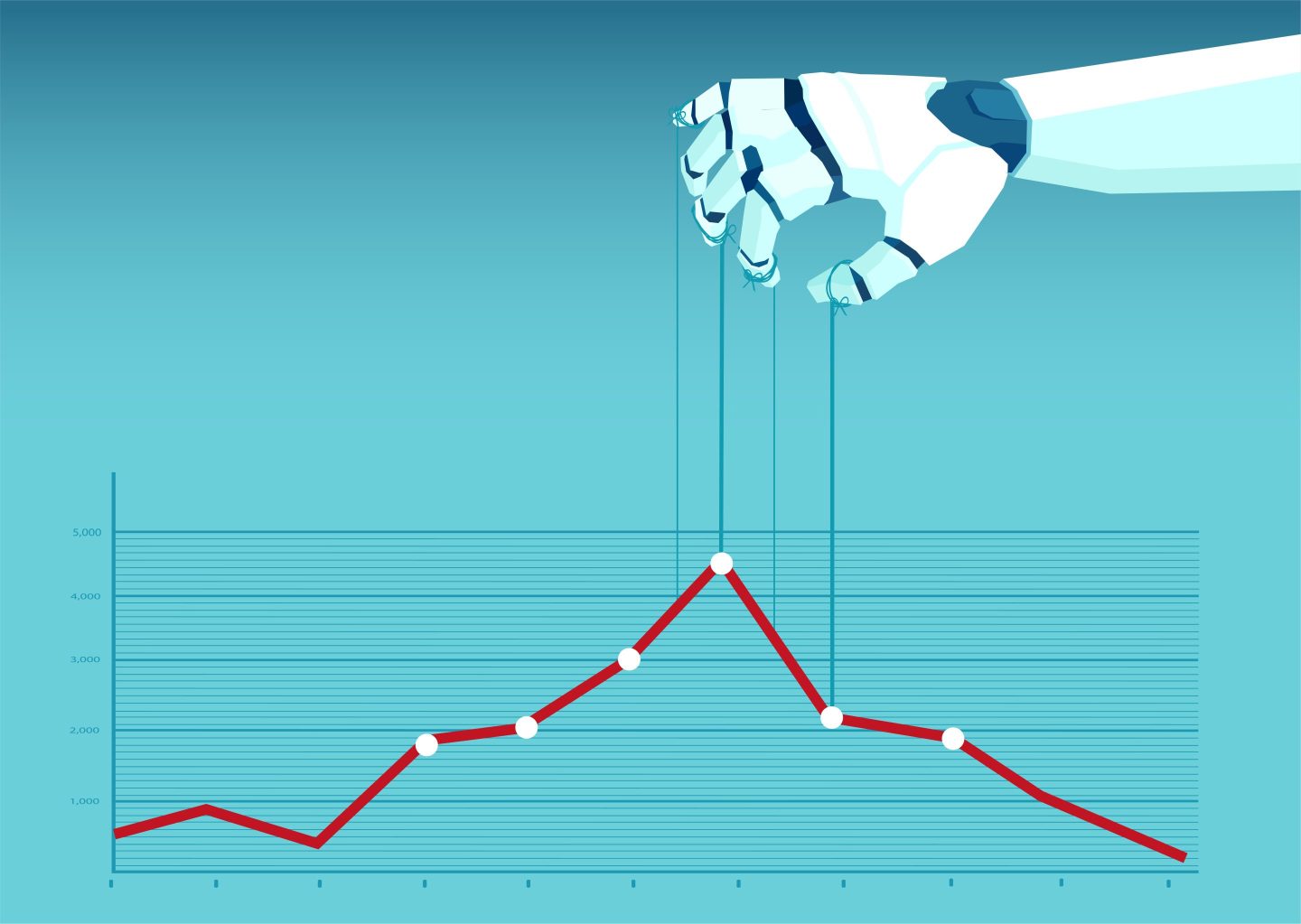
Artificial Intelligence (AI) could be the answer. Technology has served as a disinflationary force before—the microchip is one stellar example. Today, AI could serve as a disinflationary counterweight in a world where inflationary shocks are the new normal.
Back to the Future? Not this time
For much of the last 25 years, productivity increases kept inflation low. I’m not talking just about labor productivity, but output as well. Every dollar of input has grown in terms of output, much of it on the back of offshoring.
Relying on cheaper production capacity in places such as China, Vietnam, India, and beyond has been a key tool available to Western companies, and that movie is coming to an abrupt end. For the next 20 to 30 years, most inputs will be inflationary, and the only real weapon we have to counter them is AI.
In some respects, the slump has already started. From 2012 to 2019, the average annual U.S. productivity rate was below 1%, dragged down by an overall decline in net investment as a percentage of GDP, a slowdown in offshoring of manufacturing and services, and fewer gains from automation now that many of the initial low-hanging opportunities have been taken.
Going forward, companies will have little choice but to look to AI and GenAI to drive productivity. And over the long term, it will probably be either the only—or at least the best—lever available.
Even before GenAI takes hold, the predictions about its productivity impact have been optimistic. McKinsey thinks AI could add $4.4 trillion in corporate profits annually. (For context, the U.K.’s GDP is $3 trillion). And Nielsen thinks GenAI could boost labor productivity by 66%. However, no one really knows. These estimates aren’t as important as what AI can do for specific industries—and those performances will vary.
Productivity gains are likely to be correlated to the level of digitization achieved by each industry. Sectors such as transportation, logistics, and agriculture won’t see the same uplift as retail, technology, media, and professional services.
A decade of AI
Many companies have started seeing the benefits of AI. They’re relying on it not to replace human judgment but to remove heavy cognitive workloads so people can work better, smarter, and more efficiently. It’s about pulling humans into the loop and accelerating the ability to test and learn with data-driven decisions.
Our industry has been using AI for almost a decade, from providing seamless end-to-end efficiencies in our supply chain and logistics to helping us manage our network more effectively through automation. We’ve been applying AI in our network buildout and plotting the most optimal 5G coverage, to name just a few examples. What’s more, in customer service, AI assists our employees so they spend less time hunting down information and more time in a personalized interaction, resolving issues with the customer and fine-tuning service offers.
More broadly, AI is remaking the healthcare industry with advances in imaging diagnostics and the development of new therapies. In real estate, AI is accelerating response times to property listing inquiries to support sales. In investing, AI is opening new research paths for improved analytics. These efficiencies, along with the networks that enable them and even more sophisticated computing, will drive the next 20 to 30 years of productivity gains in America. AI is making all that happen, but it’s going to be an important challenge for society to get it right.
A long, exciting road ahead
While many AI efficiency benefits are evident today, we are still far from realizing its full potential. In my lifetime, I’ve never seen a bigger gap between technology and adoption. The technology that’s already available is incredibly sophisticated, especially around GenAI. And adoption is going to take time. Look at electric cars: they have been around since the 1800s but only recently have they started to enter the mass market.
There’s a lot of work to be done. For example, most of AI’s value sits in specialized data sets in vertical models that either don’t exist today or are still being built. This is a widespread problem among large companies that ingest billions of bits of data daily. And building a single platform in a way that’s privacy-safe and data-intelligent is no small feat.
But change is coming. The companies that start on their AI journey now—or have already started—will be well-positioned to drive the productivity gains that will be the key to a low-inflation environment for the next 20 years.
More must-read commentary published by Fortune:
- Women can’t fix the ‘broken rung’ unless they acknowledge the role they play in workplace bullying and discrimination
- Tech billionaires’ Trump-Vance dance is missing the point: You can’t always get what you want
- Gen Z’s enthusiasm for all things touchable is resurrecting the analog economy—and costing parents
- Nokia CEO: Europe shouldn’t be afraid to back its innovation champions
The opinions expressed in Fortune.com commentary pieces are solely the views of their authors and do not necessarily reflect the opinions and beliefs of Fortune.