• Home
  • Latest
  • Fortune 500
  • Finance
  • Tech
  • Leadership
  • Lifestyle
  • Rankings
  • Multimedia
RetailTarget

Target treks off the beaten path amid sales slump—by selling its own-brand products at other retailers

Sasha Rogelberg
By
Sasha Rogelberg
Sasha Rogelberg
Reporter
Down Arrow Button Icon
Sasha Rogelberg
By
Sasha Rogelberg
Sasha Rogelberg
Reporter
Down Arrow Button Icon
May 6, 2024, 5:20 PM ET
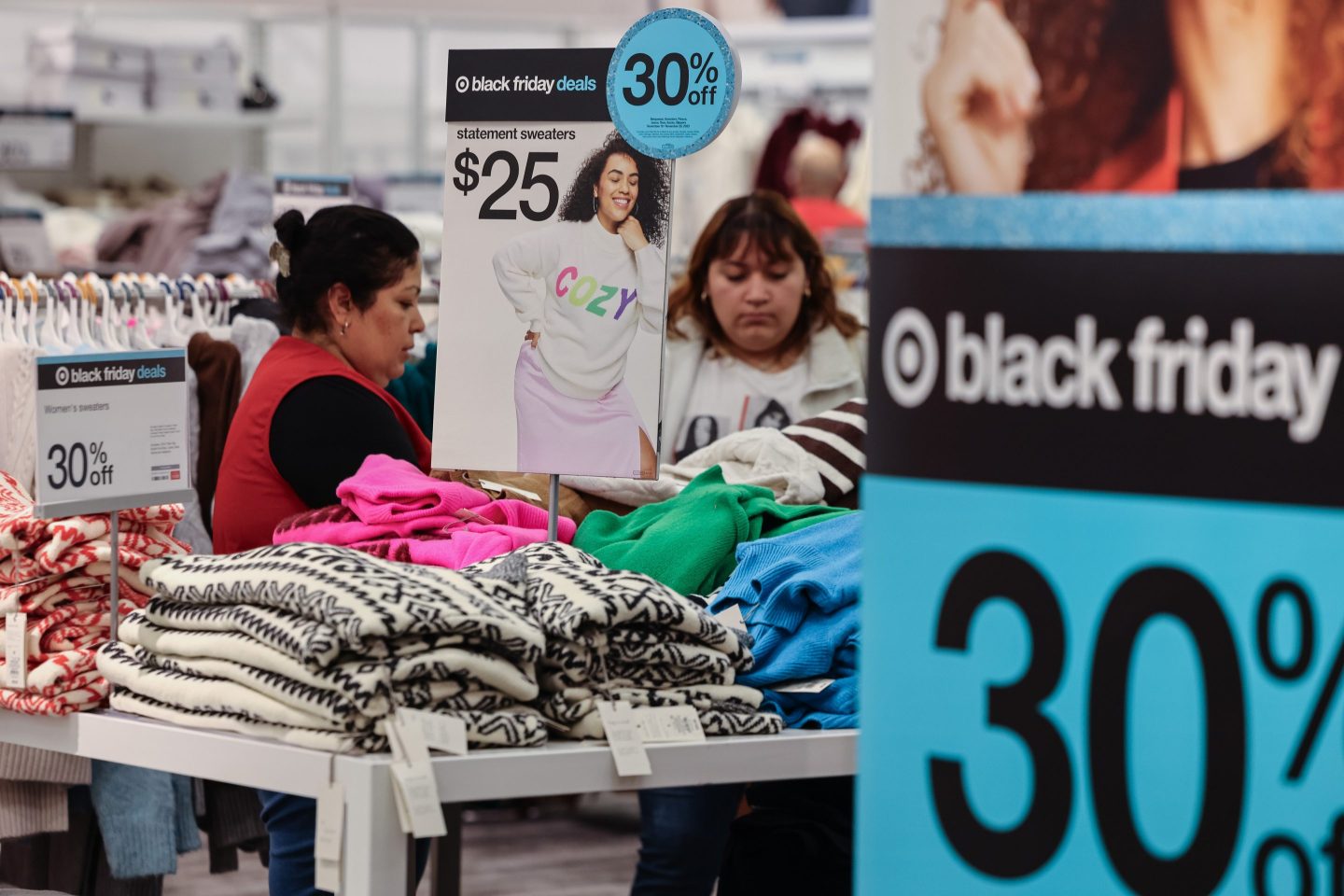
Shoppers look at clothing on display at Target.
Black Friday signs at a Target store ahead of Black Friday last year in Smyrna, Georgia.Elijah Nouvelage/Bloomberg—Getty Images

Target is continuing to lean into its familiar strategy of private-label brands that have brought the Minnesota-based company $30 billion in annual sales—but now it’s veering from the path of competitors by putting its products in other retailers. 

Recommended Video

The big-box chain announced on Monday plans to expand its Cat & Jack children’s clothing line across 85 Hudson’s Bay Co. Canadian department stores, adding outerwear and shoes to the brand’s 1,400 items, most of which are under $15. Since the partnership launched in March, the brand has been incredibly popular in Canada, Target reported, resulting in a 15% increase in basket size at Hudson’s Bay.

Target has no plans to replicate its own-brand expansion in the U.S., but its Cat & Jack expansion is the latest of the company’s tactics to win over consumers in times of slashed discretionary spending. In February, the company launched a new “dealworthy” budget brand of under-$10 home goods. That’s after 2023 saw a 1.7% drop in sales to $105.8 billion. 

Target has failed to make the same inroads as rival Walmart, where sales are steadily growing, though their strategies have converged. Last week, Walmart launched a store-brand grocery line, and in March, Target launched its paid reward program Target Circle 360, parroting Amazon Prime and Walmart+. 

It should be no surprise that retailers are growing their private-label brands. About 60% of shoppers say they buy private labels at least somewhat frequently, per a September 2023 CivicScience report. And according to market research firm Circana, sales of own brands grew 6% in 2023 to $217 billion. But while retailers are taking cues from each other and consumers to line their shelves with own-brand items, Target is taking a more unconventional route, experts say.

Defying convention

Braden Douglas, founder and CEO of marketing agency Crew Marketing Partners, told Fortune that Target’s play to expand its private brands beyond its own stores isn’t a popular gambit.

“It’s not very common because most other retailers don’t want to help another competitor increase revenue,” he said.

The tough economic climate means that big-box retailers are more likely to take strategic risks to attract consumers. For Target, the move makes sense, Douglas argued: Target has a solid supply chain that allows it to be nimble and expand, but is limited by its own geography that’s almost exclusively in the U.S. Target made its debut in Canada in 2013, purchasing the leases of over 200 Zellers, a failed retail chain, from Hudson’s Bay. Because of Target’s rapid expansion, the venture wasn’t expected to be profitable until 2021, and the company pulled the plug on all of its Canadian chains less than two years later. Expanding offerings for Hudson’s Bay could offer Target a do-over of its rocky experiment up north.

“There’s still great demand from that,” Douglas said. “I like that they’re [going to] dip their toe back into the water.”

Calculated risk

While Target’s private-label strategy is uncommon, that doesn’t mean it’s unheard of, argued Katrijn Gielens, professor of marketing at University of North Carolina at Chapel Hill’s Kenan-Flagler School of Business. Even Target carries products from competitors’ private-label brands, including No7, the skincare line from pharmacy chain Boots. Gielens has seen similar moves from national grocery chains successfully putting health-conscious private-label brands in smaller, regional stores.

Gielens agreed with Douglas that competitors will not frequently put their own-brand products in each others’ stores. But she added that expanding private brands to new geographies or to appeal to specific demographics is a cheap way to build exposure, because buying and distributing private brands on a larger scale often has cost-saving advantages.

“You need a certain reputation; you need to have certain expertise and knowledge,” she said. “It’s not easy to pull off.”

The practice of expanding private-label brands beyond their originating retailer grew more common from 2008 to 2012, and the trend tends to emerge in times of economic unease, Gielens said. Not only do private brands offer an effective sales strategy during times of recession, but interest in those brands is usually sustained in the years that follow. From 2008 to 2022, private brands across retailers made an estimated $35 billion, Forbes reported, using data from Nielsen and Information Resources, Inc.

As inflation remains stubborn and consumer confidence still lower than it was pre-pandemic, Gielens expects to see companies making moves similar to Target’s, even riskier ones, to take advantage of private-brand favorability.

“This is when people are more open to explore and to also consider things that come with a slightly lower price point,” she said. “It’s the right window of opportunity.”


Join us at the Fortune Workplace Innovation Summit May 19–20, 2026, in Atlanta. The next era of workplace innovation is here—and the old playbook is being rewritten. At this exclusive, high-energy event, the world’s most innovative leaders will convene to explore how AI, humanity, and strategy converge to redefine, again, the future of work. Register now.
About the Author
Sasha Rogelberg
By Sasha RogelbergReporter
LinkedIn iconTwitter icon

Sasha Rogelberg is a reporter and former editorial fellow on the news desk at Fortune, covering retail and the intersection of business and popular culture.

See full bioRight Arrow Button Icon

Latest in Retail

millennial
CommentaryConsumer Spending
Meet the 2025 holiday white whale: the millennial dad spending $500+ per kid
By Phillip GoerickeDecember 12, 2025
23 hours ago
McDonald
RetailRetail
Lululemon CEO Calvin McDonald to step down as quarterly profit dips 13%
By Anne D'Innocenzio and The Associated PressDecember 12, 2025
1 day ago
Sarandos
CommentaryAntitrust
Netflix, Warner, Paramount and antitrust: Entertainment megadeal’s outcome must follow the evidence, not politics or fear of integration
By Satya MararDecember 12, 2025
1 day ago
InvestingMarkets
Retail investors drive stocks to a pre-Christmas all-time high—and Wall Street sees a moment to sell
By Jim EdwardsDecember 12, 2025
1 day ago
Five panelists seated; two women and five men.
AIBrainstorm AI
The race to deploy an AI workforce faces one important trust gap: What happens when an agent goes rogue?
By Amanda GerutDecember 11, 2025
2 days ago
Oreo
RetailFood and drink
Zero-sugar Oreos headed to America for first time
By Dee-Ann Durbin and The Associated PressDecember 11, 2025
2 days ago

Most Popular

placeholder alt text
Economy
Tariffs are taxes and they were used to finance the federal government until the 1913 income tax. A top economist breaks it down
By Kent JonesDecember 12, 2025
1 day ago
placeholder alt text
Success
Apple cofounder Ronald Wayne sold his 10% stake for $800 in 1976—today it’d be worth up to $400 billion
By Preston ForeDecember 12, 2025
23 hours ago
placeholder alt text
Success
40% of Stanford undergrads receive disability accommodations—but it’s become a college-wide phenomenon as Gen Z try to succeed in the current climate
By Preston ForeDecember 12, 2025
22 hours ago
placeholder alt text
Economy
For the first time since Trump’s tariff rollout, import tax revenue has fallen, threatening his lofty plans to slash the $38 trillion national debt
By Sasha RogelbergDecember 12, 2025
18 hours ago
placeholder alt text
Economy
The Fed just ‘Trump-proofed’ itself with a unanimous move to preempt a potential leadership shake-up
By Jason MaDecember 12, 2025
16 hours ago
placeholder alt text
Success
At 18, doctors gave him three hours to live. He played video games from his hospital bed—and now, he’s built a $10 million-a-year video game studio
By Preston ForeDecember 10, 2025
3 days ago
Rankings
  • 100 Best Companies
  • Fortune 500
  • Global 500
  • Fortune 500 Europe
  • Most Powerful Women
  • Future 50
  • World’s Most Admired Companies
  • See All Rankings
Sections
  • Finance
  • Leadership
  • Success
  • Tech
  • Asia
  • Europe
  • Environment
  • Fortune Crypto
  • Health
  • Retail
  • Lifestyle
  • Politics
  • Newsletters
  • Magazine
  • Features
  • Commentary
  • Mpw
  • CEO Initiative
  • Conferences
  • Personal Finance
  • Education
Customer Support
  • Frequently Asked Questions
  • Customer Service Portal
  • Privacy Policy
  • Terms Of Use
  • Single Issues For Purchase
  • International Print
Commercial Services
  • Advertising
  • Fortune Brand Studio
  • Fortune Analytics
  • Fortune Conferences
  • Business Development
About Us
  • About Us
  • Editorial Calendar
  • Press Center
  • Work At Fortune
  • Diversity And Inclusion
  • Terms And Conditions
  • Site Map

© 2025 Fortune Media IP Limited. All Rights Reserved. Use of this site constitutes acceptance of our Terms of Use and Privacy Policy | CA Notice at Collection and Privacy Notice | Do Not Sell/Share My Personal Information
FORTUNE is a trademark of Fortune Media IP Limited, registered in the U.S. and other countries. FORTUNE may receive compensation for some links to products and services on this website. Offers may be subject to change without notice.