• Home
  • Latest
  • Fortune 500
  • Finance
  • Tech
  • Leadership
  • Lifestyle
  • Rankings
  • Multimedia
LeadershipJamie Dimon

Jamie Dimon, who said the $34 trillion national debt was pushing U.S. off a ‘cliff,’ insists it’s ’vital’ to boost military spending

Sunny Nagpaul
By
Sunny Nagpaul
Sunny Nagpaul
Down Arrow Button Icon
Sunny Nagpaul
By
Sunny Nagpaul
Sunny Nagpaul
Down Arrow Button Icon
April 8, 2024, 5:34 PM ET
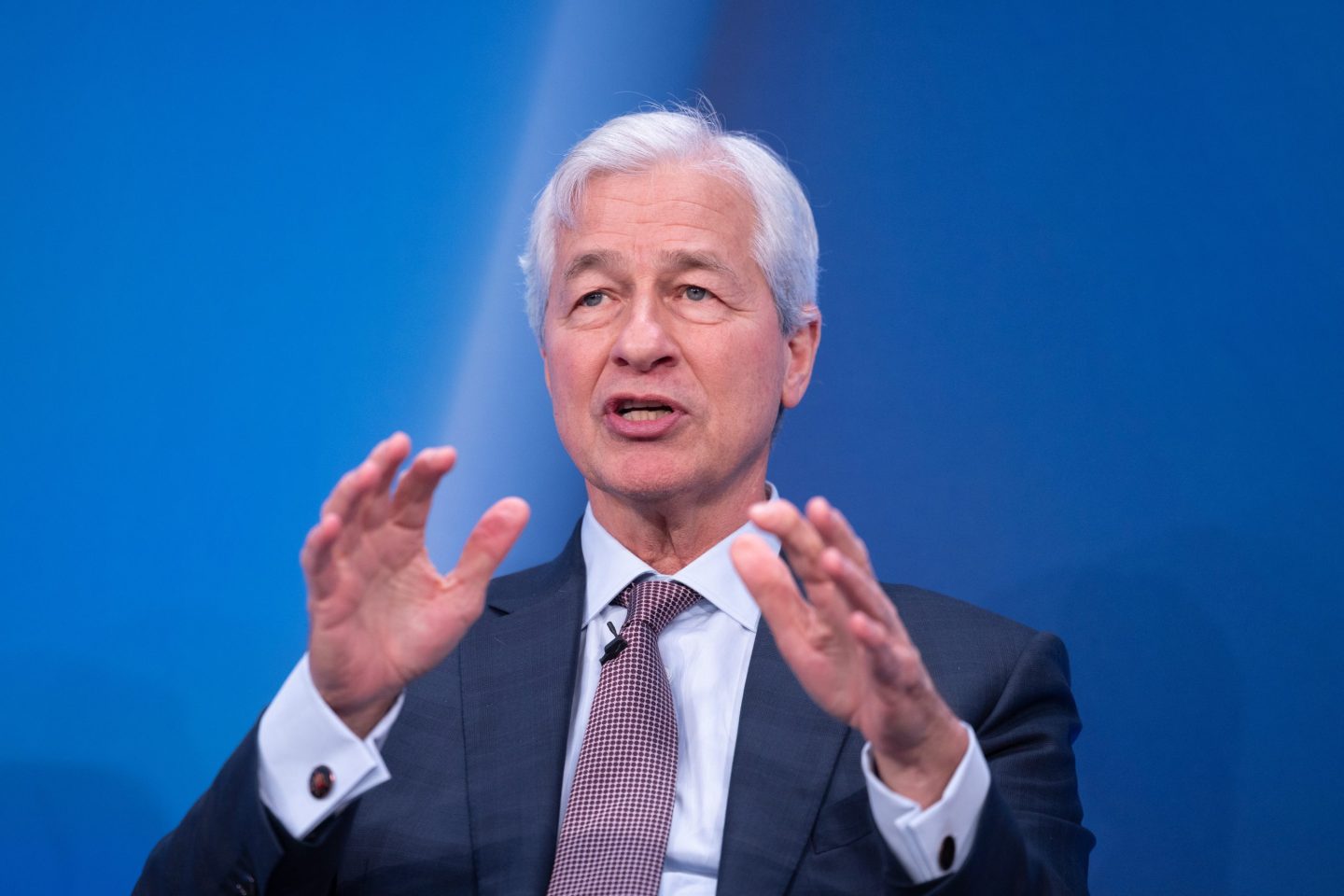
JP Morgan CEO Jamie Dimon at the UK Global Investment Summit at Hampton Court Palace in London, UK, on Monday, Nov. 27, 2023.
JPMorgan Chase CEO Jamie Dimon.Chris Ratcliffe/Bloomberg via Getty Images

Jamie Dimon’s annual shareholder letter came out on Monday, and its 61 pages are full of ideas that lean more political than financial. Dimon, who has seemed like a U.S. critic of late as he slams the national debt, comes off as an ultrapatriotic cheerleader in his latest missive. 

Recommended Video

Every time he sees the American flag, he wrote to shareholders, “it reminds me of the values and virtues of this country and its founding principles conceived in liberty.” The particular values he’s emphasizing: more military spending to ensure America’s world leadership; diversity, equality and inclusion initiatives; and, perhaps unsurprisingly, more growth for banks.  

After securing the helm of JPMorgan Chase as CEO 20 years ago, Dimon has been adding “national thought leader” to the list of roles he dabbles in as a financial boss. He’s had private talks on the economy with former presidential candidate Nikki Haley, although whether he actually has political dreams is yet to be known.  

In his letter, Dimon took a stance on America’s position as a global leader right off the bat. “The terrible ongoing war and violence in the Middle East and Ukraine,” as well as “growing geopolitical tensions, importantly in China,” he wrote, are challenging America’s global leadership role, which he said is further undermined by the U.S.’s political polarization.

While he noted the country’s economy continues to be resilient, marked by consumers still spending, the economy is being fueled by large amounts of “government deficit spending and past stimulus.” But as unwelcome as that spending is, he wrote, it will need to increase as global supply chains are restructured (as seen in the drop in oil production after Russia’s invasion of Ukraine) and as the country transitions to a greener economy.

Despite his earlier criticism of government spending—he has called the debt a “cliff” and warned of a stock market “rebellion” over government debt—Dimon identified one key area he says needs a boost: military expenditures. The ongoing wars have “the potential to disrupt energy and food markets, migration, and military and economic relationships, in addition to their dreadful human cost,” he wrote. 

The fallout from these wars, he wrote, “should also lay to rest the idea that America can stand alone,” adding that “global peace and order are vital to American interests.” To that effect, Dimon said, America needs to lead with one of its biggest strengths: military spending. 

And that spending is copious. This year, the U.S approved about $883 billion in funding for national defense, according to a Senate Armed Services Committee report, up from about $816 billion in the 2023 budget. 

The U.S. is the world’s largest military spender, representing about 39% of the world’s military spending despite having just 4% of its population. It spent more on national defense than the next nine countries combined, most of which, including the U.K., Germany, and France, are politically aligned with the U.S. 

But the Pentagon’s budget only accounts for about one-third of the U.S.’s total war-related spending, according to a Brown University report on the costs of war. Between 2001 and 2022, U.S.-funded combat in post-9/11 war zones in Syria, Iraq, Libya, Yemen, and Ukraine has accumulated $2.3 trillion in costs when considering additional Homeland Security spending, interest on debt, and veterans’ health care. And to Dimon’s earlier point, the current wars have been paid for “almost entirely with borrowed money, on which interest has to be paid,” while in the past, wars were paid for by raising taxes and selling war bonds. 

Between 2001 and 2022, the U.S paid over $1 trillion in interest on wars, according to the Brown report.

The shift in military funding started during George W. Bush’s presidency, when he slashed federal taxes just as the country invaded Afghanistan and Iraq in 2001, according to Just Security, an online forum that analyzes security and foreign policy. Barack Obama made most of those cuts permanent while overseeing expanded U.S. military activity in Syria, and Donald Trump implemented another round of massive tax cuts in 2017 as the U.S. was doubling down on its war in Afghanistan, dropping its most powerful non-nuclear bomb in the country’s Nangarhar Province. Federal taxes dropped from about 19% of gross domestic product in 2001 to about 16% by the start of 2020.

Usually, Just Security writes, wars are funded through higher taxes and war bonds after an initial “emergency” funding period of one to two years. Yet for the entire decade between 2001 and 2011, conflicts in the Middle East were paid for from emergency budgets, which are devoid of “serious legislative or executive oversight.” 

Progressive politicians have long called for less military spending, urging lawmakers to reallocate some military funds to other industries that need support, like health care and education. And lately, they’ve been meeting a rare point of agreement with some Republicans, who were outraged over a $1.7 trillion funding bill for aid to Ukraine that Biden passed in December 2022, the Guardian reported.  

Debt aside, America’s military spending does, however, help the country secure its spot as a world leader. The country’s hundreds of overseas military bases, combined with the world’s largest economy and leadership positions in various international institutions like the United Nations, make it an “undeniable global power,” according to a report from the Council on Foreign Relations. 

The downsides to high military spending include concerns that such spending is economically unsustainable, is wasteful, and wreaks environmental havoc—militaries are responsible for about 5.5% of global greenhouse gas emissions, according to a Conflict and Environment Observatory report. Beyond that, the military bases allow the U.S. to hold military presences in countries, including Cuba, the Philippines, Spain, Germany, and South Korea—many of which, especially in Europe, have negative perceptions about that presence, according to a federal government study. 

China is the world’s second-largest military spender, allocating $293 billion for its national defense in 2022, up 4.7% from the year before—but it’s still just a fraction of the U.S budget. 

In his letter, Dimon also offers his takes on other big issues in the country, including doubling down on DEI initiatives. He highlighted his company’s Advancing Black Pathways program, stating its focus on “strengthening the economic foundation of Black communities because we know that opportunity is not always created equally.”

This comes as far-right politicians continue churning out initiatives aimed at dismantling diversity programs. At least 65 bills that limit DEI programs in higher education were introduced in 25 states in 2023, and eight of them became law. The passed bills include limitations like censoring classroom instructions on racism and sexism, banning books about people of color and those who are queer, and closing DEI offices in universities. 

In a world becoming increasingly more complex with these issues, Dimon reiterated that there is growing interconnectedness between foreign economic policy, national security, and investment. The U.S. needs “to lead with its strengths—not only its military but also its economic, diplomatic, and moral forces,” he wrote. “There is nothing more important.”

Join us at the Fortune Workplace Innovation Summit May 19–20, 2026, in Atlanta. The next era of workplace innovation is here—and the old playbook is being rewritten. At this exclusive, high-energy event, the world’s most innovative leaders will convene to explore how AI, humanity, and strategy converge to redefine, again, the future of work. Register now.
About the Author
Sunny Nagpaul
By Sunny Nagpaul
LinkedIn icon
See full bioRight Arrow Button Icon

Latest in Leadership

Finance
Lorem ipsum dolor sit amet, consectetur adipiscing elit, sed do eiusmod tempor incididunt ut labore et dolore magna aliqua. Ut enim ad minim veniam
By Fortune Editors
October 20, 2025
Finance
Lorem ipsum dolor sit amet, consectetur adipiscing elit, sed do eiusmod tempor incididunt ut labore et dolore magna aliqua. Ut enim ad minim veniam
By Fortune Editors
October 20, 2025
Finance
Lorem ipsum dolor sit amet, consectetur adipiscing elit, sed do eiusmod tempor incididunt ut labore et dolore magna aliqua. Ut enim ad minim veniam
By Fortune Editors
October 20, 2025
Finance
Lorem ipsum dolor sit amet, consectetur adipiscing elit, sed do eiusmod tempor incididunt ut labore et dolore magna aliqua. Ut enim ad minim veniam
By Fortune Editors
October 20, 2025
Finance
Lorem ipsum dolor sit amet, consectetur adipiscing elit, sed do eiusmod tempor incididunt ut labore et dolore magna aliqua. Ut enim ad minim veniam
By Fortune Editors
October 20, 2025
Finance
Lorem ipsum dolor sit amet, consectetur adipiscing elit, sed do eiusmod tempor incididunt ut labore et dolore magna aliqua. Ut enim ad minim veniam
By Fortune Editors
October 20, 2025

Most Popular

Finance
Lorem ipsum dolor sit amet, consectetur adipiscing elit, sed do eiusmod tempor incididunt ut labore et dolore magna aliqua. Ut enim ad minim veniam
By Fortune Editors
October 20, 2025
Finance
Lorem ipsum dolor sit amet, consectetur adipiscing elit, sed do eiusmod tempor incididunt ut labore et dolore magna aliqua. Ut enim ad minim veniam
By Fortune Editors
October 20, 2025
Finance
Lorem ipsum dolor sit amet, consectetur adipiscing elit, sed do eiusmod tempor incididunt ut labore et dolore magna aliqua. Ut enim ad minim veniam
By Fortune Editors
October 20, 2025
Finance
Lorem ipsum dolor sit amet, consectetur adipiscing elit, sed do eiusmod tempor incididunt ut labore et dolore magna aliqua. Ut enim ad minim veniam
By Fortune Editors
October 20, 2025
Finance
Lorem ipsum dolor sit amet, consectetur adipiscing elit, sed do eiusmod tempor incididunt ut labore et dolore magna aliqua. Ut enim ad minim veniam
By Fortune Editors
October 20, 2025
Finance
Lorem ipsum dolor sit amet, consectetur adipiscing elit, sed do eiusmod tempor incididunt ut labore et dolore magna aliqua. Ut enim ad minim veniam
By Fortune Editors
October 20, 2025
Fortune Secondary Logo
Rankings
  • 100 Best Companies
  • Fortune 500
  • Global 500
  • Fortune 500 Europe
  • Most Powerful Women
  • Future 50
  • World’s Most Admired Companies
  • See All Rankings
Sections
  • Finance
  • Fortune Crypto
  • Features
  • Leadership
  • Health
  • Commentary
  • Success
  • Retail
  • Mpw
  • Tech
  • Lifestyle
  • CEO Initiative
  • Asia
  • Politics
  • Conferences
  • Europe
  • Newsletters
  • Personal Finance
  • Environment
  • Magazine
  • Education
Customer Support
  • Frequently Asked Questions
  • Customer Service Portal
  • Privacy Policy
  • Terms Of Use
  • Single Issues For Purchase
  • International Print
Commercial Services
  • Advertising
  • Fortune Brand Studio
  • Fortune Analytics
  • Fortune Conferences
  • Business Development
About Us
  • About Us
  • Editorial Calendar
  • Press Center
  • Work At Fortune
  • Diversity And Inclusion
  • Terms And Conditions
  • Site Map
Fortune Secondary Logo
  • About Us
  • Editorial Calendar
  • Press Center
  • Work At Fortune
  • Diversity And Inclusion
  • Terms And Conditions
  • Site Map
  • Facebook icon
  • Twitter icon
  • LinkedIn icon
  • Instagram icon
  • Pinterest icon

Latest in Leadership

Businessmen shaking hands across the table
SuccessEducation
Not all degrees are a waste of time: MBA graduates from Harvard, MIT, and Wharton are making over $245,000 just three years after graduating
By Preston ForeFebruary 22, 2026
2 hours ago
Happy Dutch woman out of work for the day
Successwork culture
Forget 40 hours: The Dutch get their work done in just 32 hours a week—and women made it possible
By Emma BurleighFebruary 22, 2026
2 hours ago
SuccessThe Interview Playbook
A millennial manager took her job hunt to Tinder and landed 3 interviews—she says getting a job on the dating app was easier than finding love
By Orianna Rosa RoyleFebruary 22, 2026
2 hours ago
Olympic champions like two-time gold medalist Ryan Held (pictured center left) are finding a new start at Goldman Sachs after retiring from sports.
SuccessCareers
Meet the retired Olympic champions starting second careers at Goldman Sachs with zero financial expertise and no office experience
By Emma BurleighFebruary 22, 2026
2 hours ago
solomon
CommentaryDEI
Goldman’s board kills DEI — and that’s not a terrible thing
By Betsy AtkinsFebruary 22, 2026
2 hours ago
jesse
CommentaryDEI
A decade ago, I had a front row seat as Jesse Jackson held big tech firms accountable for being overwhelmingly white and male
By Brennan Nevada JohnsonFebruary 22, 2026
3 hours ago

Most Popular

placeholder alt text
Innovation
The U.S. spent $30 billion to ditch textbooks for laptops and tablets: The result is the first generation less cognitively capable than their parents
By Sasha RogelbergFebruary 21, 2026
1 day ago
placeholder alt text
Big Tech
Peter Thiel and other tech billionaires are publicly shielding their children from the products that made them rich
By Marco Quiroz-GutierrezFebruary 21, 2026
1 day ago
placeholder alt text
Startups & Venture
'I have a chip on my shoulder.' Phoebe Gates wants her $185 million AI startup Phia to succeed with 'no ties to my privilege or my last name'
By Sydney LakeFebruary 21, 2026
1 day ago
placeholder alt text
Success
40% of Stanford undergrads receive disability accommodations—but it's become a college-wide phenomenon as Gen Z try to succeed in the current climate
By Preston ForeFebruary 21, 2026
23 hours ago
placeholder alt text
Politics
Trump's plan B to impose new tariffs is also illegal because a balance-of-payments deficit doesn't exist, trade experts say
By Jason MaFebruary 21, 2026
21 hours ago
placeholder alt text
Success
Mark Cuban says AI won’t take your job anytime soon because it still acts like a hungover college intern—with a $100K price tag to show for it
By Preston ForeFebruary 20, 2026
2 days ago

© 2026 Fortune Media IP Limited. All Rights Reserved. Use of this site constitutes acceptance of our Terms of Use and Privacy Policy | CA Notice at Collection and Privacy Notice | Do Not Sell/Share My Personal Information
FORTUNE is a trademark of Fortune Media IP Limited, registered in the U.S. and other countries. FORTUNE may receive compensation for some links to products and services on this website. Offers may be subject to change without notice.