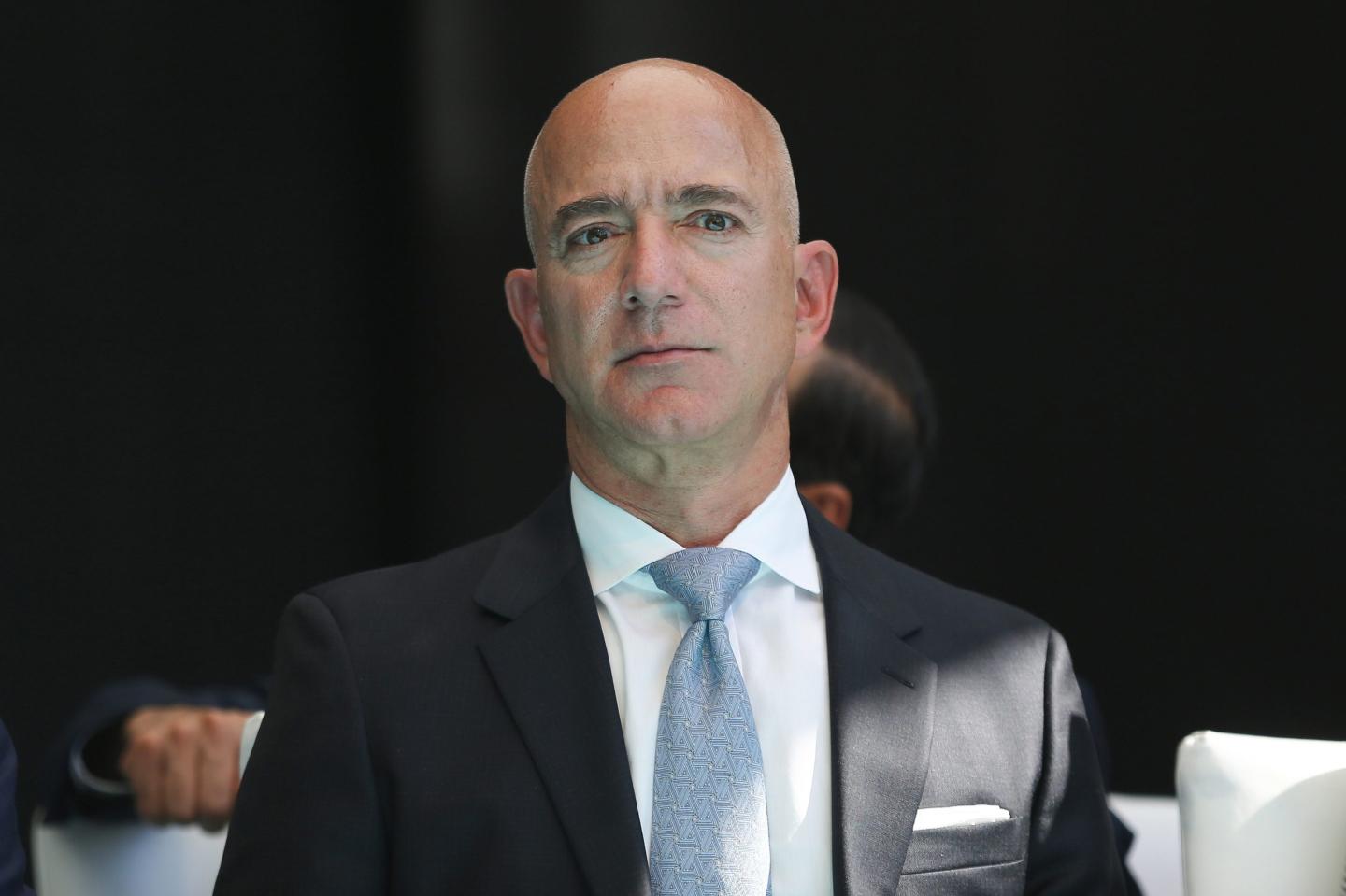
The phenomenon of the “snowbird” is well known: someone with the means to move between two properties, New York City and Miami being the classic example, just in time to miss the cold weather as Gotham gets gross and stormy. But Jeff Bezos and other ultrawealthy millionaires and billionaires are creating a new breed of taxbirds, flocking to states like Florida and Texas in their migration away from chillier fiscal regimes elsewhere in the country.
In November, when Amazon founder Jeff Bezos announced his blockbuster move from Seattle to Miami, he said it was to be closer to his parents and to his space travel company Blue Origin’s Cape Canaveral headquarters. But it’s hard to imagine that money—and taxes—didn’t also play a role. The difference in Washington’s and Florida’s capital gains tax rates have already saved Bezos almost $300 million—and that was just for $4 billion worth of Amazon stock that he sold in the span of four days last week.
Bezos is just one of a growing flock of taxbird billionaires who have fled blue states with high tax rates in favor of a sunnier home for their wallets. Amazon’s home state of Washington, which has no income taxes, started collecting a controversial 7% capital gains tax in 2023—a policy that’s ruffled its wealthiest citizens’ feathers, and, at least in Bezos’ case, sent them flying to greener financial pastures. Just ask the high-end tax professionals who advise them.
“I have lots of clients who I’m in the process of helping move,” Lewis M. Horowitz, a Seattle-based tax attorney with Lane Powell, told Fortune. “I don’t know whether Mr. Bezos left because he’s got a new boat. Whether his new girlfriend prefers sun over some of our dismally gray days we can have here in the winter [in Seattle]. Or whether he did because he knew he was going to sell $4 billion worth of Amazon stock, and multiplied $4 billion times 7%…could that have affected his decision? I’d be astonished if it didn’t.”
Bezos is just one of a who’s who of high-profile billionaires who have moved in recent years to low-tax states such as Florida and Texas. Citadel CEO Ken Griffin, with a net worth of $37.4 billion, moved from Chicago to Miami in 2022, along with his company, the $62 billion hedge fund giant Citadel. (Griffin has denied that taxes motivated the decision.) Billionaire investor Carl Icahn moved to Florida from New York in 2019. And of course, Elon Musk moved from California to Texas in 2020.
There are fewer than 1,000 billionaires in the country, which means that any one of them moving can have big implications for states’ tax revenue. For example, Elon Musk paid $11 billion in federal and state taxes in 2022—some 550,000 times the average American’s federal tax bill the same year. Notably, many billionaires actually pay lower tax rates than average Americans, but they still have an outsize impact on state tax revenues because of the scale of their wealth.
The flight of the taxbirds
“In a country like the U.S. where you can move from state to state with no visa restrictions, and where each state is competing for capital, it is just not prudent to not be competitive with your neighbors,” said John Pantekidis, managing partner and general counsel at TwinFocus, which manages over $7 billion for ultra-high-net-worth (UHNW) families, in an interview with Fortune.
“People are moving out of high-tax states,” added Pantekidis; and for low-tax states “like Florida, Texas, Tennessee, you’re seeing large flows of capital for these reasons. There has been an uptick, and there continues to be.”
The legislative and legal battle to enact Washington’s new capital gains tax shows just how tricky it can be to tax the ultrarich—and just how costly it can be when legislators take things too far, and wealthy residents take their business (and their tax contributions) elsewhere.
Washington is one of nine states that doesn’t levy personal or corporate income taxes—it’s been dubbed the “most regressive tax system in the nation.” But for decades, that made it a financial safe haven for the host of giant corporations and technocrats living in the Seattle metro area.
In 2021, though, Washington’s state legislature narrowly passed a 7% capital gains tax, which almost every state already has. Legislators estimated that the annual revenues from the tax could bring in up to $200 million per year, which would go toward funding public schools.
After a legal battle over the constitutionality of the capital gains tax that saw the Washington Supreme Court ultimately rule in favor, the state started collecting last year. And the impact was huge—the tax brought in over four times projected revenues, or over $800 million. But for the most part, those revenues didn’t come from the millions of citizens who supported the tax at the polls: A whopping half of that sum came from just 10 wealthy families.
An earlier version of the proposal was even more extreme. It would have drawn 97% of its revenue from just four people: Bezos, Microsoft founder Bill Gates, his ex-wife and philanthropist Melinda French Gates, and former Microsoft CEO Steve Ballmer. And if the tax had been enacted just a few years earlier, Bezos would have owed over $1 billion in taxes on the $15.7 billion in Amazon shares he sold in 2020 and 2021. Voters might have shown broad support, but it’s safe to say that among Washington’s wealthiest, it’s not the most popular policy.
“When I talk about state and local taxes. I love to talk about Mark Twain,” says Larry J. Brant, a Portland-based tax attorney at Foster Garvey, alluding to the great American writer who once said, ”I love taxes that other people have to pay.” A lot of the taxes created in the last few years at the state and local level are Mark Twain taxes, Brant explained—“taxes that most of the voters don’t have to pay.”
The totally predictable consequences of increasing taxes
Critics argue that given the huge impact on the state’s richest citizens, it’s only natural that Washington’s wealthy are moving elsewhere—and lawmakers should have seen the writing on the wall as soon as they pitched the tax in the first place.
“I thought it was absolutely going to happen. My colleagues thought it was absolutely going to happen,” said Horowitz, whose firm fought the tax in court, referring to wealthy residents like Bezos leaving the state. “Progressive legislators down in our state capitol didn’t think it would happen, because they’re stupid.”
Horowitz says that when considering taxes that will affect the wealthiest, legislators need to think beyond their means and use extra care in making sure that billionaires don’t just pack their bags if rates get too high.
“[For] you and I, if they increase our tax rate in whatever city you live in by 2%, you probably won’t move. [That] law of physics breaks down at the subatomic level, or at the überwealthy level,” Horowitz said.
Sending wealthy residents packing can have big implications for state tax revenues. Pantekidis told Fortune that after Massachusetts enacted a 4% “millionaires’ tax” last year, multiple clients of his, including Fortune 500 CEOs, left the state for lower tax rates in Florida and New Hampshire—and took with them multiple millions of dollars of potential tax revenue.
“They’re shooting themselves in the foot by doing this,” said Pantekidis in reference to states raising taxes on their wealthiest citizens. ”Once [wealthy citizens] leave, their businesses follow suit. You lose jobs. You have to be long term here. Making it unfavorable for [wealthy] people is not favorable in the long term.”
Billionaire migration fits into a broader trend of Americans moving away from high-tax states and into regions with more favorable tax rates. A recent Census Bureau report showed that in 2023, three-quarters of states with below-average tax rates gained population, while almost 80% of states with above-average-taxes lost population on net.
“We’re going to wait and see if the [Washington] tax is repealed,” said Horowitz.
Update, 2/16, 3:19 PM: An earlier version of this article stated that over 60% of Washington residents supported a 7% capital gains tax. 61% of voters voted to repeal the policy in a November 2021 ballot measure.