

In 1974, New York Times humorist Russell Baker identified a “pig in the python” working its way through the economy: the bulge of 76 million baby boomers squeezing through America’s economic system, distorting everything they passed through. When boomers flooded the labor market in the 1970s, they created a competitive squeeze that never fully released—leaving the generations behind them without the wage rebound economists had predicted. When they bought homes, prices soared. When they took the top jobs in business, culture, and civic life, they held them—and held them, and held them.
For half a century, the baby-boom generation has functioned like a slow-moving wave through the American economy, and as the last of them cross into retirement age, the country is discovering just how much of its future they’re still holding in place. In the labor market, four decades of boomer dominance suppressed wages and opportunity for younger workers, and their accelerating exit now threatens a worker shortage businesses are unprepared to absorb. In housing, empty-nest boomers sit on a disproportionate share of the family-size homes that millennial parents need but cannot find or afford. And in the corner offices, executive suites, and corridors of political power, boomer leaders have spent years building monuments to their own indispensability rather than successors capable of replacing them—leaving institutions to manage their decline rather than their transition.
The pig, as the Times once put it, is finally leaving the python. The question is whether anything is ready to take its place.
Now, as the last of the boomers cross into their late sixties and early seventies, the question America is finally being forced to confront is, What did they leave behind? What will the python look like next?
The labor market: two-way squeeze
A study published this month in the Proceedings of the National Academy of Sciences offers a rigorous accounting of what the boomer generation cost and what their departure may now unlock.
Steven Ruggles, a demographer at the University of Minnesota, tracked U.S. labor-force flows decade by decade from 1910 to 2040. His findings are arresting. The sheer size of the boomer cohort suppressed economic opportunity for young workers throughout the 1970s and into the 2010s. Economists had long predicted a rebound: As boomers aged and smaller generations entered the workforce, competition would ease, and wages for young workers would recover. It never happened. Female labor-force participation and immigration filled the gap, keeping competition high and young workers’ incomes depressed for an extra three decades beyond what models anticipated.
But Ruggles’s most striking finding looks forward, not back. Boomer retirements—now accelerating—are about to trigger what he calls “a radical reshaping of labor markets” in which new workers will be in extremely short supply through 2040. The pig is finally leaving the python. And the python, it turns out, is not ready.
Businesses that spent 40 years operating in a buyer’s market for labor—plenty of workers, modest wage pressure—now face the opposite. The generation that made it hard to find a good job for four decades is now making it hard to find workers at all.
The housing market: empty nests, locked doors
The labor market is an abstraction. The housing market is not.
Baby-boomer empty nesters own nearly twice the share of American homes with three or more bedrooms—28%—compared to millennial parents, who own 16%, according to a recent Redfin analysis of 2024 Census data. There it is: the spatial expression of the same generational hold.
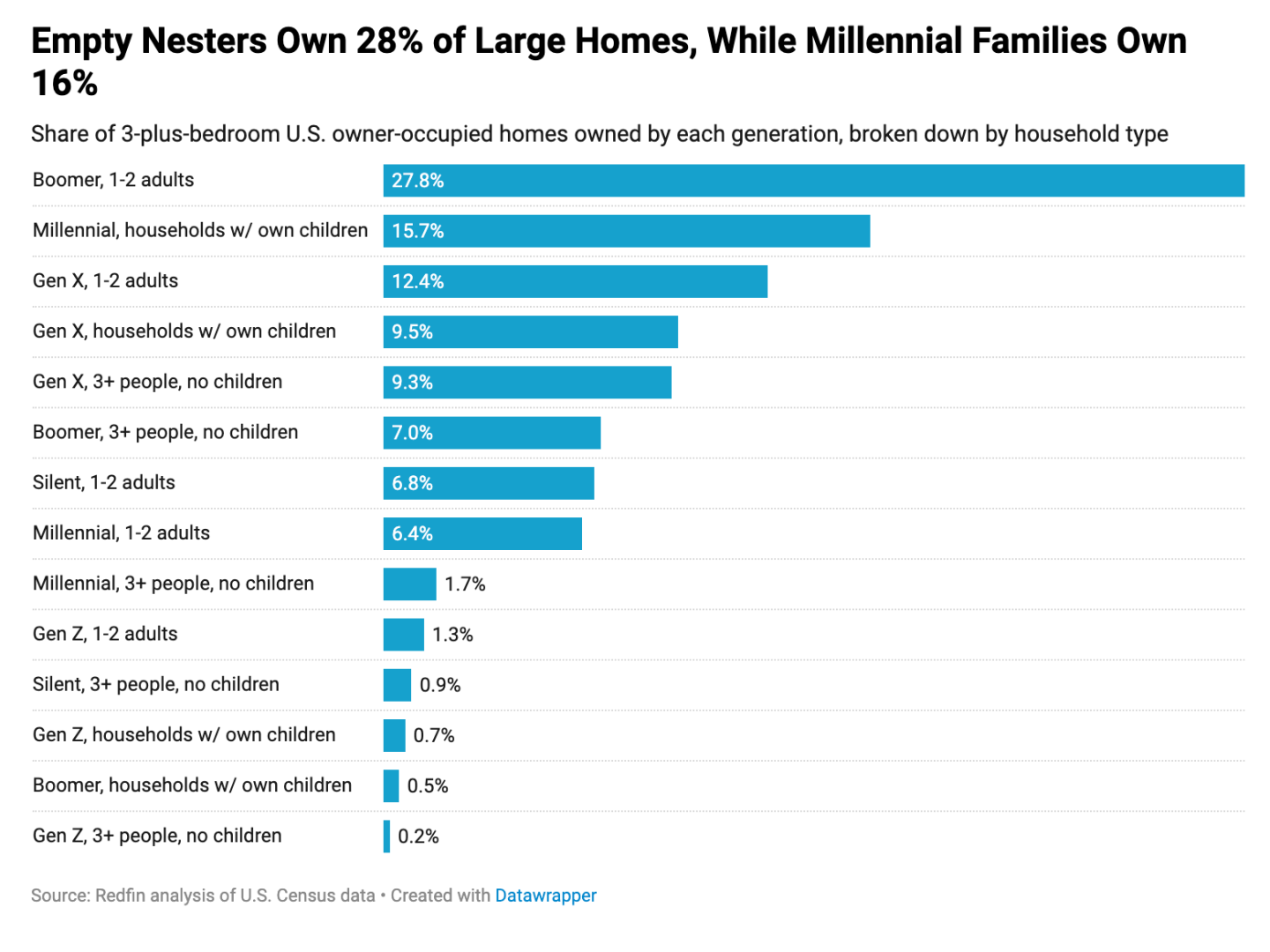
Millennials, now the largest generation of parents in America, need the space. Boomers, whose children left years ago, have it. And most boomers either aren’t moving—or they’re moving into what used to be considered starter homes and are now ideal homes for downsizing grandparents to move close to their offspring.
“Empty-nest baby boomers own more large homes than millennials with kids in every major U.S. metro,” Redfin says, with millennial parents not reaching 20% of large homes anywhere in the country. The top cities are Austin and Columbus (19.2%), with Minneapolis (18.9%) just behind. Empty-nest boomers, on the other hand, own at least 20% of large homes everywhere in the country. Grandma and grandpa are having the whole family visit, but those bedrooms are sitting empty most of the year.
Many boomers are mortgage-free or locked into low rates that make any transaction financially painful. Others cite family ties, routines, or simply the daunting task of emptying a home of possessions accumulated over decades. The result is that millennial families run into both a supply shortage and an affordability wall simultaneously.
What gains millennials have made came largely from absorbing homes vacated by the Silent Generation, the cohort born before the boomers. Boomer homeowners have barely budged, Redfin found. The pig hasn’t left the python yet.
The corner office: no succession plan
Perhaps nowhere is the generational bottleneck more acute—or more deliberately ignored—than at the top of American institutions.
Writer and urban analyst Aaron Renn recently published a pointed essay cataloguing what he calls the “boomer succession failure.” His case study is Anna Wintour, the 76-year-old editor who has dominated global fashion culture since 1988. When the New York Times recently explored the future of the Metropolitan Museum of Art’s Costume Institute, the answer was quietly revealing: Wintour is not replaceable. So instead of replacing her, Renn argued, the Met has spent years quietly building a quasi-endowment—seeded by the Met Gala itself—so the Costume Institute can run on investment returns after she is gone. This year’s gala added a record $42 million to that fund. There is no succession plan, just a life-support system for the post-Wintour era.
Renn argues this is not an isolated case but a defining pattern of boomer leadership. Mitch Daniels, widely considered the most effective governor in modern Indiana history, invested in a leadership development program bearing his name, but produced no protégé of comparable stature. Tim Keller, the pastor who effectively invented the modern urban evangelical church movement through New York’s Redeemer Presbyterian, spent heavily training the next generation of clergy but did not produce a successor. After retiring, he used his star power to raise roughly $100 million—then split the church into three smaller entities, because no single person could sustain what he had built.
Renn didn’t look at the political dimension, but it’s well known that boomers have had an iron grip on the presidency for decades. From Bill Clinton’s election in 1992 through Donald Trump’s current second term, the White House has been occupied by a boomer for all but four years. Clinton, George W. Bush, and Trump were all born within a two-month window in 1946—the very first months of the baby boom—and Obama was born in 1961 at its tail end. The Silent Generation, sandwiched between the Greatest Generation and the boomers, was essentially skipped entirely in presidential politics, with the lone exception of Joe Biden, and Gen X has yet to hold the office. The jump will likely go straight from boomers to millennials.
Trump was born June 14, 1946, making him one of the oldest boomers, not merely a typical one. The man currently in the Oval Office is among the very first members of the generation that has never relinquished power.
Boomers are 43% of Congress despite being only 23.7% of the U.S. population—a representation ratio nearly 2-to-1 relative to their actual share of the country. But when you zoom in on the Senate, boomers still hold 61% of seats in the more influential chamber. In raw numbers, that’s 233 boomer members versus 196 Gen Xers and just 84 millennials, who are roughly 25% of the population but only 16% of Congress. Any way you look at it, one generation holds the cards.
The common thread, Renn writes, is cultural. Top boomer leaders surrounded themselves with people who would subordinate themselves entirely to the boss’s vision—loyalists, not heirs. They saw themselves as irreplaceable, and so they became irreplaceable. Now the institutions they ran face the same choice the Met made: Endow the decline or find a way to rebuild.
Back in 1974, Baker argued in the Times that as the boomers reach retirement age, “both the childless and the child‐bearing factions will probably make common political cause against the diminished young population, which would be increasingly hard‐taxed to pay retirement benefits for the aging majority.” That sounds very much like a generation voting itself, largely via the boomer-dominated Senate, ever more generous benefits on a surging $39 trillion national debt as large as the economy itself, while kicking the can down the road so the next several generations can figure out how to pay for it.
In the labor market, the boomers crowded out opportunity for 40 years and are now leaving a workforce ill-prepared to replace them. In housing, they are sitting on the family-size inventory that the next generation needs and cannot access. In the institutions that shape culture, commerce, and civic life, they are now engineering managed retreats rather than genuine transitions.
It’s a lot to digest.
Every generation inherits a country and leaves one behind. The boomers inherited the most prosperous nation in history. The argument about what they did with it is just getting started.