With sweeping views of lower Manhattan behind him, entrepreneur Danny Meyer shares a futuristic vision of a restaurant that would know almost everything about the way we like to dine.
What if a restaurant could know exactly what a guest likes to eat? What are your favorite wines? Do you even drink wine? How long do you like to dine? Do you order dessert? And with that knowledge, it could tailor a customized experience that satisfies the senses.
“By taking the guesswork out of the actual technical part of taking your order, it allows us to put 100% of our hearts into making you feel welcome,” says Meyer, speaking at an event hosted by IBM at Manhatta, a fine dining restaurant owned by his Union Square Hospitality Group.
The Shake Shack founder says artificial intelligence can bring three key benefits to hospitality: increased revenue because restaurants will know more about their guests and how they like to spend, efficiencies to supply-chain and other back-office operations, and helping restaurants provide greater hospitality by focusing more on guests and less on mundane tasks.
“Any great tech should advance touch,” says Meyer. “And I think hospitality is all about human touch.”
We now use our phones to order a coffee while out for a walk or track a delivery driver to the precise moment they will reach our doorstep. Robots are making burrito bowls at Chipotle and Sweetgreen’s salads. And AI is the latest innovation that’s upending how restaurants and diners interact.
Much of the focus has been on AI-powered tools that recommend add-ons to an order. McDonald’s and IBM are using AI for drive-through orders, though the response on social media last year was lukewarm. IBM acquired McD Tech Labs from the world’s largest fast-food restaurant chain in 2021, and together, they’ve greatly lifted order automation rates where the tech has been deployed, giving recommendations that are a bit more sophisticated than “Do you want a larger size of fries?”
“It is really about reducing friction,” says Rob Thomas, IBM’s senior vice president of software and chief commercial officer. “I believe every company in the world is going to use generative AI for some type of customer service, which is happening pretty significantly today.”
But there are limits. “I’m skeptical that AI is going to disrupt or replace creative-type jobs,” Thomas tells Fortune. “I think chefs are all safe.”
In November, Yum Brands chief financial officer Chris Turner told investors the Pizza Hut and Taco Bell operator is testing voice-enabled AI drive-throughs in two California restaurants to boost productivity and efficiency, while generating automated upsell recommendations.
Dine Brands’ IHOP chain debuted AI recommendation technology for online ordering in August. Google Cloud utilizes years of content across the tech giant’s ads, search, and YouTube to encourage an online order of a steak burger with bacon to perhaps add on a milkshake. Or a side of pancakes to a breakfast order with IHOP.
About 20% of IHOP’s business today comes from off premise, a shift in spending that was initially fueled by the pandemic but remains persistent. Kieran Donahue, IHOP’s chief marketing officer, says the chain makes decisions based on the guest perspective, and that’s led to an evolution of the company’s digital strategy, including a loyalty program last year and updates to the website and IHOP app.
“When you sit in our restaurant and you have a dining experience, our servers are there to help you make some decisions and offer you some suggestions,” says Donahue. “This recommendation engine that we are testing is a bit of a service experiment. It is providing a level of digital service that you might equate to dine-in.”
Regardless of whether a user is a loyalty member or not, Google Cloud’s Recommendations AI model is meant to offer a variety of upsell options, which can range from seasonal items to specials to items purchased previously. “Ultimately, the AI engine and the recommendation engine are providing meaningful recommendations for both of those users,” says Jason Suarez, vice president of digital, business intelligence, and CRM engineering at Dine Brands.
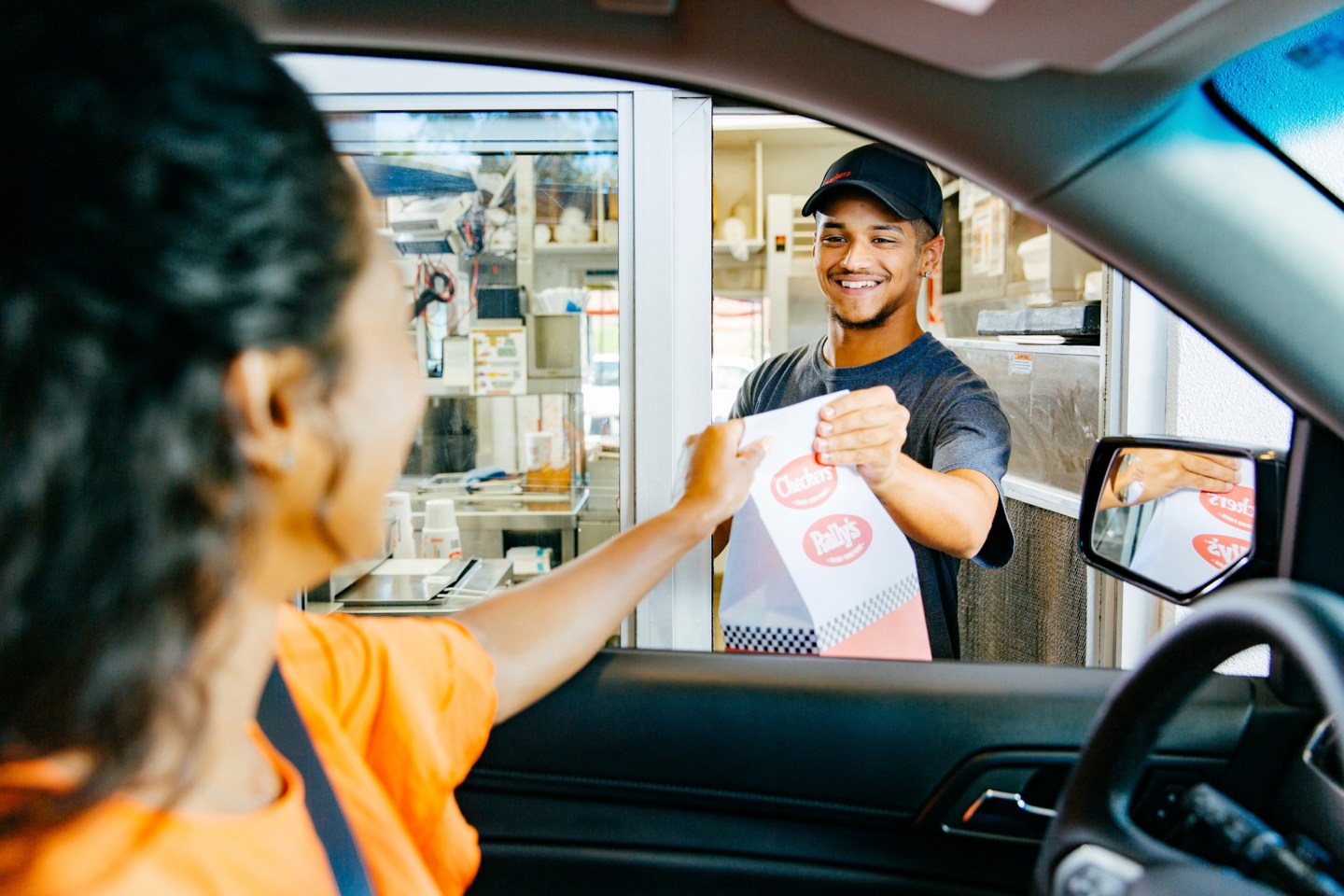
With nearly 800 locations across 34 states, Checkers and Rally’s began rolling out AI-based drive-thru voice ordering in mid-2021, an investment the company claims made it the first large restaurant concept to utilize AI in this way. Today, over 350 corporate and franchised stores have deployed AI at the drive-through, and over the summer, Checkers added a Spanish-speaking feature.
AI won’t be deployed to every location, as some restaurants don’t have a drive-through or high enough volume to justify the cost of adding AI.
“My philosophy is you don’t innovate just to say you are innovating,” says Minh Le, chief information officer at Checkers and Rally’s. “There has to be a purpose and return. Technology costs money.”
Le leaned on AI to help automate some tasks that would make the cashier position less stressful. It is a job where an employee is taking orders, while at the same time processing payments at the window, handing food to customers, and filling drink orders. Burnout can result in low retention. But with as much as 95% of orders automated by AI, cashiers can “focus on the customer at the window and provide better service,” says Le.
AI experimentation isn’t limited to large chains. In Kenya, the generative AI craze caught the attention of hospitality entrepreneur Shamim Ehsani. He began to tinker with the tech personally, but quickly utilized it to center the creative concept for a new Thai-style restaurant he would open in Nairobi, called BangBang.
BangBang is named after a Muay Thai champion and Hollywood star, whose photos and bio adorn the restaurant’s website and branding. But he isn’t real. BangBang is a completely fictional character, a backstory and images all created by AI, which also helped Ehsani with graphic design, logos, and color choices for the restaurant.
Ehsani used Midjourney for the image generation and would ask ChatGPT questions such as “What colors would be good for a Thai restaurant?” and “What fonts should I use for the menu?” And because Ehsani isn’t formally trained on Adobe, he says, AI tools can help supplement some of his technical deficiencies. “With AI, I think it really helps to build on my creativity so that I can deliver what I have in my mind,” says Ehsani.
The use of those new AI tools has led to some intellectual property concerns, and Ehsani admits the line is blurred. “We tell our guests that the images are AI-generated,” he says. “It’s important to be upfront and honest about how we use technology and weave it into the guest’s journey.”