A thousand miles from his usual Wall Street perch, a 60-year-old powerlifter stepped into the spotlight as he prepared to dead-lift more than 410 pounds.
Mike Mayo was probably the only contestant at last year’s powerlifting nationals who used to have an Alan Greenspan photo pinned to his apartment wall — and undoubtedly the only one who spends his day job sparring with financial leaders, often moving shares of their banks with just a few words.
But here, in the halls of a Memphis convention center, the analyst hardly looked like an oddity in tight black shorts. Sucking in a breath, he squatted 336 pounds, then benched 230, and finished with the dead lift — walking away each time with a boyish skip.
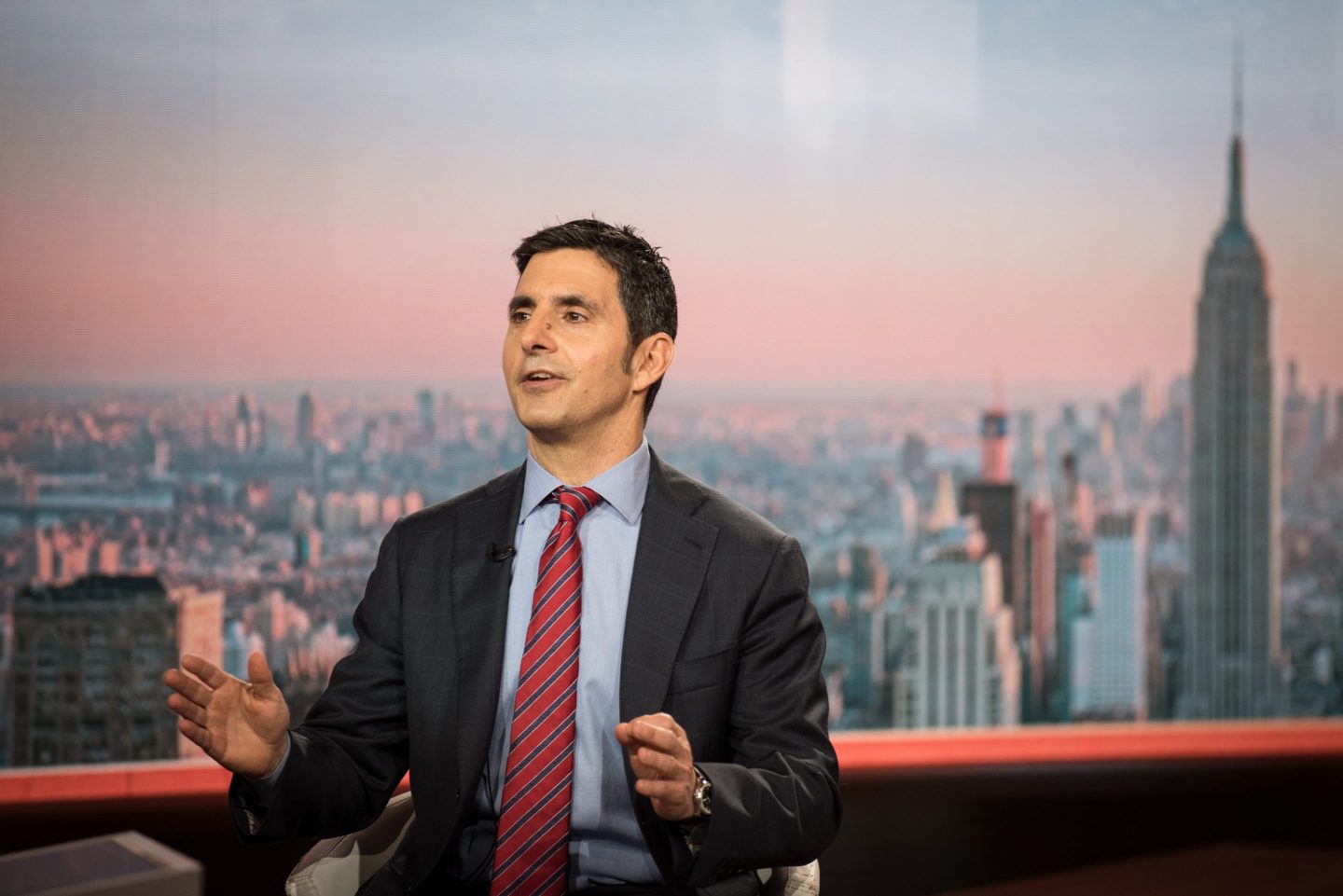
This week the action shifts to New York as Mayo watches the nation’s giant banks post annual earnings — and Wall Street watches Mayo. Famously intense, the Wells Fargo & Co. researcher isn’t just a spectacle on conference calls, where he’s known to needle banking bosses. His call for the sector is drawing attention, too. Now in his fourth decade covering banks, he’s convinced shares of US lenders are poised for liftoff, and that short sellers should get ready to have their faces ripped off.
The sector was jolted last March as the collapse of three regional banks weighed on the industry. Shareholders worried about the toll that rising interest rates would take on lenders, leaving their stocks behind.
That’s meant Mayo has been wrong in his view for much of the past two years. “Market’s wrong, I’m not wrong,” he counters. He’s even emerged as the loudest cheerleader of embattled Citigroup Inc. — the longtime laggard among major bank stocks.
How those predictions play out this year will test the standing of an analyst who has taken the coveted top spot in the Institutional Investor poll — a key barometer for Wall Street relevance — the past four years. He achieved that, in part, by breaking with the staid constraints of his business and making himself unignorable in the industry through pointed research reports and a willingness to publicly squabble with its leaders.
“I’m going to be a pain in the ass, I’m going to be pushy,” Mayo said in an interview. “Because I want to get the best possible information that exists, so that I can serve the investors — my clients — better than anybody else.”
He’s notched enough wins that even some of his past targets give him his due.
“I listen to him when he speaks, and I read all his reports because he knows what he speaks about,” JPMorgan Chase & Co.’s Jamie Dimon, the dean of Wall Street CEOs, said in an interview. “Every now and then there’s some disagreement, but there’s nothing wrong with that. We’ve always had a little bit of banter.”
Despite what people might think, Mayo said he never does something to draw a reaction.
Disco Ball
The analyst has always pitched himself as a quirky outsider, even authoring a memoir called Exile on Wall Street.
He punctuates his commentary with attention-grabbing pronouncements. He’ll warn that banks face “earnings hell,” that short sellers could be “blown to Neptune,” or — in JPMorgan’s case — “Goliath is winning.”
He shows up on TV toting props such as road signs, a black hoodie and a disco ball snagged from a toy store on East 86th Street to illustrate a point about 1970s inflation. His showmanship even permeates his self-evaluations, which he writes in the third person.
Over the years, colleagues would sometimes cringe at his antics and on other occasions play along. Teammates at a prior firm recall breaking into push-up and burpee contests on their office floors.
“I told him, ‘You are like a WWF character — If you are anything like you pretend to be, I won’t like you,’” said Steve Buell, an early boss who’s still fond of him. “Mike has adopted this persona that makes people think he’s a loudmouth, egocentric and a whole lot of other things that I know he’s not. He’s created a boisterous character, he’s found a way to be heard.”
When Mayo joined Wells Fargo in 2017, the CEO at the time welcomed him with enthusiasm but warned him to keep his ego in check.
Pot-Stirrer
Because of his knack for creating a stir, CEOs and their finance chiefs routinely wince when Mayo takes the mic, and they sometimes privately grumble about what they see as his penchant for grandstanding.
He can be a “critic, a fan, a skeptic and a provocateur,” Morgan Stanley Chairman James Gorman said. “He’s never short of opinions.”
A broadside against Bank of America Corp. CEO Brian Moynihan on live TV once prompted a hand-written letter to the analyst from Warren Buffett, who leads the company’s biggest stockholder. More recently, Mayo goaded Goldman Sachs Group Inc. CEO David Solomon about his moonlighting as a DJ during their first meeting. Mayo recalls the banker’s terse, one-word counter — “Really?” — and the uncomfortable 10 seconds of silence that followed.
Mayo goes beyond telling investors what banks are doing and what it means, instead prescribing fixes with the air of an activist. Such was his campaign last year for Truist Financial Corp. to restructure its board, which it ultimately did. He also once personally lobbied the top holders of Comerica Inc. to express displeasure with management at the regional bank’s annual meeting.
Shortly after the collapse of Bear Stearns, Mayo was golfing in New Jersey when he spotted the failed firm’s cigar-chomping former CEO, Jimmy Cayne. He rushed over to chat with Cayne, who delivered a grim prediction that the financial system would collapse.
“That was like Mike to just hop in the cart without saying a word, driving across two fairways to see Jimmy,” said Matt Fischer, who worked under Mayo for more than a decade and was golfing with him that day.
Despite Cayne’s warnings, Mayo — like most of his brethren — failed to anticipate the collapse of Lehman Brothers later that year.
Gordon Gekko
He grew up around his family’s Romanian restaurant, Vagabond, in the basement of a Maryland high-rise. He cut his teeth at Greenspan’s Federal Reserve, starting in 1988 as a junior regulator scrutinizing bank mergers.
But he had long set his sights on Wall Street, seeing himself as some sort of oxymoronic cross between Gordon Gekko and a man of virtue. He endured dozens of rejections by firms such as Goldman Sachs by the time he finally landed a role at Switzerland’s UBS.
He paints a comical image of his younger self: sprinting across Park Avenue to JPMorgan predecessor Chemical Bank to grab press releases instead of waiting for them to be faxed to the rest of the street, just so he could be the first to call investors with his feedback.
The modus operandi of analysts was different in those days. Coziness with company executives was the standard operating procedure.
“The investment banks were hiring analysts who would support investment banking and paid them directly based on those investment banking revenues,” Mayo said. “That’s like a restaurant reviewer getting paid based on how much business one of the restaurants they review generates.”
When the dot-com bubble burst in 2000, a crackdown on brokerages ensued, culminating in the so-called “Global Settlement” that sought to disentangle bank researchers from the dealmakers who wanted them to talk up stocks of corporate clients.
But Mayo had already gone negative on banks, warning clients in May 1999 that there were risks emerging and advising them to sell. He would later tell Congress about the potential for intimidation from companies, revoked access and other forms of retaliation after making such a call. Mayo even argued for the elimination of deal-based incentive pay for research analysts.
In October 2007, he made a key call, slapping a sell rating on Citigroup, which had swelled to become the world’s most valuable financial services firm in years prior. The stock would go on to lose more than 90% of its value.
‘Good Quarter, Guys’
Mayo says he despises the trope of cheerleading Wall Street analysts lauding executives on conference calls. “If I ever say ‘good quarter guys,’ just go ahead and fire me and bar me from the industry for the rest of my life,” he said.
Still, his standoffishness with banks hasn’t stopped him from consistently pitching the sector’s stocks for the past 20 months, even as investors shied away.
In May 2022, he said the industry should have the best net interest income growth in four decades and the stock market had yet to price that into the shares. The KBW Bank Index, tracking the country’s largest lenders, sank that year, underperforming even the dour S&P 500. Heading into 2023, he said the sector was primed to rise by half. But the KBW index broke with the broader market and dropped almost 5%, marking its first back-to-back annual declines since the financial crisis.
“I thought interest rates going to 3% was going to be bank heaven. And it would’ve been bank heaven if it stopped there,” he said. “The fact that it went to 5% made it bank hell.”
After Silicon Valley Bank collapsed in March, Mayo reined in his expectations, saying shares were likely to only rise about one-third and pivoting to pushing JPMorgan as his top pick. While Mayo says the call about net interest income in 2022 was wrong, he feels good about the returns investors could make from the JPMorgan call. Dimon’s bank surged 27% last year.
Going into 2024, Mayo argues that investors are overlooking how much more resilient these companies are in the face of economic softness because of their efforts to lower the risk in their balance sheets.
Seven Omelets
Mayo turned to his current obsession of powerlifting in 2021, after learning he had osteoporosis and realizing he’d broken 15 bones over the course of five years. He embraced a life eschewing alcohol in favor of protein shakes and baffling meal requests. At a California hotel, his ask for a seven-egg omelet resulted in him getting seven, one-egg omelets.
After the nearly 1,000-pound lift across the three chief categories at the meet in Memphis, Mayo quickly switched gears, crossing into Charleston, South Carolina, to let senior Goldman Sachs leaders know why the stock was still not pulling its weight. By Monday night, Mayo had met with the board’s lead director and published a report predicting that Solomon’s job was secure.
When he went on TV that Tuesday, a huge silver medal he won at the meet dangled on a black-and-red band around his neck. He was one of three contestants in his category.
Mayo, who needs to win the Institutional Investor poll five more times to qualify for its most elite club, said he’s not done fighting.
“My biggest professional goal is to make the II hall of fame,” he said. “And to win the gold medal at the national powerlifting championship.”