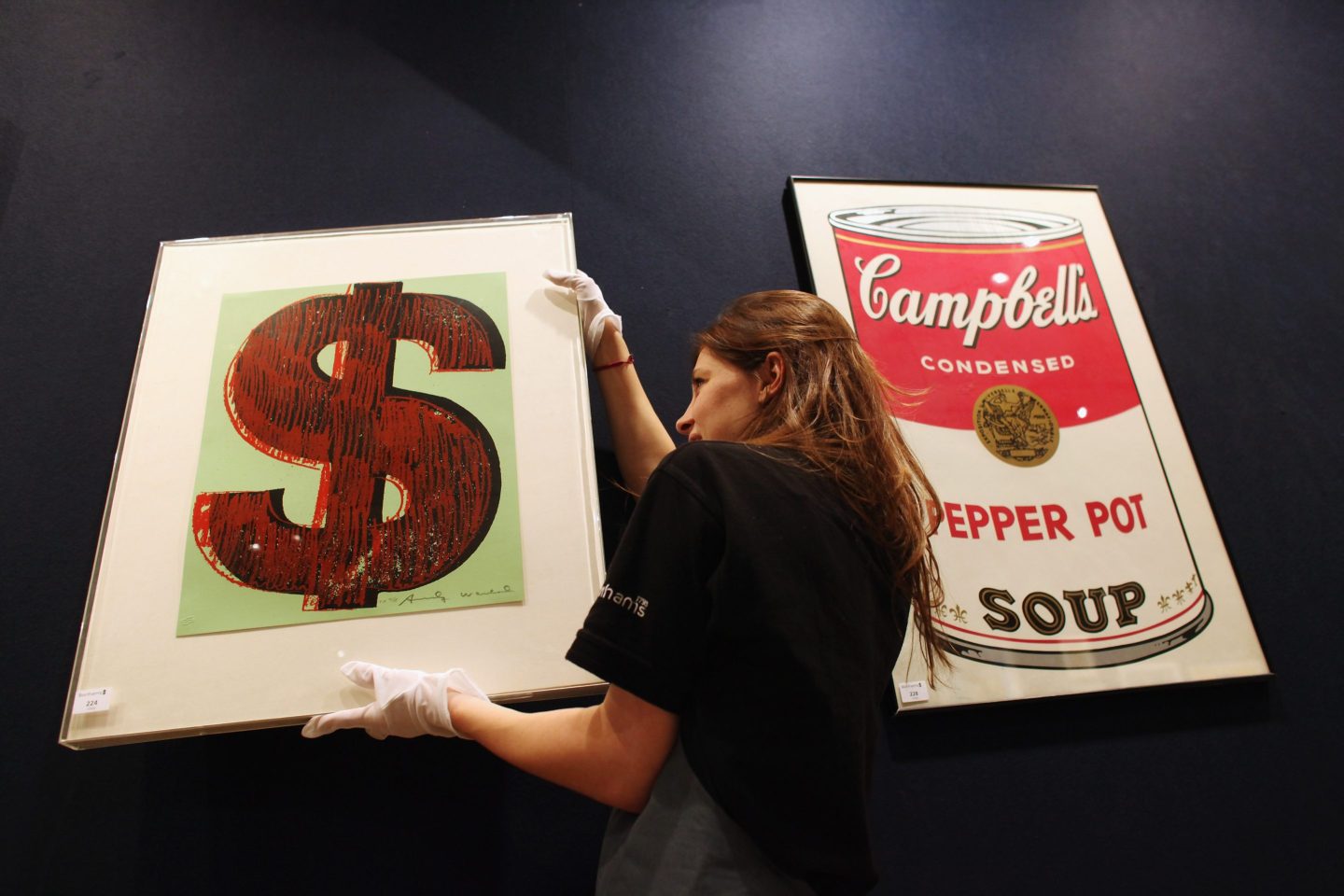
Pop art is going AI—or is it just more pop art, after all? That’s the question raised by a class-action lawsuit filed nearly a year ago by a group of artists against the virtual face of AI-driven artwork: Midjourney, the research lab that uses the Stable Diffusion image-generation engine, and Stability AI, which created that engine. Andy Warhol is just one of the iconic artists whose names are being dragged into the case, but what would Andy himself say?
Warhol was famous for many things: mentoring the legendary 1960s rock band the Velvet Underground as well as ’80s art legend Jean-Michel Basquiat, playing a pivotal part in the Downtown scene via his “Factory,” and of course, all those soup cans. But he was also endlessly quotable and eerily prophetic on the 21st century. He anticipated Twitter and TikTok by predicting, “In the future, everyone will be world-famous for 15 minutes,” but he also foreshadowed this lawsuit when he said, “Art is anything you can get away with.”
Simply put, Warhol made a career off mass-producing copies of others’ art, and he himself was a frequent target of copyright lawsuits during and after his lifetime. He wasn’t alone in this among his cohort of “pop artists,” either. Roy Lichtenstein was accused of lifting hundreds of works from comic-book artists who themselves struggled financially, decades before Disney produced multibillion-dollar blockbusters based on the same panels. More recently, contemporary artist Shepard Fairey, whose most widely known work is a 2008 Barack Obama poster, spent years defending a copyright claim over the photograph on which the poster is based.
All three of these artists (along with thousands of others) now appear in a Midjourney database unearthed as part of the lawsuit, serving as the alleged source material for its generative AI tool. The long-brewing class action has taken on new life since November, when the plaintiffs in that case filed reams of documents they say show illegal copying of their work, including the list of 20,000 artist names and styles that Midjourney could imitate. CEO David Holz wrote on Midjourney’s Discord forum at the time, “i think you’re all gonna get [your] mind blown by this style feature.” The reaction has been a bit more furious than that.
Claims of a copy-and-paste ‘parasite’
The artists who brought the class-action suit, who include a movie concept artist, a cartoonist, and a fantasy illustrator, claimed that instead of “learning” from billions of works, as the generative AI’s creators promised, the technology was nothing more than a copy-and-paste machine—a “parasite” feeding off others’ work. They are demanding billions of dollars in compensation.
Midjourney did not respond to a request for comment from Fortune.
The plaintiffs’ November document took some time to go viral, but around the turn of the new year the creative community exploded in indignation and sometimes in shock at their inclusion on the list. One user, video game artist Jon Lam, lamented that artists in the database were “dehumanized to styles” and were being used as inputs for a tool that would render them obsolete.
“Prompt engineers, your ‘skills’ are not yours,” he said.
Shock and indignation are one thing, though, and the law is quite another.
‘We always knew Midjourney copied’
While technology news site The Register called the find a “smoking gun,” legally, it is more like a dog that didn’t bark, said Rebecca Tushnet, a First Amendment professor at Harvard Law School and founder of the Organization for Transformative Works, which advocates for fair use principles in fan art.
“We always knew that Midjourney copied a bunch of stuff. The key question is going to be, is it fair use to do so,” Tushnet told Fortune. She was referring to the fair use doctrine of U.S. law, which holds that copyrighted material may be quoted or copied without permission (or payment), but only for purposes of commentary, criticism, or parody, or when they are sufficiently “transformed” so as to be considered a new work.
Tushnet also noted that copyright covers individual creations only—not particular artistic styles, techniques, or approaches.
“There is no copyright over style, but there is a copyright over work,” she said. That includes even a style as distinctive as Warhol’s. “Lots of image editing software has, like, a “Warholize” button. It’s shorthand for a style,” Tushnet said. Before generative AI came along, “we hadn’t thought that ‘Warholize’ was a problem.”
It’s ironic, then, that some of the prominent artists on Midjourney’s alleged copy list have themselves been accused of doing much more than imitating but outright stealing work from others—sometimes to the financial detriment of the people who inspired them.
Lichtenstein, a painter who created giant replicas of comic-book art, is considered one of the foremost artists of the 20th century. But the painter copied the work of lesser-known artists on a massive scale, according to a documentary released last year that found he made “direct copies” of about 300 pieces from other artists. While Lichtenstein’s priciest work sold for $165 million, the comic-book artists he mimicked made far less; one of them, Russ Heath, died relying on charity to feed himself, according to the Guardian.
More recently, poster and graffiti artist Shepard Fairey ran into his own copyright issues over a popular red and blue poster of Barack Obama that shot to fame during Obama’s 2008 campaign. The underlying image was a photo taken by Mannie Garcia for the Associated Press; Fairey had sued the AP, arguing fair use, but ultimately settled and agreed to seek permission for future projects.
A Factory production
Still, Warhol remains arguably the most famous copier. The pop artist rose to fame by making striking screenprints from others’ photographs, assisted by young artists and hangers-on in a space aptly called the Factory. In interviews, The New Yorker reported, Warhol would bring along his assistant, Gerard Malanga, and freely admit to reporters that Malanga “did a lot of my paintings.” Warhol argued that he was reinventing the artist as a thinker, at least as much as a doer, a stance continued to this day by Factory-style art superstars such as Jeff Koons. Critics begged to differ.
The works produced by Warhol’s factory became tremendously valuable: A $195 million print from the Marilyn series set a record two years ago for the priciest American artwork, as well as the priciest 20th-century work, sold at auction—appropriate for someone who once said, “Being good in business is the most fascinating kind of art.”
But during the decade in which he produced his best-known pop art, Warhol oversaw the creation of silk-screened works, “usually based on photographs that someone else had taken, and made with Malanga wielding the squeegee,” with not a single piece of hand-drawn work, The New Yorker noted.
Often, those photographers sued him for using their works without permission. Starting in the 1960s, Warhol faced lawsuits from photographer Fred Ward, whose photograph of Jackie Kennedy was the basis of Warhol’s Sixteen Jackies; Charles Moore, whose photograph of police attacking demonstrators Warhol turned into the print Race Riot; and Patricia Caulfield, whose work was the basis for Warhol’s Flowers series. In Caulfield’s case, according to the New York Times, Warhol initially sought permission to use her photograph from the magazine that published it, but, deciding the price was too high, he instead clipped it directly from the magazine.
Warhol settled in all three cases and promised to use his own work going forward, but the lawsuits kept coming, ending up at the Supreme Court which, last year, dealt a blow to the Warhol estate.
The decision in Andy Warhol Foundation v. Goldsmith capped off nearly four decades’ worth of derivative works that began in 1981, when Lynn Goldsmith photographed Prince. In 1984, Vanity Fair commissioned Warhol to create an illustration based on the photo and paid Goldsmith $400 for its one-time use. But Warhol also created a number of prints from Goldmith’s image, none of which Goldsmith was paid for. After Prince’s 2016 death, Condé Nast paid the Andy Warhol Foundation $10,000 to rerun a photo; Goldsmith was neither paid nor credited. In the decision last year, the Supreme Court found that because the image was used for a commercial purpose, the Warhol estate had erred in not paying Goldsmith.
That decision could throw the future of AI art into disarray, legal experts said. Generative AI startups that are now valued in the billions of dollars might expect to pay for the millions of copyrighted works on which they trained the technology.
“This decision all but ensures that AI developers need to get permission from—and compensate—creators if they want to use their works to train their AI systems, and can no longer rely on fair use arguments,” Copyright Alliance CEO Keith Kupferschmid told The Wrap after the decision.
However, Tushnet told Fortune that, while the Warhol decision affects artists relying on a single reference work, the question at issue in the Midjourney case is much larger.
“The case is about creating a large corpus of works and then learning from them. The value of the corpus does not exist in any one picture—it’s in having the file to learn from,” she said.
“When [generative] AI first came in, people denied that it could be art because it’s just an operation of a machine. Then, clearly, people developed expertise in using it in an artistic way,” she said. “It’s very hard to predict what technology will do.”