
Despite the skyrocketing valuations of the Magnificent Seven and anxiety over massive AI capital expenditures, one top economist argues that the U.S. stock market is missing the most critical ingredient of a financial mania: the exit of the “smart money.”
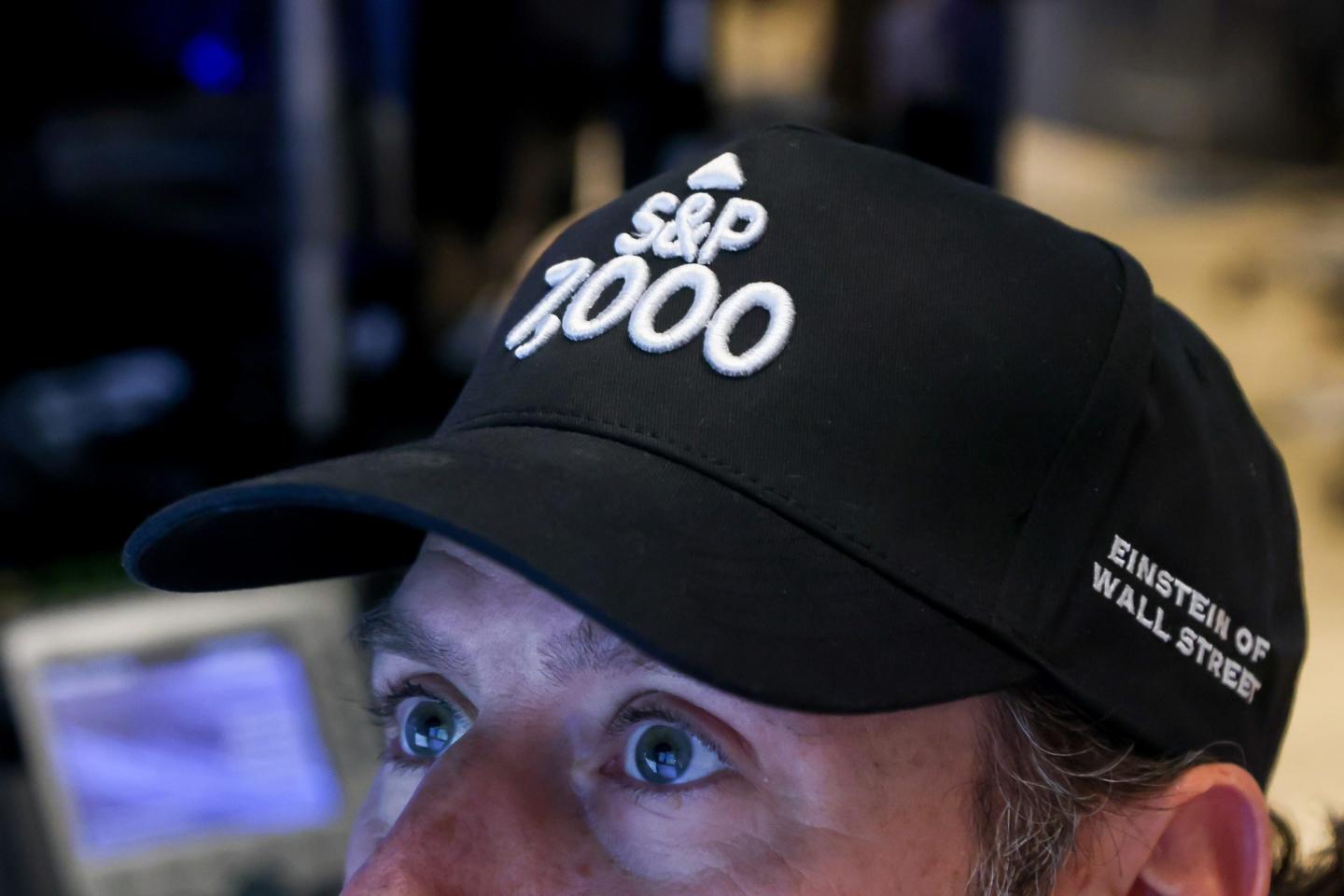
Owen Lamont, a portfolio manager at Acadian Asset Management and a former University of Chicago finance professor, said that while the market looks and feels frothy, we are not currently in an AI bubble. As he talked to Fortune from his office in Boston, the S&P 500 breached 7,000 for the first time, but he wasn’t dissuaded. To Lamont, the telltale sign of a bubble is equity issuance, when corporate executives, the ultimate insiders, rush to sell overvalued stock to the public.
“Part of the reason I think there’s not a bubble is I don’t see the smart money as acting like there’s a bubble,” he told Fortune. “Maybe I should say there’s not a bubble yet.”
In his view, the smoking gun for a bubble forming would be companies going public and selling equity. That would be a play for the dumb money, he added.
Lamont—who has also taught at Harvard, Yale, and Princeton, and blogs for Acadian under the moniker Owenomics—dialed back to some of the financial history classics to make his point.
“The one thing we see in bubbles going back to the South Sea Bubble of 1720 is issuance,” he said. For readers who aren’t financial historians, Lamont was referring to a joint stock company from the early (or earlier) days of capitalism, involving the United Kingdom’s financing during the War of the Spanish Succession.
Issuance and the other three horsemen of the bubble apocalypse
In 2026, a flood of new shares isn’t hitting the market, as it did during the dotcom crash of 2000 and the speculative frenzy of 2021, which Lamont considers a bubble, unlike most of his peers. Corporations are doing the opposite of that right now. In the past year, U.S. companies have engaged in approximately $1 trillion worth of stock buybacks, Lamont noted, as he detailed in his November blog post, “A trillion reasons we’re not in an AI bubble.” Companies are the smart money, he explained, and when they sell equity, that’s a sign the equity is overpriced. But shares in open float have been shrinking.
Lamont’s bubble-detection framework relies on “Four Horsemen”: overvaluation, bubble beliefs, issuance, and inflows. While he conceded that three of these are present in the market of early 2026—valuations are high, retail investors are piling in, and sentiment is frothy—the absence of issuance disqualifies the current cycle from bubble status. In fact, it’s “baffling” that there aren’t more IPOs. “They haven’t come yet, and maybe they’re coming in 2026,” he said. In 1999, for instance, the market absorbed over 400 IPOs. And in 2021, the market was awash in SPACs and meme stocks. Today, the landscape is surprisingly quiet.
The economist explained that he developed this framework out of his “weird background,” an initial academic interest in corporate finance derived from his curiosity about causes of the Great Depression. “I wouldn’t claim that my four horsemen are the only way to do it or the best way to do it, but they’re the way that seemed most empirically relevant to me.”
And with a bit of historical perspective, Lamont noted that U.S. stocks may be expensive but they’re not at dotcom extremes. He graduated from college in 1988, and recalled the Japanese stock market bubble being truly “incredible” at that point, far worse than any conditions today. He referenced the famous Shiller CAPE ratio. One of many indicators created by Nobel Prize–winning economist Robert Shiller, this divides a stock or index price by its 10-year average of inflation-adjusted earnings per share, sort of a long-range viewpoint of the classic price-to-earnings ratio. At the peak of 1999, Lamont noted, the CAPE was a 45, and today it’s 40, but Japan was over 90 in the late ’80s.
Lamont recalled a paper released at the time from two finance professors, James Poterba and Ken French, that was called “Are Japanese Stock Prices Too High?” A year later, the title had to be changed to the past tense, because the market had crashed so much.
When Lamont was teaching at the University of Chicago in the mid-1990s, he added, he saw himself as believing the market was mostly efficient, but what he saw in that time moved him closer to behavioral economics. “Bubbles are a behavioral phenomenon, and they embody people making cognitive mistakes,” he said. In 1996, he produced academic research arguing the market was overvalued—only to watch the S&P 500 double and the Nasdaq triple over the next few years. He suggests we may be in a similar position today: “Maybe we’re in the early innings” of the AI story.
When the dotcom bubble did burst, Lamont added, he and many of his peers were stunned. “I would say it really changed our view of whether the market is rational. And I remember going to academic conferences, like in 1999, and…many, many finance professors were like, ‘This is crazy, it makes no sense, it’s gotten out of hand.’” A few years later, he added, speaking slowly so as to be precise, “it’s not true that every person who believed in rational asset pricing changed their mind…but it’s certainly true that only those capable of changing their mind did change their mind.”
The weird and wonderful world of peak-bubble IPO fraud
“I define a bubble as the price has gone up and people are trading, owning, buying an asset that they believe [is] overvalued,” Lamont explained.
While this market has those preconditions—a revolutionary technology and spectacular profit growth—the cycle has not yet reached the terminal phase where insiders rush for the exits. In his scenario, the Nasdaq 100 doubles in a year and the Shiller CAPE ratio surges toward 80, echoing Japan in 1989. This would also unleash a wave of fraud, he added.
“One of the wonderful things about the IPO market is you don’t need to be a good company to IPO. You just need to have gullible retail investors think you’re a good company,” Lamont said, jokingly. He asked hypothetically, where are the fraudulent companies in today’s market? “We had plenty of fraudulent companies in 2021, so I’m disappointed by the lack of creativity of the white-collar criminals,” he added, tongue planted in cheek.
While skeptics worry that Big Tech’s billions in AI spending will yield poor returns, Lamont said he viewed this as a “rational gamble” rather than speculative mania. He compared the current AI build-out to drilling for oil: an expensive investment with uncertain probability, but a rational corporate strategy nonetheless. He also compared it to another famous high-risk capex cycle: railroads, arguing that such booms often occur in the early or middle stages of transformative technologies, not just at the end.
“I think that it’s quite plausible to say that [the hyperscaler companies are] building too many data centers and they don’t need them,” Lamont said, referring to the center of the potential AI bubble concentrated around Nvidia and OpenAI, with Microsoft and Oracle orbiting. “But it doesn’t mean it’s irrational on the face of it, and it doesn’t mean that they’re overvalued today.”
Many new technologies have resulted in overbuilding, like building too many railroads and building too many oil wells, but that also doesn’t guarantee a bubble. “Historically, it’s true that at times when there’s a huge wave of capex, that’s not a good time to invest in the stock market. That’s a time when the market’s overvalued.” When asked if investors should buy gold again, coming a few days after it first passed $5,000 per ounce, Lamont responded, “I don’t know about that one.”
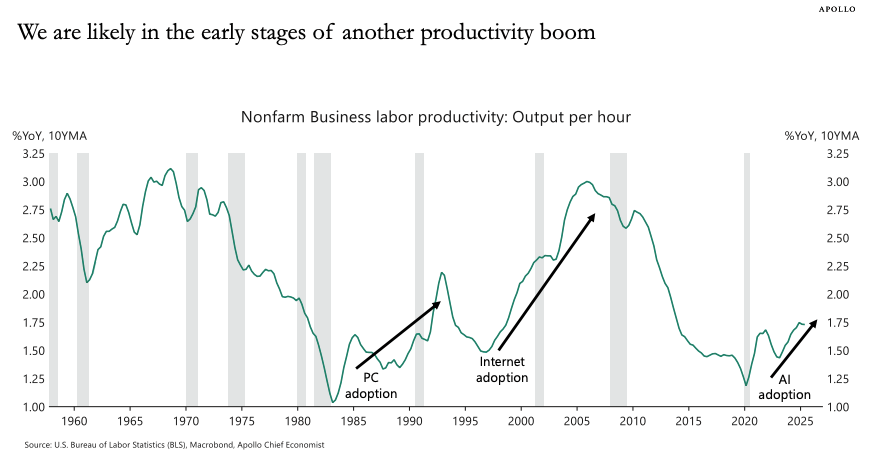
To Lamont’s point, many top market watchers believe this is an AI boom, not a bubble, with Apollo Global chief economist Torsten Slok, for instance, releasing a chartbook likening the productivity boom from AI to the adoption of PCs and the internet. “While there are questions about the magnitude of the impact at the macro level,” Slok wrote, “it is clear that there are already significant sector impacts including in DevOps software, robotic process automation and content management systems.”
An IPO megacycle?
For those watching for the end, Lamont suggested keeping an eye on the calendar for 2026. If high-profile private companies like SpaceX finally decide to go public, triggering a wave of copycat IPOs, the “smart money” may finally be signaling the top.
Ominously, as Lamont was talking to Fortune, the Financial Times reported that the largest private equity company in the world, Blackstone, was preparing a blockbuster year for IPOs. Jonathan Gray, president of the asset management giant, told the FT that 2026 comprises “one of our largest IPO pipelines in history.”
Similarly, Kim Posnett, the cohead of investment banking at Goldman Sachs, recently predicted in a Q&A with Fortune that the market is entering an IPO “megacycle” that will be defined by “unprecedented deal volume and IPO sizes.” She distinguished it from the two periods Lamont alluded to, the late ’90s dotcom wave and the 2020–21 surge, saying that the “next IPO cycle will have greater volume and the largest deals the market has ever seen.” As if on cue, the Wall Street Journal reported on Thursday that OpenAI is planning to go public in the fourth quarter of 2026, citing people familiar with the matter.