
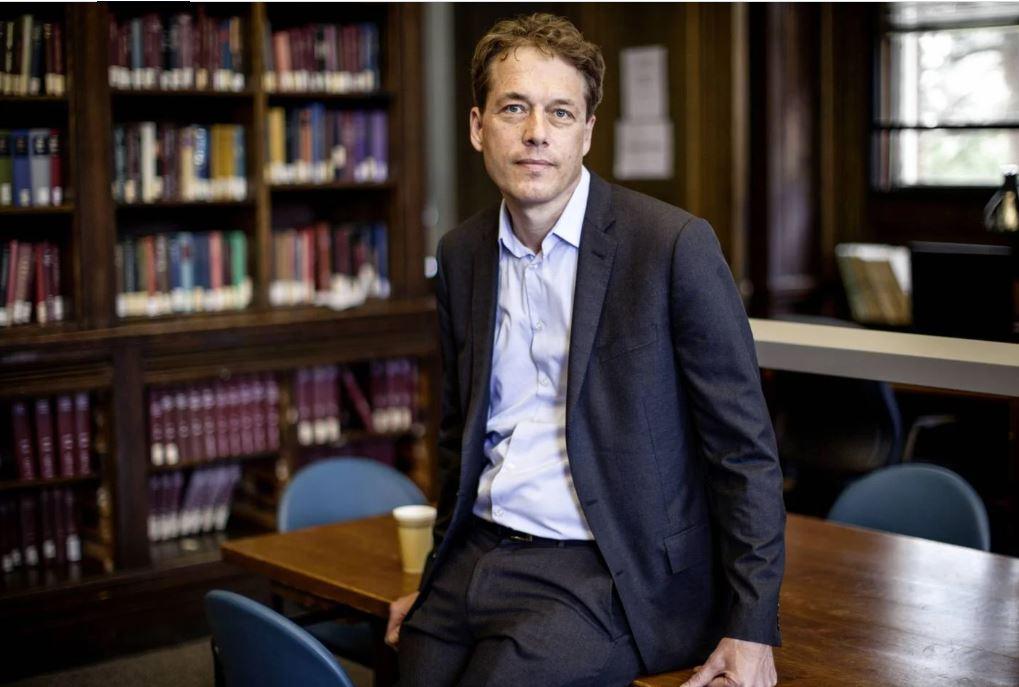
Sven Beckert isn’t here to judge capitalism, even though he just wrote a provocative, ambitious, 1,300-page book on its history. As he writes several times in the book (which this editor has read), he’s not even sure what it is. He’s trying to understand it.
The Harvard professor, who Zoomed in to talk to Fortune from his home office in Cambridge, Mass., explained that his new book, Capitalism: A Global History, is the product of an eight-year odyssey to seek understanding of the way we actually live out our economic lives. “Often, when I teach the history of capitalism here at Harvard, many of my students think that capitalism is kind of the state of nature.” But that’s just not the case when you look at the historical record, he added.
When pressed to explain what his book accomplishes, he said it’s two-pronged: to offer a more global perspective on the history of capitalism and to “denaturalize” the history of whatever capitalism is. Capitalism is neither eternal nor natural, in Beckert’s telling; itʼs a human invention that spread and evolved over centuries through deliberate choices, sometimes extraordinary violence, and incredible institutional innovation. Capitalism rose from the margins of medieval trade to dominate modern life, and so it could also, someday, fade or transform again.
These may be considered bold claims by some who take capitalism’s primacy as inevitable, but the book has been generally well reviewed. Although some critics have taken shots at it for being a bit of a “doorstop,” like Beckert’s previous tome, the Pulitzer finalist, award-winning Empire of Cotton, the ambition and narrative boldness of this global history have been generally praised.
In the Boston Globe, Hamilton Cain wrote that Beckert weaves a sprawling tapestry that “unfurls with the suspense and intricacy of a detective novel,” with capitalism’s ascendance reading a bit like a crime story, even a whodunit. Adrian Wooldridge of Bloomberg Opinion criticized it for nearly the identical thing, saying that the book “ignores [the] secret sauce” of innovation, focusing more on its exploitative history than on how it created new value. Beckert insisted that his book is all about the question of how, not why. He attempted to chart “how we get from a world in which this logic exists, but it’s marginal, to a world in the year 2025, where [it] almost structures all of our economic life—and almost all of our lives.”
From marginal to dominant
Beckert told Fortune that his research showed traces of capitalist logic can be seen in the historical record as far back as 1,000 years ago, but for hundreds of years it “remained marginal to economic life.” In his book, he talks many times of “islands” and “nodes,” as capitalists were at first outsiders, regarded as almost freakish by people who lived their life without the constant accumulation of more money to invest. Then, when the tide started to turn and capitalism became ascendant, in the last 500 years, the islands and nodes shifted to the holdouts from the capitalist way of life, like the farmers of the 20th century.
“The first thing I always say is that capitalism is not the same as the existence of markets,” Beckert said. He pointed out that “economic life” existed for all of human history, but not the relentless accumulation and reinvestment of capital, which was practiced by a few merchant communities on the outskirts of society. Capitalism “has existed in many different parts of the world,” Beckert insisted, “but it was also rather thinly spread and rather weak…This kind of capitalist logic that is so crucial to economic life today, that is something relatively novel.”
Beckert points out in his book that until the fall of the USSR in the late 1980s, something like 30% of the world was living in a noncapitalist system, and much of the rural West was able to avoid the capitalist way of life by, for example, growing their own food as subsistence farmers. (Tom Lee of Fundstrat recently compared the emergence of artificial intelligence to flash-frozen food in the 1920s, which changed the composition of the economy from 40% subsistence farmers to just 2%.)
The professor highlighted ancient mercantile communities of capitalists in unexpected places such as the Port of Aden, in Yemen, or Cambay, in modern Gujarat, India. Goods were traded across oceans from Aden as early as 1150, he finds, while Song-dynasty China invented paper money centuries before Europe, and textiles thrived in ancient Indian hubs ages before the Industrial Revolution. But these capitalists were encircled for hundreds of years by a sea of subsistence farmers and tributary empires that operated on completely different principles. “The extremely global nature of early merchant communities, that was something that I, broadly speaking, I did have a sense of,” Beckert said, but hadn’t put together in quite this way before.
“They were always connected to a state,” Beckert said of the early merchants, but they were also freewheeling and kind of separate from that state,” he said, that is, until things drastically changed in the 19th century. Beckert highlights the disturbing case of Hermann Röchling, the German steel industrialist who saw such capitalist opportunities that he closely allied himself with successive German governments and found himself “on trial for war crimes, not just in one war, but in two wars, World War I and World War II, which must be a world historical record.”
How capitalism moved to the center
To illustrate just how unnatural the capitalist logic was once considered, Beckert’s book highlights the odd case of Robert Keayne, a Puritan merchant in 1639 Boston. Keayne was dragged before a court and church elders nearly 400 years ago, but not for stealing. Instead it was for the “very evil” practice of selling goods for a profit that exceeded community standards. He was nearly excommunicated for behaving in a way that is now considered the basic function of business. It would take centuries, Beckert argues, for the “covetous” accumulation of wealth to be rebranded as a public good, or in other words, for capitalism to be regarded as normal.
For his part, Beckert insisted that he’s not trying to judge capitalism, even if some harsh judgments emerge throughout his book. “The ability to write this book is, of course, itself an outcome of the capitalist revolution,” he told Fortune, arguing that at this juncture in the 21st century, the logic of capitalism has brought enormous productivity gains, unprecedented economic growth and made many people much wealthier. He wouldn’t be able to fly to Barbados or Cambodia for research without it, he acknowledged.
And Beckert did travel far and wide over eight years to dig up what he regards as a kind of secret history of the origins of capitalism. From the dusty outskirts of Phnom Penh to the archives of the Godrej company in India to the relics of the sugar plantations of Barbados (where he spent 10 days), Beckert surprised himself again and again by what he found.
When the American colonies emerge on the scene, for example, more than a third of the way into his narrative, Beckert points out that West Indies were much more central to global capitalism than the 13 territories that would become the United States. The city of Boston, he notes, might have perished if it didn’t figure out how to become a service hub for Barbados, whose sugar plantations generated huge revenues. “That’s also kind of an amazing story,” Beckert agreed. “For us, Barbados is a foreign country and it’s far away, but for them [Bostonians in the early 1700s], it was also part of the British empire. And then it was…kind of a suburb to Boston—or vice versa. They were tightly integrated with one another.”
Beckert said he was surprised in what his research turned up of the darkness of capitalism’s past. “I did know a lot about the history of slavery, but being on this island and then reading the historical records and reading the kind of horrific accounts of what happened on this island in the 1600s, that was also not really surprising, but it was really quite shocking, the degree of violence that I found within this history.”
Could capitalism end?
Beckert told Fortune that he believes the world is currently in a “moment of transition,” similar to the shift that occurred in the 1970s when the Keynesian order gave way to neoliberalism. One of the largest surprises of the book is at its very conclusion, when he suggested that someday, capitalism could end. The fact that “it rests on the ever expanding accumulation of capital” implies that somehow, someway, the capital will run out. “In the distant future,” he writes, historians will look back at our times and “find it difficult to understand our ways of thinking, our ways of being.”
Ultimately, Beckert said he views his book not as a moral tale with capitalism as the villain, but as an investigation into human agency. By revealing that capitalism was once fragile, marginal, and weak—and that it required centuries of specific political choices, violence, and institutional building to become dominant—he hopes to show that the future remains unwritten. “This is not like a machine that kind of unfolds on its own,” Beckert said. “This is a human-created order.”
As the global economy faces new shocks in the mid-2020s, Beckert’s history offers a reminder: The economy is not a force of nature. It was made by people, and it can be remade by them. “The future is open,” he told Fortune. “People build a world that’s different from the world that they were born into [and] sometimes the least powerful have made a huge difference in the trajectory of the development of capitalism. So, I think that is important to see at the contemporary moment.”