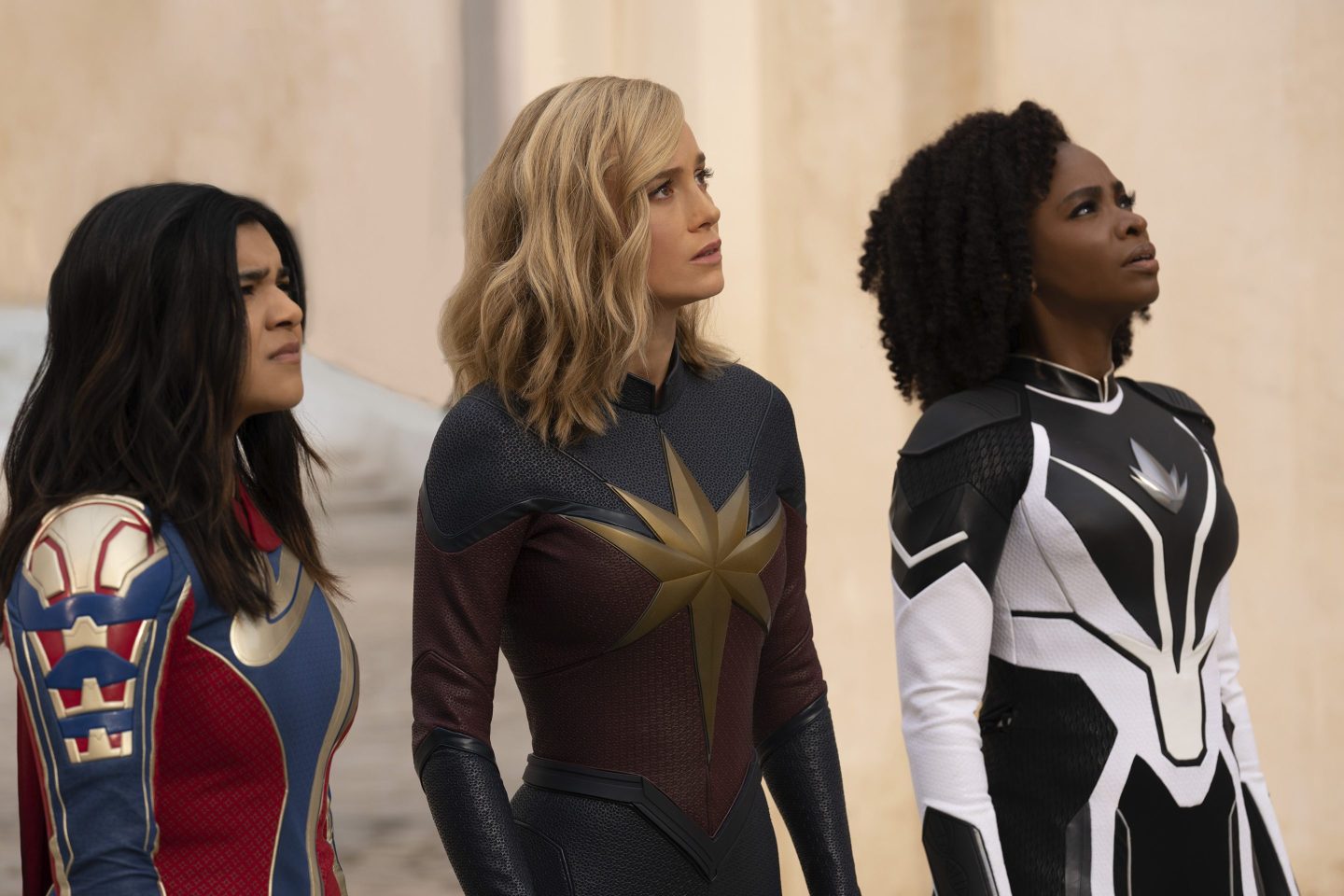
The Marvels opened this month with the lowest box-office numbers of any of the 33 movies of the Marvel Cinematic Universe. While that obviously isn’t good news for Marvel Studios, it’s not as if its producers suddenly forgot how to make entertaining movies: audiences will likely show up again, especially when an MCU movie has “Avengers” or “X-Men” in the title.
It does mark the end of an era of unquestioned dominance–and because Marvel has set the pace for Hollywood for the past 15 years, its current situation helps illuminate Hollywood’s future trajectory.
While some fans might say that the history of Marvel Studios is bookended by Fantastic Four movies or Blade movies, the studio’s history isn’t delineated by cosmic rays or vampire hunters, but by writers’ strikes.
The Writers Guild of America went on strike in 2007-8 and again this year. In between those two labor disputes, Marvel Studios built itself into one of the dominant players in Hollywood, transforming from a scrappy independent studio owned by a struggling toy company into the Disney division responsible for the most successful movie franchise of all time, 32 movies grossing $29.5 billion and counting.
Each of those strikes forced Marvel to answer serious questions about how it was going to make entertainment about superheroes in flying armor and capes.
The solution for almost every problem
In 2007, the studio was scrambling to finish its first movie, Iron Man, before the WGA prohibited its members from contributing any further work. The movie had been shot and edited and was coming together in post-production–except that the final battle, between Tony Stark and his rival Obadiah Stane, was a boring slugfest between two men in metal suits, lacking the character and the wit that animated the rest of the movie.
Just before the WGA told its members “pencils down,” screenwriters Art Marcum and Matt Holloway concocted a new scene, where Stark would realize that Stane’s suit would ice up at high altitude, letting him win victory with brains rather than brawn. Because it was too late for significant reshoots, and because actor Jeff Bridges wasn’t available, they wrote it to make use of as much preexisting footage as possible, heavily supplemented with CGI.
When director Jon Favreau and producer Kevin Feige implemented that last-minute solution, they unwittingly established three core principles of Marvel Studios. One: long-planned ideas could be ruthlessly scrapped at any point if a better option presented itself. Two: Special effects worked best when they were reflections of character, not just expensive light shows. Three: Up against a deadline, CGI was the best solution for almost any problem.
Applied, those principles led to crushing workloads for the studio’s digital artists (many subcontracted through VFX houses) and help explain the unsatisfying nature of some of Marvel’s recent movies and TV shows.
The creeping nature of narrative vagueness
Over the years, having the freedom to change anything at the last minute devolved into storytelling that felt mushy because the writers needed to keep their options open in case the studio asked for a sudden revision to the ending (probably because of the corporate imperative to set up an entirely different project).
Jac Schaeffer, the head writer of WandaVision, told us that on that 2021 Disney Plus series, “The finale was just this ongoing question. Which is pretty typical for Marvel projects–the climax of a Marvel movie is just iterated and iterated until the very end.”
By 2023, that narrative vagueness was costing Marvel Studios some serious money: the six-part Secret Invasion series cost over $200 million, more than either Barbie or Oppenheimer. A huge chunk of that money went to reshoots and last-minute CGI patches that didn’t save the show from witheringly negative viewer reactions.
The strikes this year, in tandem with the end of the streaming wars, gave Marvel Studios a much-needed pause and a chance to sort through the glut of TV shows it had developed for Disney Plus. Studio head Feige has already made some painful decisions: halfway through the shoot of the 18-episode TV series Daredevil: Born Again, he decided that the show wasn’t working, dismissed the head writers, and went back to the drawing board.
After years of eschewing TV conventions like pilots and showrunners, Marvel has recognized that there was a reason the industry used them. Adopting traditional methods might help sharpen Marvel’s storytelling–and it brings the studio in accord with the provisions of the recently negotiated deal between the WGA and the Alliance of Motion Picture and Television Producers. This is good, because the next front of Hollywood labor conflict is already opening up, and it’s all about digital labor.
One of the sticking points in the recently settled Screen Actors Guild strike was that actors want to be able to control their own digital representations and not be turned into pixel puppets. And that Marvel attitude towards fixing movies late in the process–just lean on the CGI artists–has pervaded Hollywood and made the working life of many digital specialists into a miserable grind.
In September, Marvel’s in-house VFX artists voted to unionize. If it becomes more expensive for studios like Marvel to do last-minute digital patches, that might spur the industry to be less improvisational about its storylines.
Hollywood may mark 2023 as a turning point–not because Marvel Studios had its first box-office flop but because it was the year that studios had to negotiate the terms of our digital future.
Joanna Robinson, Dave Gonzales, and Gavin Edwards are the authors of the book MCU: The Reign of Marvel Studios.
More must-read commentary published by Fortune:
- Amazon’s $26 billion delivery business runs on exhausted, sweat-soaked drivers running door to door. Now we’re on strike
- Merit-based flexibility could be the future of work as return-to-office mandates fail to prop up productivity
- A new global study shows the real reason the West is still one step ahead of Asia when it comes to the digital economy–and it’s not technological prowess
- Melinda French Gates: ‘It’s time to change the face of power in venture capital’
The opinions expressed in Fortune.com commentary pieces are solely the views of their authors and do not necessarily reflect the opinions and beliefs of Fortune.