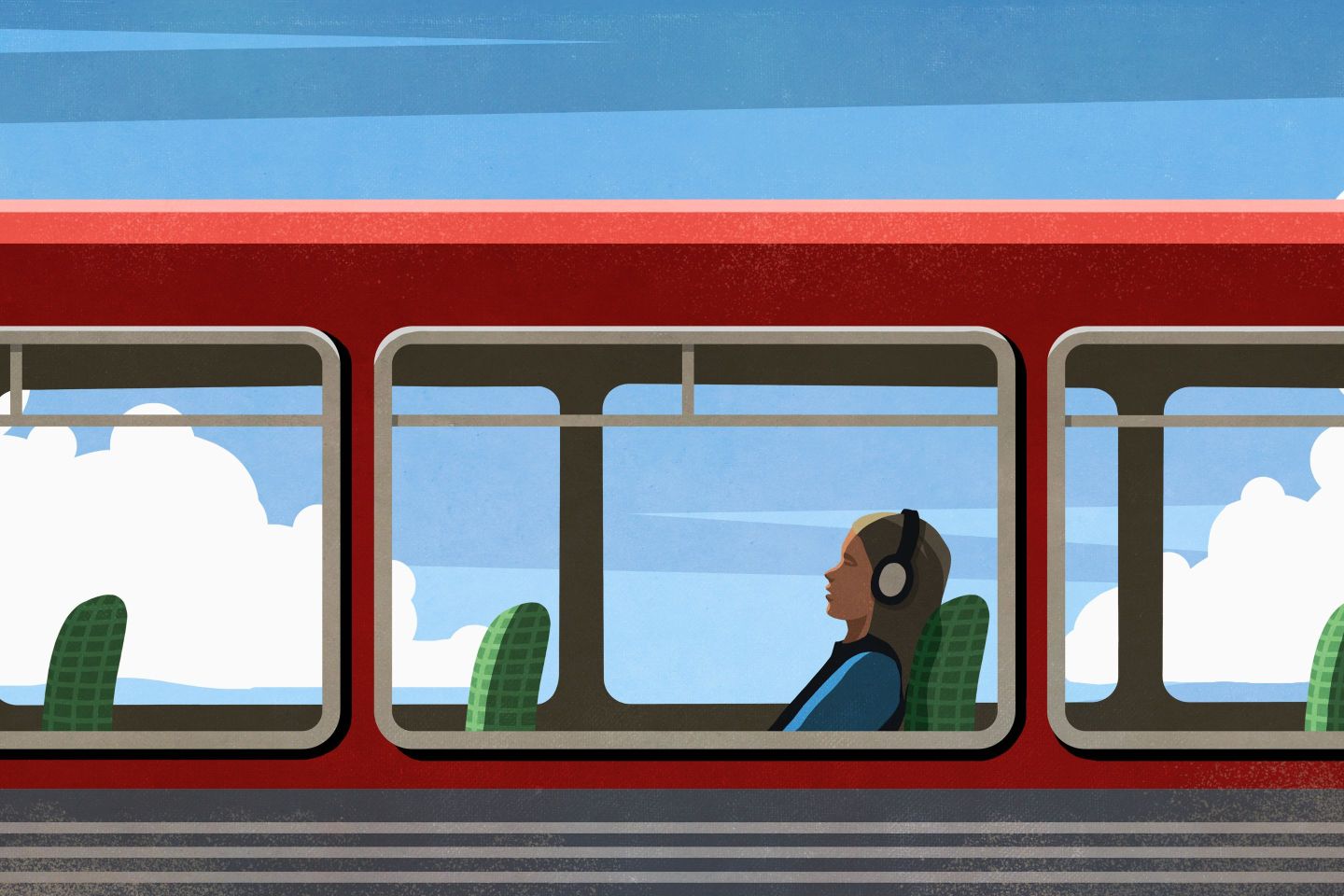
To an onlooker, the throngs of people spilling off platforms and out of car parks during rush hour on a weekday may all appear to have a similar story.
But look closer—some wipe sleep from their eyes, others hastily pack away make up bags, and a few may unwind a travel pillow from around their neck.
These are the long-distance commuters—those who wake up in the dark, and view their cars or a train as their second home.
And like the trip.
During the pandemic, average commuting times unsurprisingly fell.
In 2019, one in 10 workers had an hour-long commute, while just 3% had a journey of more than 90 minutes. But according to the U.S. Census Bureau, the number of people traveling for more than an hour fell to 7.7% in 2021, with average commutes down to 25.6 minutes from 27.6 minutes in 2019.
When COVID hit, some of the biggest businesses in the world promised to go remote—or hybrid—for good.
Some two million people moved away from America’s major cities between 2020 and 2022, banking that their commutes would be less frequent when the world reopened.
A year or so later, however, businesses are calling staff back, and the mandatory commute has returned with a vengeance.
Yet veterans of the ultra-commute say there are silver linings to be found, and they’re tired of the griping from newcomers.
‘Commuting gives me an edge’
Jonathan Walters has been a long-distance commuter for the majority of his working life.
Prior to COVID he travelled from Chicago to work in Naperville—a 45-minute to 75-minute drive, depending on traffic—and in 2021 moved out to the smaller city to be closer to work. The only problem was, his job changed and he ended up with a commute back into Chicago.
For some people this seemingly unavoidable commute might be a bugbear—but for the associate vice president at a transportation company, it’s become welcome.
Walters told Fortune he refers to his 5 a.m. starts as “windshield time”—a chance to get his thoughts in order.
“When I get in I’ve had over an hour where I’m pretty focused, I’ve had time to prioritize my day and to think about the first two or three things that are going to be on my list,” he explained. “Especially when it comes to customer or internal meetings, I can make sure they’re more succinct because I’ve had time to think and plan already.”
Previously Walters, like millions of other people, saw his commute as a “necessary evil.”
He decided to try and shift his mindset to view the travel time as a positive thing, saying people should “take advantage of that rather than whining about it.”
“It’s not going to change anything by complaining about it,” he said. “You might as well make it something that—if not productive—is at least positive.”
Across the Atlantic, 25-year-old Melissa Howard’s day also starts at 5 a.m. Twice a week she makes her way from home in rural Cambridgeshire, England, to the office, taking two trains to get into—and across—London.
By 8 a.m., the PR executive is working—an hour before most of her colleagues in the industry log on—and she’s already set up a plan of action for her day: she says it gives her an “edge.”
“I feel pumped for the day, especially when I’m getting in before everyone else,” Howard said. “It gives me an extra hour to get settled, I get more things done without being distracted by anyone.”
The financial upsides
Howard’s commute costs her £180 (approximately $219) a week—though half the amount is covered by her employer.
She’s one of the lucky few—most employees are footing the bill of a 31% increase in their journey costs compared to pre-COVID. The average American shells out $8,466 on commuting annually, according to calculations of various government data from real estate agent matching service Clever Real Estate.
In the U.K. it’s a similar story—the average person reportedly spends around £17.23 ($21) getting to work every day, though that increases when commuting to major hubs like London, Manchester and Birmingham.
But despite Howard sometimes missing the easy convenience and social aspect of living in London, she has no plans to move to the metropolis.
“Looking at the prices versus the benefits, I just don’t think there’s enough,” Howard said. “It’s not even just the rent as well. It’s almost everything that comes with it—food, drink.”
Similarly, while Walters’s journey costs him around $6,000 a year, he mentally offsets this with the “constant” pleasant surprise of how much more affordable life is in Naperville is compared to Chicago.
“For a bottle of wine we’re paying a third, or two-thirds, of what we would pay in Chicago—even at the same restaurant chain. The city nowadays is nickel-and-diming everything: whether it’s parking, tolls, street parking, city stickers—just having the luxury of having a car comes with a lot of additional expenses,” he said.
His two-story, four-bed home also has more space for his eight and four-year-old children—and he feels they’re safer and more independent outside America’s third-largest city.
Commutes might be necessary for your career
Every long-distance commuter Fortune spoke to agreed that regular trips to the office are necessary—whether it’s to get in that all-important face time with the boss, or to bounce ideas around with colleagues.
Micah Shepard is the president and regional CEO for Schaeffler’s Asia operations, overseeing 1,600 staff across 10 offices, as well as factory sites.
Although Shephard lives in Pattaya in Eastern Thailand, he spends half his working year not just commuting but traveling long-distance: in the next month alone he’ll visit Germany, Australia, Vietnam, China and the Philippines.
Without this sacrifice—Shepard is a father to two sons—the CEO said he “definitely” wouldn’t have achieved the same level of career success.
“The visibility that comes with either traveling or commuting to different locations puts you in a narrow bracket of employees,” he told Fortune. “I also recommend to younger employees that they need to learn from the senior people who normally come to the office.”
As a manager himself Shepard said sometimes those who work completely remotely are “out of sight, out of mind,” but acknowledged flexibility doesn’t hold back staff if they perform well in a remote or hybrid role.
As soon as he got back on the road, however, Shepard saw a difference in the company’s success.
“If I look at the performance of my team over the last year and the fact that I have travelled and got back out into the market—compared to my peer companies—we’ve changed the quickest, medium term growth has been faster and product releases, customer engagement, and marketing activities have all significantly increased,” he said.