• Home
  • Latest
  • Fortune 500
  • Finance
  • Tech
  • Leadership
  • Lifestyle
  • Rankings
  • Multimedia
CommentaryLeadership

We studied 1,300 Airmen for 4 months to know what makes them mission-ready. Here’s what we found–and how you can use it to achieve success

By
Michael Litano
Michael Litano
,
Gabriella Kellerman
Gabriella Kellerman
,
Prakriti Singh
Prakriti Singh
and
Derek Hutchinson
Derek Hutchinson
Down Arrow Button Icon
By
Michael Litano
Michael Litano
,
Gabriella Kellerman
Gabriella Kellerman
,
Prakriti Singh
Prakriti Singh
and
Derek Hutchinson
Derek Hutchinson
Down Arrow Button Icon
September 8, 2023, 12:29 PM ET
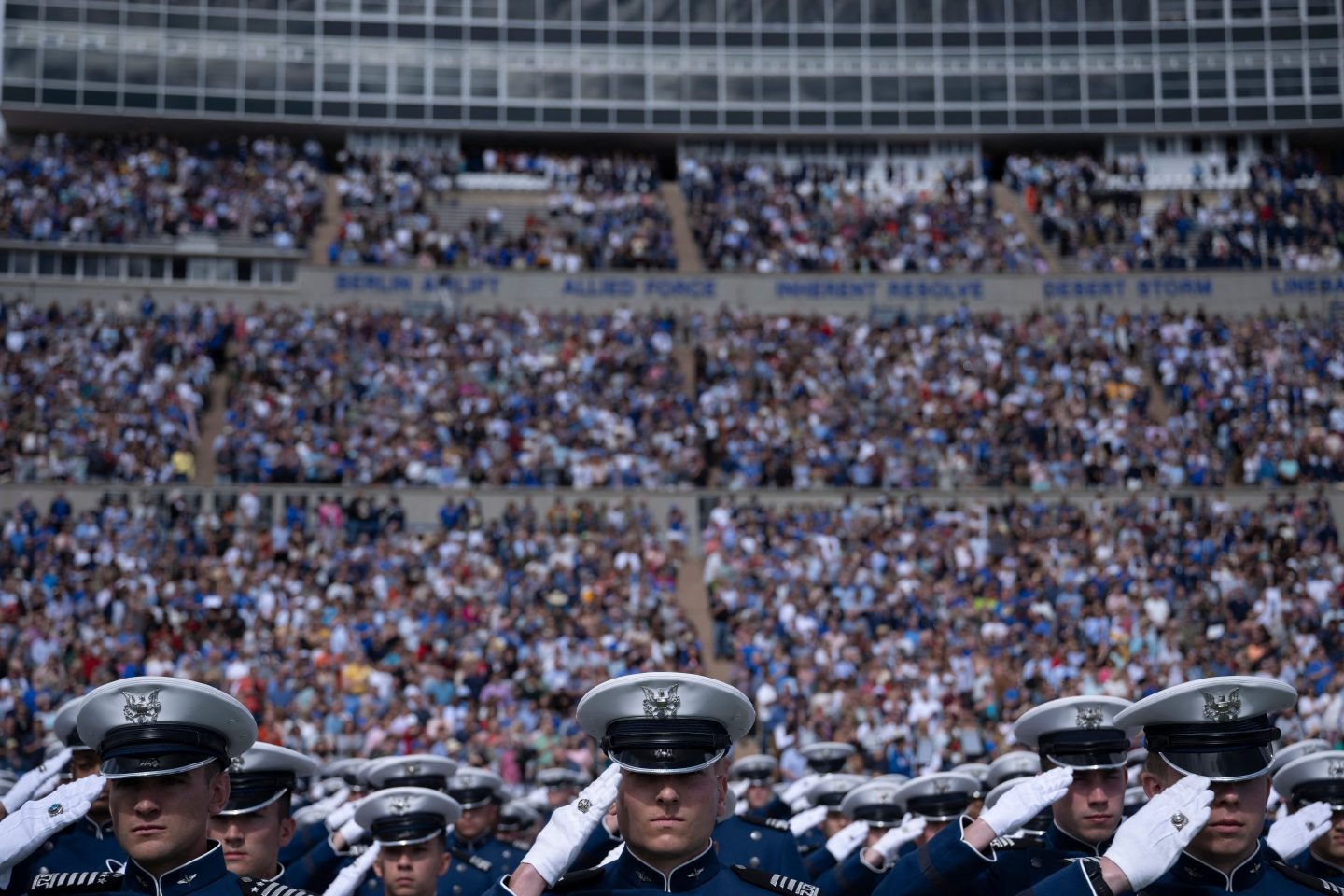
Cadets attend their graduation ceremony at the United States Air Force Academy in El Paso County, Colorado, on Jun. 1.
Cadets attend their graduation ceremony at the United States Air Force Academy in El Paso County, Colorado, on Jun. 1.BRENDAN SMIALOWSKI - AFP - Getty Images

In the military, mission readiness is paramount. It determines success or failure on the battlefield–and impacts life-and-death outcomes. Military leaders are recognizing that psychological readiness is vital to individual and unit-level mission readiness. After studying job performance across 1 million people in the U.S. Armed Services over five years, Dr. Martin Seligman, the father of positive psychology and a BetterUp Science Board member, found that optimism and well-being are the biggest drivers of job performance. Mindset matters when performance is on the line.

Amid rapid and unpredictable change, often precipitated by small groups of stakeholders or one-off events, business teams need to be agile, adaptable, focused, and creative to drive results–just like soldiers in the increasingly networked and dynamic world of war. Their leaders, too, must keep adapting and performing without succumbing to exhaustion or burnout–be it mental, physical, or emotional.

As such, in today’s work environments, psychological readiness–to perform, adapt, and persist through shifting priorities and changing conditions in service of a shared mission–is as important for corporate teams as it is for military units.

What can we learn from the military? It turns out that too many troops lack readiness. A 2020 Department of Defense survey suggests 25% of service members are not mission-ready–and 41% believe their unit is not ready. While having troops and tanks in the right places is important, so is having troops ready to do their jobs. If individuals lack psychological readiness, leaders and units struggle to perform. 

Seeking to fill gaps in the literature on psychological readiness, BetterUp conducted a study with over 1,300 members of the USAF to determine the mindsets, skills, and behaviors associated with mission readiness and the degree to which individual and unit readiness can be improved. 

Our findings allow military and corporate leaders alike to apply the latest science on psychological readiness in order to build stronger, more resilient–more ready–teams and individuals.

The behavioral drivers of readiness in the military

Over a four-month period, participants engaged in personalized coaching with an ICF-certified coach, covering personal and professional topics such as alignment, purpose and meaning, physical activity, and emotional regulation. A validated survey at intake and conclusion of the study measured how overall readiness and key mindsets, skills, and behaviorschanged over time with coaching.A relative-weights analysis further identified which mindsets and behaviors were the most important drivers or predictors of readiness, based on the variance found in the intake survey. 

What did we find? Individual and unit mission readiness improved for service members in the study. 

Individuals: After four months, 13% more Airmen and Guardians felt prepared to carry out their wartime mission. Those who started low experienced the largest gains.

Airmen with the highest purpose and meaning, alignment, emotional regulation, and physical activity were the most likely to report the highest levels of individual mission readiness, with purpose and meaning as the largest contributor.

Of note, in the study, participants were also able to developandstrengthen these important drivers of readiness. The sample group experienced growth in physical activity (15%), emotional regulation (13%), alignment (13%), and purpose and meaning (8%).

Units or teams:  After four months, 17% more Airmen and Guardians believed their units were mission-ready. Again, those who initially rated their unit readiness as low experienced the largest improvement.

For unit readiness, purpose and meaning and empowerment were both strong predictors, as was relationship building. Study participants grew 17% in empowerment, 14% in relationship building, and 8% in purpose and meaning leading to overall improvement in unit readiness. As previous research has also shown, when unit leaders exhibit leadership behaviors such as empowerment, trust, and care, it has a significant impact on the psychological readiness of their unit.

Michael Litano is RVP of people insights at BetterUp. Gabriella Kellerman is BetterUp's Chief Innovation Officer. Prakriti Singh is a senior manager of government alliances at BetterUp. Derek Hutchinson is a senior analytics consultant of people insights at BetterUp.

The opinions expressed in Fortune.com commentary pieces are solely the views of their authors and do not necessarily reflect the opinions and beliefs of Fortune.

Join us at the Fortune Workplace Innovation Summit May 19–20, 2026, in Atlanta. The next era of workplace innovation is here—and the old playbook is being rewritten. At this exclusive, high-energy event, the world’s most innovative leaders will convene to explore how AI, humanity, and strategy converge to redefine, again, the future of work. Register now.
About the Authors
By Michael Litano
See full bioRight Arrow Button Icon
By Gabriella Kellerman
See full bioRight Arrow Button Icon
By Prakriti Singh
See full bioRight Arrow Button Icon
By Derek Hutchinson
See full bioRight Arrow Button Icon

Latest in Commentary

Julian Braithwaite is the Director General of the International Alliance for Responsible Drinking
CommentaryProductivity
Gen Z is drinking 20% less than Millennials. Productivity is rising. Coincidence? Not quite
By Julian BraithwaiteDecember 13, 2025
21 hours ago
carbon
Commentaryclimate change
Banking on carbon markets 2.0: why financial institutions should engage with carbon credits
By Usha Rao-MonariDecember 13, 2025
22 hours ago
Dr. Javier Cárdenas is the director of the Rockefeller Neuroscience Institute NeuroPerformance Innovation Center.
Commentaryconcussions
Fists, not football: There is no concussion protocol for domestic violence survivors
By Javier CárdenasDecember 12, 2025
2 days ago
Gary Locke is the former U.S. ambassador to China, U.S. secretary of commerce, and governor of Washington.
CommentaryChina
China is winning the biotech race. Patent reform is how we catch up
By Gary LockeDecember 12, 2025
2 days ago
millennial
CommentaryConsumer Spending
Meet the 2025 holiday white whale: the millennial dad spending $500+ per kid
By Phillip GoerickeDecember 12, 2025
2 days ago
Sarandos
CommentaryAntitrust
Netflix, Warner, Paramount and antitrust: Entertainment megadeal’s outcome must follow the evidence, not politics or fear of integration
By Satya MararDecember 12, 2025
2 days ago

Most Popular

placeholder alt text
Economy
Tariffs are taxes and they were used to finance the federal government until the 1913 income tax. A top economist breaks it down
By Kent JonesDecember 12, 2025
2 days ago
placeholder alt text
Success
Apple cofounder Ronald Wayne sold his 10% stake for $800 in 1976—today it’d be worth up to $400 billion
By Preston ForeDecember 12, 2025
2 days ago
placeholder alt text
Success
40% of Stanford undergrads receive disability accommodations—but it’s become a college-wide phenomenon as Gen Z try to succeed in the current climate
By Preston ForeDecember 12, 2025
2 days ago
placeholder alt text
Economy
The Fed just ‘Trump-proofed’ itself with a unanimous move to preempt a potential leadership shake-up
By Jason MaDecember 12, 2025
2 days ago
placeholder alt text
Success
Apple CEO Tim Cook out-earns the average American’s salary in just 7 hours—to put that into context, he could buy a new $439,000 home in just 2 days
By Emma BurleighDecember 12, 2025
2 days ago
placeholder alt text
Economy
For the first time since Trump’s tariff rollout, import tax revenue has fallen, threatening his lofty plans to slash the $38 trillion national debt
By Sasha RogelbergDecember 12, 2025
2 days ago
Rankings
  • 100 Best Companies
  • Fortune 500
  • Global 500
  • Fortune 500 Europe
  • Most Powerful Women
  • Future 50
  • World’s Most Admired Companies
  • See All Rankings
Sections
  • Finance
  • Leadership
  • Success
  • Tech
  • Asia
  • Europe
  • Environment
  • Fortune Crypto
  • Health
  • Retail
  • Lifestyle
  • Politics
  • Newsletters
  • Magazine
  • Features
  • Commentary
  • Mpw
  • CEO Initiative
  • Conferences
  • Personal Finance
  • Education
Customer Support
  • Frequently Asked Questions
  • Customer Service Portal
  • Privacy Policy
  • Terms Of Use
  • Single Issues For Purchase
  • International Print
Commercial Services
  • Advertising
  • Fortune Brand Studio
  • Fortune Analytics
  • Fortune Conferences
  • Business Development
About Us
  • About Us
  • Editorial Calendar
  • Press Center
  • Work At Fortune
  • Diversity And Inclusion
  • Terms And Conditions
  • Site Map

© 2025 Fortune Media IP Limited. All Rights Reserved. Use of this site constitutes acceptance of our Terms of Use and Privacy Policy | CA Notice at Collection and Privacy Notice | Do Not Sell/Share My Personal Information
FORTUNE is a trademark of Fortune Media IP Limited, registered in the U.S. and other countries. FORTUNE may receive compensation for some links to products and services on this website. Offers may be subject to change without notice.