

• Home
  • Latest
  • Fortune 500
  • Finance
  • Tech
  • Leadership
  • Lifestyle
  • Rankings
  • Multimedia
Successreturn to office

Forcing workers back to the office may be backfiring: Flexible workplaces are hiring talent twice as fast as those requiring full-time attendance

Orianna Rosa Royle
By
Orianna Rosa Royle
Orianna Rosa Royle
Associate Editor, Success
Down Arrow Button Icon
Orianna Rosa Royle
By
Orianna Rosa Royle
Orianna Rosa Royle
Associate Editor, Success
Down Arrow Button Icon
August 7, 2023, 8:18 AM ET
Photo of an empty desk in an office
Firms embracing remote work are experiencing a major advantage: More people want to work for them as RTO mandates become widespread.Erik Von Weber—Getty Images

Two years into the return-to-office battle, and it’s becoming apparent that its staunchest supporters are facing headwinds. 

Recommended Video

Employers following in the footsteps of Goldman Sachs and JPMorgan by mandating a full-time office return may be inadvertently making themselves unattractive to job seekers, new research shows.

According to an analysis of more than 4,500 companies by Scoop, a software firm that tracks workplace policies, and People Data Labs, a data technology company, companies with remote or hybrid policies appear to be hiring people at about twice the rate of those requiring full-time attendance.

The research, or The Flex Index July 2023 Job Growth Report, maintains that some form of flexible work is the only way forward for workplaces that want to keep a competitive edge in the current tight labor market. 

WFH wins in the eyes of workers—and therefore employers

Despite widespread walkouts over the increased pressure to return to the old ways of working, many employers have pressed on with their back-to-the-office plans, with around 1 million workers in the U.S. alone expected to return to their cubicles from September. 

But as it turns out, listening to workers’ complaints about being forced to return to their desk pays—because they’re showing exactly what job seekers are thinking. 

Over the past three months, Scoop Technologies’ analysis found that “fully flexible” companies—ones where all employees work remotely or have complete autonomy over whether they go into the office—grew headcount by 1.9% on average. Meanwhile, those with “structured hybrid” work policies grew by 1.5%. In comparison, employers that were fully in-office grew their headcount by just 0.8%.

And, the research suggests, employers shouldn’t dismiss the data as merely short-term backlash to the sudden wave of return-to-office policies: The researchers’ analysis goes as far back as this time last year, during the Great Resignation, when RTO mandates were few and far between, and found a similar gap. 

Over the past 12 months, fully flexible companies grew headcount by 5.6%, which dropped slightly to 4.1% for hybrid companies. Meanwhile, full-time in-office companies grew by 2.6%—less than half the rate of flexible firms.

The combination of pricey commutes, sad desk lunches, and paying for childcare means that in-office workers are earning almost 10% less than their remote counterparts. So it’s perhaps not surprising that employers that allow their staff to do their jobs from home—instead of spending time and money to do the very same thing on company watch five days a week—are faring better with job seekers. 

Workers don’t want to have their choice revoked

What’s more, the research highlights that workers don’t want to be forced to go into the office: The more in-office days an employer mandated, the more it struggled to hire staff. Meanwhile, hybrid workplaces that have set in-office days, rather than a looser minimum day-per-week requirement, experienced a slighter slower headcount growth rate. 

Separate research has echoed that people are more open to returning to the office when it is out of choice, rather than forced: Unispace found that around a third of workers felt happy, motivated, and excited about heading into the office, but those feelings decreased for those mandated to go in. 
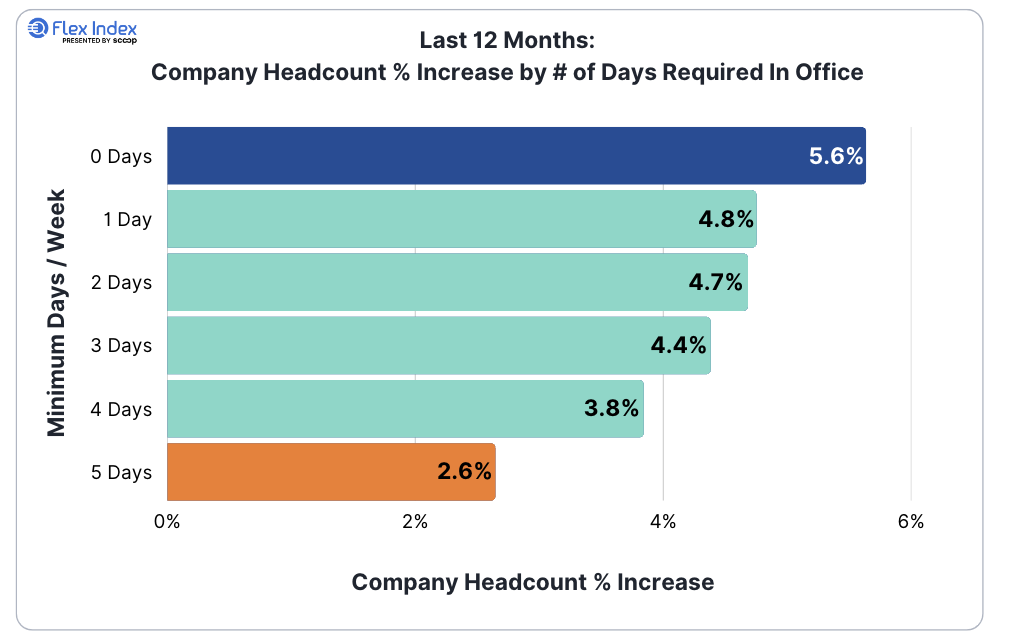
Plus, it appears that three days per week in office is where job candidates draw the line. The Flex Index research shows that employers mandating a four-day week in the office experienced a significant drop in headcount growth, while those expecting staff to head in between one and three days a week experienced similar levels of growth. 

“Headcount growth is not a perfect proxy for economic growth, but it is likely that the companies that are adding headcount are also the ones that are growing sales, the report says. “Put simply, the growth in the economy—at least for corporate employees—appears to be with the companies that are offering flexibility.”

It’s why the researchers said that they ultimately expect to see a drop in the number of companies pressing on with full-time office plans and instead favoring hybrid models “that better reflect the needs of the workforce.”


Join us at the Fortune Workplace Innovation Summit May 19–20, 2026, in Atlanta. The next era of workplace innovation is here—and the old playbook is being rewritten. At this exclusive, high-energy event, the world’s most innovative leaders will convene to explore how AI, humanity, and strategy converge to redefine, again, the future of work. Register now.
About the Author
Orianna Rosa Royle
By Orianna Rosa RoyleAssociate Editor, Success
Instagram iconLinkedIn iconTwitter icon

Orianna Rosa Royle is the Success associate editor at Fortune, overseeing careers, leadership, and company culture coverage. She was previously the senior reporter at Management Today, Britain's longest-running publication for CEOs. 

See full bioRight Arrow Button Icon

Latest in Success

Apple CEO Tim Cook
SuccessBillionaires
Apple CEO Tim Cook out-earns the average American’s salary in just 7 hours—to put that into context, he could buy a new $439,000 home in just 2 days
By Emma BurleighDecember 12, 2025
35 minutes ago
Tensed teenage girl writing on paper
SuccessColleges and Universities
40% of Stanford undergrads receive disability accommodations—but it’s become a college-wide phenomenon as Gen Z try to succeed in the current climate
By Preston ForeDecember 12, 2025
1 hour ago
SuccessHow I made my first million
Hinge CEO says he bribed students with KitKats to get the $550 million-a-year business off the ground: ‘I had to beg and borrow a lot’
By Orianna Rosa RoyleDecember 12, 2025
2 hours ago
Steve Jobs, Steve Wozniak, and Ronald Wayne's signatures on the bottom of Apple's founding contract.
SuccessWealth
Apple cofounder Ronald Wayne sold his 10% stake for $800 in 1976—today it’d be worth up to $400 billion
By Preston ForeDecember 12, 2025
2 hours ago
Former Meta COO Sheryl Sandberg
SuccessWomen
Sheryl Sandberg breaks down why it’s a troubling time for women in the workplace right now
By Emma BurleighDecember 12, 2025
6 hours ago
Late Apple cofounder Steve Jobs
SuccessCareers
Apple’s Steve Jobs told students to never ‘settle’ in their careers: ‘If you haven’t found it yet, keep looking’
By Emma BurleighDecember 11, 2025
1 day ago

Most Popular

placeholder alt text
Success
At 18, doctors gave him three hours to live. He played video games from his hospital bed—and now, he’s built a $10 million-a-year video game studio
By Preston ForeDecember 10, 2025
2 days ago
placeholder alt text
Success
Palantir cofounder calls elite college undergrads a ‘loser generation’ as data reveals rise in students seeking support for disabilities, like ADHD
By Preston ForeDecember 11, 2025
1 day ago
placeholder alt text
Investing
Baby boomers have now 'gobbled up' nearly one-third of America's wealth share, and they're leaving Gen Z and millennials behind
By Sasha RogelbergDecember 8, 2025
4 days ago
placeholder alt text
Economy
‘We have not seen this rosy picture’: ADP’s chief economist warns the real economy is pretty different from Wall Street’s bullish outlook
By Eleanor PringleDecember 11, 2025
1 day ago
placeholder alt text
Economy
Tariffs are taxes and they were used to finance the federal government until the 1913 income tax. A top economist breaks it down
By Kent JonesDecember 12, 2025
6 hours ago
placeholder alt text
Uncategorized
Transforming customer support through intelligent AI operations
By Lauren ChomiukNovember 26, 2025
16 days ago
Rankings
  • 100 Best Companies
  • Fortune 500
  • Global 500
  • Fortune 500 Europe
  • Most Powerful Women
  • Future 50
  • World’s Most Admired Companies
  • See All Rankings
Sections
  • Finance
  • Leadership
  • Success
  • Tech
  • Asia
  • Europe
  • Environment
  • Fortune Crypto
  • Health
  • Retail
  • Lifestyle
  • Politics
  • Newsletters
  • Magazine
  • Features
  • Commentary
  • Mpw
  • CEO Initiative
  • Conferences
  • Personal Finance
  • Education
Customer Support
  • Frequently Asked Questions
  • Customer Service Portal
  • Privacy Policy
  • Terms Of Use
  • Single Issues For Purchase
  • International Print
Commercial Services
  • Advertising
  • Fortune Brand Studio
  • Fortune Analytics
  • Fortune Conferences
  • Business Development
About Us
  • About Us
  • Editorial Calendar
  • Press Center
  • Work At Fortune
  • Diversity And Inclusion
  • Terms And Conditions
  • Site Map

© 2025 Fortune Media IP Limited. All Rights Reserved. Use of this site constitutes acceptance of our Terms of Use and Privacy Policy | CA Notice at Collection and Privacy Notice | Do Not Sell/Share My Personal Information
FORTUNE is a trademark of Fortune Media IP Limited, registered in the U.S. and other countries. FORTUNE may receive compensation for some links to products and services on this website. Offers may be subject to change without notice.