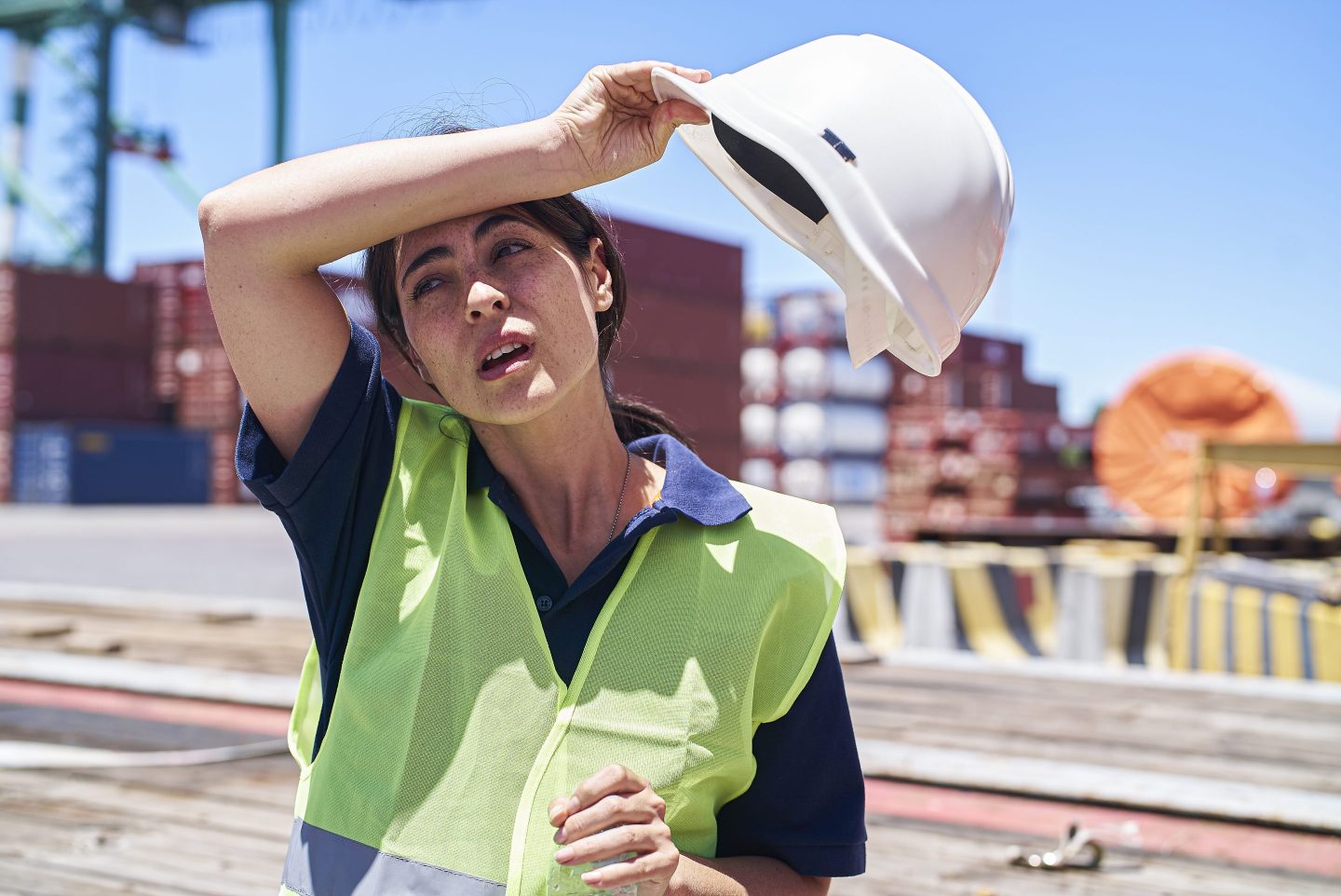
Large swaths of the U.S., from the Gulf Coast to the Pacific, have suffered under an intense heat wave for more than three weeks. In Phoenix, the number of consecutive days with a temperature above 110 degrees has surpassed 26, a bleak record. Millions of Americans are feeling the burn and many companies find themselves contending with a future where work is done in increasingly hotter weather.
Heat is the No. 1 cause of weather-related deaths in the U.S. Between 2017 and 2022,121 workers died on the job from reported heat-related distress, according to data from the Occupational Safety and Health Administration (OSHA). As many as 86 million people were exposed to dangerous temperatures in a single day last week, according to an extreme heat tracker published by The Washington Post. Many of those people either work in the heat directly, or are exposed to high temperatures during their commutes.
California, Oregon, Washington, Colorado, and Minnesota are among states that mandate breaks, water, and shade to protect at least some outdoor laborers when temperatures hit 80 degrees on the lowest end. But rules are hazier at the federal level. Extreme heat falls under OSHA’s “general duty” clause, which requires employers provide a work environment free of “recognized hazards” that are likely to cause death or serious physical harm. But it doesn’t provide specific guidance about what those are, or how employers should address them.
This week, President Biden ordered the Department of Labor to ramp up its enforcement of heat safety violations and to issue a “hazard alert” with information on what “employers can and should be doing now to protect their workers.” In 2021, he ordered OSHA to draft and implement heat-specific standards and means for enforcing them; none are in place yet.
That has left individual employers responsible for shielding their workers from a rapidly warming planet, according to experts. Already, companies like Amazon and UPS are contending with how to protect employees who work in hot conditions. The effects of a warming climate are not just an issue for blue-collar workers. Hotter temperatures are a problem for the entire labor force and U.S. business landscape, slated to cost hundreds of billions in labor productivity over the next few decades.
“The health and safety of employees should always be an organization’s top priority,” says Jen Fisher, human sustainability leader at Deloitte. “There are a lot of opportunities to accommodate employees during extreme weather, build awareness about the impact of climate change, and advance human sustainability in the future.”
A high toll on workers
Extreme heat poses a major health risk for outdoor workers, like UPS delivery people. Videos of drivers passing out have spread across social media, and employees have voiced concerns about working in the metal trucks and delivering packages in hot weather.
Excessively hot working conditions was one of the core issues in union negotiations between UPS and the Teamsters Union, representing some 340,000 workers. The two sides reached a tentative deal on a new contract this week to potentially stave off what would have been one of the largest labor union strikes in history.
“We care deeply about our people, and their safety remains our top priority. Heat safety is no exception,” a UPS spokesperson wrote in a statement to Fortune.
UPS and the union agreed to terms in June that would better protect workers in hot environments, including new delivery vehicles equipped with air conditioning units, fans in the cabs of package cars, and better airflow systems. UPS says it spent $343 million in safety training and research last year, including educating employees on signs of heat exhaustion.
“Protecting your workers is the cost of doing business, and it has to be normalized,” Heather White, the founder of climate action nonprofit OneGreenThing, tells Fortune. “Talking about the effects of extreme heat and climate change has to be normalized.”
Citing the UPS debacle, she says having air conditioning in metal delivery trucks where the temperature can reach above 100 degrees is the most basic thing the company can do for its drivers, adding that for the most part, companies have not done enough.
It’s important that outdoor workers in delivery, construction, agricultural, or landscaping jobs have water and access to shade and air conditioning, wear heat-appropriate attire, and get adequate breaks, White says. However, being at the mercy of the elements isn’t exclusive to workers who spend the majority of their day outside.
Some Amazon workers, for example, have compared warehouse conditions to “working in a convection oven while blow-drying your hair.”
In June, Amazon published a blog post about how it’s protecting drivers and fulfillment center workers from stifling heat. When asked what specifically it does to protect workers from heat, the company redirected Fortune to the blog post, which says it has installed “a variety of cooling measures” in its buildings, including a system that constantly measures the temperature and humidity to alert employees when climate conditions change.
“We train all of our employees and partners on the signs and symptoms of heat-related illness, environmental and personal risk factors, hydration guidance, and other tips from public health and medical professionals,” the company wrote. “Most importantly, everyone is encouraged to take a preventive cool-down rest break anytime they need, and employees and safety teams are empowered to speak up to address any temperature-related issues.”
But Eric Frumin, health and safety director for labor union coalition the Strategic Organizing Center, which does not include Amazon workers but has launched campaigns about work conditions at the company, and has previously filed an SEC complaint, isn’t impressed.
“[Amazon] has so misrepresented the reality or the value of what they are doing when it comes to the working conditions in warehouses that I have a hard time believing what they say,” says Frumin. “If you have a building and it’s not all air-conditioned, or there’s only air conditioning on the ground level, it’s not going to be enough—and a fan isn’t going to help.”
The result, Frumin says, is a business model that’s unsustainable, adding that the heat likely contributes to the company’s 100% turnover rate. The cost of that level of attrition is around $8 billion a year, according to leaked documents Engadget reported last year.
The future of working on a warming planet
The effects of extreme heat go far beyond the toll it takes on the bodies of individual workers—it also affects the bottom line.
The U.S. could lose $100 billion a year to lost labor productivity as a result of workers suffering under extreme heat, according to a 2021 report from the Adrienne Arsht-Rockefeller Foundation Resilience Center, a climate nonprofit. That number could balloon to $200 billion by 2030 and a half a trillion by 2050.
Workers whose jobs require them to be outside or in non-climate-controlled environments wind up reducing their hours by as much as 13% on the hottest days, according to a 2014 study published in the Journal of Labor Economics. In a 2021 study of factories in India, researchers found that output fell 2% per degree Celsius. And in the U.S., a week with six or more days with heat over 90 degrees Fahrenheit reduced production at auto assembly plants by 8%, according to a 2012 paper from researchers at Wharton and Columbia Business School.
“On a pragmatic level, we’re talking about what the future of business operations is going to look like in a changing climate. We have people who deny climate change is happening, but what you can’t deny is the very tangible costs,” says Andy Hoffman, professor of management, organizations and sustainability at the University of Michigan.
“If you’re a company that relies on water, for example, agriculture, that’s going to be gravely impacted by climate change and will have an effect on the bottom line,” Hoffman continues. “And just think: What’s going to happen to insurance rates? You might try to ignore the impact of workers in extreme heat, but the insurance company is going to make sure you don’t.”
Extreme heat has caused around 20,000 workplace injuries a year in California between 2001 and 2018, according to a study from the Washington Center for Equitable Growth, which examined worker’s comp claims.
The dangers of extreme heat are not confined to businesses that employ blue/collar workers. It also makes white-collar workers like financial traders, government officials, and office workers less efficient, according to the World Bank. And a working paper found that court judges “dismiss fewer cases, issue longer prison sentences, and levy higher fines when ruling on hot days.”
Experts say companies will likely be forced to make new operational workforce decisions as a result of the climate change threat. For instance, flexible schedules that minimize the time people work or commute in extreme heat, especially in cities like New York where subway platforms can exceed 100 degrees in the summer. Companies might want to consider telling workers to stay home when the temperature becomes dangerously high, says Fisher.
Other workplace accommodations could include climate-friendly dress codes like making it acceptable for employees to wear shorts or short-sleeve tops to their work sites. She adds it’s just as important to provide employees with mental health resources to deal with climate-related anxiety as the world contends with the impact of climate change.
Higher temperatures worsen other climate emergencies as well, like increased wildfires that deteriorate air quality. That can make it challenging to keep the air in office buildings clean, says Tyler Smith, vice president of healthy buildings at Johnson Controls, a multinational conglomerate that produces fire, HVAC, and security equipment for buildings. And poor air quality can significantly affect employees’ cognitive function and ability to focus.
“It’s a double whammy. Not only is it hot, but the air simply isn’t as clean as it used to be,” Smith says. He adds that old building infrastructures only exacerbate the problem. “We’re really stressing these systems to their ragged edge,” he says.
If companies are scrambling to determine how best to protect workers during extreme heat, it’s because leaders are now feeling the physical effects of climate change—and it’s likely to get worse.
“This is the biggest challenge of our lifetime,” White says. “For companies, it is all at stake. They need to focus on shifting to making sure their businesses are operating more sustainably, but they have to remember at the same time that their sustainability isn’t just about product, but people.”