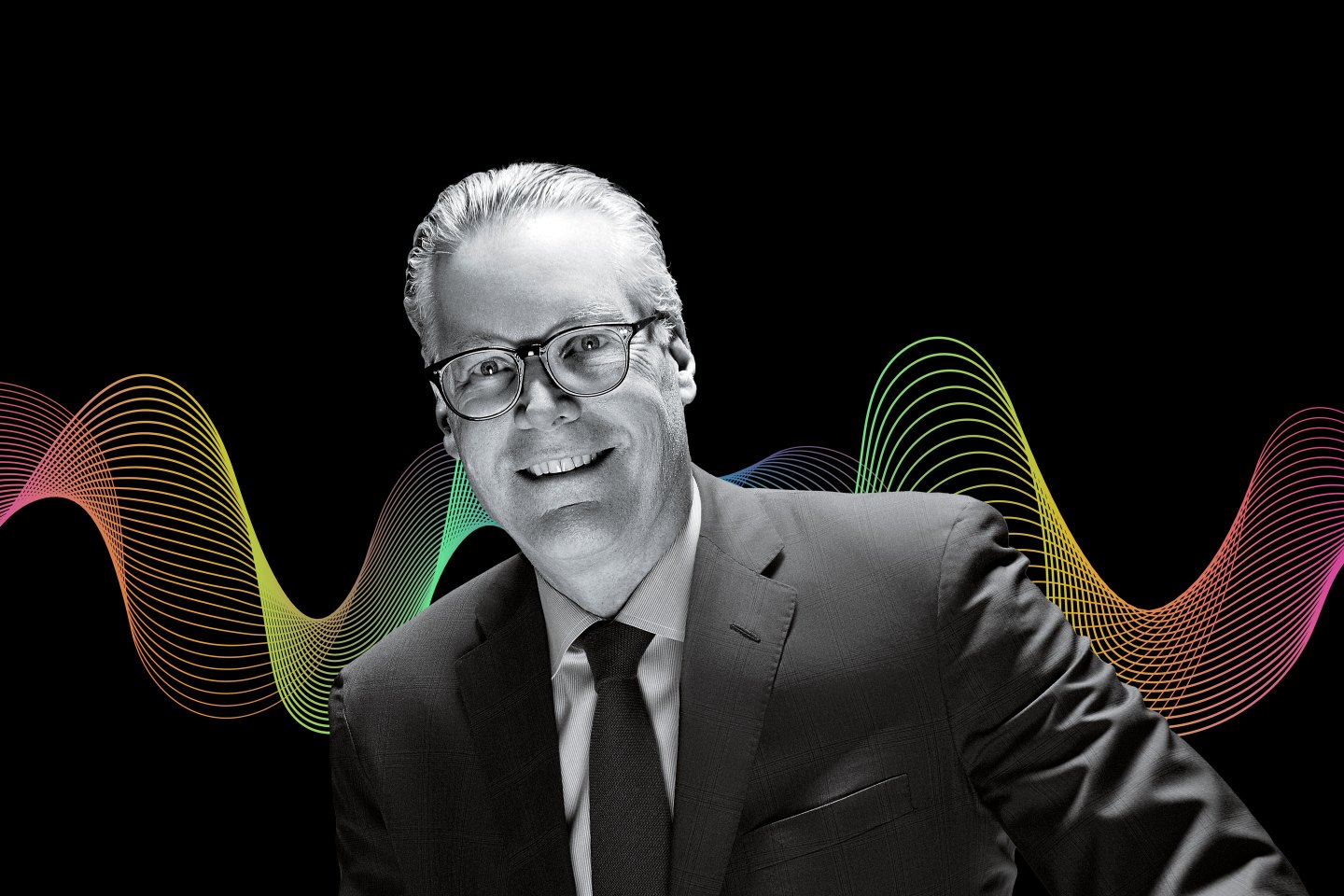
On this week’s episode of Fortune‘s Leadership Next podcast, co-hosts Alan Murray and Michal Lev-Ram talk with Delta Air Lines CEO Ed Bastian about the mind-boggling challenges of running an airline through the COVID-19 pandemic; sustainability in the airline industry; Delta’s “employee-first culture”; and why he spoke out on tough topics including guns and voting rights in the face of enormous pressure.
Listen to the episode or read the full transcript below.
Transcript
Alan Murray: Leadership Next is powered by the folks at Deloitte, who, like me, are exploring the changing rules of business leadership and how CEOs are navigating this change.
Welcome to Leadership Next, the podcast about the changing rules of business leadership. I’m Alan Murray.
Michal Lev-Ram: And I’m Michal Lev-Ram.
Lev-Ram: Alan, this has been a very exciting day for the Leadership Next team. We recorded today’s interview with both of us here in New York in our office. And our guest was here in-person for the very first time.
Murray: You had to fly to get here. I’ve been on so many airplanes in the last six months that it’s making my head spin a little bit. And so I think it’s appropriate that today we were able to welcome Delta CEO Ed Bastian into the studio. He’s such a fun guy to talk to, very personable, and runs a great company. So being in person with him was was fun.
Lev-Ram: And I have to admit, I did not fly Delta from SFO to here. But but we heard a lot about Delta. And he had just so many interesting stories to tell. He took over as CEO of Delta in 2016. But he’s been at the company for a very long time, spent 25 years there. Actually left and came back at some point. And that means he’s been with the company through some incredibly challenging times in the airline industry and in the world. And that includes 9/11, of course, the pandemic, Delta’s bankruptcy declaration in 2007… a lot of stuff.
Murray: It was interesting to hear him talk about all of those. And he also talked about the thing I really wanted to hear him talk about: He’s been in some pretty controversial showdowns with the Georgia state legislature, both because of an action he took to rescind a discount program for members of the National Rifle Association, and because of strong comments he made around that voting bill that was passed by Republicans in the Georgia legislature after the last presidential election. So I was eager to talk to him about how he felt about being labeled as a “woke CEO,” and why he did what he did, and whether he will continue to do it.
Lev-Ram: Yeah, we heard about that. I think he was very candid, and also told us about revenge travel on a lighter note, and how that’s leading to a lot of demand. Delta has brought on 25,000 employees to help meet that demand. And speaking of the culture at Delta, they were ranked number 12 on Fortune’s [World’s] Most Admired Companies this year, and the company’s usually towards the top of our annual best places to work list as well. So we talked a bit about what it’s like to work for Delta, and why they are the only major airline whose flight attendants are not unionized, which I thought was really interesting.
Murray: So, I’m a committed Delta flyer. I grew up in Tennessee. Couldn’t go anywhere without going through Atlanta. So I got onto the loyalty program earlier. I like the service they provide, but a;so really like getting on the airplane right there at the door. You see that sticker on there.
Lev-Ram: Oh, yeah.
Murray: It says Fortune’s World’s Most Admired. But Michal, enough talking about the interview. Let’s just get to it. Here’s our interview with Ed Bastian of Delta Air Lines.
Murray: Ed Bastian of Delta, thanks for being with us. I’ve spent a lot of time on Delta airplanes and in Delta Sky Clubs over the last few months, and I don’t seem to be alone. There’s a lot going on out there. Can you tell us what it looks like from where you sit?
Bastian: Well, first of all, thanks for having me on. It’s good to be with you guys. The demand is really, really strong. This is, people talk about revenge travel, or pent-up travel. This is beyond anything that people can classify as truly pent up. Because we went through several years of people not being able to get back out and travel and experience and see loved ones, see their business colleagues, adventures. All the reasons we travel, and people had a lot of time. Over the three years we’ve quantified the gap between what the inherent demand for travel, U.S. travel, was, over the last three years that couldn’t be met, based on any kind of historical pattern. That gap is $300 billion—with a B—billion.
Murray: Wow. And we seem to be trying to spend it all in three months here. I mean, it’s crazy out there.
Bastian: I’m sure we’ll talk about the economy and consumer and everything we’re seeing. But we’re seeing demand that we’ve never seen before, and there’s no end in sight. We’ve had the 20 largest cash sales days in our history all occur this year.
Lev-Ram: So in that sense, I guess, it’s not just a, you know, the long-awaited COVID recovery. How do you look at forecasting in this new reality? Because it’s not really back to normal, like we never had revenge travel before. It wasn’t a term.
Bastian: Well, first of all, consumer behaviors have changed a lot, too, because people are also booking further out. One of the things that we did during COVID, which I’m glad we did, and we’re not going to change back, is we eliminated change fees from our products. So people can book with confidence, because people want to make certain they get their trip. A lot of people remember what it was like last summer, when everyone started to travel again, how hard it was. And people just wanted to go, and seemed like the world wanted to travel all at the same time, and didn’t matter where they went or what they paid. They just wanted to be out. And we struggled as an industry, because we have a lot of new people that we’re training and bringing back up again. This summer we’re ready, we’ve hired over 25,000 people. They’re trained, and they’re experienced, and they’re ready to see the crowds and the demands. And so as a result of that, you know, our forecasts are that this is going to stay very, very busy. And we’re going to make sure that we’re staffed and we’ve got every plane possible that we’re utilizing. There’s also a lot of constraints around the industry. The aircraft manufacturers aren’t producing as many aircraft on time. The engine makers are having challenges delivering the engines that we need, or the repairs that are needed. Supply chain challenges, staffing challenges still exist in some parts of the industry. So you know, there’s more balance between the supply than ever in terms of what you can put out with strong demand, which is which is yielding some some good results for our industry.
Murray: I fly Delta a lot. I don’t get hit with fees the way I do on some other airline. You know, if you actually want a seat, you have to pay extra for it. Other airlines are clearly using that to make money. How do you make money?
Bastian: We were going to take it off before COVID hit, but when COVID hit, it was the perfect time to take it off. Because one of the deterrents to travel during COVID was, you weren’t quite sure what conditions you were going to find. If you were going to be sick, if the city wasn’t going to be open, if you could even go to the location you were planning to go to. So we wanted people to be able to book, and if something had to happen to change, we could change and make it easy. The other thing that’s happened, Alan, during this period, we’ve invested a lot in our app, and the technology and the self-service capability. And so customers can also control their own experience when they have to make a change, when they have to get a refund, when they have to look for some better alternative. We always tell people we want the app to feel like it’s their own red coat, the famous Delta red coat, in their pocket ready there to serve them.
Murray: Michal and I were having the same conversation with the CEO of Marriott recently. I mean, as, as people who work in an industry that got disintermediated by the big tech platforms, you know, media went to Google and Facebook and we became dependent on them for our audiences. What you’ve done, and what Marriott has done, is really impressive.
Bastian: You go back 10 years ago, the big online agencies, the Expedias, the Pricelines, the Travelocities, they all consolidated. And we are now to the point where less than 10% of our bookings go through those online agents.
Lev-Ram: Wow.
Murray: Wow.
Lev-Ram: And over 50% of the bookings go direct to Delta.
Murray: Wow. Fifty percent through the app?
Bastian: Mostly through the app or dot com or our reservations line, you know, people call. And what that gives you is opportunity to build a better service experience, because you know your customers then.
Lev-Ram: So I’ve been told you like to talk about free Wi-Fi. So we can’t talk to you without bringing it up. But this is another thing that I think you’ve said is kind of been a long time coming. So why now?
Bastian: Well, we’ve been working on this for years. People don’t understand, customers don’t understand why you have to charge for Wi-Fi in the sky. And the reality is that the airlines don’t have the equipage. They don’t have the bandwidth. The reality is you’re hurtling at 500 miles an hour versus sitting here in a conference room or living room and getting getting good reception. Because people want to be connected. And that’s the only place in the world that you’re not connected is in the sky. And so we’ve invested billions of dollars, including during COVID, we struck a new deal with a new satellite provider Viasat. And they’re doing a wonderful job for us. We had to get every single one of our plane type models re-outfitted and recalibrated and approved and certified by the FAA. And we have over 20 different models of planes that we operate. Every single one of them had to be tested, and that’s a six- to 12-month process. And so, it’s been a tremendous amount of work. But one of the reasons we wanted to make it, obviously we wanted to create great customer experience. The other reason is, there’s still a lot of our customers we don’t know. What we know we have a great loyalty program. We have 20 million active users of our SkyMiles program, but we also know there’s over 20 million members or customers out there that are not members of our program that are using our product that haven’t signed on or for some reason, they haven’t made an attachment. They don’t have the loyalty. And when you give them high quality Wi-Fi that works, people say yes, I’m in. Just since we soft-launched in November, we’ve had over 600,000 new members…
Murray: New signups?
Bastian: Signups.
Murray: Wow.
Bastian: And interestingly, it’s exactly what I thought it’d be. The demographic of our existing SkyMiles members is about 40 years of age. The average age of the people signing up is 10 years younger, 30 years of age, that haven’t made a decision yet, haven’t joined a company. So there’s going to be a loyalty factor or stickiness, a reason why I fly Delta is for Wi-Fi. And then we’re going to be bringing in a lot of entertainment, shopping opportunities, exploratory exclusive offers from folks while you’re on that portal. So the Wi-Fi is just the start.
[Music starts]
Murray: Jason Girzadas, the CEO-elect of Deloitte US, is the sponsor of this podcast and joins me today. Welcome, Jason.
Jason Girzadas: Thank you, Alan. It’s great to be here.
Murray: Jason, we live in an era of disruption, technology disruption, geopolitical disruption, workplace disruption, and it makes accurate predictions about what’s going to happen in the future more difficult than it has ever been. Yet the polls that we do together with you show that most business leaders largely remain optimistic. Why do you think that is?
Girzadas: I think optimism is a result of the fact that we’ve been through an incredibly tumultuous three years. And so I think business leaders realize that they’ve built resiliency into their organizations. The prospect of even more disruption isn’t as foreign of a concept, and I think there’s more confidence in their ability to adapt and to be agile. Secondarily, there’s been tremendous investment in technology and new capabilities that client organizations and executives broadly are optimistic about those creating more value and more opportunities. So, it’s a function of what we’ve been through, as well as the investments that have been made that give a sense of optimism despite some of the headwinds.
Murray: And what’s your advice to companies that are struggling with the potential disruption in the future?
Girzadas: Well, disruption is the new normal. I don’t think there’s any placid water on the horizon or calmness that we can predict. So it’s a function of getting accustomed to the discontinuities that are ahead of us. Whether it’s around technology, or geopolitical change, or workplace changes associated with the future of work, or the demands of the talent workforce, change is the new normal, and as a result, it is requiring executive teams to actually look holistically at those challenges, be [inaudible] with doing scenario planning, and being on the lookout for where and how to capitalize on disruption—versus being concerned by it or seen as a barrier to their success.
Murray: Jason, thanks for your perspective. And thanks for sponsoring Leadership Next.
[Music ends]
Lev-Ram: Okay, so let’s go back aways. You became CEO in 2016, but you have a history with the company, and you left, you came back. You’ve gone through so many ups and downs before COVID as well. 9/11. What’s been the biggest challenge for you, as a leader at Delta over the years? What do you think has been the most challenging time?
Bastian: Well, there’s been a lot of challenges, and certainly the pandemic was the granddaddy of all challenges. But you’re right, we’ve been born of adversity and crisis, whether 9/11, which led to a bankruptcy, went through the recession in 2008. Big merger, we bought Northwest and disruptions, fuel spikes, wars, you know, this, this is an industry…
Lev-Ram: Sounds like a great job.
[Laughter]
Bastian: It’s great if you like a challenge.
Lev-Ram: Run towards fire, right?
Bastian: But there’s something to be said for that. You know, there’s reasons why people do these jobs. And there’s reasons why people do run to fires and people that put out fires, is because we want to make a difference. And we enjoy, and it’s exhilarating when you when you get it right. And we know that this service that we provide, air travel, is one that over time had been commoditized, had been beaten down. And it was only it was only a price game for consumers. And we said we wanted to do it differently. We wanted it to be something where people chose us because we’re the best, not just because we’re the most the most affordable, and we’ve accomplished that. And that was probably the most difficult thing of the pandemic. We’d gotten to the top of our our industry, not just in the U.S., but a global scale, the largest, most profitable, highest-performing, and then COVID cut our legs out. And we were all back to zero all of a sudden. And I’d say that was probably the most difficult time of all these various crises. There were several weeks there that I was just pretty depressed. You know, it’s just everything, and all the work over the last 15 years to create. You’re back to not only having to build it back, but you didn’t even know how you’re going to build it back in the face of a global pandemic. Quickly snapped myself out of it. Realized that there was not a time in the 100-year history of Delta Air Lines that was more important for the person to be sitting in the seat than right then and there. And I realized it wasn’t a burden. It was a blessing. It was a privilege to lead. It was an honor to have that choice, and take 100,000 people through the journey of their lifetime. And every single day, I remind myself what an honor it is, what an opportunity. I really do believe that. Making a difference matters. And so, yeah, it’s not it’s not for the faint of heart. But it’s something that I get a tremendous amount of joy and reward through, seeing the the excitement of our own people.
Murray: So speaking of not for the faint of heart, you are headquartered in the great state of Georgia, just a little down the road from where I grew up, Chattanooga, Tennessee. And you’ve been in a couple of high-profile fights with the Republican state legislature. One when you decided to pull back a discount plan for people traveling to the NRA conference after the Parkland shootings. Then again, after the election, when the state legislature passed a voting bill and you took a public stand against it—a lot of blowback. People accused you of being a “woke CEO.” The Wall Street Journal editorial page has jumped on your case. Why did you do it? What have you learned from it? Do you regret doing it? Would you do again, if you had to? And then we can go from there into talking about the state of our nation’s politics?
Bastian: Well, these were not comfortable decisions, and they were not taken at the spur of the moment. I mean, one of the things that I’ve learned, and I think many of us are learning, is that this is not something that you just decide to do one day. We’re not trained to do, our goal is to keep ourselves out of the headlines, and we don’t want to be seen as being politicians. Candidly, we want all customers to love us. But there’s times where the values of what you stand for, particularly for your own employees, matter. And you need to be their voice, they expect you to have a voice on some matters that are deeply troubling and concerning to them. And what I’ve learned, Alan, is that you don’t—if you’re always clear about who you are, what values you represent, what your company stands for, when those times come, you almost feel it’s appropriate to speak up in the right way. And no, I don’t regret it. Was it fun? No, it was awful, an awful experience. Did we learn from it? Of course we learned from it. But we stood by our people, which was the most important. And even in our people, you know, that’s not universal support. There was some challenges within the the employee group. But the voting rights legislation, particularly our African-American community, felt targeted, and we are the largest employer of Black Americans in the state of Georgia. And there was a huge call to let them know that, you know, their voices were being heard and we were going to try to make make something of that.
Murray: But the pandemic may have been a passing problem. This is not. It’s growing. You have a word today, I think we’re going to have an announcement from a candidate for president who is going to make woke corporations a centerpiece, if not the centerpiece, of his campaign. You have attorneys general, in numerous states around the country, that are all trying to pull companies into the political fray, make it impossible for you to stay out by exploiting these kinds of opportunities. What should we do about that? What are you going to do about that? I mean, you can’t spend your time fighting political battles.
Bastian: And I don’t. And I don’t. And I’m not a politician, and I’m not looking to make political statements. I’m looking to run the best airline I can and be a voice for our people, you know, when it matters. I think the litmus test on all these as we look back is when when a CEO or a corporate official speaks, are people surprised of the stance they took? Because that’s when the real problems come up, when people are surprised, and it catches attention. If you’re always talking about what you’re for, as compared to what you’re against, and when something that’s clearly against what you have told people time and time and time what you’re for, then it’s more, it’s not, it’s never easy, but at least people can understand that perspective that you’re lending. But when people come out and make a stance, or they flip-flop on a stance, or they, people have a hard time drawing the relationship between why they took that stance and who they are and what values they represent, that’s when you get yourself into problems.
Lev-Ram: That’s really interesting, because I’m sure you’re closely watching what’s going on with Disney, right next door to you guys. And that that litmus test that you’re talking about is a really interesting lens. But it does seem like, just as we’re seeing with with Disney, it is so hard to stay out of the conversation, because there are just such high stakes now, and there’s a business case here. Do you feel like it’s gotten harder to stay out of the dialogue?
Bastian: I don’t, I don’t think so. You know, you’ve got to be very careful before you get into the dialogue, you know, just don’t throw your hat in the ring, so to speak. And I, you know, I think this is there’s something and you guys have reported on it in the past, about trust, and how corporate leaders are seen with a higher level of trust than ever before. And as a result, your customers, your employees, you know, the credibility, because, you know, you’re seen as being somewhat objective about certain matters as compared to politicians who have a partisan view. You know, we’ve got to be careful that we protect that trust, not at the risk of, you know, kind of being a being a voice of of divisiveness or difference, but being a positive voice of what we what we are for, and I keep telling people that. If we are positive, and we’re constructive and we’re trying to make a difference or trying to be as strong with Republicans as Democrats, we want everybody to be flying on Delta, and they all do fly on Delta, we will be okay.
Murray: Another issue that you have made central to Delta’s mission is sustainability, and that’s a hard one for an airline. So I mean, we’re, we’re not going to be flying electric planes anytime soon, right? So what do you think the path forward is? I mean, for a while, you and other airlines were buying offsets, but some people criticize the offsets? Are they real? Does that really solve the problem? What do you think the path forward is for Delta on sustainability?
Bastian: Oh, it’s a tough path. We’re in an industry that’s labeled as hard to decarbonize because jet fuel is 95% of our footprint that we create. And there is not an alternative at scale or any kind of affordability to with biofuels or sustainable aviation product in even in the medium term. So as a result, you have to do everything. You know, it’s the new engines. We’re taking about 50 new airplanes this year, all of which are anywhere between 20% to 30% more fuel efficient than the planes we retired. People don’t appreciate—we retired at Delta over 200 old airplanes during the pandemic. Today, the cost to fly you like for like in terms of fuel efficiency as a consumer, 6% more fuel efficient every single consume,r every single day on Delta than just in 2019.
Murray: Quick question about that: When you retire them, somebody else buys them, right?
Bastian: No, no, no, no, no, no, no. We tend to stay with them right to the very end.
Murray: So, you’re seriously retiring them from use.
Bastian: Yeah, we own these planes. We will not let another airline take them. So they’re more valuable. They’re more valuable dead than alive for the parts. So think about 6% more fuel efficient, everything that we have, 200 million customers a year. That’s a significant step. And every year, we’re getting one to two points better as as we move forward. So that’s a big statement. It was great in the Inflation Reduction Act that we finally have federal support and incentive to invest in sustainable aviation development in terms of fuels. And the big problem, I talk to all the energy producers, they’re good friends, and they would love to invest and develop opportunity for us to have a more sustainable product. They just don’t know how the airlines are going to be there for them if they put the billions of dollars in to buy it because we can’t afford it. So this is a place where government does make a difference. It’s the work on the taxiways. So you when you look outside the window of a plane at a tarmac, you see lots of activity—tugs and cars and at Delta, our goal is by the end of 2025, to be 50%, electric of everything that’s on the ground and 100% electrified by 2030 on the ground. It’s elimination of plastics aboard our in-cabin experience or in our airports and our clubs. And so it’s a sum of everything that we’re working on long term. I think sustainable aviation fuel has real, real opportunity, particularly in the states where you can have the access to the resources. One of the problems with biofuels is that they don’t transit. You can’t put it in a pipeline, it’s not going anywhere. So you have to develop it close to where your home market use is. So in Michigan, in Minnesota, in Georgia, we have great states that are very interested in developing these resources and these tools, and they’re providing their own state incentives on top of some federal incentives. So this is going to take everyone coming together to create a better future for us all.
Murray: You think the long-term solution is more likely to be biofuels than to be some sort of a hydrogen-based fuel?
Bastian: Yes, yes. I mean, over time, will there be hydrogen entering the equation? Yes. But you’re probably talking, minimum, 25 years or more before you start to see any any meaningful difference. You know, we’re just not, we don’t have the airports, we don’t have the fuel capabilities. We don’t have the storage capabilities on our planes. You’re talking about a very different industry at that point.
Lev-Ram: Very different kind of innovation. But we had Reid Hoffman on recently talking about generative A.I., and I don’t think you can talk to a CEO today, Alan, without bringing it up. How are you thinking about it? And I know you’ve used A.I. and algorithms for a long time. But with generative A.I., are there new applications? Are there new innovations for Delta?
Bastian: There will certainly be enormous opportunity for us. I think you’re also talking, a lot of CEOs are a bit cautious about stepping in too quickly on this, because it’s it’s a world we don’t quite know enough about. It’s also a real challenge for an airline like Delta. We have a long history with great technology. But we’re not necessarily designed to implement that technology. We don’t have our knitting of our own framework in place. We’re in the midst of a very large application to move things to the cloud with AWS, we’re about halfway through. That journey will be done by the end of next year. And so then we’ll be able to be much more agile in its use. So we’re not interested in generative A.I. just for as a science project, you know, I think we have plenty of other science projects that we can work on. But we are one of the very first industries that use A.I. in the algorithm. For pricing, for revenue management, we operate 5,000 flights a day, and there’s hundreds of thousands of flights that are out available for purchase over the course of a year, where pricing is dynamic is changing. You’ve got loyalty arrangements, you’re using SkyMiles, using currency, and all that data and that insight is is algorithm driven.
Murray: And we also have had some pretty high-profile incidents of mismanagement of scheduling crews. So, you know, making sure people are in the right place at the right time, not on Delta, on other airlines, but I assume that’s part of it as well.
Bastian: Our digital strategy, which means different things to different people, is probably the most important initiative we have in the company right now. Because when you think about an airline, you think about Delta, we have very expensive assets in our planes. We have very expensive employees, our pilots, our mechanics, our crews. We’re dealing with a lot of variables in the weather and atmospheric conditions. And our flight schedule is always subject to some some kind of change. And how do you get to a full optimization of the best solution for your customers, for your shareholders, financially, for your employees, to be able to balance all these different constraints and variables that are happening real time all the time in our industry? I think there’s there’s enormous value in that. And we’re going to be very careful to make sure we don’t just start doing it, because it’s the new, cool thing as compared to really understanding what we’re looking to create. But I think, over the next several years, you’re going to see some really interesting applications. And it won’t be just taking—I know people talking about well, you don’t need reservation agents anymore. Yes, there will be some, but we need reservation agents, because people like to talk to people. You’d be surprised how many calls we get in our reservation centers from customers that just want to hear everything’s on schedule, that they know where they go, they already know but they just want that assurance, and that’s part of the service we provide. There’s no robot that’s going to be able to replace the touch of a human.
Lev-Ram: Speaking of people, I have a couple of questions on this end. And the first one is on the shortages that we have seen coming out of COVID when it comes to pilots and other personnel, but I think pilots is one that’s of particular interest. And so, just curious for an update there. And then second question, my understanding is that you’re the only major airline where flight attendants are not unionized. And so we’d love to hear a bit about that and why that’s the case. Why you’ve maintained that. There’s a ton of interest and attention right now, as you know, on unions with the writers strike and unionization efforts across tech companies, which we haven’t seen in the past. So two part question there.
Bastian: First question on pilots and staffing: We’re in a good place. It’s taken us several years to get to the point where our pilots are now fully in position. It wasn’t a problem hiring pilots. We have many, many pilots that want to come for Delta. It’s really been the training of pilots. When the pandemic hit, one of the first things we did is, we knew we had to get small fast. And so we made a very generous, generous retirement opportunity for all of our employees, and we had about 2,000 pilots take them. We had at the time, we had 12,000 pilots, and so it’s—a large number of our pilots took retirement. We also knew that in order to replace those 2,000 pilots, we were going to have to train 12,000 pilots to get there, because the people that retired tend to be at the top of the seniority rung. The people coming in are at the bottom. Every person comes in kind of bumps somebody else, and there’s a daisy chain effect. So we knew it was going to take us three years to get to our full capability. It’s because of, there’s a limited amount of training devices, and simulators are very expensive. And the school houses are brick buildings with your—there’s only so much you can do. You can’t train pilots, you know, sitting on a computer. They’ve got to be experiencing with an instructor. So we’re at that point, and we’re trained across the board, we have over 25,000 new people that we’ve brought in over the last two years, and they’re trained, they’re ready to go. It’s going to be a good summer for them, and they’re going to—they’re ready. It’s our Super Bowl.
On the employees: Delta has always had a great culture with its employees. It’s had the best service. It’s had the best relations. It has the best profit sharing. It has the best performance. I think one of the reasons why is, that we have a direct relationship with our people. We treat our people well. I tell our people all the time, it’s our responsibility to take care of you, not somebody else, and the better job we do, the better job that you’re going to be able to perform, you know, for your customers. And it’s an employee-first culture. And we’re the only airline in our industry that is largely non-union. We have our pilots unionized, but that’s about it. Everybody else, including ground staff and mechanics, everybody is non-union. And they’ve delivered the best performance, they’ve gotten the best pay, they’ve gotten the best rewards, and my goal is to obsess on taking the very best care of them.
Lev-Ram: We talked earlier about some of the past challenges and the crises that you’ve gone through as CEO, and I wanted you to share with us a little bit about a sense of, I guess, redemption and homecoming in Salt Lake City. If you could just share that that story briefly.
Bastian: It’s a beautiful story. The company went through bankruptcy following 9/11, and I was the chief restructuring officer for the company, as well as the chief financial officer. So, I was having to make a lot of hard decisions about reducing things. We had to cut jobs, we had to cut pay, we had to cut benefits, we had to cut contracts in order to survive. And one of the contracts that went was the naming rights on the Delta Center in Salt Lake City, which we had put in 1990 when the center was built. We have a large hub in Salt Lake City, we have a large employee base, we have a lot of great customers in Salt Lake City. It was very painful. And because the Delta brand is so strong in that community, even though that it was no longer called the Delta Center, for years and years people would call it the Delta Center. I always felt kind of bad about that. It was like, I wasn’t paying for it, and people would come to me, so why don’t we take it back? And I said, well, they already call it the Delta Center. I don’t know what that would do.
Lev-Ram: Why should we pay money?
Bastian: Precisely. But when Ryan Smith, the owner of the Jazz, took over the team a number of years ago—and he’s a friend of mine—we started talking. I mentioned to him if there was ever an opportunity to get the Delta Center back, I would be very interested in in exploring that. And we did earlier this year. We made a deal to bring the name of the Delta Center back. When we announced that in January, that we were taking it back, and there’s going to be another celebration in October when the name is back up outside in the street, people were emotional. People were stopping you in the streets. The ushers heard, and they went home and got their old Delta Center name badges and put them on for that for that night. That’s where brands and corporations and individuals, you make a difference. And so the investment we have in that community, it is into the billions of dollars. But this was kind of the cherry on top.
Murray: You’re going to make a few basketball games, you think?
Bastian: I am definitely going to make a few basketball games.
Lev-Ram: You’re rooting for the Jazz next season?
Bastian: I’m rooting for the Jazz and I’ve got to be careful, my good friend Tony Ressler owns the Hawks.
Murray: Yeah, you have to watch…
Bastian: I like everybody.
Murray: Keep that up. Ed Bastian, great conversation. Thank you so much for taking the time to be on Leadership Next.
Bastian: It’s good to be with you guys. Thank you for having me.
Murray: Leadership Next is edited and produced by Alexis Haut. Our theme is by Jason Snell. Our executive producer is Megan Arnold. Leadership Next is a product of Fortune Media.
Leadership Next episodes are produced by Fortune‘s editorial team. The views and opinions expressed by podcast speakers and guests are solely their own and do not reflect the opinions of Deloitte or its personnel. Nor does Deloitte advocate or endorse any individuals or entities featured on the episodes.