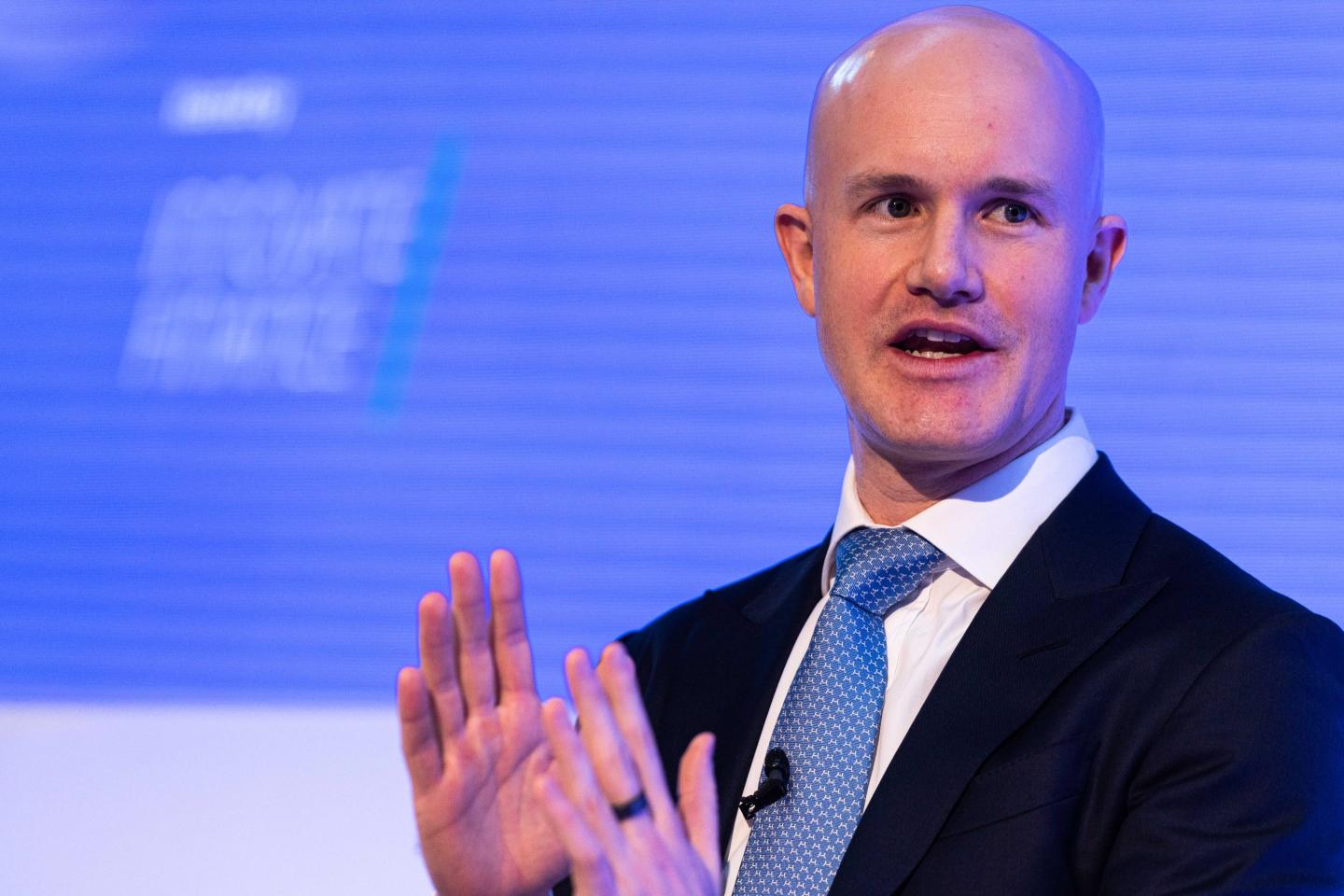
Coinbase’s share price dropped as much as 17% following a lawsuit today by the U.S. Securities and Exchange Commission, which says the company operated its crypto exchange “as an unregistered national securities exchange, broker, and clearing agency”—and that it illegally failed to register its staking-as-a-service program.
Coming just a day after the agency charged Binance for operating an unregistered exchange and sneaking past trading controls, this is definitely a full-frontal assault on some of the biggest names in the crypto sector.
For the grisly details, I’ll direct you to articles on both suits (Binance here and Coinbase here) by my very busy colleague Leo Schwartz, who describes today’s announcement as “yet another blow to the reeling crypto industry, with Coinbase long presenting itself as a legally compliant player in the volatile sector.”
Here’s Coinbase chief legal officer Paul Grewal: “The SEC’s reliance on an enforcement-only approach in the absence of clear rules for the digital asset industry is hurting America’s economic competitiveness and companies like Coinbase that have a demonstrated commitment to compliance.”
And here’s SEC enforcement chief Gurbir S. Grewal: “You simply can’t ignore the rules because you don’t like them or because you’d prefer different ones: The consequences for the investing public are far too great. As alleged in our complaint, Coinbase was fully aware of the applicability of the federal securities laws to its business activities, but deliberately refused to follow them. While Coinbase’s calculated decisions may have allowed it to earn billions, it’s done so at the expense of investors by depriving them of the protections to which they are entitled.”
Meanwhile, outside Cryptoland, Microsoft will pay $20 million to settle Federal Trade Commission charges over its alleged violations of the Children’s Online Privacy Protection Act (COPPA)—which the FTC has been vigorously enforcing of late. The agency said Microsoft was collecting under-13s’ personal data before notifying parents and getting their consent; not telling parents what data it collects, why it collects it, and with whom it shares said data; and hanging on to the kids’ data for too long.
From my perch in Europe, I always find it remarkable how privacy protections available to everyone here are for some reason only available to kids in the U.S. At least the FTC is making sure to give teeth to the rules it has to work with.
More news below.
Want to send thoughts or suggestions to Data Sheet? Drop a line here.
David Meyer
Data Sheet’s daily news section was written and curated by Andrea Guzman.
NEWSWORTHY
Apple’s gamble on its mixed-reality headset. Apple unveiled its $3,499 Vision Pro headset on Monday, demonstrating its typical flair in entering a market late with a product more stylish than its competitors and charging a premium. The device, which lets users maneuver through FaceTime, email, and other tools using just their eyes, hands, and voice will be available sometime early next year and will support streaming on Disney+ and Unity games. Because of its high price, analysts predict it won’t initially catch on with mainstream consumers, but that could change in the years ahead as the cost comes down.
Reddit defends its new pricing plan. Reddit’s new pricing for third-party app developers to access the site’s APIs has developers like those behind Narwhal and Apollo worried that they cannot afford it. Reddit says it is committed to supporting a developer ecosystem but needs to be fairly compensated to support “high usage” third-party apps. The pricing of $0.24 per 1,000 API calls is “based on usage levels that we measure to be comparable to our own costs,” Reddit told Bloomberg. But some of its users are jumping to the defense of developers as its most popular communities make plans to set themselves to private, or “go dark” as part of a 48-hour protest next week over the new pricing.
TikTok users in Hong Kong allegedly had data accessed. A former executive at the parent company of video-sharing app TikTok, alleges that a committee of China’s Communist Party members accessed the data of TikTok users in Hong Kong in 2018. The Wall Street Journal reported on the claims, which say that the committee members looked at the activity of civil rights activists and protesters in Hong Kong, using TikTok to access their network information, SIM card identifications, and IP addresses to identify and locate them. The former executive said the data also included the users’ communications on TikTok. The company denies the allegations, which are part of a new filing in a wrongful-dismissal lawsuit by Yintao Yu, who worked as head of engineering for ByteDance’s U.S. offices in 2017 and 2018.
This Day in Tech History
Birth of Tetris. In 1984, a software engineer at the Soviet Academy of Sciences in Moscow named Alexey Pajitnov built the game Tetris as a way to test a new computer known as the Electronika 60. The game was first played by programmers with access to that computer, but its popularity quickly spread. A salesman for a software company called Andromeda came across the game in Hungary and asked for the rights to sell it as a computer game in the West. It was eventually released as a commercial PC title in the U.K. and the U.S. in 1988. It later came to the Game Boy console, which Pajitnov considers the best version of the game, and sold 35 million units, CNN reports.
IN CASE YOU MISSED IT
Ducking finally! Apple is using A.I. to let users type what they really mean, by Prarthana Prakash
Hollywood writers are having a steampunk moment, Barclays says. A.I. really will change everything—a few decades from now, by Rachel Shin
A blog post detailed a Sam Altman freakout about a huge chips shortage threatening OpenAI. Then it was taken down, by Jeremy Kahn
Gen Z is investing younger than any past generation and American Gen Zers are leading the way—with crypto acting as the gateway drug, by Orianna Rosa Royle
The IMF’s No. 2 official says experts were wrong to ignore lost jobs from automation—and warns we ‘don’t have the luxury of time’ to regulate A.I., by Prarthana Prakash
BEFORE YOU GO
The metaverse of the Tamagotchi world. The newest generation of interactive virtual pets, known as Tamagotchis, are being released by Bandai Namco Toys, which promises to let users connect via the Tamaverse.
Now available for preorder and released on July 15, the Tamagotchi Uni flashes an in-device social platform available in seven languages that allows users to connect with their friend’s Tamagotchi to go on playdates, exchange gifts, and marry each other. Consumers can expect updates with new Tamaverse areas and items, and can also play mini-games and access popular and new characters. Still, it won’t allow for direct communication between players, like Meta’s Horizon Worlds or Epic Games’ Fortnite, The Verge reports.
This is the web version of Data Sheet, a daily newsletter on the business of tech. Sign up to get it delivered free to your inbox.