
Good morning. Big day at the office: A new edition of the Fortune 500 has arrived.
As always, lots to unpack about our iconic, annual (since 1955!) list of the largest U.S. companies by revenue.
To get started, allow me to focus your attention on the dearly beloved Magnificent 7 tech firms:
—Amazon takes the top spot, breaking Walmart’s 13-year streak as the No. 1 company.
—Apple stays parked at No. 4.
—Alphabet moves up two spots to No. 5 and repeats as the most profitable company (in terms of absolute dollars) with more than $100 billion.
—Nvidia, jumps 15 spots to No. 16 with a 66% gain in revenue.
—Meta jumps five spots to No. 17, its highest-ever rank.
—Microsoft rises one spot to No. 11, its highest-ever rank.
—Tesla repeats at No. 43 despite a 3% decline in revenue.
There’s plenty more to dig through (peep Uber’s ascent and Arista Networks’ arrival, for example) so don’t hesitate to poke around.
In the meantime, more tech news below. —Andrew Nusca
Want to send thoughts or suggestions to Fortune Tech? Drop a line here.
Trump issues his long-awaited, scaled-back AI order
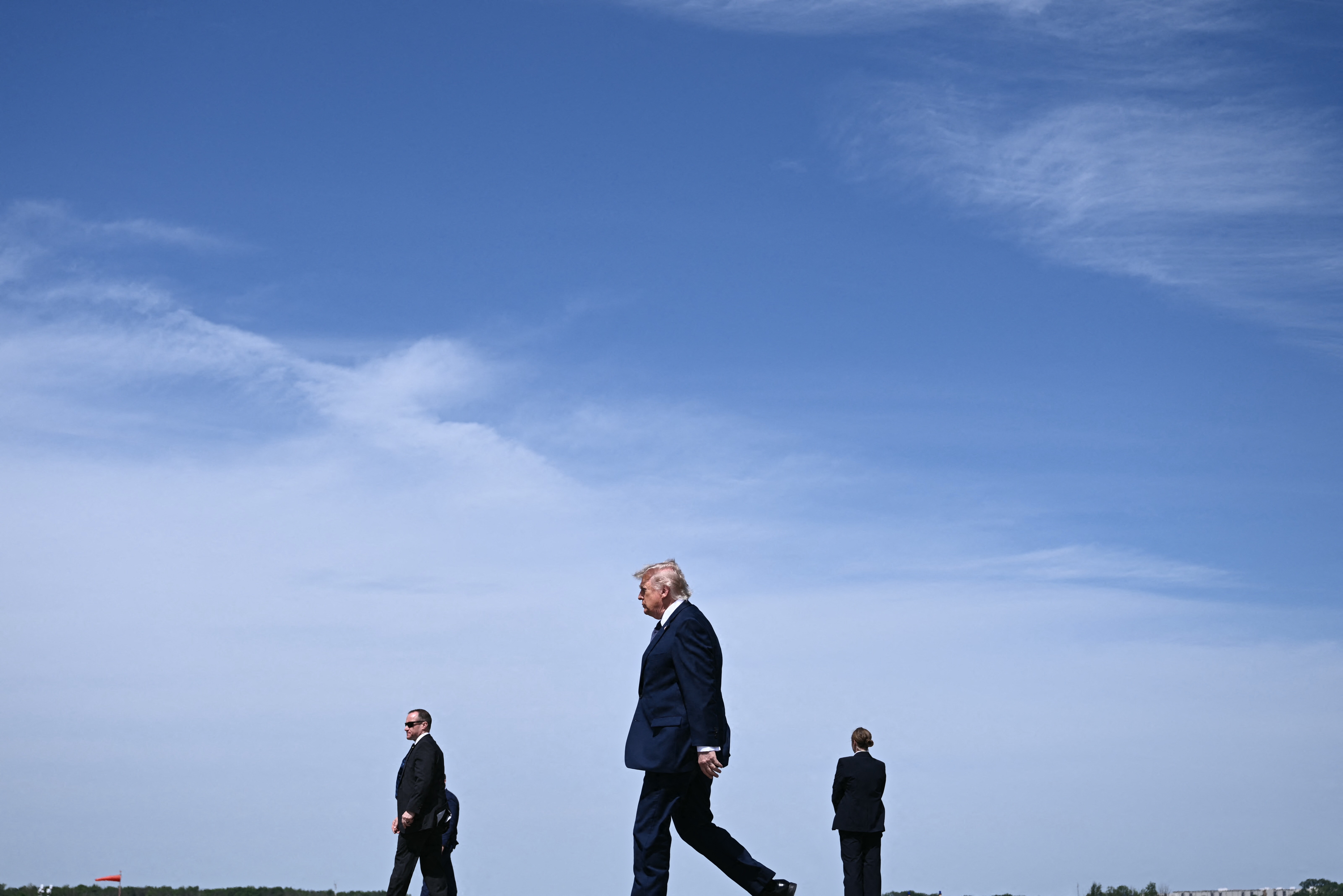
President Trump’s long-rumored executive order about artificial intelligence has finally dropped.
The EO, published Tuesday with little fanfare, aims to address cybersecurity threats posed by AI.
It calls for the prioritization of cyber defense, the provision of cybersecurity tools and services (including frontier models) for government agencies and various other organizations, and a voluntary “AI cybersecurity clearinghouse” for the patching of software vulnerabilities, among other things.
The order is substantially less aggressive than the one the White House had reportedly hoped for—a sign that the tech industry was able to successfully push back on additional federal oversight.
For example, the current order requests a 30-day review of AI companies’ new models; an earlier draft, set to be signed on May 21, “had called for a voluntary review as much as 90 days in advance,” according to a Politico report.
The earlier draft “had received signoff by White House officials at the highest levels and had been reviewed by the tech giants OpenAI, Anthropic and Google,” according to the report. “But former AI czar David Sacks warned Trump hours before the planned signing that the order would slow innovation.”
That’s putting it lightly. Surely on administration minds? The looming risk that powerful new AI models like Anthropic’s Mythos would allow adversaries to find and exploit software flaws faster than the federal government can patch them. —AN
DeepSeek is reportedly fundraising at a $59 billion valuation
Speaking of China…the Hangzhou AI startup DeepSeek is reportedly on the cusp of raising about 50 billion yuan (or approx. $7.4 billion) in its first funding round.
According to Reuters, investors include Tencent (10 billion yuan), the lithium-ion battery king CATL (5 billion yuan), and founder Liang Wenfeng, who “committed 20 billion yuan of his own money.”
The fundraise may yet include investments from gaming developer NetEase, retailer JD.com, and China's national artificial intelligence fund, according to the report.
The round is believed to value the company between 350 billion yuan and 400 billion yuan—that is, between $52 billion and $59 billion.
DeepSeek, you’ll recall, shocked the world last year when its inexpensive V3 and R1 models challenged the Silicon Valley notion that extraordinary sums of money were necessary to produce cutting-edge large language models, or LLMs.
Amid the U.S.-China AI arms race, though, DeepSeek is just one gear in a national machine that aims to power a self-sufficient AI industry in China.
Really, though, the competition begins at home. As OpenAI, Anthropic, Google, and Microsoft duke it out in the U.S., Alibaba, ByteDance, DeepSeek, and Tencent are doing the same in China.
If and when the round closes, expect DeepSeek’s new capital to pay for more computing infrastructure and talent—much the same as its peers, on both sides of the Pacific. —AN
Microsoft introduces its first advanced reasoning AI model
By gum, there’s an awful lot of Microsoft news this week, thanks to its annual Build developers’ conference.
There’s Project Solara, an agent-first computing platform. There’s ASSERT, an open-source framework to let developers run AI behavior tests. There’s a partnership with the Mayo Clinic for an AI healthcare assistant running on medical data. And there are seven—count ‘em, seven!—new AI models.
The most notable? Microsoft’s flagship MAI-Thinking-1, its first advanced reasoning AI model.
Microsoft calls it a “medium-sized model” that matches leading models on benchmarks and beats Anthropic’s Sonnet 4.6, which was released in February, in blind anecdotal tests.
“We trained it from the ground up on enterprise grade, clean and commercially licensed data, without distillation from third-party models,” Microsoft wrote in a blog post. “MAI-Thinking-1 is a step in our broader work to build towards Humanist Superintelligence: advanced AI capabilities designed to serve people and organizations, not to replace them.”
The new model promises strong mathematical and scientific reasoning, comfort with long context and multiple layers of instructions, and enterprise-grade security and compliance. Microsoft said it wanted the model “to be capable without being brittle, concise without being incomplete, and helpful without overreaching.” (Who among us, really.)
It’s now available in private preview via Microsoft Foundry (née Azure AI Studio) and will be released to the public “soon.” —AN
More tech
—Anthropic’s Project Glasswing, which includes Mythos AI model access, expands to organizations in 15 nations.
—Bitcoin sentiment sours, triggering more than $1.5 billion in crypto liquidations in a day’s time.
—Marvell shares leap 32% after Nvidia CEO Jensen Huang calls the chipmaker the “next trillion-dollar company.”
—Microsoft promises a “scalable quantum computer that is commercially valuable” by 2029.
—Palo Alto Networks beats Wall Street estimates for Q3 revenue and offers a sunny Q4 forecast.
—Uber caps employees’ AI costs. A $1,500 limit in monthly token spending per tool.
—The U.S. sanctions Nobitex, Iran's largest crypto exchange, on accusations of helping its government evade sanctions.