• Home
  • Latest
  • Fortune 500
  • Finance
  • Tech
  • Leadership
  • Lifestyle
  • Rankings
  • Multimedia
FinanceBanks

New York Fed economists explain why SVB and Signature Bank suddenly turned into rural 1930s banks without deposit insurance

By
Tristan Bove
Tristan Bove
Contributing Reporter
Down Arrow Button Icon
By
Tristan Bove
Tristan Bove
Contributing Reporter
Down Arrow Button Icon
May 15, 2023, 6:08 PM ET
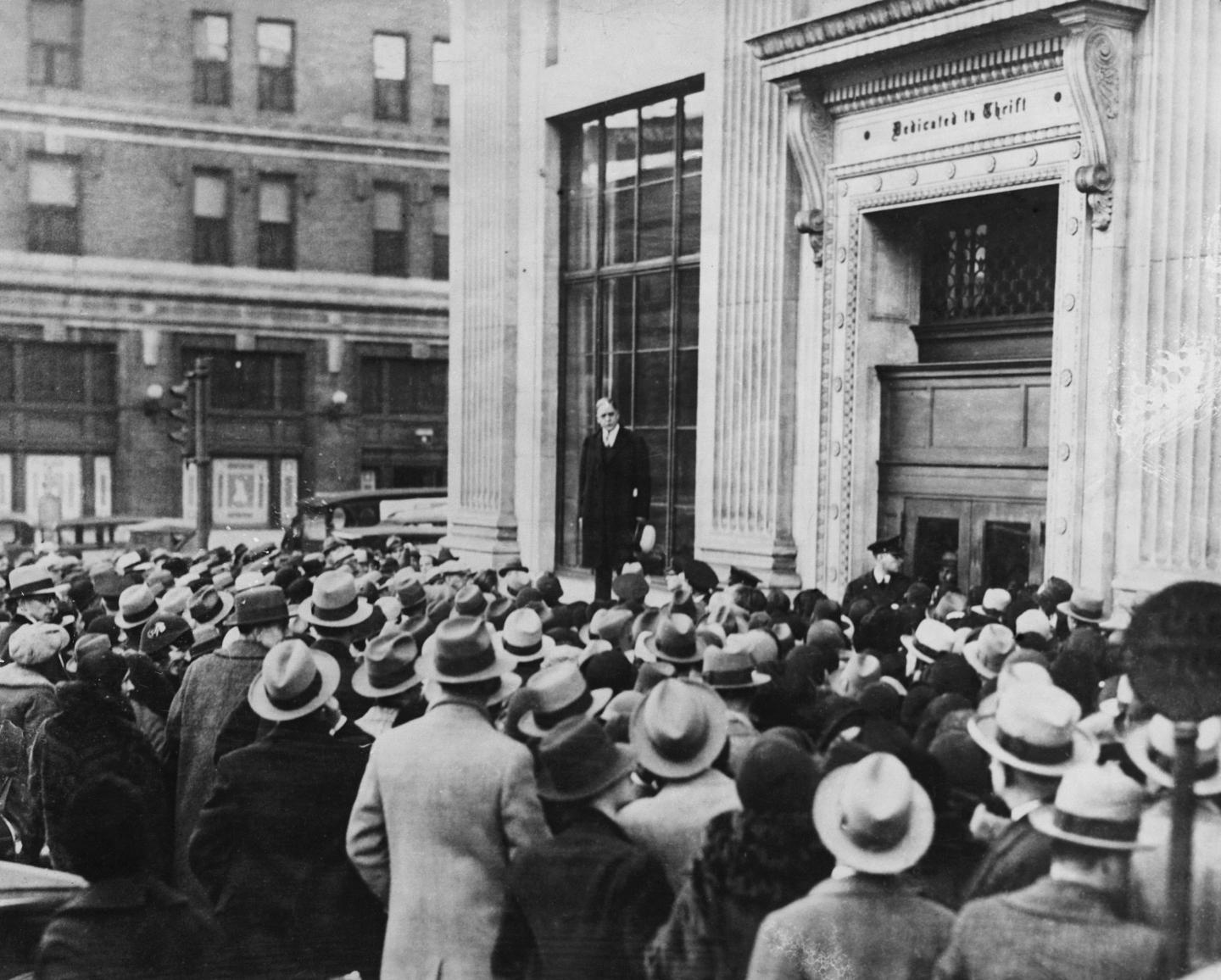
John Poole, president of the Federal American Bank, addresses a crowd of depositors in 1933.
John Poole, president of the Federal American Bank, addresses a crowd of depositors in 1933.Hulton-Deutsch Collection/CORBIS/Corbis via Getty Images

In the wake of Depression-era bank runs that caused thousands of financial institutions to fail, the government began doing something different in the 1930s—it created the FDIC and started insuring deposits. It was intended to make people feel confident in the banking system, and less likely to pull their money out. 

Recommended Video

But that deposit insurance only goes so far—up to $250,000 for each depositor, to be exact. So when Silicon Valley Bank and Signature Bank collapsed in March and sent ripple effects throughout the banking sector, many pointed to the banks’ swathes of uninsured deposits totalling in the millions and billions as one of the main factors behind the panic, along with the Federal Reserve’s interest rate hikes and depositor panic fueled by social media. 

Although SVB and Signature were covered by the Federal Deposit Insurance Corporation, the nature of their deposits—many uninsured and in a small amount of industries—has similarities with the 9,000 banks that failed in the 1930s, according to a new blog post by economists with the Federal Reserve Bank of New York. 

The authors argue that like Depression-era banks in tiny rural communities, deposits with SVB and Signature were held by a small number of like-minded people, many of whom worked in the same industry and spoke with each other frequently. The banks also failed to control the narrative, which magnified the risk of a chaotic bank. 

With their “concentrated and uninsured deposit bases,” Silicon Valley Bank and Signature Bank look “quite similar to the small rural banks of the 1930s, before the creation of deposit insurance,” the Fed economists wrote.

Parallels to the 1930s

During the first years of the Great Depression, thousands of bank failures led to $1.3 billion in losses for depositors. But the damage was likely magnified because of the lack of deposit insurance—individual bank customers were more likely to pull out their money out of a bank at the first signs of trouble. 

“Before the FDIC was in operation, large-scale cash demands of fearful depositors often struck the fatal blow to banks that might otherwise have survived,” the FDIC’s website states. Many of those failed banks were dedicated to rural communities, with the majority of their depositors being local and employed in the agricultural sector. 

Although SVB and Signature banks didn’t cater to small town farmers, the Fed economists pointed out that their depositors were also part of tight-knit communities—in finance, tech and law. 

“Both SVB and SB had a depositor base that looked local, in that depositors reportedly interacted with one another in their regular business dealings,” they wrote. “SVB’s depositors were connected through venture capital networks and SB’s depositors were connected through law firm networks.”

Before its collapse, SVB had made a name for itself as the bank of choice for California’s startup and venture capital elite. Nearly half of all U.S. venture-backed startups banked with SVB, according to the bank itself, and its big gamble to concentrate on tech, which for years seemed like a good bet, eventually came back to bite it as a significant number of its clients were affected by evaporated VC funding over the past year.

Signature also had a concentration problem, as one of the only banks to offer services to crypto companies after many others began turning their backs on the sector earlier this year. Signature’s deposits were more diversified than Silvergate, a bank highly-focused on cryptocurrency that also collapsed in March, but was still reliant on customers from a relatively small pool of industries, as Signature was largely concentrated in banking services for real estate and law firms.

Because the bulk of both banks’ clients were companies, most deposits also exceeded the FDIC’s insurable limit of $250,000. In fact, the two banks had some of the highest proportions of uninsured deposits in the whole banking sector. Among banks with at least $50 billion in assets, SVB had the highest share of uninsured deposits at 93.8%, while Signature came in fourth with 89.3%, according to S&P Global Market Intelligence.

As many of the bank’s depositors knew each other professionally, the bank runs happened almost overnight, as account-holders spread panic on social media and instant messaging platforms like Twitter, Slack, and Whatsapp, with some venture capitalists telling their portfolio companies on group chats to move their funds out of SVB “as fast as possible,” magnifying the risks of concentration.

The New York Fed economists argued that the banks’ failure of communication and transparency was chiefly responsible for the sudden run, while advising other institutions to focus on managing narratives around risk that might threaten to erode confidence in future. 

Like the small rural banks that failed a century ago, banks like SVB and Signature with highly concentrated and localized customer bases need to be adept at handling information to restore confidence before panic, which justified or not, undermines the financial soundness of banking institutions, the New York Fed economists wrote.

“Both SVB and SB, like the small rural banks before the creation of the FDIC, should have been acutely aware of the importance of managing the information about their balance sheet,” they said. “Looking ahead, our work emphasizes that banks need to remain aware of, and actively manage, the information about balance sheet risks that is presented to their depositors, especially in times of financial stress.”

Join us at the Fortune Workplace Innovation Summit May 19–20, 2026, in Atlanta. The next era of workplace innovation is here—and the old playbook is being rewritten. At this exclusive, high-energy event, the world’s most innovative leaders will convene to explore how AI, humanity, and strategy converge to redefine, again, the future of work. Register now.
About the Author
By Tristan BoveContributing Reporter
LinkedIn iconTwitter icon
See full bioRight Arrow Button Icon

Latest in Finance

Finance
Lorem ipsum dolor sit amet, consectetur adipiscing elit, sed do eiusmod tempor incididunt ut labore et dolore magna aliqua. Ut enim ad minim veniam
By Fortune Editors
October 20, 2025
Finance
Lorem ipsum dolor sit amet, consectetur adipiscing elit, sed do eiusmod tempor incididunt ut labore et dolore magna aliqua. Ut enim ad minim veniam
By Fortune Editors
October 20, 2025
Finance
Lorem ipsum dolor sit amet, consectetur adipiscing elit, sed do eiusmod tempor incididunt ut labore et dolore magna aliqua. Ut enim ad minim veniam
By Fortune Editors
October 20, 2025
Finance
Lorem ipsum dolor sit amet, consectetur adipiscing elit, sed do eiusmod tempor incididunt ut labore et dolore magna aliqua. Ut enim ad minim veniam
By Fortune Editors
October 20, 2025
Finance
Lorem ipsum dolor sit amet, consectetur adipiscing elit, sed do eiusmod tempor incididunt ut labore et dolore magna aliqua. Ut enim ad minim veniam
By Fortune Editors
October 20, 2025
Finance
Lorem ipsum dolor sit amet, consectetur adipiscing elit, sed do eiusmod tempor incididunt ut labore et dolore magna aliqua. Ut enim ad minim veniam
By Fortune Editors
October 20, 2025

Most Popular

Finance
Lorem ipsum dolor sit amet, consectetur adipiscing elit, sed do eiusmod tempor incididunt ut labore et dolore magna aliqua. Ut enim ad minim veniam
By Fortune Editors
October 20, 2025
Finance
Lorem ipsum dolor sit amet, consectetur adipiscing elit, sed do eiusmod tempor incididunt ut labore et dolore magna aliqua. Ut enim ad minim veniam
By Fortune Editors
October 20, 2025
Finance
Lorem ipsum dolor sit amet, consectetur adipiscing elit, sed do eiusmod tempor incididunt ut labore et dolore magna aliqua. Ut enim ad minim veniam
By Fortune Editors
October 20, 2025
Finance
Lorem ipsum dolor sit amet, consectetur adipiscing elit, sed do eiusmod tempor incididunt ut labore et dolore magna aliqua. Ut enim ad minim veniam
By Fortune Editors
October 20, 2025
Finance
Lorem ipsum dolor sit amet, consectetur adipiscing elit, sed do eiusmod tempor incididunt ut labore et dolore magna aliqua. Ut enim ad minim veniam
By Fortune Editors
October 20, 2025
Finance
Lorem ipsum dolor sit amet, consectetur adipiscing elit, sed do eiusmod tempor incididunt ut labore et dolore magna aliqua. Ut enim ad minim veniam
By Fortune Editors
October 20, 2025
Fortune Secondary Logo
Rankings
  • 100 Best Companies
  • Fortune 500
  • Global 500
  • Fortune 500 Europe
  • Most Powerful Women
  • Future 50
  • World’s Most Admired Companies
  • See All Rankings
Sections
  • Finance
  • Fortune Crypto
  • Features
  • Leadership
  • Health
  • Commentary
  • Success
  • Retail
  • Mpw
  • Tech
  • Lifestyle
  • CEO Initiative
  • Asia
  • Politics
  • Conferences
  • Europe
  • Newsletters
  • Personal Finance
  • Environment
  • Magazine
  • Education
Customer Support
  • Frequently Asked Questions
  • Customer Service Portal
  • Privacy Policy
  • Terms Of Use
  • Single Issues For Purchase
  • International Print
Commercial Services
  • Advertising
  • Fortune Brand Studio
  • Fortune Analytics
  • Fortune Conferences
  • Business Development
About Us
  • About Us
  • Editorial Calendar
  • Press Center
  • Work At Fortune
  • Diversity And Inclusion
  • Terms And Conditions
  • Site Map
Fortune Secondary Logo
  • About Us
  • Editorial Calendar
  • Press Center
  • Work At Fortune
  • Diversity And Inclusion
  • Terms And Conditions
  • Site Map
  • Facebook icon
  • Twitter icon
  • LinkedIn icon
  • Instagram icon
  • Pinterest icon

Latest in Finance

paramount
LawM&A
Warner Bros. officially deems Paramount’s bid ‘superior,’ and Netflix withdraws
By Nick LichtenbergFebruary 26, 2026
10 hours ago
President Donald Trump pictured in North Carolina standing in front of an American flag
EconomyHealth
Medicare spending set to nearly double in 10 years and Medicaid and ACA spending up a third, CBO says, just as Trump’s tax cuts shorten their life span
By Tristan BoveFebruary 26, 2026
10 hours ago
An office building that houses the Jane Street Group headquarters
CryptoBitcoin
Bitcoin fans latch on to ‘ridiculous’ Jane Street conspiracy to explain price slump
By Jeff John RobertsFebruary 26, 2026
12 hours ago
broker
EconomyMarkets
Citadel Securities demolishes viral AI doomsday essay, arguing the real ‘Global Intelligence Crisis’ is ignorance of macro fundamentals
By Nick LichtenbergFebruary 26, 2026
12 hours ago
michigan
LawChina
China’s government intervenes to show Michigan scientists were carrying worms, not biological materials
By Ed White and The Associated PressFebruary 26, 2026
13 hours ago
A man sits in his bedroom at a desk, looking at his laptop and taking a phone call.
Future of Workremote work
Remote employees have quietly unlocked one major workplace perk: Getting paid 12% more than their in-office colleagues, Fed study finds
By Sasha RogelbergFebruary 26, 2026
13 hours ago

Most Popular

placeholder alt text
Innovation
An MIT roboticist who cofounded bankrupt robot vacuum maker iRobot says Elon Musk’s vision of humanoid robot assistants is ‘pure fantasy thinking’
By Marco Quiroz-GutierrezFebruary 25, 2026
2 days ago
placeholder alt text
Success
Jeff Bezos says being lazy, not working hard, is the root of anxiety: ‘The stress goes away the second I take that first step’
By Sydney LakeFebruary 25, 2026
2 days ago
placeholder alt text
Economy
Trump claims America is ‘winning so much.’ The IMF agrees, adding that Trump’s trade policies are the only thing holding it back from even more
By Tristan BoveFebruary 26, 2026
13 hours ago
placeholder alt text
Success
Gen Z Olympic champion Eileen Gu says she rewires her brain daily to be more successful—and multimillionaire founder Arianna Huffington says it really does work
By Orianna Rosa RoyleFebruary 25, 2026
2 days ago
placeholder alt text
AI
Jamie Dimon says society should start preparing for AI job displacement: ‘Now’s the time to start thinking about’ it
By Marco Quiroz-GutierrezFebruary 25, 2026
2 days ago
placeholder alt text
Success
Ex–presidential candidate Andrew Yang warns that millions of white-collar workers will lose their jobs within 18 months: ‘The AI jobpocalypse is here’
By Preston ForeFebruary 25, 2026
2 days ago

© 2026 Fortune Media IP Limited. All Rights Reserved. Use of this site constitutes acceptance of our Terms of Use and Privacy Policy | CA Notice at Collection and Privacy Notice | Do Not Sell/Share My Personal Information
FORTUNE is a trademark of Fortune Media IP Limited, registered in the U.S. and other countries. FORTUNE may receive compensation for some links to products and services on this website. Offers may be subject to change without notice.