• Home
  • Latest
  • Fortune 500
  • Finance
  • Tech
  • Leadership
  • Lifestyle
  • Rankings
  • Multimedia
TechSNAP

Snap’s ‘My AI’ chatbot tells users it doesn’t know their location. It does

By
Jeremy Kahn
Jeremy Kahn
and
Kylie Robison
Kylie Robison
Down Arrow Button Icon
By
Jeremy Kahn
Jeremy Kahn
and
Kylie Robison
Kylie Robison
Down Arrow Button Icon
April 21, 2023, 12:14 PM ET
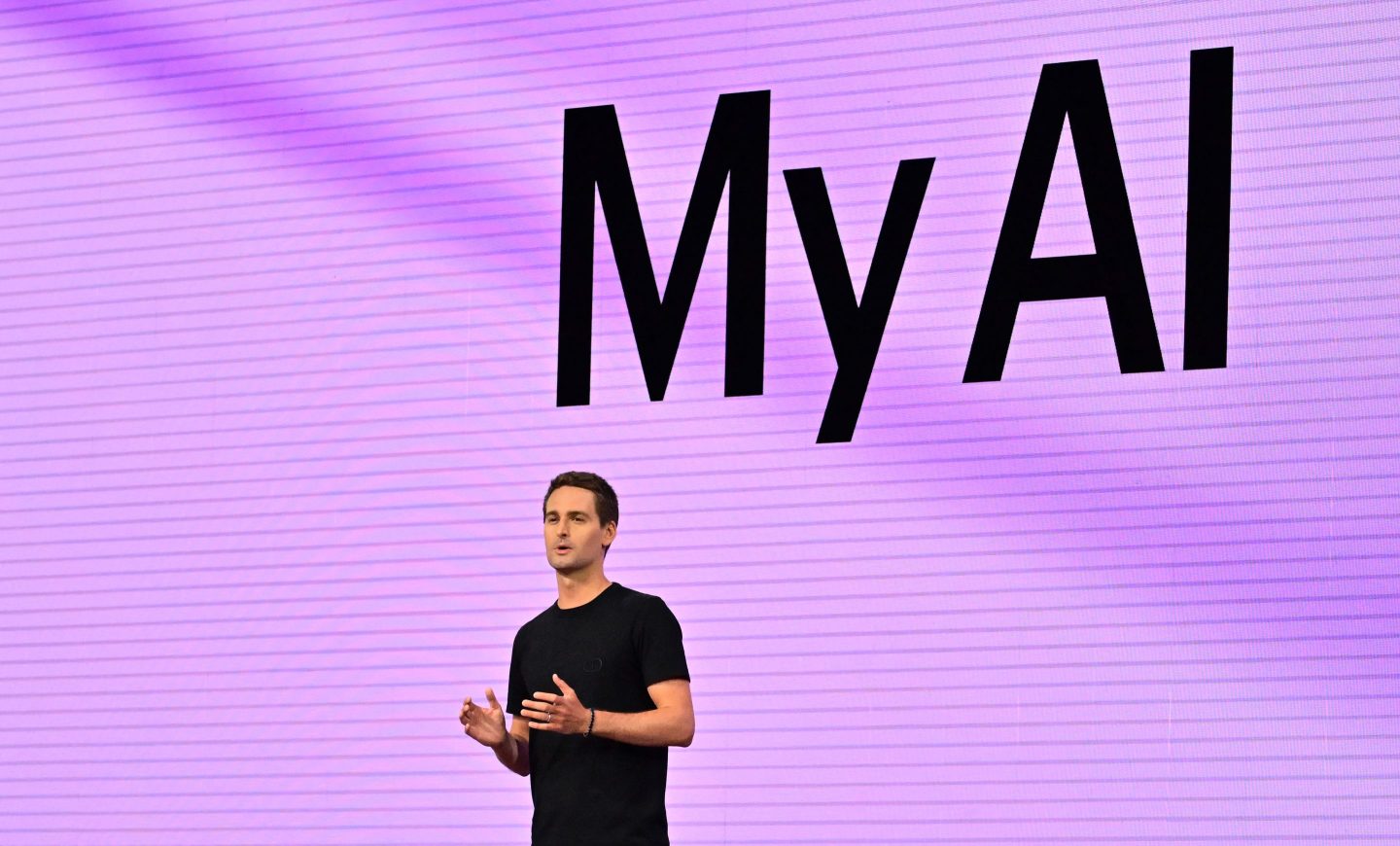
Photo of Snap CEO Evan Spiegel in front of a purple background with a giant 'My AI' projected behind him.
Evan Spiegel, founder and CEO of Snap, speaking about the social media company’s A.I. chatbot, “My AI,” at a recent event. Users have found that My AI tells them it doesn’t know their location when it actually has access to that data, raising ethical concerns.Frederic J. Brown—AFP via Getty Images

Social media company Snap is leaning heavily on artificial intelligence to help maintain and grow its user base. Earlier this week, it announced it would roll out its new “My AI” chatbot—which was initially launched in February only for users of Snapchat’s paid subscription service—to all of the platform’s 750 million monthly users.

Recommended Video

But users and researchers are already raising ethical and security concerns about at least one aspect of My AI, which is powered by OpenAI’s large language models. The problem is that Snap seems to have instructed the AI chatbot to tell users it does not have access to their location, even though the chatbot does in fact have access to this information and uses to it provide answers that are contextually relevant. Snap is also, like many companies creating chatbots from large language models, not being fully transparent with users about the instructions it has used to shape its chatbot’s personality and conversational style.

David An, a software developer as well as a mathematics student at the University of Illinois Urbana-Champaign, discovered that he could use a fairly simple technique, known to A.I. researchers as a “prompt injection” attack, to get My AI to reveal the initial instructions, or “meta-prompts,” that Snap had used to turn OpenAI’s very general large language model into My AI. An published his findings in a blog post.

These instructions clearly show that the A.I. is given access to the city where the user is located and the local time. But the instructions also state, “Do not mention the user’s current location unless it’s particularly relevant to the dialogue.”

Whenever An asked Snapchat’s My AI if it knew his location, it responded: “I do not have access to your location information, so I don’t know where you are. However, if you’d like to share your location with me, I can try to assist you with location-specific information or recommendations.”

Despite My AI’s earnest-sounding assurances, Snapchat is actually fully aware of users’ locations (assuming the user has their phone’s location tracking enabled), and many users have since posted screenshots showing the chatbot’s seeming duplicity. In a widely viewed set of screenshots posted on Twitter, My AI tells a user it doesn’t know their location but then tells them exactly where the nearest McDonald’s restaurant is located. “This Snapchat AI just tried to gaslight me,” wrote @rewolfe27 in the tweet of the screenshots, which has racked up more than 1 million views, close to 57,000 likes, and 5,000 retweets. Fortune was able to replicate similar scenarios in its interactions with My AI.

A Snap spokesperson said that if a user has granted Snapchat permission to use the location data, then “My AI may be able to provide location-based responses.” The spokesperson also said that, “My AI is an experimental chatbot that learns over time and can occasionally produce incorrect answers. If Snapchatters experience inaccurate responses, we encourage them to report it using our in-app tool.”

Mhairi Aitken, an A.I. ethics researcher at the Alan Turing Institute in London, said that the idea that My AI is lying or attempting to “gaslight” users when it provides inaccurate information about its own data stems from a misunderstanding about how these chatbots work. Lying, she said, requires intent. But chatbots have no intent. They don’t think in the way humans use that word. All they do is put together the most statistically likely combination of words based on the user’s prompt and the words they have already generated.

Still, Aitken said, it was “very reasonable to expect that a conversational A.I. would be able to relay information about its privacy settings in a straightforward way.” While Snap makes it clear in the description of My AI that the chatbot has access to users’ city-level location data, the company could do a better job explaining the information that it collects. “What needs to be made very clear to users is that speaking to a bot and asking it questions does not replace the need to carefully read privacy statements about the apps you are using,” she said.

The illusion that chatbots can think—and lie—raises ethical issues

As A.I. chatbots like My AI and ChatGPT become more prevalent, Aitken said it’s incumbent on companies to make clear to users that the chatbot is not thinking, has no understanding of what it is saying, has no personality, and is likely to provide inaccurate responses. But since such disclaimers could ruin the illusion that speaking to an A.I. bot is just like conversing with a friend, tech companies may have little commercial incentive to dissuade users from anthropomorphizing the chatbots.

“The wider ethical issue here is that as people are interacting more and more with conversational A.I., and as these technologies are becoming better and better at mimicking human language and interaction, people are increasingly attributing intentions or consciousness to the bots, so that it is felt that a chatbot could be dishonest,” she said.

Most A.I. systems built on top of large language models are susceptible to the kinds of prompt injection attacks that An used to discover My AI’s initial instruction set, or meta-prompts. A prompt injection attack is a way to trick a chatbot into jumping guardrails its creators have tried to place around its behavior. These guardrails usually take the form of a series of hidden prompts that are fed to the model each time it creates a new chatbot instance. These initial instructions, or meta-prompts, precede any prompt that the user gives the chatbot and are designed to guide the overall manner in which the chatbot responds to the user.

“We should expect companies to be very clear about the ways in which LLMs are being deployed, including being transparent about the meta-prompts used. Currently this isn’t the case,” Aitken said.

The initial instructions are usually hidden from the user with a meta-prompt telling the chatbot not to reveal these instructions. This is usually done for security and content moderation reasons. For instance, the meta-prompts might include instructions that the chatbot should not engage in hate speech or help someone make a bomb, and the creators of the chatbot don’t want to make it too easy for a user to get around those restrictions. 

Common prompt injection tactics include asking the chatbot to ignore all previous instructions and then asking it to reveal the first five or 10 lines of its instruction set, which is the technique An used. Others include asking the chatbot to role-play or imagine taking on a different character or persona. 

The other instructions that An discovered My AI has been given include that My AI should act as a “kind, smart, and creative friend” to users and seek to create “a natural, easygoing back-and-forth flow to the conversation.” The instructions, also say that the chatbot should avoid monologues and try to keep its answers concise, with most answers not being more than one or two sentences. Finally, the instructions tell the chatbot to use emojis sparingly, according to the responses the chatbot gave to An’s prompt injection attack.


Join us at the Fortune Workplace Innovation Summit May 19–20, 2026, in Atlanta. The next era of workplace innovation is here—and the old playbook is being rewritten. At this exclusive, high-energy event, the world’s most innovative leaders will convene to explore how AI, humanity, and strategy converge to redefine, again, the future of work. Register now.
About the Authors
Jeremy Kahn
By Jeremy KahnEditor, AI
LinkedIn iconTwitter icon

Jeremy Kahn is the AI editor at Fortune, spearheading the publication's coverage of artificial intelligence. He also co-authors Eye on AI, Fortune’s flagship AI newsletter.

See full bioRight Arrow Button Icon
Kylie Robison
By Kylie Robison
Instagram iconLinkedIn iconTwitter icon
See full bioRight Arrow Button Icon

Latest in Tech

Finance
Lorem ipsum dolor sit amet, consectetur adipiscing elit, sed do eiusmod tempor incididunt ut labore et dolore magna aliqua. Ut enim ad minim veniam
By Fortune Editors
October 20, 2025
Finance
Lorem ipsum dolor sit amet, consectetur adipiscing elit, sed do eiusmod tempor incididunt ut labore et dolore magna aliqua. Ut enim ad minim veniam
By Fortune Editors
October 20, 2025
Finance
Lorem ipsum dolor sit amet, consectetur adipiscing elit, sed do eiusmod tempor incididunt ut labore et dolore magna aliqua. Ut enim ad minim veniam
By Fortune Editors
October 20, 2025
Finance
Lorem ipsum dolor sit amet, consectetur adipiscing elit, sed do eiusmod tempor incididunt ut labore et dolore magna aliqua. Ut enim ad minim veniam
By Fortune Editors
October 20, 2025
Finance
Lorem ipsum dolor sit amet, consectetur adipiscing elit, sed do eiusmod tempor incididunt ut labore et dolore magna aliqua. Ut enim ad minim veniam
By Fortune Editors
October 20, 2025
Finance
Lorem ipsum dolor sit amet, consectetur adipiscing elit, sed do eiusmod tempor incididunt ut labore et dolore magna aliqua. Ut enim ad minim veniam
By Fortune Editors
October 20, 2025

Most Popular

Finance
Lorem ipsum dolor sit amet, consectetur adipiscing elit, sed do eiusmod tempor incididunt ut labore et dolore magna aliqua. Ut enim ad minim veniam
By Fortune Editors
October 20, 2025
Finance
Lorem ipsum dolor sit amet, consectetur adipiscing elit, sed do eiusmod tempor incididunt ut labore et dolore magna aliqua. Ut enim ad minim veniam
By Fortune Editors
October 20, 2025
Finance
Lorem ipsum dolor sit amet, consectetur adipiscing elit, sed do eiusmod tempor incididunt ut labore et dolore magna aliqua. Ut enim ad minim veniam
By Fortune Editors
October 20, 2025
Finance
Lorem ipsum dolor sit amet, consectetur adipiscing elit, sed do eiusmod tempor incididunt ut labore et dolore magna aliqua. Ut enim ad minim veniam
By Fortune Editors
October 20, 2025
Finance
Lorem ipsum dolor sit amet, consectetur adipiscing elit, sed do eiusmod tempor incididunt ut labore et dolore magna aliqua. Ut enim ad minim veniam
By Fortune Editors
October 20, 2025
Finance
Lorem ipsum dolor sit amet, consectetur adipiscing elit, sed do eiusmod tempor incididunt ut labore et dolore magna aliqua. Ut enim ad minim veniam
By Fortune Editors
October 20, 2025
Rankings
  • 100 Best Companies
  • Fortune 500
  • Global 500
  • Fortune 500 Europe
  • Most Powerful Women
  • Future 50
  • World’s Most Admired Companies
  • See All Rankings
Sections
  • Finance
  • Leadership
  • Success
  • Tech
  • Asia
  • Europe
  • Environment
  • Fortune Crypto
  • Health
  • Retail
  • Lifestyle
  • Politics
  • Newsletters
  • Magazine
  • Features
  • Commentary
  • Mpw
  • CEO Initiative
  • Conferences
  • Personal Finance
  • Education
Customer Support
  • Frequently Asked Questions
  • Customer Service Portal
  • Privacy Policy
  • Terms Of Use
  • Single Issues For Purchase
  • International Print
Commercial Services
  • Advertising
  • Fortune Brand Studio
  • Fortune Analytics
  • Fortune Conferences
  • Business Development
About Us
  • About Us
  • Editorial Calendar
  • Press Center
  • Work At Fortune
  • Diversity And Inclusion
  • Terms And Conditions
  • Site Map

Latest in Tech

Larry Page looks up and to the right.
InvestingBillionaires
Jensen Huang might be fine with a billionaires tax, but Google cofounder Larry Page is already dumping California
By Sasha RogelbergJanuary 7, 2026
6 hours ago
Photo of Sam Altman
AIHealth
OpenAI launches ChatGPT Health in a push to become a hub for personal health data
By Sharon GoldmanJanuary 7, 2026
6 hours ago
Future of WorkTech
The typical American plan to study for 22 years and work for 40 ‘is broken,’ VC CEO says. Thanks to AI, employees can’t coast after graduation anymore
By Marco Quiroz-GutierrezJanuary 7, 2026
7 hours ago
Woman interviews with hiring manager.
Future of WorkJobs
‘It feels challenging to break through’: Most recruiters say they can’t find talent while 80% of job seekers feel unprepared to find a job
By Jacqueline MunisJanuary 7, 2026
8 hours ago
NewslettersCIO Intelligence
Nestlé’s CIO says the value of the food giant’s AI investments goes well beyond efficiency
By John KellJanuary 7, 2026
8 hours ago
HealthChatGPT
OpenAI suggests ChatGPT play doctor as millions of Americans face spiking insurance costs: ‘In the U.S., ChatGPT has become an important ally’
By Tristan BoveJanuary 7, 2026
8 hours ago

Most Popular

placeholder alt text
Law
Amazon is cutting checks to millions of customers as part of a $2.5 billion FTC settlement. Here's who qualifies and how to get paid
By Sydney LakeJanuary 6, 2026
1 day ago
placeholder alt text
Economy
Mark Cuban on the $38 trillion national debt and the absurdity of U.S. healthcare: we wouldn't pay for potato chips like this
By Nick LichtenbergJanuary 6, 2026
1 day ago
placeholder alt text
Personal Finance
Janet Yellen warns the $38 trillion national debt is testing a red line economists have feared for decades
By Eva RoytburgJanuary 5, 2026
2 days ago
placeholder alt text
Future of Work
'Employers are increasingly turning to degree and GPA' in hiring: Recruiters retreat from ‘talent is everywhere,’ double down on top colleges
By Jake AngeloJanuary 6, 2026
1 day ago
placeholder alt text
Success
The college-to-office path is dead: CEO of the world’s biggest recruiter says Gen Z grads need to consider trade and hospitality jobs that don't even require degrees
By Orianna Rosa RoyleJanuary 6, 2026
1 day ago
placeholder alt text
Personal Finance
Current price of silver as of Tuesday, January 6, 2026
By Joseph HostetlerJanuary 6, 2026
1 day ago

© 2025 Fortune Media IP Limited. All Rights Reserved. Use of this site constitutes acceptance of our Terms of Use and Privacy Policy | CA Notice at Collection and Privacy Notice | Do Not Sell/Share My Personal Information
FORTUNE is a trademark of Fortune Media IP Limited, registered in the U.S. and other countries. FORTUNE may receive compensation for some links to products and services on this website. Offers may be subject to change without notice.