
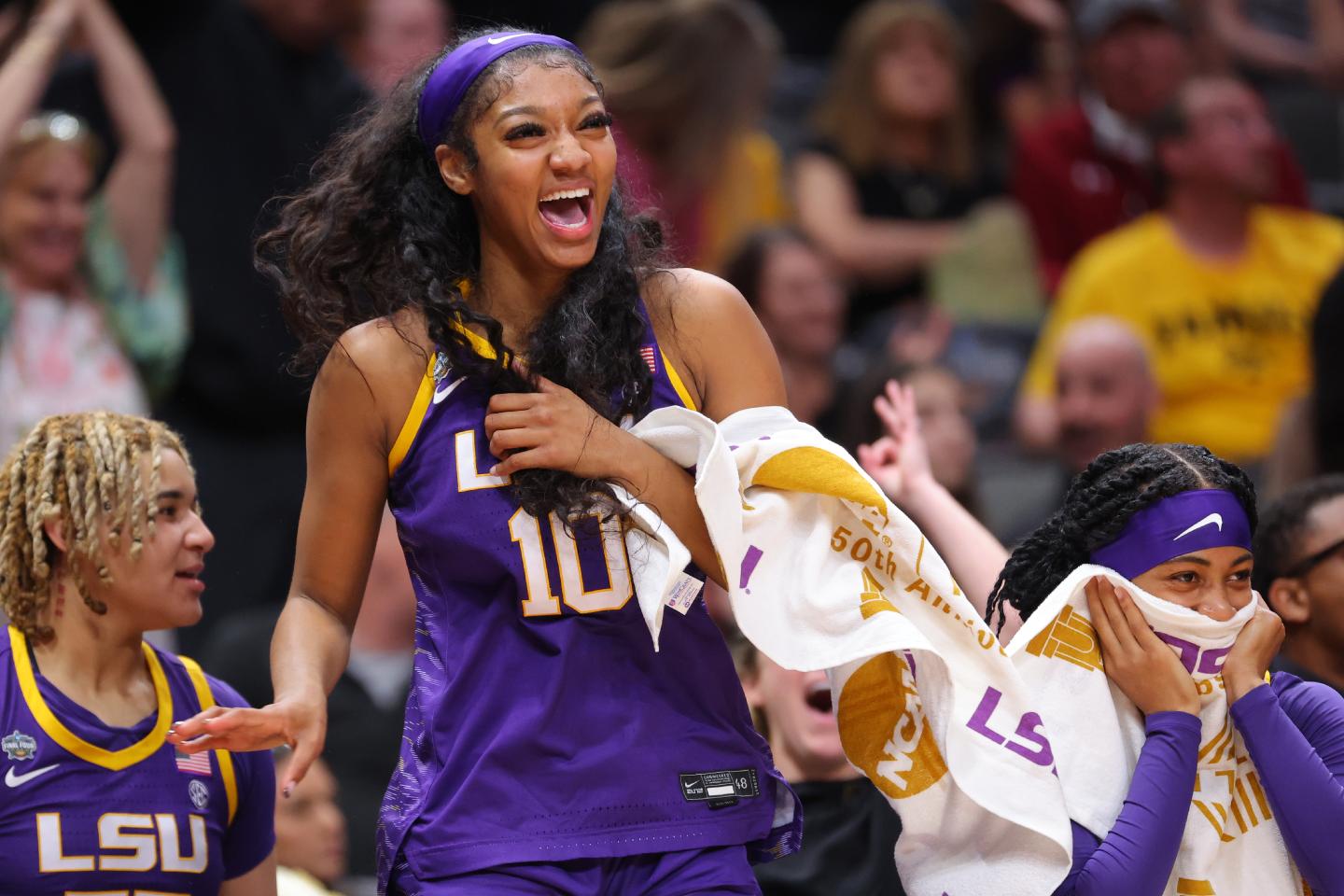
And the crowd went wild…unfortunately, for all the wrong reasons.
Until things went sideways, the 2023 NCAA Women’s Basketball Championships on Sunday night was a helluva game and a long-overdue affirmation that women’s teams sell tickets and galvanize fans.
The Women’s March Madness Final Four tournament had become the most viewed women’s college basketball semi-final event in ESPN history, so by the time the LSU Tigers and Iowa Buckeyes met in the final match-up, the sell-out crowd of 19,482 fans (and a still unknown number of viewers) was ready. It was drama from the start. LSU had never had a winning basketball program and placed its hopes in Kim Mulkey, a coach with three titles under her bedazzled belt, who brought the team to the top spot after only two years on the job.
Did I mention the drama?
Iowa superstar Caitlin Clark—expected to lead her team to victory—received a controversial technical foul that kept her sidelined during a critical part of the game. Ultimately, LSU blew by Iowa 102-85, despite extraordinary gameplay from Clark and the Iowa team. The game had it all: Highs, lows, refs to yell at, the thrill of an underdog team going the distance, the agony of defeat, and diehard fans typically only seen in men’s college basketball.
And then, it had some racism.
The trouble began when Louisiana State University star Angel Reese approached Clark and waved an open hand in front of her own face, a “now you see me, now you don’t” gesture popularized by WWE star John Cena (and borrowed from rapper Tony Yayo). It’s basketball. It’s a trash-talking, flamboyant, bring-the-emotion-delight-the-crowd kind of thing, and what athletes do all the time.
It’s also the very thing that Clark, who is white, had done earlier in the tournament, and viewers loved it.
But when Reese, who is Black, mimicked the gesture, she was called “classless” by sports journalist Jose de Jesus Ortiz, a term I now recommend you add to your racist dog-whistle handbook. When former ESPN host Keith Olbermann called her an “idiot,” other Twitter users piled on to dissect the gesture—some in her defense, others calling her some version of a thug—instead of enjoying the excellence displayed by young women athletes performing under enormous pressure.
Reese addressed the controversy immediately after the game.
“All year, I was critiqued for who I was. I don’t fit the narrative,” she said. “I don’t fit the box that y’all want me to be in. I’m too hood. I’m too ghetto. Y’all told me that all year. But when other people do it, y’all don’t say nothing. So this is for the girls that look like me. For those that want to speak up for what they believe in. It’s unapologetically you. And that’s what I did it for tonight. It was bigger than me tonight.”
Ellen McGirt
@ellmcgirt
Ellen.McGirt@fortune.com
This edition of raceAhead was edited by Ruth Umoh.
On Point: TikTok
Everything you need to know about A.I. 2023
Stanford Institute for Human-Centered Artificial Intelligence has released a voluminous new report on all things A.I. The 2023 version includes an analysis of A.I.'s environmental impact, global A.I. legislation, and diversity in the field. Spoiler alert: There isn't much diversity.
Stanford
Vice President Kamala Harris heads back from Africa
It appears to have been a success, with moments of statecraft and a boost in investment interest across the continent. It was also a poignant moment for the Black diaspora. “She is the ambassador we need at the moment,” Tracy Sharpley-Whiting, who chairs African American and Diaspora Studies at Vanderbilt University, told the AP. “That’s a joyous thing.”
CNN
Etsy launches new impact fund
The Etsy Impact Investment Fund is allocating $30 million to support the creative economy in underserved and overlooked communities. Some of the first allocations will go to Grameen America, which offers investment, training, and support to women business owners from low-income and marginalized demographics.
ESG Today
A surprising figure denounces race-based affirmative action
Richard D. Kahlenberg, a professor and self-described liberal champion of the working class, has come to believe that race-based admissions hurt the very people it aims to serve and would be better framed as a class issue. It’s earned him some very odd bedfellows.
New York Times
On Background
Last Friday, I shared a quote from acclaimed novelist Chimamanda Ngozi Adichie as an attempt to leave us on an inspiring note. I did the opposite. A longtime reader alerted me to her complicated and often hurtful views on trans issues, which had recently resurfaced in this interview with the Guardian. I had forgotten this association, and I unreservedly apologize for quoting her without proper context, and very specifically on Trans Day of Visibility. I will aim to be a more careful curator going forward. As always, I remain grateful for my readers who continually light my way. —EM
Parting Words
“As we learn to bear the intimacy of scrutiny and to flourish within it, as we learn to use the products of that scrutiny for power within our living, those fears which rule our lives and form our silences begin to lose their control over us.”
—Audre Lord, author, essayist, and poet, on poetry and life