
More than a year ago, I forecast a recession would begin in the second half of 2023. That was a no-brainer. Years of virtually zero interest rates ignited stock markets, bond markets, and housing bubbles. To deal with the spike in the inflation rate to 9% in June 2022, the Federal Reserve began to increase the Fed funds rate–the rate banks lend to each other overnight–expecting to cool demand for goods and services and thus bring the rate of inflation down to its target rate of 2%.
With inflation increasing at the fastest pace in more than 40 years, the Fed had to act to deal with the pain families were feeling as wage increases lagged the rise in the cost of living. In short, the wage-price spiral is a myth. More accurately, a price-wage spiral unfolds during inflationary cycles.
In an effort to cool off the economy and get inflation to its target rate, the Federal Reserve began to increase the Fed funds rate rapidly throughout 2022. Rates increased from virtually zero in March of that year to a target range of 4.75-5.00 for March 2023.
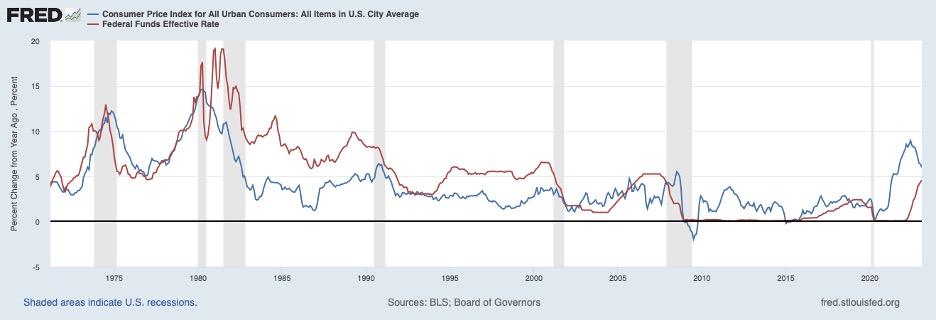
Nevertheless, the latest CPI data reveal prices rose 6% in February 2023 compared with the same month the previous year–well above the new Fed funds target rate of 5%. Historically, the Fed would raise its funds rate above the inflation rate to break the back of inflation. In short, Jerome Powell is no Paul Volcker, who raised the Fed funds rate more than four decades ago to nearly 18%–well above the 12% inflation rate (see above). We will have to wait and see if the Fed will raise the Fed funds rate in coming months to bring the inflation rate down.
However, Chairman Powell has another concern besides tweaking the Fed funds rate to slay the inflation dragon, which he addressed during his Mar. 23 press conference after the Fed announced the new funds rate target. The collapse of Silicon Valley Bank and Signature Bank complicates the Fed’s task of “managing” the macroeconomy by moving the Fed funds rate up and down to dampen inflation (and inflation expectations) and boost economic activity when the economy eventually slides into a recession. Additionally, the Fed is responsible for ensuring financial stability when banks fail and preventing more bank runs throughout the country. Only time will tell if Chairman Powell’s assertion that the banking system is “sound” turns out to be true.
The truth of the matter is a combination of fractional reserve banking, easy money, and FDIC depositor insurance has created a moral hazard that promotes risky bank lending. Thus, when a rumor of a bank’s shaky financial condition gains traction, a run unfolds, revealing tenuous liquidity situations and weak balance sheets.
The conundrum the Fed faces is of its own making. Once price inflation accelerates, expectations take hold–and it typically takes a large move in interest rates to dampen the public’s appetite for debt, which would reduce demand and hence cause prices to decelerate, if not actually decline.
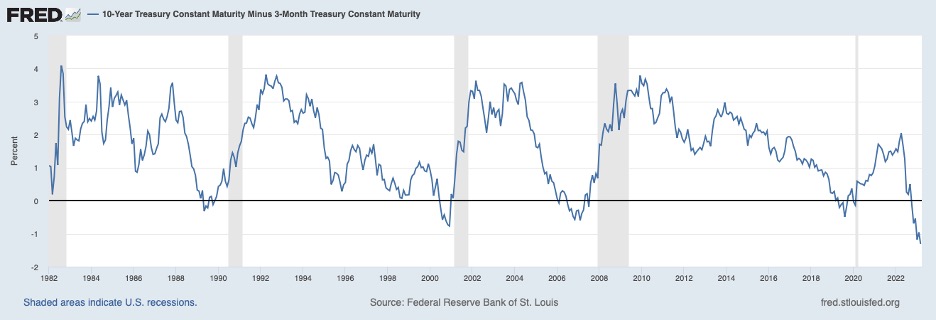
Meanwhile, one of the best indicators of an impending recession is the inverted yield curve, particularly the difference between the 10-year Treasury note and the three-month T-bill. The curve inverted at the end of October 2022. Historically, when short-term rates rise above the long-term rate a recession begins about a year later. Interestingly, when the yield curve inverted in 1998, a recession did not follow until the curve inverted again in 2000 when the Fed tightened credit to deal with the dot-com bubble. In other words, there are exceptions to every “rule.”
Furthermore, the yield curve inverted in March 2019, when the Fed began to raise the fed funds rate in response to what was perceived to be an “overheated” economy and robust financial markets.
The Federal Reserve then “pivoted”–and the yield curve went positive after then-president Trump criticized the Fed for raising interest rates before the 2020 election. This is one of many episodes in history of a president making his views known to the “independent” Federal Reserve, which usually responds to a president’s wishes going into an election year. All presidents want the Fed to keep the monetary spigot open and interest rates low to make sure the economy is humming when they seek another term.
The massive monetary stimulus of 2020 to deal with the economy’s implosion because of the COVID-19 lockdown came home to roost in 2022. The Fed’s unprecedented increase in its balance sheet from $3.8 trillion in early 2020 to $7.1 trillion by the end of 2022 provided the fuel to raise prices across the board. With M2 declining in recent months and the Fed continuing to shrink its balance sheet, effectively withdrawing liquidity from the economy, what effect will this have on prices, unemployment, and GDP?
We are witnessing the beginning of increasing unemployment in the financial sector and high-tech, which have benefitted from the Fed’s easy money policies since the Great Recession of 2008.
Recently, Goldman Sachs, a bellwether of Wall Street profitability and employment, announced layoffs of around 4,000 employees and cut bonuses. If Goldman’s announcement is a forerunner of 2023’s Wall Street’s downsizing, then higher unemployment is unfolding in the canyons of lower Manhattan–and soon in the rest of the country as 2023 unfolds. Facebook parent Meta and Amazon recently announced another major downsizing of their workforces. If layoffs accelerate in the next few months, a recession–a readjustment to the end of the easy money policies of the past few years–will be underway.
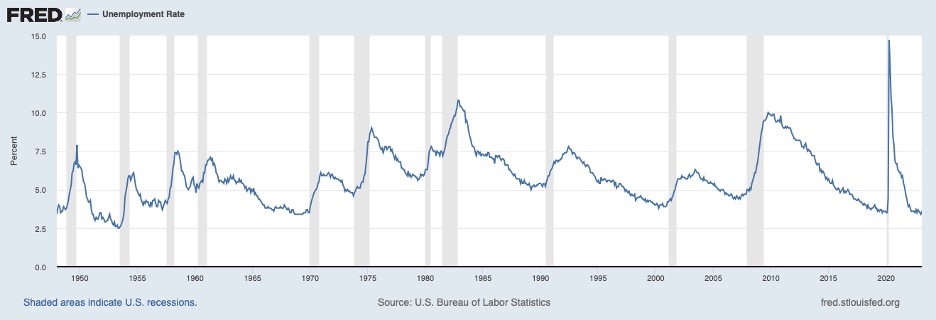
The job market may seem strong overall–but according to a long-term chart of the unemployment rate (above), layoffs tend to begin early in the recession phase of the business cycle, and then accelerate markedly as companies realize they must cut expenses to deal with the new economic reality of tight money and slowing demand.
When the unemployment rate reaches a trough as the economy peaks, it tends to “stabilize” at the lowest level of the cycle–and then it is off to the races.
When unemployment reaches politically intolerable levels, that’s when the Fed “pivots” and begins to lower the fed funds rate. Another easy money boom is ignited.
When will the Fed pivot? 2023? 2024? Later? It is too early to tell–but watching the unemployment rate ratchet up is the best indicator for the next episode of easy money and the next upswing in the economy.
Murray Sabrin, Ph.D., is emeritus professor of finance, Ramapo College of New Jersey. His new book, The Finance of Health Care: Wellness and Innovative Approaches to Employee Medical Insurance provides business decision-makers with the information they need to match the optimal health care plan with the culture of their workforce. Sabrin’s autobiography, From Immigrant to Public Intellectual: An American Story, was published in November, 2022.
The opinions expressed in Fortune.com commentary pieces are solely the views of their authors and do not necessarily reflect the opinions and beliefs of Fortune.
More must-read commentary published by Fortune:
- SVB’s collapse adds financial instability to the Fed’s inflation fight. A recession may not be the worst outcome
- The return to the office once seemed inevitable. A new study shows companies are already reversing course
- How the IMF naively parroted Putin’s fake statistics–and botched its economic forecast for Russia
- Mozilla wants to do for A.I. what it did for web browsers with Firefox