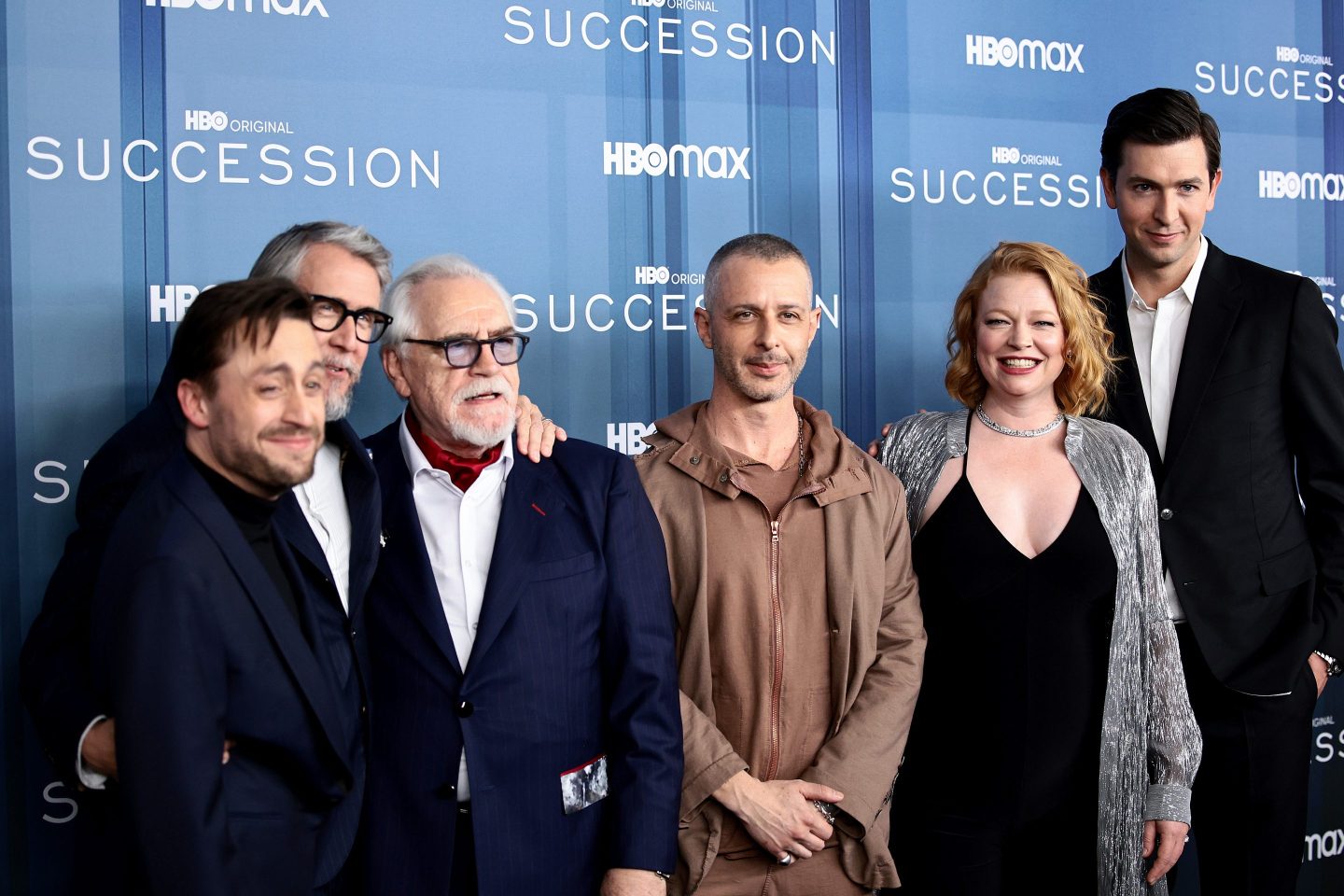
“Succession” has returned for its fourth and final season, giving the show’s fans one last opportunity to watch the kids of the wealthy Roy family desperately try to gain the approval of their media mogul father by any means necessary.
I’ve watched every episode. But at one point, I started to wonder: Where’s the appeal in watching a group of obnoxious, pampered, backstabbing siblings?
Inspired by the family of Fox Corp. chairman Rupert Murdoch, with themes and a premise pulled from Shakespeare’s “King Lear,” “Succession” tells the story of an aging patriarch who must decide which of his four children will replace him at the top.
It’s easy to assume that much of the show’s appeal lies in its playful critiques of right-wing media and the billionaire class.
But in my view, the show actually caters to an audience that wants to condemn the main characters – while secretly identifying with their pursuit of power and pleasure.
The contradictions of the liberal class
As New York Times columnist David Brooks argued in his book “Bobos in Paradise” – “bobo” a portmanteau of “bohemian” and “bourgeois” – contemporary America is full of upper-middle class professionals who long to be seen as virtuous artists, even as they engage in the relentless pursuit of money and success that allow them to ascend the ranks of the bourgeois class.
To hide the guilt they may feel for their capitalistic careerism, they look to signal their virtue and style through their consumption habits. They might pay more money to purchase a hybrid car so they can appear to be good stewards of the environment. Or they might fork over an extra buck or two to buy fair trade coffee.
Art also plays a role in status signaling. In his book “Distinction,” sociologist Pierre Bourdieu explained how class status and an appreciation of the arts are often intertwined. Wealthy people, he points out, have the time and resources to spend on activities that serve no direct practical function.
The working classes, however, have to constantly think about necessity and their limited time and money.
Bourdieu ultimately argues that the masses tend to avoid engaging with art and watching films and movies that place form over function because they do not have the luxury to spend time and money on these experiences.
It’s HBO – not mass TV
Like so many other acclaimed premium cable TV shows, “Succession” targets the very viewers – middle class and upper-middle class professionals – who can afford to pay for monthly streaming subscriptions.
To draw in these viewers, HBO needs to differentiate itself from TV networks and other streaming services. It does this, in part, by including nudity, violence and profanity that wouldn’t be permitted on network TV. It also seeks to highlight its series’ high production value.
In “Succession,” the series’ uncensored speech and behavior gives it a sense of gritty realism. But the show is also eager to flaunt its cinematic flair: strange camera angles and saturated colors suffuse each scene. These aesthetic techniques create a distancing effect on the audience; it is hard to escape a sense that this is a carefully crafted, fake world.
As I argue in my book “Political Pathologies from The Sopranos to Succession,” this combination of the real and the fake allows prestige TV shows like “Succession” to present themselves as both a mirror of the world and a fictional painting full of stylistic flourishes.
This distance and duality allow the audience to feel like it’s a part of this world, while giving viewers the space to sever themselves from any sort of complicity and identification with the worst excesses of the show’s characters.
Having it both ways
Just as upper-middle class professionals may seek to hide their crass materialism through virtue signaling and status-based consumption, the show uses its own irony to reveal that it knows what it is doing, so that it can keep on catering to viewers’ anti-social desires.
The show’s well-to-do viewers may wish they could curse out their co-workers and underlings or indulge in wildly expensive luxuries, but they know that they have to restrain themselves – the rules of their social worlds demand it – and so they turn to fantasy and popular media to live out their repressed desires.
Like the politicians who say one thing but act in another contradictory way, the series itself sends two opposing messages simultaneously. One message is that people should all be free to say and do what they want. The other message is that this type of selfish behavior must be rejected because it undermines society and personal relationships.
New Yorker writer Janet Malcolm, who died in 2021, often explored the ways in which these contradictions were ingrained in American culture. As she writes in her book “The Journalist and the Murderer,” “Society mediates between the extremes of, on the one hand, intolerably strict morality and, on the other, dangerously anarchic permissiveness … Hypocrisy is the grease that keeps society functioning in an agreeable way, by allowing for human fallibility and reconciling the seemingly irreconcilable human needs for order and pleasure.”
One of the main ways that the opposing forces of social order and individual pleasure are mediated is through humor and irony. The key to comedy, then, is that it allows people to both say and unsay the same thing – to transgress but be protected by the guise of humor.
In “Succession,” characters, like Tom, will state something and then immediately take it back and qualify it. Throughout the series, he is constantly threatening his younger colleague, Greg, before backtracking and telling him that he is only kidding – only to repeat the same threat again.
The power of cable news
The contradictions of the show’s characters – and the liberal class, more broadly – are mirrored in the past few decades of American politics.
One example of this is former U.S. president Bill Clinton, who ushered in a political strategy called the “third way.” In order to maintain power, the Democratic president often pushed through Republican policies like welfare reform, financial deregulation and the war on drugs. Underpinning this ideology is the desire to be both conservative and liberal at the same time.
Over time, the Democratic Party became representative of upper-middle class elites who still wanted to be seen as progressives. The Republican party, meanwhile, hid its focus on policies catering to the super wealthy by pretending to care about the plight of the abandoned white working class.
In both of these cases, cable news and fictional media have played a big role in concealing the tensions of class conflict behind the wall of a culture war.
In “Succession,” Waystar RoyCo, the right-wing news conglomerate owned by Logan Roy, often fans the flames of the culture war. For his part, Logan often claims that he controls the president, and it is up to him to pick the nation’s next leader. Logan’s power, then, does not come primarily from his money but from his media influence.
Since the media is positioned as the show’s most powerful political entity, I sometimes wonder what “Succession” is saying about its own status as a popular TV show. Is the series claiming that it has immense social power, or does it use humor and metafiction to free itself from any responsibility?
The answer to these questions has to be both yes and no: The series reflects the country’s political reality – but it also feeds the underlying fantasies that shape viewers’ political beliefs.
Robert Samuels is Continuing Lecturer in Writing, University of California, Santa Barbara.
This article is republished from The Conversation under a Creative Commons license. Read the original article.