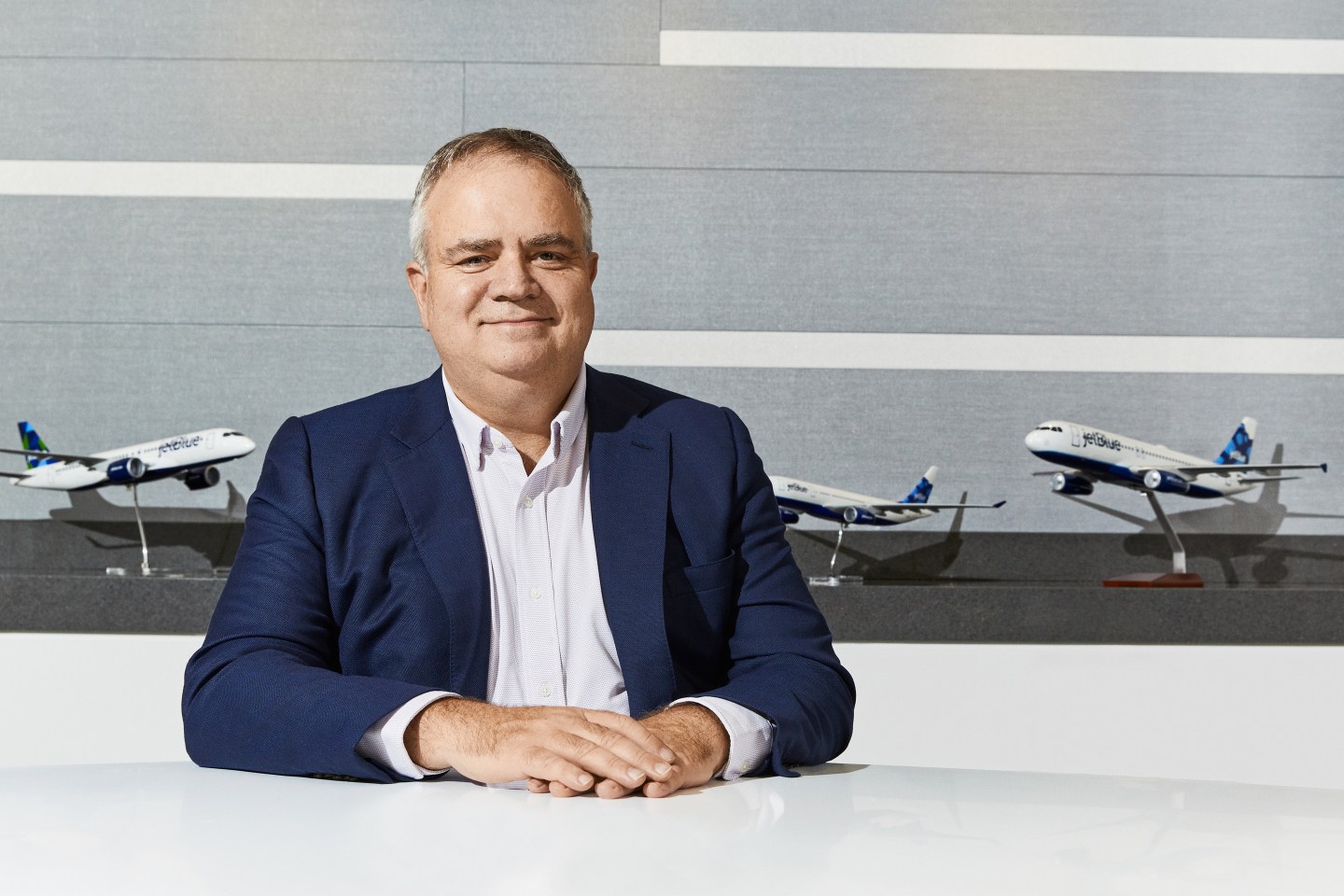
As JetBlue Airways CEO Robin Hayes expected, the U.S. Justice Department on Tuesday sued to stop the airline’s proposed $3.8 billion acquisition of discount rival Spirit Airlines, claiming the deal would lead to higher fares and fewer choices for millions of customers. The CEO, who plans to fight the lawsuit by arguing that the government has greenlit many mergers by larger rivals in the last twenty years, says combining with Spirit would accelerate JetBlue’s growth but doesn’t represent a change in its overall strategy.
Acquiring Spirit would allow JetBlue to expand its fleet of planes more quickly and thus serve smaller airports, provide the combined airline with more clout with airport operators, and win the right to operate more flights out of key airports.
The merger, announced last summer, would create the fifth-largest U.S. carrier based on domestic passenger traffic with a 9% market share, but one still much smaller than the big four: American Airlines, United Airlines, Delta, and Southwest. It would also allow JetBlue to more forcefully compete with its rivals as a national discount carrier. (JetBlue ranks No. 6 on this list, a hair behind Alaska Airlines and a smidgeon ahead of Spirit.)
If the government prevails, Hayes says JetBlue will retreat to its organic growth plan, in which progress would come more slowly. “The opportunity with the Spirit merger is really just to accelerate that,” he says.
But if the deal goes through, the new JetBlue will be better equipped to win customers from its bigger rivals, using lower fares, perks, and more destination options as a carrot stick. “We don’t have those armies of corporate customers who are willing to pay a higher fare, so we have to earn their business one flight at a time,” says Hayes.
This interview has been edited and condensed for clarity.
Fortune: Why do you consider the proposed merger with Spirit Airlines important to JetBlue? And what is your plan if the government ultimately scuttles the deal?
If they decide to sue us, which I think is likely, we’ll go to court. We feel confident because all these other airline mergers have gone ahead, and if you look at the amount of overlap between JetBlue and Spirit, it’s low. But if the merger doesn’t happen, we’ll go back to our organic growth plan. The opportunity with the Spirit merger is really just to accelerate that, but it’s not a change in strategy.
How so?
We’re facing constraints in getting airplanes, and pilot supply and other labor are tight. Also, a lot of the airports we’ve been able to access historically, like Las Vegas or LAX (Los Angeles), are close to being full, so by the time we may need more slots in four, five, or six years, the opportunities may not be there.
How does this help you serve smaller airports?
We get asked a lot in New York, for instance, if we can add more flights to Buffalo, Syracuse, or MacArthur (on Long Island.) We’ve only been able to have a limited amount of business there because we haven’t had the number of airplanes needed to serve them. One of the benefits of the merger is we can add more destinations more quickly.
How will you integrate Spirit into JetBlue if you succeed in bagging it?
Most mergers fail because of cultural reasons. We’ve got to make this happen quickly. We hired 6,000 to 7,000 people last year, so we know how to onboard fast. For Spirit’s in-flight crew members, we’ll put them through our service training. For instance, we offer a lot of free snacks and drinks.
What’s your updated approach to international travel, already one-third of your business?
We started with London in 2021 because it is the biggest market. And we had an opportunity with COVID to get slots in Heathrow that would never have existed otherwise. We have 26 more airplanes coming to fly over the ocean in the next four or five years, so we’re looking at primarily leisure markets to add, like Italy, Spain, and Lisbon. Because Europe would be seasonal, we could play some of these markets in the summer, fly the planes south, and serve Latin America in the winter.
Airfares are much higher than pre-pandemic. Are we witnessing an undoing of the “democratization” of air travel? In other words, is it en route to becoming the province of the more affluent again?
I don’t think so. What we’re experiencing is two or three constraints on capacity right now. Airfares are largely a function of capacity, and we’ve all faced significant delays in getting airplanes. You do have fuel at a multi-year high, driving up fares. And because of pent-up demand, you’re still seeing people taking two trips this year to catch up instead of the one they normally took. But 2023 is going to be the first normal year since before COVID.
People are pretty loyal to a chosen airline, so how would you win over the die-hard Spirit customer?
There is a lot more overlap between customer bases. It’s very rare that an individual will only fly one airline. We must ensure that we stay competitive for those customers, and the merger’s benefits will help. Imagine I’m living in Fort Lauderdale, and JetBlue and Spirit come together. I’m now going to be able to fly to more places than on one airline before, and by the way, I don’t have to fly out of Miami on American anymore.
Speaking of loyalty, how does JetBlue stack up, and how do you steal customers from the Big Four?
I was waiting for my flight the other day and heard the gate attendant for another flight say there were 30 people on the upgrade list. That’s just not practical, and that’s never been our approach to customer loyalty. We’ve created a process where the benefits start for people who fly very infrequently. All these loyalty tiers on other airlines have gotten really crowded. Look how crowded their lounges are. And now, because there are so many people, those airlines are making it harder to earn benefits. That’s crazy. Devaluing loyalty programs feels like a bait and switch to customers.
Is loyalty pointless? Is it unfair to think that if you give any airline enough time, it will disappoint you?
If someone flies you often enough, now and then, you’ll have a not-so-good experience, and I think that’s true of life. When that happens, the question is how well the airline covers the customer. People will forgive you for the one-off mistake. 2022 was a very challenging year with airlines ramping up. We all had different challenges at different times of the year. Some people said, ‘I’m never going to fly that airline again,’ and went to another airline and had a similar experience because it was an industry-wide issue.
Let’s talk about all the crazy weather lately. Is climate change a potential threat to your business?
It’s always in dispute whether some odd weather event is climate change. But we recognize climate change as a risk if it starts changing consumers’ attitudes about flying. It’s the biggest threat to the industry. You already see some of that in Europe, and if governments begin to regulate or tax more because it’s a tax people find reasonable, that’s a threat. By the way, JetBlue has been a leader in buying sustainable aviation fuel, but the problem is that it’s just a tiny percentage of the available fuel.
As JetBlue gets bigger, whether organically or via merger, how do you make sure it doesn’t become just another airline in customers’ eyes?
We have to remember what makes us different because if we try to become like a legacy airline, we will fail. Even if JetBlue and Spirit get together, it will be less than half the size of the next biggest legacy airline. And we don’t have those armies of corporate customers who are willing to pay a higher fare, so we have to earn their business one flight at a time.
Get to know Hayes:
- Hayes joined JetBlue in 2008 and became CEO in 2015 after a year as president. Before that, he had served as its chief commercial officer.
- His favorite airport is Hong Kong’s now-shuttered Kai Tak airport, citing its beautiful views as the plane landed. But the airport closed in 1998 because its location, surrounded on three sides by water, made maneuvers too complicated and unsafe for pilots.
- He is on the board of governors for the International Air Transport Association, the airlines’ trade group.
Fortune's CFO Daily newsletter is the must-read analysis every finance professional needs to get ahead. Sign up today.