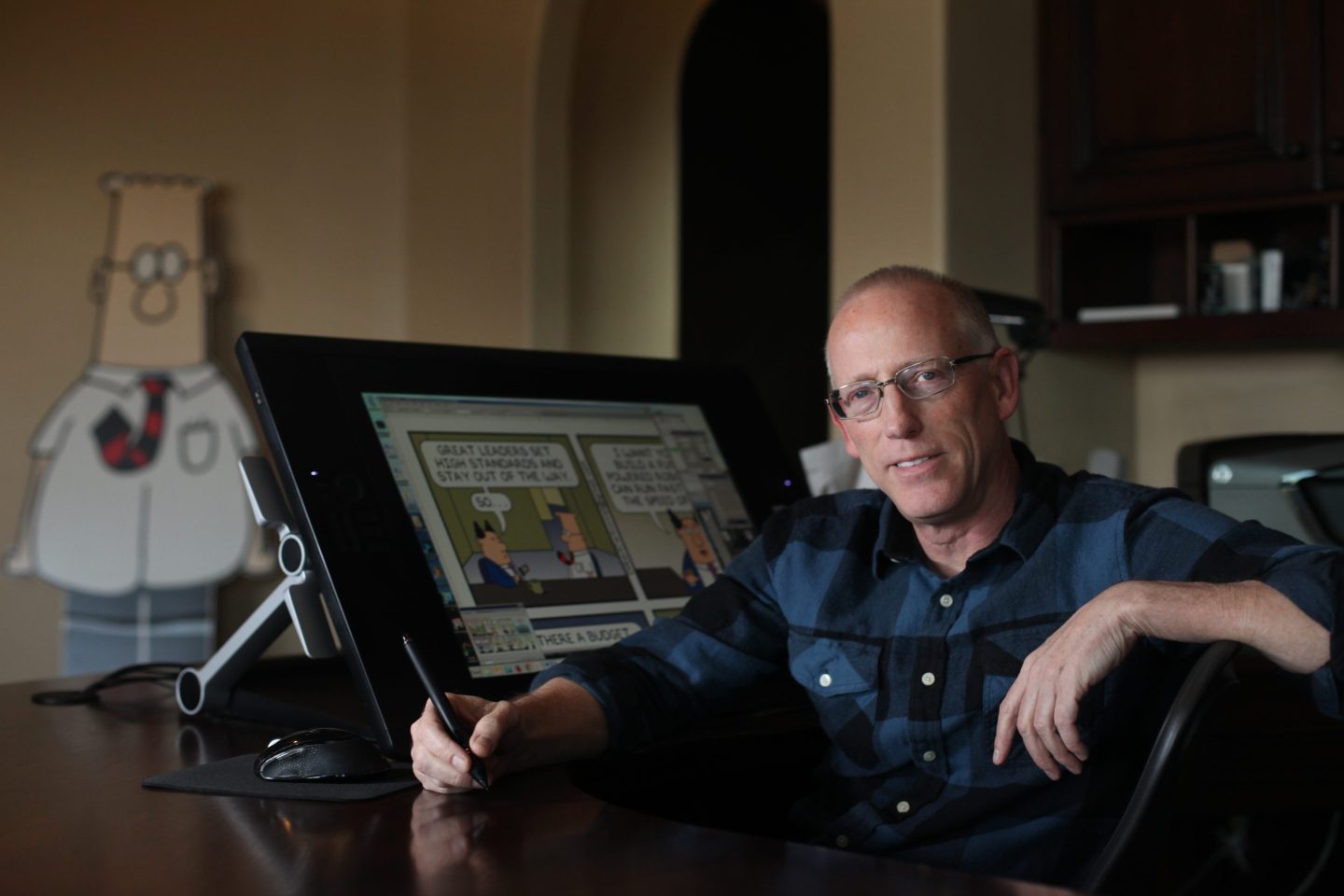
Dilbert, the put-upon chronicler of office life, has been given the pink slip.
On Feb. 26, 2023, Andrews McMeel Universal announced that it would no longer distribute the popular comic strip after its creator, Scott Adams, engaged in what many people viewed as a racist rant on his YouTube channel. Hundreds of newspapers had by then decided to quit publishing the strip.
It followed an incident in which Adams, on his program “Real Coffee with Scott Adams,” reacted to a survey by Rasmussan Reports that concluded only 53% of Black Americans agreed with the statement “It’s OK to be white.” If only about half thought it was OK to be white, Adams said, this qualified Black Americans as a “hate group.”
“I don’t want to have anything to do with them,” Adams added. “And I would say, based on the current way things are going, the best advice I would give to white people is to get the hell away from Black people, just get the f— away … because there is no fixing this.”
Adams later doubled down on his statements, writing on Twitter that “Dilbert has been cancelled from all newspapers, websites, calendars, and books because I gave some advice everyone agreed with.”
Adams is wrong. If everyone had agreed with him, “Dilbert” would still be appearing in newspapers.
The first “Dilbert” strip – a comic centered on mocking American office culture – appeared in 1989. It became a hit, and until recently, “Dilbert” ran in more than 2,000 daily newspapers across 65 countries.
Now, according to Adams, his client list is “around zero.”
Therein lies the moral of the story: Know thy audience.
Adams failed to grasp that being a social critic means your freedom of expression only goes as far as your audience is willing to accept it. Adams could say whatever he wanted to his YouTube audience because his listeners may have agreed with what he said.
Unfortunately for him, what he said on his program did not stay on his program.
But Adams’ comfortable salary depended on his satisfying a wider audience – many of whom found his opinions intolerable.
America’s tradition of free speech
In a country that prides itself on its tradition of free expression, it’s important to explore the limits of free expression in the United States. This can be done in part by looking at social criticism, as I did in my book “Drawn to Extremes: The Use and Abuse of Editorial Cartoons.”
Cartoonists are limited by their imagination, talent, taste and their senses of humor, morality and outrage. If they want an audience they must also consider the tastes and sensibilities of their editors and readers.
The United States may pride itself on its tradition of free speech, but cartoonists throughout the nation’s history have been jailed, beaten, sued and censored for their drawings.
In 1903, the governor of Pennsylvania, Samuel W. Pennypacker, called for restrictions against journalists after a Philadelphia newspaper cartoonist had depicted him as a parrot during the previous fall’s gubernatorial campaign. A state representative then introduced a bill that made it illegal to publish a cartoon “portraying, describing or representing any person … in the likeness of beast, bird, fish, insect or other inhuman animal” that exposed the person to “hatred, contempt, or ridicule.” Another cartoonist then drew the governor as a frothy stein of beer and the bill’s author as a small potato.
The bill failed to pass.
Cartoonists working for the socialist magazine The Masses were accused of undermining the war effort during World War I with their anti-war opinions and prosecuted under the Espionage Act.
And during the Cuban Missile Crisis of 1962, newspapers canceled Walt Kelly’s “Pogo” comic strip after Kelly drew Soviet Premier Nikita Khrushchev as a medal-wearing hog and Cuban leader Fidel Castro as a cigar-smoking goat because they thought the strip might jeopardize the peace process.
Perhaps no cartoonist – before the ax fell on “Dilbert” – has seen his strip canceled by more newspapers than Garry Trudeau, creator of “Doonesbury.” In 1984, dozens of newspapers canceled a series of strips wherein which Doonesbury’s dim-witted newsman Roland Burton Hedley took readers on a trip through then-President Ronald Reagan’s brain, finding “80 billion neurons, or ‘marbles,’ as they are known to the layman.” And Trudeau’s syndicate, Universal Press, refused to distribute a strip that satirized an anti-abortion documentary.
In other countries, cartoonists have been murdered in retaliation for their work. Famously, on Jan. 7, 2015, two French Muslim terrorists entered the Paris office of the satirical French newspaper Charlie Hebdo and killed 12 cartoonists, editors and police officers after the periodical published satirical drawings of the Prophet Muhammad.
The importance of context
Such controversies were generally caused by what cartoonists said in their cartoons. There have been exceptions. Al Capp, who created the comic strip “Li’l Abner,” saw his popularity wane in the 1960s and 1970s when he began expressing his far-right political opinion in both his strip and particularly in his public appearances.
Adams was similarly punished not for what he included in his comic strip but rather what for what he said on his YouTube program.
The context here is important. This was not the first time Adams has been censured after saying something deemed to be offensive. In May 2022, around 80 newspapers canceled “Dilbert” after Adams introduced his first Black character in the 30-plus year run of the strip. The character identified as white to prank his boss’s diversity goals.
Adams lost some newspapers when he decided to mock diversity in the business world. He lost his strip when he used racist language to attack Black people on his YouTube program.
Chris Lamb is Professor of Journalism, Indiana University.
This article is republished from The Conversation under a Creative Commons license. Read the original article.
Learn how to navigate and strengthen trust in your business with The Trust Factor, a weekly newsletter examining what leaders need to succeed. Sign up here.