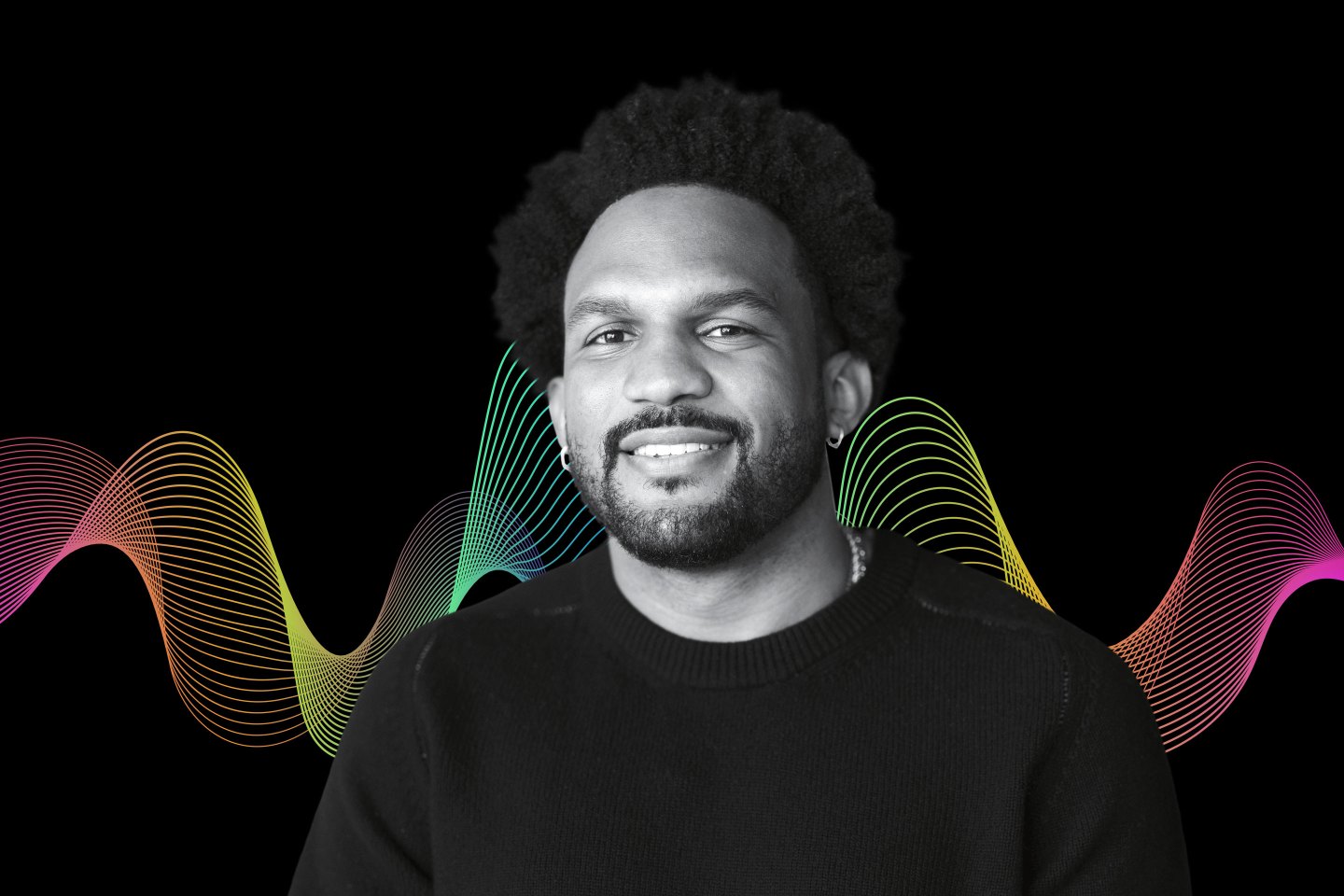
On this week’s episode of Fortune‘s Leadership Next podcast, co-hosts Alan Murray and Ellen McGirt talk with Kickstarter CEO Everette Taylor. They discuss the lack of Black leadership in the C-suites of most technology companies, as well as what Taylor wants for Kickstarter’s future (hint: more inclusion and huge growth). Taylor also shares his view that tech platforms must take responsibility for the kinds of projects they help send into the world.
“I think A.I. technology can be really beautiful or really special if utilized in the right way. You know?” says Taylor, who assumed his CEO role in October 2022. “The same way a butter knife can be great, and if it’s used the wrong way, can be pretty scary.”
Listen to the episode or read the full transcript below.
Transcript
Alan Murray: Leadership Next is powered by the folks at Deloitte, who, like me, are super focused on how CEOs can lead in the context of disruption and evolving societal expectations.
Welcome to Leadership Next, the podcast about the changing rules of business leadership. I’m Alan Murray, here with my incandescent co-host, Ellen McGirt. Ellen, how are you?
Ellen McGirt: I am wonderful, Alan. It’s great to be with you. That was such a creative introduction, and thank you for that. And I love the creativity, because we’re here with one of my favorite CEOs, Everette Taylor, of the crowdfunding platform Kickstarter. Kickstarter has been a launchpad for a lot of creativity, a lot of dreams coming true since its founding in 2009. Backers have pledged over $7 billion to over 200,000 projects on the platform.
Murray: And Ellen, I’m sure you know this, but there are also some pretty substantial businesses that have gotten their start on the platform like Peloton and Allbirds. Both started as Kickstarter projects.
McGirt: There’s been some Oscars in there too, as well. Crowdfunding, especially crowdfunding on Kickstarter, can be a really powerful boost for independent creators. I think it gives business a run for its money. Let’s talk about that. And Everette Taylor is still relatively new as the CEO.
Murray: Everette took over as CEO in October of 2022, working to bring Kickstarter into a more equitable future. We’re going to talk about that.
McGirt: We sure are. He’s the first Black person in the C-suite at Kickstarter. He’s one of the few Black CEOs in big tech at all, which is important. He’s focused on innovation and making crowdfunding equitable and accessible, and making sure that the platform is exposing creators of color as well. We’re so excited to have him on Leadership Next to talk about his vision and journey. Welcome, Everette.
Everette Taylor: Wow, that was an incredible intro. Thank you so much, Ellen. I’m really, really happy to be here.
McGirt: I’m so glad. Before we dig into your designs for the future, why don’t we just start with a really basic lesson of what Kickstarter is for anybody who hasn’t been lucky enough to launch something on the platform?
Taylor: Yes, so Kickstarter is the number-one platform for launching creative projects. And that may sound broad, because we want it to be broad. You know, we have everything from tech products to fashion and design to comics, music, art, film, games, which is huge on our platform. Anything that you can, you know, think of that you want to put into the world that’s not harmful, has a place on Kickstarter. And so, essentially, it allows people to not only bring their own community and audience to one place, to raise money to make their dreams come true, or their projects that come true, but also, they can capitalize on a platform in which millions of people use. We have a beautiful community of people that want to back and support people, and the things that they care about, or the niches that they’re interested in. So you have a central place for your own audience, but then also the power of the community that uses Kickstarter every day.
Murray: Everette, here’s a really stupid question, but help me with this. If I contribute to Peloton when it’s doing its Kickstarter project, and Peloton takes off and make makes tons of money, do I participate in that?
Taylor: No. So one of the interesting things about Kickstarter, as sad as this may be for some, is that this is not equity-based crowdfunding. This is what we call reward-based crowdfunding. And so the reward can be the actual product itself. And so, maybe you gave enough money where you can actually get the physical Peloton, or maybe it’s like, you know, certain features, or a T-shirt or whatever that may be, or that reward may be for the amount of money that you contribute. A large amount of people just contribute from the goodness of their hearts and don’t even want a reward. Or they want to see the thing actually come to life—maybe it’s a film, maybe it’s a music album, maybe it’s performance art. And so it’s not equity-based crowdfunding, which I really love, because there’s so many people, entrepreneurs that get taken advantage of by investors for their companies early on, where they give away so much of their company early on, or, you know, they’re not, you know, if you have a performance art piece that you want to put on, I don’t think you know, Andreessen Horowitz is looking to invest in that, right?
Murray: They don’t fund performance art.
Taylor: Yeah, exactly. Or you might have a, you know, a product that might be a $10-, $20-, $30 million company, but it’s not a $3 billion company potential. And you know, investors and VCs are looking for those, those big unicorns, and you know, some companies aren’t that. Most companies aren’t.
McGirt: So, you were already pretty established as a C-suite player before you took this role, you were CMO at Artsy, and you’re entrepreneurial yourself. You have a very long history, which we can talk about a little bit later. But part of your job, clearly, has been thinking about what’s next and innovating in a space that we kind of think that we already know what it is. So what was your transition into this role like for you? And how did you begin to listen to the marketplace to look for new ideas?
Taylor: Well, first of all, I want to say that you, Ellen, you may be the first person to call me an established C-level exec at 33 years old. I want to point that out to everybody that wants to write about me moving forward. I am an established executive.
Murray: Quoting Ellen McGirt.
Taylor: Secondly, I think, you know, Artsy really prepared me for this role in a lot of ways. I remember going into Artsy, because I hadn’t been a CEO before, I had been CMO before, at different companies, but never a company at the scale of Artsy, right. And the amount of business lines we had, the amount of people using our platform, etc., etc. and I learned a lot, it was really important. And I learned a lot from the CEO, Mike, who I watched day in and day out, because I knew how much I wanted to be a CEO. But I think it was a perfect place, because one, it was a marketplace, and although Kickstarter isn’t technically a marketplace, it works very much like a marketplace. Two, it was at the crux of, or at the intersection of, helping creatives, right? Now, this is creatives in visual art, but it still was about helping creatives. But also business owners. We’re a b2b and b2c platform where we helped artists but we also helped the businesses that sold to those artists. So I think it was a really good proving ground that I was helping entrepreneurs but also creative types simultaneously, and understanding their needs and things that they needed to be successful, but also understanding the power of inclusivity, of expanding and democratizing the art space. The same thing I want to do for crowdfunding is growing the space and democratizing it and opening up and really innovating on what we think crowdfunding is today.
Murray: Kickstarter had a tough time during the pandemic, as many of us did. This was before you got there, but had to lay off like 40% of its staff. What happened? What went wrong? And are you now engaged in some sort of a turnaround? Do you think your effort is a turnaround effort? Are you happy with where you are?
Taylor: I mean, hell yeah, it’s been a turnaround. And you know, we’re already off to a great start. We had, the quarter that I came, we had our strongest quarter, in 2022, and Q4. We’re already crushing some of last year’s numbers already in Q1 of 2023. And one thing that isn’t said, about you know, that time during Kickstarter’s history, is like, right after that, we had the best years in terms of crowdfunding and revenue in Kickstarter’s history, where, you know, those layoffs happened at the beginning of the pandemic, where no one knew what was going to happen. Do you think people were launching Kickstarter projects when you know, people were dying all over the world, and people are suffering and all these bad things are going on? So as a precautionary measure, you know, layoffs did happen. But I’m glad to say that we’ve really bounced back as a company, and I think we’re stronger than ever. And now we’re introducing two new business lines, the first ever in the company’s history, which I’m very, very proud of, to strengthen our revenue, strengthen the core crowdfunding industry and business that we have here at Kickstarter.
McGirt: So if I, if I were an innovation scout, and I’m looking over the especially the recent history of what’s been successful at Kickstarter, what would I see? As another way of asking what is big business getting wrong? One of my favorite examples is Hair Love, of course, the short film that was launched on Kickstarter that went on to win an Academy Award. It was the kind of thing that a studio should have been producing and wasn’t. So I’m looking at Kickstarter, I’m looking at what’s going on there. What are the big trends? What innovation are is more staff or more established studios or businesses missing?
Taylor: Well, first of all, when it comes to people of color, inclusivity, people from underrepresented backgrounds, of people that may not have the resumes that others may have? Those people are often overlooked. Those are the people that don’t have the same resources or have the ability to get into those rooms. So the whole structure in which the music industry, the film industry, the tech industry, the publishing industry, you know, is set up is not really set up for success for a lot of people. And what the trend I’ve been seeing on Kickstarter is, if you got something good, Ellen, you’re going to be successful. You know, we had Brandon Sanderson last year, didn’t go to a traditional publishing company, and literally raised $42 million for his books…
McGirt: And those are novels.
Taylor: …last year on the platform.
Murray: Just amazing.
Taylor: Amazing. One part of inclusivity is, you know, you can go out there and try to bring all these people to the platform, but if they don’t have an opportunity to be successful on the platform, it’s all for naught. And so that’s why, you know, starting these new, these two new business lines of pledge management, which will help people with fulfillment, taxes, all the things they need to do to fulfill their actual product or service on the platform, as well as digital marketing services. You know, if you don’t have the audience yourself, and you want to reach new people and be successful on the platform, it takes digital marketing, it takes extra effort to do so. And so providing people with digital marketing to help them reach more people. And then also, with pledge management, handling the business side of crowdfunding is going to be extremely important.
The other thing that I will say is Forward Funds. So, Forward Funds is a program that I’m really focused on right now to bring money onto the platform that we can put into individual projects, especially projects from creators of color and underrepresented backgrounds. And so we see statistically that they aren’t as successful on the platform as white males, as probably expected. And so what Forward Funds does is, is that it takes money and puts it into projects for creators of color on the platform. So we’re scaling up that program right now to bring millions of dollars on a platform each year to support creators of color. And the last piece that I would say, is that really investing in marketing to these communities and making sure that they know and the education around crowdfunding is going to be super duper important to make sure that one they know that this is a resource for them, but also to have the educational resources and the know-how to be successful on the platform.
Murray: Yeah, let’s take that one level deeper. I mean, you got a lot of people listening to this podcast who’ve probably contemplated Kickstarter projects. You have years of data now, what makes a good Kickstarter project? What makes it work when somebody asks you, what do I need to be successful on Kickstarter? What’s, what does the data tell you?
Taylor: Three things. Number one, have a great idea. If you have a great idea and a great product, that goes a long way. Not all Kickstarter projects are created equal in terms of how good the ideas are. I love all the ideas, by the way, but they’re, they’re not equal. And the second thing is cultivating an audience beforehand. I tell people all the time, some people think you can go on Kickstarter, and then throw it on there, and then, you know, magically make some money. No, you gotta you gotta push your audience there. You have to cultivate an audience around your product, your company, your service, even if it’s just your friends, your family, your 30 cousins, like whoever it is, you know, you have to cultivate your own audience and have them ready to go and ready to support at the beginning. The third piece, and the most important piece, is hustle. I tell people all the time, if you don’t have that hustler spirit in you, Kickstarter might not be for you. Like this is actual work. People aren’t just giving you money just because. People are giving you money because they want to see that thing come to life and they want to see it come to fruition or they want that thing. You know a lot of people that were giving to Peloton wasn’t saying like, oh, this is a cool idea. I just want to support it. No, they wanted a Peloton bike, you know. And so, it’s really important to have that hustle, one to get the backers that you need to be successful and get out there and actually have a go-to market strategy and think like, you have to run your Kickstarter, like a business.
Murray: Darn, I mean, you have to work hard, you have to work hard. It’s not easy.
Taylor: It’s not easy. It’s not easy. But you see when you have those things in place, once you start catching traction, man, regularly on the platform, you go on that platform any day, you’ll see projects that raise millions of dollars, you know, and that’s for people who understand the formula.
[Music]
Murray: I’m here with Joe Ucuzoglu, the CEO of Deloitte and the sponsor of this podcast for all of its seasons. Thank you for that, Joe.
Joe Ucuzoglu: Pleasure to be here, Alan.
Murray: Joe, CEOs are increasingly being called on to weigh in on societal issues, political issues, but they’re also getting criticism for being too political, for being woke. How do you as a CEO navigate that pressure from both sides?
Ucuzoglu: This shouldn’t be about politicizing corporate America. Companies are trying very hard to respond to the real desire of their people. People want to work for a company that will speak up for the company’s values on big societal issues, and we’re operating in a world where business is one of the few trusted institutions left, where the voice that business plays has an incredibly important role. And Alan, on many of these issues, the stances that companies have taken speak to elements of the issue that most people ought to be able to align around grounded in values, and not the elements of these issues that are oftentimes the most politicized and contentious.
Murray: You’re talking about that climate change is a problem. That inequality and opportunity for workers is important. Or that gender and racial equality is critical.
Ucuzoglu: Those are great examples. And the reality is, you’re not going to make everyone happy. There are those who think companies aren’t going far enough. There are those who think companies have already gone too far. But what we’re finding is that there’s actually a substantial majority of employees that are quite proud that the company they work for is using its voice as a force for good.
Murray: Joe, thank you.
Ucuzoglu: Alan, it’s a real pleasure.
[End music]
McGirt: But speaking of hustle, you know, you mentioned that you were looking to the Artsy CEO for guidance and for a pathway forward. You’re now an established CEO, you’re in a competitive space. And you had an untraditional pathway there, and people are now looking to you. So how do you want to make sure that your values and your hustle and your vision inspires people around you? And also, what does this mean for underrepresentation and leadership in tech?
Taylor: You know, I was just talking to someone who is the, he’s the editor-in-chief over at Time magazine. And he was talking about, what are the things that keeps you up at night? And one of the things that I’ve seen recently, after the murder of George Floyd and the summer of 2020, there was just this burst on the scene of people, and I call it like, the white guilt phenomenon, right? Where it’s like, all of these Black people were getting all of these new job opportunities, all of these things happening are, you know, we saw what Black artists, Black artists were selling more work more than ever, and all of that. And it was just like this, this moment in time, that lasted kind of like halfway or three quarters into 2022. And then really started to turn around, and that momentum has shifted. And one of the things that I saw in the world of business was that there was a lot of, you know, Black people that got opportunities, but you didn’t see too many people get CEO opportunities.
McGirt: Right.
Taylor: You didn’t see a lot of Black CEOs coming around.
McGirt: Yeah.
Taylor: And so, for me in this, in this role, it’s really important for me to show what I can do through impact. Like me driving impact, me growing revenue, me growing the market cap of the crowdfunding industry, and doing the things that I know that I can do. I want to set an example to show the power of people that you typically count out, to show the power of people that come from underrepresented backgrounds. And I want to do it through the work. I’m glad I’m on this podcast, and I’ll say this, and I’ll say that, but I want to prove it—not through media, and not through interviews. But I want to prove it through the work and the impact that I do every single day. I understand the responsibility that I have, and I don’t take that lightly, and I understand that there is a microscope on me that you probably can’t name, you know, five Black tech CEOs of like major brands, you know, you probably struggle to do that.
Murray: Well, I was just gonna ask you about the the metrics for proving it. I mean, are you trying to prove it by you know, growing revenue and growing margin, and showing the Kickstarter as a business model that can make its owners a lot of money? Or are you trying to prove it by having really great things come to life as a result of Kickstarter funding?
Taylor: I think both, right? That people really respect the numbers, the revenue numbers and all of that stuff, right. And I understand that the powers that be in the world of business and that’s doing the hiring, those are the numbers that they care about. They love the feel-good stories. They love hearing about the Issa Raes and the Jonathan Majors and all of that, that come off from Kickstarter. But at the end of the day, they speak in numbers. So I want to make sure that I’m backing that up. Because we can still do the same numbers and still have a large cultural influence. But what I want to shift is one, growing a really successful business, but at the same time, expanding that impact. If we can find, you know, one Issa Rae, let’s find 10. If we have one Peloton, let’s do 10 of those, 20 of those. Right. And so, I think the economic impact and the cultural impact that Kickstarter has is enormous already, but can we 10x that? You know, I think we can, and that’s what I want to show. We have our numbers right there on the screen. Like, you go to a website, you see how much money people have pledged. I want to double that, triple that, quadruple that. I want to make Kickstarter a force to be reckoned with, not only in the world of tech, but in the world of culture.
McGirt: How does Kickstarter make money now? And you have a very specific setup as a public benefit company? What are the challenges of that in terms of inventing new revenue streams?
Taylor: It’s not really any challenges. The biggest thing about being a PBC, a public benefit corporation, is that you’re not, you’re not sacrificing everything for revenue, right? I saw Meta just launched like Meta verified, right, and they’re about to make being verified on Instagram and Facebook very uncool. And they saw Elon Musk do the same thing at Twitter. And you do these things when you just need new revenue sources, because you’re a public company, and you don’t care about the user experience, you care about the the bottom line. And for me, I don’t have to do that. Kickstarter is private. We’re profitable. We make a lot of money. We’re in a good place. But again, for us to really innovate and expand, we have to bring in more capital. We have to bring in more revenue. The status quo is not acceptable anymore. And so you know, me introducing these new business lines, they’re not just for the sake of introducing new business lines to make money. These are two new business lines that are going to really help people. We’re going to make a lot of money doing it as well. But we’re going to help a lot of people, and that’s why we’re doing it.
Murray: Everette, Kickstarter made a big announcement back in 2021, I think, that it was moving to the blockchain. And then there were some follow up. This is all before you got there. Then there were some follow-on announcements that sort of played that down a little bit. But I wonder where in your head, where are you now? I mean, what’s the value of blockchain technology if, if any, to Kickstarter?
Taylor: There is some confusion there that Kickstarter would be moving to the blockchain. We were committed to exploring blockchain technology and how it could support or help the crowdfunding industry. Where I’m at in my role currently, is that if there is something through our research and development that I feel strongly is helpful to the core business of Kickstarter, or the crowdfunding industry as a whole, if that’s possible, then of course, I would love to explore that more. But until that time, until that time, I’m super focused on the core crowdfunding business, as well as the new business lines that we’re creating. We have a ton of stuff that we can do and innovate on just in Web 2.0. Right? And so for me, I think we have a laundry list of things that we need to take care of, even before really engaging with Web 3.0 and blockchain.
Murray: It sounds like you haven’t really seen the benefit yet of moving to a Web 3.0 or a blockchain platform. You don’t see what it what it would do for Kickstarter yet.
Taylor: I’m not saying that I don’t see any value. It’s just about finding what is that particular thing that we can do not via Web 2.0, that we can do through blockchain technology, because a lot of things you can still do on Web 2.0, a lot of things that you hear about Web 3.0 and blockchain, you’re like, wait, I can still do that via Web 2.0. And so I want to make sure we’re working on something that is truly valuable because it’s specific to that technology.
McGirt: How are you addressing the rise of A.I. in the creative space? I feel like that’s a big issue, too.
Taylor: Yeah, we recently had to take down a project, an A.I. project on our platform, and it made the news. And like I said, we are we are supportive of anything on our platform that is not harmful to others. This particular project was harmful to others. I think A.I. technology can be really beautiful or really special if utilized in the right way. You know? The same way a butter knife can be great and if it’s used the wrong way can be pretty scary. So you know, that’s the way that I look at it is that when it when it comes to A.I., I think there’s a lot of potential with the technology and I want to be supportive of that as long as it’s not harmful to others.
Murray: What, Ellen, if I can follow up on that a little bit, because we’re in the middle of this great national debate over section 230 of the telecommunications act, that new platforms have responsibility for the stuff they put out on their platforms. You took down an A.I. project because you thought it had bad effects. How much do you monitor the projects that people try and launch on Kickstarter?
Taylor: Yeah, I mean, we monitor every single one. Do we get it right every single time? Absolutely not because this one launched, but we listen to our community. I always have my ears to the street, Alan, every single day. And you know, and and that’s really, really important. It’s important to listen to your community and make decisions that your community cares about, you know, and that’s why we took that project down because ultimately, I care about the community and the community first beyond anything. And if there’s going to be anything that can be potentially harmful, we have to take responsibility for it. You see a lot of big tech companies, they aren’t taking responsibility to say oh our bad, it’s like we created a bunch of mess and now it’s like they’re walking it back. Like I think you can be proactive in the beginning.
Murray: Ellen, I have about 50 more questions. I don’t know about you, but but it looks like we have a commitment to Everette to let him go to make his next appointment.
McGirt: I know, I wish we had more time but Everette it has just been wonderful catching up with you. And Alan and I are going to put our heads together and put together a Kickstarter project. I just know it I just I really want to.
Murray: Oh yeah, don’t take ours down.
Taylor: No, we won’t take it down. I promise. Just don’t have any bad A.I., you know?
Murray: No, no, we’ll only use good A.I.
McGirt: Thank you so much and come back anytime.
Taylor: Okay, thank you guys.
Murray: Leadership Next is edited by Alexis Haut. It’s written by me, Alan Murray, along with my amazing colleagues Ellen McGirt, Alexis Haut, and Megan Arnold. Our theme is by Jason Snell. Our executive producer is Megan Arnold. Leadership Next is a production of Fortune Media. Leadership Next is a production of Fortune Media. Leadership Next episodes are produced by Fortune‘s editorial team.
The views and opinions expressed by podcast speakers and guests are solely their own and do not reflect the opinions of Deloitte or its personnel. Nor does Deloitte advocate or endorse any individuals or entities featured on the episodes.
Learn how to navigate and strengthen trust in your business with The Trust Factor, a weekly newsletter examining what leaders need to succeed. Sign up here.