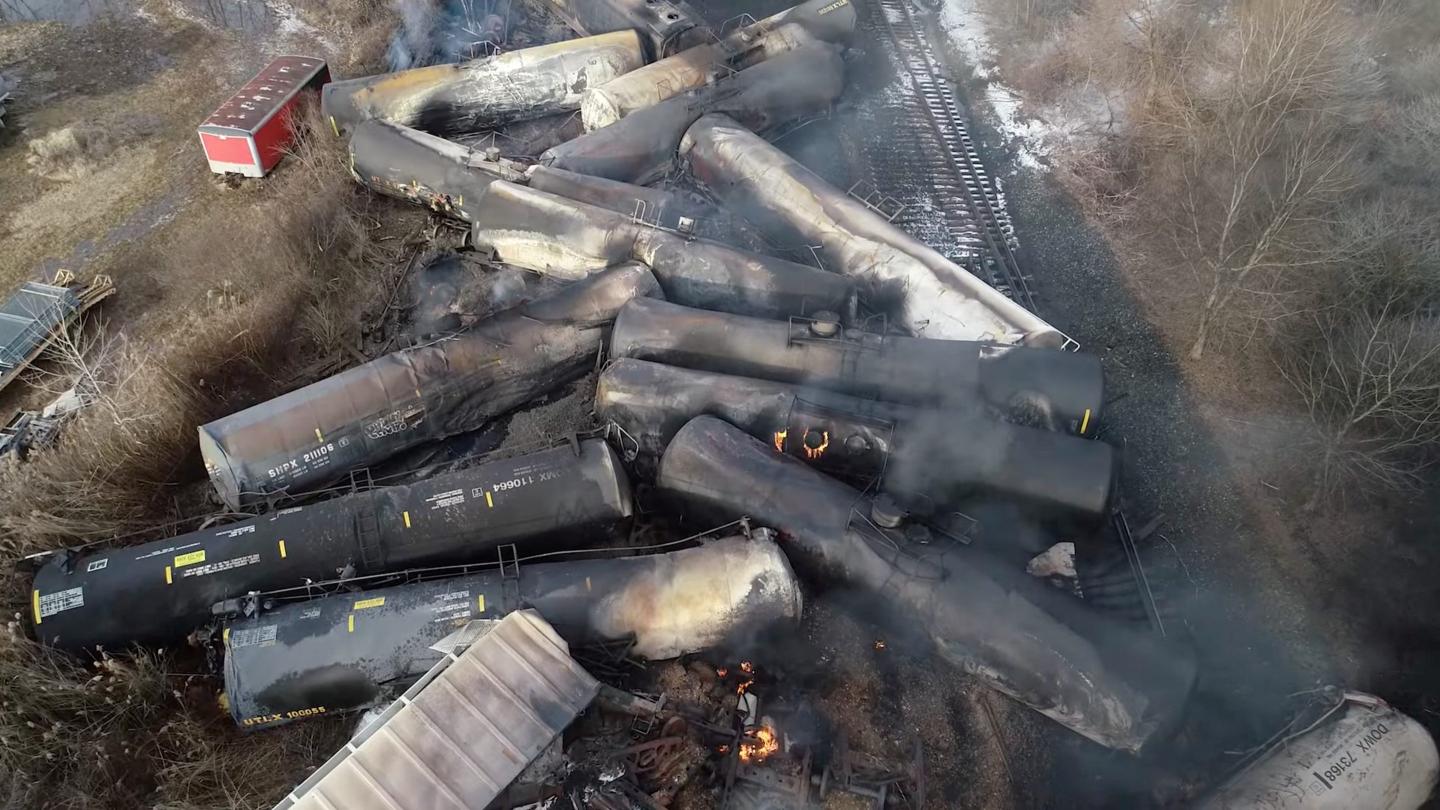
A train derailment that released a toxic gas plume and disrupted life near East Palestine, Ohio, has ignited criticism of the rail industry’s safety standards and calls for wider reform.
A freight train derailed in the state on Fed. 3, causing a 38-car pileup and fire damage to an additional 12 cars. The train was carrying 20 cars containing hazardous materials, 11 of which derailed. After the crash, officials attempted a “controlled burn” that released toxic smoke into the air, sparking evacuation orders affecting the 5,000 residents of the town nearby.
The evacuation order was lifted last week, but many residents are reluctant to return to their homes for fear of long-term environmental consequences. Officials say those could include soil and water contamination. Many residents have criticized Norfolk Southern Railways, the train’s operator, for lacking adequate safety procedures that could have averted the derailment.
The National Transportation Safety Board has released a preliminary report about the accident, and will investigate more over the coming months. But in a press conference Thursday, NTSB chair Jennifer Homendy said that while there was no evidence the crew “did anything wrong,” she called the derailment “100% preventable.”
Rail workers and union leaders tell Fortune the Ohio derailment is only the latest extreme example of the kind of train accident constantly taking place across the U.S. And they say it’s the result of years of underinvestment, cost-cutting, and pushback against safety protocols in an industry controlled by just a few major companies.
“The industry needs to be brought back under control,” Michael Paul Lindsey, a locomotive engineer and member of Railroad Workers United, a group representing workers from different unions, told Fortune. “We have problems with these massive long trains everywhere along the way, and companies are insistent that it has to work, even if we cut corners doing it.”
Rail industry lobbied against stricter safety protocols
The derailment in Ohio made national headlines, but less severe accidents still happen all the time.
There are around 1,000 rail derailments a year, according to the Department of Transportation, including incidents involving hazardous materials. “We get derailments like this very regularly,” Lindsey said.
“It is difficult to have confidence that the railroads will invest money and implement safety protocols that will ensure the safety of the public and their employees, because they are always reluctant to do so when cost is their primary concern,” Clark Ballew, director of communications at the Brotherhood of Maintenance of Way Employes, a rail worker union, told Fortune.
In 2014, the Obama administration began pushing for tighter rail safety regulations. These included requiring trains carrying large amounts of hazardous materials being fitted with extra locks on cars and electronically controlled pneumatic brakes (ECP) to replace the Civil War–era braking systems most trains still use. The ECP system applies brakes to all train cars simultaneously, instead of a gradual car-by-car braking system.
A narrow 2015 ruling would have mandated that all trains carrying 20 or more cars of high-hazard flammable materials install ECP brakes by 2023. But rail companies actively lobbied against these rules, with one Norfolk Southern representative telling regulators in 2015 that the company had “serious concerns” over how ECP brakes would impact their operations. The Trump administration repealed the requirement in 2018, saying ECP brakes were not “economically justified.”
A 2015 NTSB study found that ECP brakes “out-performed” other forms of braking. Meanwhile, a 2023 study by the Association of American Railroads, a trade group representing rail companies, found that implementing ECP brakes “would not provide a meaningful safety benefit.” A 2017 review by the National Academy of Sciences based on a modeling test by the Department of Transportation was “unable to make a conclusive statement” on the performance of ECP brakes compared to other systems, while criticizing the DOT’s modeling methodology.
“Having [ECP brakes] may not have prevented the derailment, but in my opinion it would have severely reduced its impact. It wouldn’t have been as bad,” Gabe Christenson, a railroad conductor and cochair of Railroad Workers United, told Fortune about the Ohio derailment.
Former regulators have also commented on how ECP brakes might have mitigated the damage in Ohio. “ECP brakes would have avoided that monster pile-up behind the derailed car,” Steven Ditmeyer, a former official at the Federal Railroad Administration, told USA Today last week.
The current focus of the NTSB investigation is on an overheated wheel bearing on Norfolk Southern’s train, which was seen to be covered with sparks or flames in a security camera recording in Salem, Ohio, before the derailment. Norfolk Southern relies on detectors known as hot boxes installed alongside its railroads to monitor temperatures as trains pass and alert train staff of any abnormalities and risks. Lindsey said the failure to do so in the 20 miles between Salem and where the train derailed raises questions about the detectors’ reliability.
Three hot boxes detected the wheel bearing warming before the derailment, according to the NTSB’s preliminary report, although only one of them picked up a temperature high enough to trigger an alarm for the train’s staff. It only did so right before the train derailed.
A Norfolk Southern spokesperson told Fortune the company is fully collaborating with the NTSB, but declined to comment any further during the agency’s ongoing investigation. CEO Alan Shaw said in an interview with the Wall Street Journal this week that the company will revise its safety procedures moving forward.
“It is clear that our safety culture and our investments in safety didn’t prevent this accident. We’re going to see how we could have prevented it when we get the NTSB results,” he said.
Cost-cutting and ‘a handful of railroads’
For years many railroad companies, including Norfolk Southern, have operated on a business philosophy known as “precision scheduled railroading,” which focuses on maximizing efficiency with longer and heavier trains to cut costs and deliver more profits.
Advocates of the model say it helps improve productivity and lower costs for customers, while critics argue it overworks employees and trains’ long length and heavy load creates more risks of derailments. The Norfolk Southern train that derailed was 149 cars, or 1.9 miles long, according to a company spokesperson.
That efficiency-maximizing mindset has also affected railroad staffing, particularly over the past few years. Between 2017 and 2021, 22% of employees at large rail companies Norfolk Southern, CSX, and Union Pacific were laid off. Critics have said the emphasis precision scheduled railroading places on cutting costs inevitably leads to layoffs.
Rail companies have come under fire in the past year after workers spoke out against employers cutting spending while overworking remaining employees to the point of risking safety. Rail workers came close to striking twice in 2022, citing the industry’s understaffing and strict attendance policies while companies rewarded shareholders with large stock buybacks, around $200 billion since 2010. Norfolk Southern, which in 2022 reported record revenue, announced a $10 billion stock buyback program last year.
On both occasions, the Biden administration stepped in to avert strikes and industry shutdowns that would have been catastrophic to the economy. Once Biden ordered rail employees back to work, companies met rail unions on demands for significant pay raises, although they did not grant concessions on the sick leave workers had demanded. Earlier this month, CSX announced a deal with unions to provide more sick leave policies.
But the bigger problem, unions and other critics say, is that the rail industry has become far too consolidated and is failing to foster competition, allowing big companies to get away with cost-cutting measures.
The railroad industry has become concentrated among a small number of companies in recent years. Including Norfolk Southern, there are seven Class One railroad companies in the U.S., down from 33 in 1980. Critics including unions, senior politicians, and legal experts say the consolidation has led to less competition and accountability for the industry’s big players, while warning that the industry’s nature raises the risk of more accidents.
“We all knew it was going to happen,” Christenson said about the Ohio derailment. “They really need to look at how this monopoly crowds people out. Everyone in America is being held hostage by a handful of railroads.”