The return to office looks like it’s going backward. After office occupancy rose to over 50.4% in late January, it dropped to 45.6% by early February before recovering slightly to 48.6%. That’s despite many business leaders trying to get their employees back to the office in an effort to prevent “quiet quitting.”
The term “quiet quitting” emerged in early 2022, and refers to doing the bare minimal tasks of your job description well enough that you don’t get fired. The concept quickly went viral on TikTok.
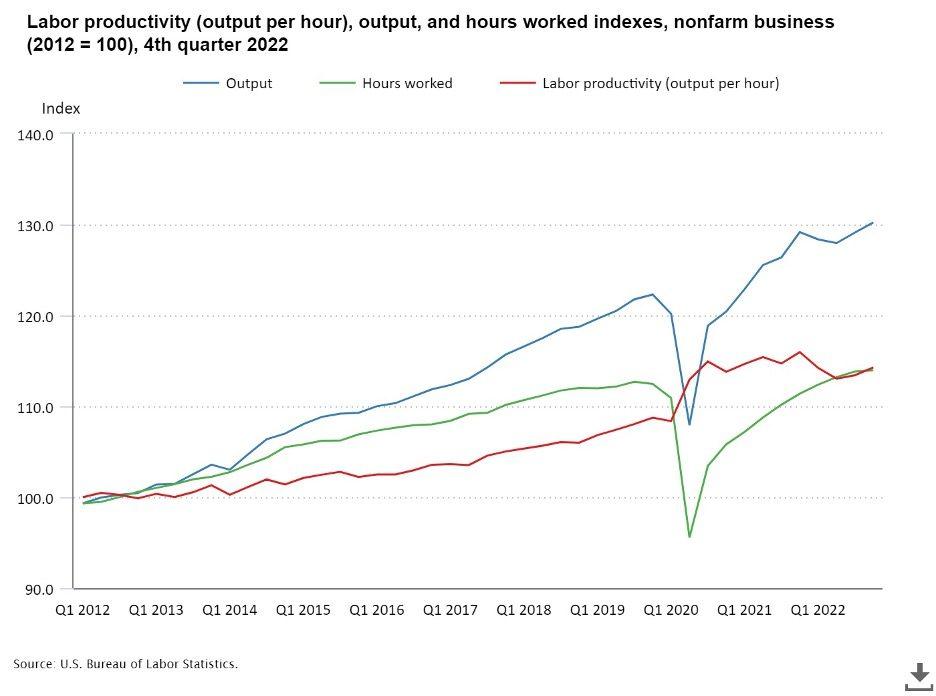
Yet it only started to gain traction as an issue of concern among business leaders when government data on productivity released in August 2022 showed a sharp and unexpected drop in the first and second quarters of 2022. The following month, Gallup released a survey indicating that as many as half of all Americans may be quiet quitters, further exacerbating business leaders’ concerns about this problem.
Is remote work to blame for quiet quitting?
Many traditionalist leaders rushed to attribute this drop in productivity and rise in quiet quitting to remote work. BlackRock CEO Larry Fink attributed the drop in productivity to remote work. He called for requiring employees to come to the office to address this problem.
Yet the claims of traditionalists don’t add up. If quiet quitting and the resultant drop in productivity stemmed from remote work, we should see a drop in productivity right from the start of the pandemic, when office workers switched to remote work. Then, when offices opened back up, especially after the Omicron wave at the end of 2021, we should see productivity going up as workers went back to the office from early 2022 onward.
In reality, we see the opposite trend. U.S. productivity jumped in the second quarter of 2020 as offices closed, and stayed at a heightened level through 2021. Then, when companies started mandating a return to the office in early 2022, productivity dropped sharply in Q1 and Q2 of that year. Productivity recovered slightly in Q3 and Q4 as the productivity loss associated with the return to office mandate was absorbed by companies–but it never got back to the period when remote-capable employees worked from home.
What explains the drop in productivity associated with quiet quitting?
Forcing employees to come to the office under the threat of discipline leads to disengagement, fear, and distrust, according to the director of research and strategy for workplace management at Gallup Ben Wigert,. Gallup finds that “the optimal engagement boost occurs when employees spend 60% to 80% of their time–or three to four days in a five-day workweek–working off-site.”
The Integrated Benefits Institute found in an October 2022 survey that employees who work remotely or in a hybrid environment reported being more satisfied (20.7%) and more engaged (50.8%).
No wonder, then, that mandates forcing employees to come to the office result in quiet quitting. Disengaged workers aren’t productive. That’s especially the case if they’re looking for a new job. The career website Monster reported that two-thirds of survey respondents would quit rather than return to the office full time. Unsurprisingly, many of those who are forced to return to the office start polishing their resumes and meeting with recruiters.
Solving quiet quitting in the mandated return to the office
The best approach for the future of work is a flexible team-led approach, with team leads making the call on work arrangements that serve the needs of their team. Team leads know best what their teams need, including how to maximize productivity, engagement, and collaboration.
Following the best practices for returning to the office can minimize quiet quitting concerns. A conversation about compensation should always accompany a return to office initiative. For instance, research by Owl Labs suggests that it costs an average of $863 a month for the average office worker to commute to work versus $432 a month to work from home.
What works best is to pay for fees associated with specific office-related costs, rather than a general salary increase. Pay the commuting costs of your staff. Pay for a nice catered lunch. Pay for their dry-cleaning costs.
Such payments help address the initial discontent and reduce the attrition typically associated with the mandated office return. However, this doesn’t address the quiet quitting that results from people coming to the office and doing the same thing they would do at home, except with a two-hour commute.
An October 2022 survey by Slack found that many knowledge workers who are required to go back to the office are spending up to four hours on video calls. Slack’s head in the U.K. Stuart Templeton said that employers risked turning their offices into “productivity killers,” since “making a two-hour commute to sit on video calls is a terrible use of the office.”
That’s the kind of thing that leads directly to quiet quitting. We know that people are much more productive on individual tasks that require focus at home. The survey by Slack confirmed this impression: 55% of respondents preferred to do “deep work” at home, and only 16% cited the office as a better place for deep work.
Instead, the office should be a place for socializing, collaboration, and in-depth training, especially for newer employees. To address socializing needs, it’s valuable to organize fun team-building exercises and social events as staff comes back to the office.
To facilitate collaboration, it’s important to consider how in-office staff work together with those working from home. Employees who come in on different days of the week still require hybrid collaboration and meetings. To facilitate collaboration between in-office and remote staff, it helps to provide virtual office environments, which put both kinds of workers on a level playing field. Likewise, it’s imperative to improve audiovisual collaboration to facilitate effective hybrid meetings.
There’s no replacement for face-to-face experiences for in-depth training around soft skills, such as effective in-person communication, conflict mediation and resolution, and ethical persuasion. My clients find that if they offer valuable training regularly once their employees return to the office, there’s a reduction in quiet quitting and a boost in employee engagement and productivity.
Finally, it’s valuable to help staff address burnout as part of the return to the office, for example by providing mental health benefits. In a late 2022 Gallup survey, 71% of respondents said that compared to in-office work, hybrid work improves work-life balance and 58% reported less burnout.
While a mandated return to the office will inevitably lead to some quiet quitting and loss in productivity, focusing on helping employees socialize, collaborate, and get great professional development and mentoring shows them the value of the office, which will reduce quiet quitting and boost performance.
Gleb Tsipursky, Ph.D., helps tech and finance industry executives drive collaboration, innovation, and retention in hybrid work. He serves as the CEO of the boutique future-of-work consultancy Disaster Avoidance Experts. He is the best-selling author of 7 books, including Never Go With Your Gut and Leading Hybrid and Remote Teams.His expertise comes from over 20 years of consulting for Fortune 500 companies from Aflac to Xerox and over 15 years in academia as a behavioral scientist at UNC-Chapel Hill and Ohio State.
The opinions expressed in Fortune.com commentary pieces are solely the views of their authors and do not necessarily reflect the opinions and beliefs of Fortune.
More must-read commentary published by Fortune:
- A soft landing is playing out—but optimism needs to be for the right reasons
- Overconfident tech CEOs have overpaid for ‘box tickers’ and ‘taskmasters.’ Here’s why the real ‘creators’ will survive the mass layoffs
- The U.S. has thwarted Putin’s energy blackmail. Europe says ‘Tanks a lot!’
- Once the ‘intellectual blood banks’ of the rich and powerful, can speechwriters be replaced with ChatGPT?
Learn how to navigate and strengthen trust in your business with The Trust Factor, a weekly newsletter examining what leaders need to succeed. Sign up here.