• Home
  • Latest
  • Fortune 500
  • Finance
  • Tech
  • Leadership
  • Lifestyle
  • Rankings
  • Multimedia

Trendingnow

1

U.S. companies have finally gotten $71 billion in tariff refunds, but they’re using it to offset inflation caused by the Iran war

2

FedEx CEO says we are in the middle of the biggest supply chain shift he’s seen in 35 years: ‘We are the referendum’

3

Buffett says AI giants are ‘playing a game they don’t want to play’ in the AI race, reveals he was behind Berkshire’s $31 billion bet on Google

1

U.S. companies have finally gotten $71 billion in tariff refunds, but they’re using it to offset inflation caused by the Iran war

2

FedEx CEO says we are in the middle of the biggest supply chain shift he’s seen in 35 years: ‘We are the referendum’

3

Buffett says AI giants are ‘playing a game they don’t want to play’ in the AI race, reveals he was behind Berkshire’s $31 billion bet on Google
China

Alibaba is at the center of a huge Hong Kong-Wall Street realignment

By
Yvonne Lau
Yvonne Lau
Down Arrow Button Icon
By
Yvonne Lau
Yvonne Lau
Down Arrow Button Icon
July 28, 2022, 2:44 PM ET
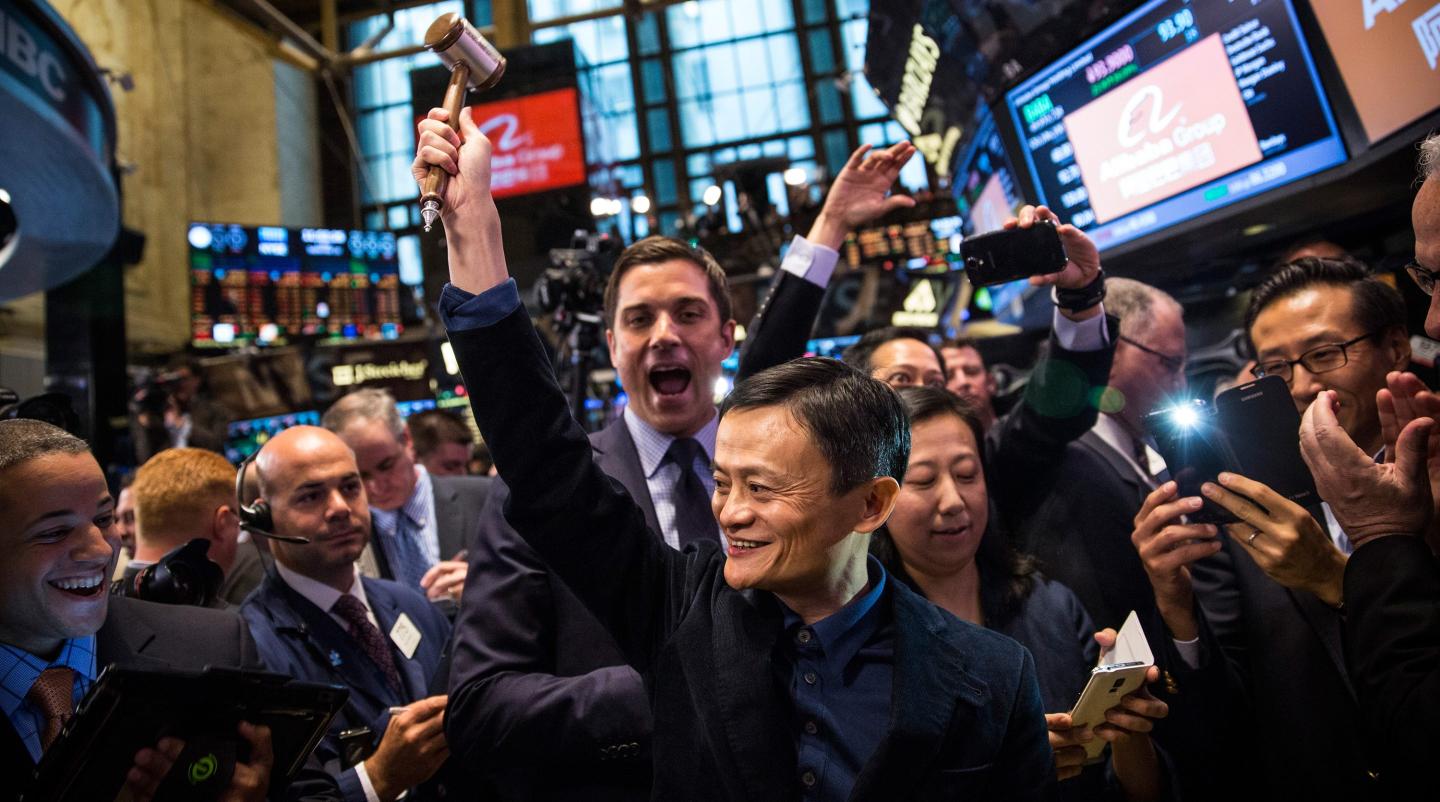
Photo of Alibaba founder Jack Ma ringing the bell at the New York Stock Exchange during the company's initial public offering on September 19, 2014, in New York City.
Alibaba Group founder Jack Ma celebrates as the Alibaba stock goes live during the company's initial price offering (IPO) at the New York Stock Exchange on September 19, 2014 in New York City. Andrew Burton—Getty Images
Add Fortune on Google for similar content.

In September 2014, Alibaba—China’s e-commerce technology behemoth—debuted on the New York Stock Exchange at a market valuation of $25 billion, becoming the U.S.’s largest-ever initial public offering.  

Less than a decade later, Alibaba’s calculus has changed. On Monday, the company announced that it will pursue a primary listing on the Hong Kong Stock Exchange (HKEX), as the 2024 deadline for U.S.-listed Chinese firms to comply with U.S. audit rules inches closer. Washington and Beijing are negotiating rules that would allow American officials to inspect the books and auditors of Chinese companies that are publicly listed in the U.S., but the two sides have been unable to strike an agreement.

Discussions have hit an impasse because Beijing wants to redact sensitive information in Chinese firms’ audit papers over national security concerns, but the U.S. is demanding full access, according to Bloomberg. Should the U.S. and China fail to ink a deal, 261 U.S.-listed Chinese firms worth $1.3 trillion could be booted from American stock exchanges.

The primary—rather than secondary—listing in Hong Kong of one of China’s most vaunted tech firms will strengthen the Asian bourse’s role as Wall Street’s replacement for Chinese securities listed in the U.S. Alibaba’s move also provides a blueprint for its peers—offering a viable back-up plan that allows direct access to a new pool of mainland China investors in case of a U.S. delisting and global investor retreat. And, experts say, it could be the catalyst that sparks a wave of Chinese tech giants flocking to the city for a primary listing, which could result in billions of inflows for one of Asia’s top stock exchanges. 

Hong Kong hedge

For Chinese firms, Hong Kong’s sophisticated capital market and closeness to mainland China makes it the most attractive Wall Street alternative in the event of a mass U.S. delisting of Chinese stocks. The loss of China-based companies from New York would make it more difficult for Americans to invest in Chinese companies. U.S. institutional investors alone hold $200 billion of exposure to Chinese American Depository Receipts (ADRs), a specific security that lets U.S. investors purchase shares in foreign firms. 

Over the last few years, Chinese companies have pursued secondary listings—also known as ‘homecoming listings’—in Hong Kong to hedge against the U.S. delisting risk. Secondary listings are easier, quicker, and cheaper to complete than primary listings. 

Alibaba will convert its secondary listing into a dual primary listing in New York and Hong Kong. With the 2024 delisting deadline looming closer, and Washington and Beijing seemingly no closer to reaching an agreement, this strategy made the most sense for Alibaba given that it’s at a high risk for a U.S. delisting, Liqian Ren, director of ModernAlpha at Wisdom Tree Asset Management, told Fortune. 

China is angling for a compromise that would see U.S.-listed Chinese firms divided into three categories: those that hold non-sensitive, sensitive and secret data, according to an FT report. Beijing would likely allow those in the first category to open their books to American regulators. But companies holding what Beijing deems as sensitive and secret data would be required to delist from the U.S., as it wants to prevent foreign authorities from accessing such information. 

China recently enacted new data security and personal information protection laws, which gives its authorities more control over private companies’ data in the name of national security. Alibaba, an e-commerce and cloud provider with over 1 billion users, would most likely be classified as a company holding information that Beijing wants to keep within its borders. “Every feature of Alibaba points to the fact that its time in the U.S. could soon be over,” Ren says. 

Alibaba’s pivot “will prove a catalyst” for its peers to follow suit, Adam Montanaro, investment director of global emerging markets equities at abrdn, told Fortune. Hong Kong should “expect a flurry” of U.S.-listed Chinese firms seeking a primary Hong Kong listing, Travis Lundy, analyst at Quiddity Advisors, an investment advisory firm, wrote in a Monday note. 

Chinese giants like Alibaba rival JD.com, internet and artificial intelligence (A.I.) giant Baidu, and gaming firm NetEase, are highly likely to go this route, Brian Freitas, analyst at Periscope Analytics, said in a Monday report. The larger U.S.-listed Chinese stocks, around 80 to 100 of them, will be eligible for a primary listing, Lundy estimates. Such firms “fit the bill” to be delisted from the U.S. as major internet platforms with millions of users and troves of data, Ren notes. 

SoftBank-backed e-commerce firm Dingdong has begun preparing for a dual primary listing in Hong Kong, according to a recent Reuters report. In May, video platform Bilibili said that it had applied for a HKEX dual primary listing and aims to finalize the deal in October. “The writing is on the wall for these companies,” Ren says. 

Tapping the mainland pipeline

And a primary listing on the HKEX offered one critical advantage for Chinese companies: direct access to mainland investors. 

Primary listed stocks in Hong Kong are eligible for inclusion in the Stock Connect, a system linking the Hong Kong, Shanghai, and Shenzhen exchanges. Mainland individual and institutional investors can therefore directly invest in these firms. 

Wealth management firm Bernstein predicts that Alibaba’s inclusion in Stock Connect could translate to $21 billion in investor inflows to its Hong Kong-listed shares. The company’s 3-month average daily trading volume in Hong Kong would likely rise from the current $700 million closer to its New York volume of $2.6 billion, Brendan Ahern, chief investment officer at Krane Funds Advisors, a China-focused investment management firm, told Fortune. He points to Alibaba rival Tencent as a case study. Chinese investors, via the Stock Connect, currently hold 7% of Tencent stock valued at $29 billion. Alibaba would see a “significant inflow… assuming a similar amount” of Chinese investor funds are channelled into Alibaba’s Hong Kong share class, he says. 

Chinese investors will flock to these stocks, experts say. A recent rally by China’s tech stocks will attract mainland investors “who believe the worst” has passed, John Lau, head of Asian Equities at financial services firm SEI Investments, told Fortune. Mainland investors are also searching for ways to diversify their portfolios, given China’s real estate crisis and the government’s cryptocurrencies crackdown, Ren says. 

Goldman Sachs predicts that investors could provide Hong Kong with $30 billion of inflows should Alibaba and 14 other Chinese firms convert their secondary listings to primary listings in Hong Kong. 

Sign up for the Fortune Features email list so you don’t miss our biggest features, exclusive interviews, and investigations.

About the Author
By Yvonne Lau
LinkedIn iconTwitter icon
See full bioRight Arrow Button Icon
Add Fortune on Google for similar content.

Latest in

Finance
Lorem ipsum dolor sit amet, consectetur adipiscing elit, sed do eiusmod tempor incididunt ut labore et dolore magna aliqua. Ut enim ad minim veniam
By Fortune Editors
October 20, 2025
Finance
Lorem ipsum dolor sit amet, consectetur adipiscing elit, sed do eiusmod tempor incididunt ut labore et dolore magna aliqua. Ut enim ad minim veniam
By Fortune Editors
October 20, 2025
Finance
Lorem ipsum dolor sit amet, consectetur adipiscing elit, sed do eiusmod tempor incididunt ut labore et dolore magna aliqua. Ut enim ad minim veniam
By Fortune Editors
October 20, 2025
Finance
Lorem ipsum dolor sit amet, consectetur adipiscing elit, sed do eiusmod tempor incididunt ut labore et dolore magna aliqua. Ut enim ad minim veniam
By Fortune Editors
October 20, 2025
Finance
Lorem ipsum dolor sit amet, consectetur adipiscing elit, sed do eiusmod tempor incididunt ut labore et dolore magna aliqua. Ut enim ad minim veniam
By Fortune Editors
October 20, 2025
Finance
Lorem ipsum dolor sit amet, consectetur adipiscing elit, sed do eiusmod tempor incididunt ut labore et dolore magna aliqua. Ut enim ad minim veniam
By Fortune Editors
October 20, 2025

Most Popular

Finance
Lorem ipsum dolor sit amet, consectetur adipiscing elit, sed do eiusmod tempor incididunt ut labore et dolore magna aliqua. Ut enim ad minim veniam
By Fortune Editors
October 20, 2025
Finance
Lorem ipsum dolor sit amet, consectetur adipiscing elit, sed do eiusmod tempor incididunt ut labore et dolore magna aliqua. Ut enim ad minim veniam
By Fortune Editors
October 20, 2025
Finance
Lorem ipsum dolor sit amet, consectetur adipiscing elit, sed do eiusmod tempor incididunt ut labore et dolore magna aliqua. Ut enim ad minim veniam
By Fortune Editors
October 20, 2025
Finance
Lorem ipsum dolor sit amet, consectetur adipiscing elit, sed do eiusmod tempor incididunt ut labore et dolore magna aliqua. Ut enim ad minim veniam
By Fortune Editors
October 20, 2025
Finance
Lorem ipsum dolor sit amet, consectetur adipiscing elit, sed do eiusmod tempor incididunt ut labore et dolore magna aliqua. Ut enim ad minim veniam
By Fortune Editors
October 20, 2025
Finance
Lorem ipsum dolor sit amet, consectetur adipiscing elit, sed do eiusmod tempor incididunt ut labore et dolore magna aliqua. Ut enim ad minim veniam
By Fortune Editors
October 20, 2025
Fortune Secondary Logo
Rankings
  • 100 Best Companies
  • Fortune 500
  • Global 500
  • Fortune 500 Europe
  • Most Powerful Women
  • World's Most Admired Companies
  • See All Rankings
  • Lists Calendar
Sections
  • Finance
  • Fortune Crypto
  • Features
  • Leadership
  • Health
  • Commentary
  • Success
  • Retail
  • Mpw
  • Tech
  • Lifestyle
  • CEO Initiative
  • Asia
  • Politics
  • Conferences
  • Europe
  • Newsletters
  • Personal Finance
  • Environment
  • Magazine
  • Education
Customer Support
  • Frequently Asked Questions
  • Customer Service Portal
  • Privacy Policy
  • Terms Of Use
  • Single Issues For Purchase
  • International Print
Commercial Services
  • Advertising
  • Fortune Brand Studio
  • Fortune Analytics
  • Fortune Conferences
  • Business Development
  • Group Subscriptions
About Us
  • About Us
  • Press Center
  • Work At Fortune
  • Terms And Conditions
  • Site Map
  • About Us
  • Press Center
  • Work At Fortune
  • Terms And Conditions
  • Site Map
  • Facebook icon
  • Twitter icon
  • LinkedIn icon
  • Instagram icon
  • Pinterest icon

Latest in

Jensen Huang’s signature black leather jacket just sold at Sotheby’s for nearly $1 million—and the money is going to young tech builders
SuccessJensen Huang
Jensen Huang’s signature black leather jacket just sold at Sotheby’s for nearly $1 million—and the money is going to young tech builders
By Sydney LakeJuly 17, 2026
8 minutes ago
Businesses are experimenting with cheaper Chinese AI models as U.S. rivals get more expensive
AIChina
Businesses are experimenting with cheaper Chinese AI models as U.S. rivals get more expensive
By Tatiana SatauaJuly 17, 2026
15 minutes ago
NordicTrack X24 Treadmill Review (2026): Expert Reviewed
HealthFitness
NordicTrack X24 Treadmill Review (2026): Expert Reviewed
By Christina SnyderJuly 17, 2026
24 minutes ago
Sarah Friar, CFO of OpenAI
AIFinance
OpenAI’s CFO: 4 questions that reveal if your AI spend is paying off
By Sheryl EstradaJuly 17, 2026
37 minutes ago
Markets may have just experienced their second DeepSeek shock, this time thanks to a Chinese AI lab named after a Pink Floyd album
AsiaChina
Markets may have just experienced their second DeepSeek shock, this time thanks to a Chinese AI lab named after a Pink Floyd album
By Nicholas GordonJuly 17, 2026
59 minutes ago
Raj Subramaniam, CEO of FedEx
SuccessFortune 500: Titans and Disruptors of Industry
FedEx’s CEO landed his first job by taking a roommate’s abandoned interview. Now he’s running a $75 billion shipping giant
By Emma BurleighJuly 17, 2026
1 hour ago

Most Popular

U.S. companies have finally gotten $71 billion in tariff refunds, but they’re using it to offset inflation caused by the Iran war
Economy
U.S. companies have finally gotten $71 billion in tariff refunds, but they’re using it to offset inflation caused by the Iran war
By Sasha RogelbergJuly 17, 2026
12 hours ago
FedEx CEO says we are in the middle of the biggest supply chain shift he’s seen in 35 years: ‘We are the referendum’
C-Suite
FedEx CEO says we are in the middle of the biggest supply chain shift he’s seen in 35 years: ‘We are the referendum’
By Fortune EditorsJuly 15, 2026
2 days ago
Buffett says AI giants are ‘playing a game they don’t want to play’ in the AI race, reveals he was behind Berkshire’s $31 billion bet on Google
Big Tech
Buffett says AI giants are ‘playing a game they don’t want to play’ in the AI race, reveals he was behind Berkshire’s $31 billion bet on Google
By Mia OsmonbekovJuly 16, 2026
24 hours ago
26 Meta employees accuse Mark Zuckerberg of using AI to target 8,000 layoffs against workers on medical, parental or family leave
Law
26 Meta employees accuse Mark Zuckerberg of using AI to target 8,000 layoffs against workers on medical, parental or family leave
By Barbara Ortutay, Alexandra Olson and The Associated PressJuly 15, 2026
2 days ago
JPMorgan CEO Jamie Dimon says 300,000 workers are needed to rebuild American shipbuilding—with jobs paying $100,000 without a college degree
Success
JPMorgan CEO Jamie Dimon says 300,000 workers are needed to rebuild American shipbuilding—with jobs paying $100,000 without a college degree
By Preston ForeJuly 16, 2026
1 day ago
Current price of oil as of July 17, 2026
Personal Finance
Current price of oil as of July 17, 2026
By Joseph HostetlerJuly 17, 2026
9 hours ago

© 2026 Fortune Media IP Limited. All Rights Reserved. Use of this site constitutes acceptance of our Terms of Use and Privacy Policy | CA Notice at Collection and Privacy Notice | Do Not Sell/Share My Personal Information
FORTUNE is a trademark of Fortune Media IP Limited, registered in the U.S. and other countries. FORTUNE may receive compensation for some links to products and services on this website. Offers may be subject to change without notice.