• Home
  • Latest
  • Fortune 500
  • Finance
  • Tech
  • Leadership
  • Lifestyle
  • Rankings
  • Multimedia
Personal FinancePersonal Finance

41% of employees are living paycheck to paycheck, more than before the pandemic

Megan Leonhardt
By
Megan Leonhardt
Megan Leonhardt
Down Arrow Button Icon
Megan Leonhardt
By
Megan Leonhardt
Megan Leonhardt
Down Arrow Button Icon
June 16, 2022, 10:21 AM ET
Woman looking at receipt from a supermarket.
More than four in 10 Americans say they're living paycheck to paycheck, a higher rate than 2019. LordHenriVoton—Getty Images

For a brief, shining moment last year, Americans were actually doing better financially than they had in a long time. 

Although the early days of the pandemic brought about job losses and lockdowns, the recovery had been strong—and government stimulus programs bolstered Americans’ savings rates and disposable income. 

But those halcyon days proved fleeting. Personal savings rates fell to 4.4% in April, according to the Bureau of Economic Advisors. That’s the lowest level in over seven years—and a far cry from the high of 33.7% seen in April 2020.

Even with the marginally higher wages Americans have been negotiating, most people are struggling financially amid dwindling savings and soaring prices. About 41% of workers recently surveyed by WTW reported they are living paycheck to paycheck, according to research from the 2022 Global Benefits Attitudes Survey released Thursday. That’s higher than the 38% who reported running out of money before their next paycheck in 2019. 

“The link between financial stability and overall well-being has become even more precarious as employees fret over inflation, economic instability, and workplace challenges,” said Mark Smrecek, senior director of retirement at WTW. 

Even those with higher incomes are feeling the squeeze. Over a third of workers earning $100,000 or more (36%) reported living paycheck to paycheck, WTW found. That’s compared to just 18% in 2019. 
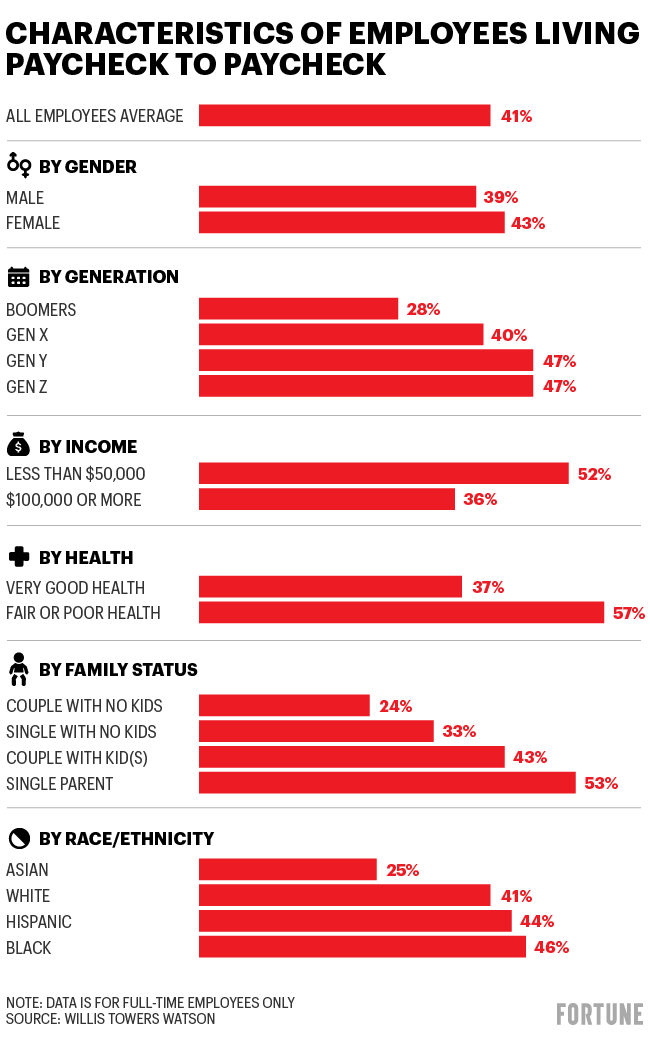
Of course, those with fewer resources are being hit harder. Inflation is typically a bigger burden on lower-income households that usually spend a bigger portion of their budget on necessities. So when food, gas, and housing costs surge, that means there’s even less left over at the end of the month. More than half of lower-income workers, single parents, and those struggling with their health say they’re living paycheck to paycheck right now, according to WTW’s survey.

Even meeting basic needs is a challenge for a significant number of employees—about 43% find it difficult or very difficult to cover one or more core needs, including housing, food, health care, and childcare. 

In many cases, employers are not immune to the financial struggles of their workers. Thanks to the tight labor market, workers have some leverage to demand higher wages—and they are. Or they’re leaving for higher pay elsewhere. Thursday’s report from WTW finds employees living paycheck to paycheck are nearly twice as likely to quit for even a 5% raise than those who are more financially secure. 

Employers are getting the message. About 63% of companies are planning to provide pay adjustments in response to inflation, according to a recent survey from Gartner released this month. That’s up from just one in five organizations that were considering a cost-of-living wage adjustment in April. 

“Employees are now looking to their employers for support. Employers, in turn, can help employees weather the storm and enhance their financial stability by factoring in well-being when considering programs,” Smrecek said.

Are you a single adult who lives alone? Fortune wants to hear how inflation is affecting your budget. Email reporter Alicia Adamczyk to share your story for a future article.

About the Author
Megan Leonhardt
By Megan Leonhardt
LinkedIn iconTwitter icon
See full bioRight Arrow Button Icon

Latest in Personal Finance

Julian Braithwaite is the Director General of the International Alliance for Responsible Drinking
CommentaryProductivity
Gen Z is drinking 20% less than Millennials. Productivity is rising. Coincidence? Not quite
By Julian BraithwaiteDecember 13, 2025
18 hours ago
Personal Financemortgages
7 best HELOC lenders in 2025: How to choose the best home equity line of credit for your situation
By Joseph HostetlerDecember 12, 2025
2 days ago
Personal FinanceCertificates of Deposit (CDs)
Truist CD rates 2025: Probably not your best option (but here’s how to decide)
By Joseph HostetlerDecember 12, 2025
2 days ago
The Citibank logo on a green layered background.
Personal FinanceCertificates of Deposit (CDs)
Citibank CD rates 2025
By Joseph HostetlerDecember 12, 2025
2 days ago
The Bank of America logo on a green layered background.
Personal FinanceCertificates of Deposit (CDs)
Bank of America CD rates 2025: How to ensure you get the highest APY
By Joseph HostetlerDecember 12, 2025
2 days ago
The Citizens Bank logo on a green layered background.
Personal FinanceCertificates of Deposit (CDs)
Citizens Bank CD rates 2025: Strong APY (but can you afford it?)
By Joseph HostetlerDecember 12, 2025
2 days ago

Most Popular

placeholder alt text
Success
Apple cofounder Ronald Wayne sold his 10% stake for $800 in 1976—today it’d be worth up to $400 billion
By Preston ForeDecember 12, 2025
2 days ago
placeholder alt text
Economy
Tariffs are taxes and they were used to finance the federal government until the 1913 income tax. A top economist breaks it down
By Kent JonesDecember 12, 2025
2 days ago
placeholder alt text
Success
40% of Stanford undergrads receive disability accommodations—but it’s become a college-wide phenomenon as Gen Z try to succeed in the current climate
By Preston ForeDecember 12, 2025
2 days ago
placeholder alt text
Economy
The Fed just ‘Trump-proofed’ itself with a unanimous move to preempt a potential leadership shake-up
By Jason MaDecember 12, 2025
1 day ago
placeholder alt text
Success
Apple CEO Tim Cook out-earns the average American’s salary in just 7 hours—to put that into context, he could buy a new $439,000 home in just 2 days
By Emma BurleighDecember 12, 2025
2 days ago
placeholder alt text
Economy
For the first time since Trump’s tariff rollout, import tax revenue has fallen, threatening his lofty plans to slash the $38 trillion national debt
By Sasha RogelbergDecember 12, 2025
2 days ago
Rankings
  • 100 Best Companies
  • Fortune 500
  • Global 500
  • Fortune 500 Europe
  • Most Powerful Women
  • Future 50
  • World’s Most Admired Companies
  • See All Rankings
Sections
  • Finance
  • Leadership
  • Success
  • Tech
  • Asia
  • Europe
  • Environment
  • Fortune Crypto
  • Health
  • Retail
  • Lifestyle
  • Politics
  • Newsletters
  • Magazine
  • Features
  • Commentary
  • Mpw
  • CEO Initiative
  • Conferences
  • Personal Finance
  • Education
Customer Support
  • Frequently Asked Questions
  • Customer Service Portal
  • Privacy Policy
  • Terms Of Use
  • Single Issues For Purchase
  • International Print
Commercial Services
  • Advertising
  • Fortune Brand Studio
  • Fortune Analytics
  • Fortune Conferences
  • Business Development
About Us
  • About Us
  • Editorial Calendar
  • Press Center
  • Work At Fortune
  • Diversity And Inclusion
  • Terms And Conditions
  • Site Map

© 2025 Fortune Media IP Limited. All Rights Reserved. Use of this site constitutes acceptance of our Terms of Use and Privacy Policy | CA Notice at Collection and Privacy Notice | Do Not Sell/Share My Personal Information
FORTUNE is a trademark of Fortune Media IP Limited, registered in the U.S. and other countries. FORTUNE may receive compensation for some links to products and services on this website. Offers may be subject to change without notice.