• Home
  • Latest
  • Fortune 500
  • Finance
  • Tech
  • Leadership
  • Lifestyle
  • Rankings
  • Multimedia
Commentary

Our obsession with robots was a distraction from the real threats facing the U.S. workforce

By
Rachel Korberg
Rachel Korberg
and
Roy E. Bahat
Roy E. Bahat
Down Arrow Button Icon
By
Rachel Korberg
Rachel Korberg
and
Roy E. Bahat
Roy E. Bahat
Down Arrow Button Icon
April 15, 2022, 8:43 AM ET
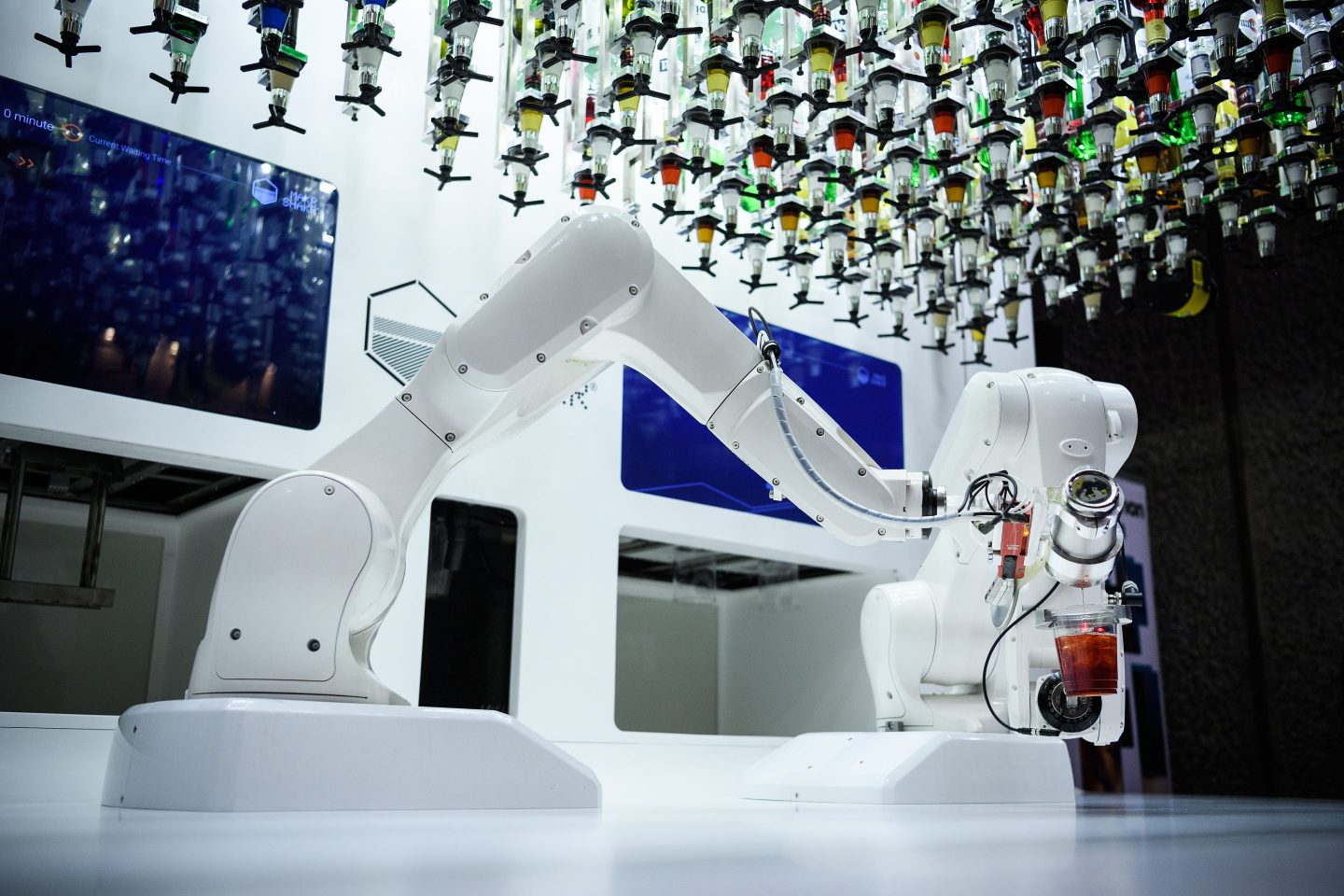
A cocktail-making “robot”
Toni, an automated cocktail maker, was pitted against six bartenders during a press event in London. But Toni and her robot comrades aren’t the real problem for today’s workforce.Leon Neal—Getty Images

Remember when the robots were coming for our jobs? Before the pandemic, there was a constant stream of conferences, policy reports, and news headlines sounding the alarm about technology replacing human workers.

A sample of those headlines: AI and Robots Could Threaten Your Career Within Five Years; Automation could replace 800 million workers by 2030; We’re heading into a jobless future.

Yet today we are experiencing the opposite. There are nearly 5 million more job openings than unemployed people in the U.S., according to recent Department of Labor data, and a record 4.5 million people quit their jobs in November. Many employers say they are unable to hire enough workers, which has contributed to supply-chain jams, small-business closures, and even shortages of cream cheese.

How did so many get it so wrong? And how can we ensure that future predictions about the labor market are more accurate?

We got it wrong because we often excluded workers from this very conversation. If workers had been invited to fancy business conferences or gatherings of economists, more experts might have identified the ample warnings of today’s hiring shortages. Workers have long known that issues like low pay, being denied a voice in the workplace, and the high costs of care would eventually rear their heads as business vulnerabilities and national economic risks.

For years, workers have been saying, loudly, that it shouldn’t be normal to be working and poor. More than 53 million people work low-wage jobs and struggle to pay for rent, childcare, and transportation, let alone health care and education. 

In the UN’s ranking of childcare in 41 rich countries, the U.S. scored second to last, far behind less well-off countries, like Slovenia. As any working parent will understand, a lack of reliable, quality child care leads to decreased productivity.

Workers could have told experts that erratic schedules make them want to quit. Following the success of just-in-time manufacturing and lean supply-chain practices, companies began to apply these techniques designed for machines to human workers.

The result? Constantly changing schedules and no slack to facilitate learning. One man in Pittsburgh whose employer used a just-in-time scheduling algorithm found the changes to his schedule so untenable he was forced to take a lower-paying job with less advancement potential simply to gain stability. 

Workers have continuously said—to opinion pollsters and through labor organizing—that they want stability, a voice on the job, family-sustaining pay and benefits, and a chance to get ahead.

By focusing so much attention on the threat of robot-driven job loss and ignoring these critical warning signs, we made our economy even more vulnerable.

There is a straightforward solution: Workers, especially those in the types of “essential” lower-paying jobs that keep the economy running, must have a seat at the decision-making table.

This is already underway. California’s Future of Work Commission modeled worker-informed policy development. It included business and labor leaders and heard testimony from frontline workers to identify multidimensional solutions, from innovation in workplace benefits to improving job quality and—yes—helping workers prepare for technology-related change.

Listening to workers and delivering good jobs is also smart business. The number one ESG issue Americans are now judging companies on is their treatment of workers. The industry is responding: The new Worker Financial Wellness Initiative—a coalition of 13 major companies employing more than 800,000 people in the United States—have committed to conducting assessments to better understand their employees’ needs and explore solutions that range from increasing salaries to decreasing benefits costs or offering stock ownership.  

For employers, attracting people to open jobs may require not only increased pay but also more of a say. For governments, the trillions in recently appropriated recovery dollars are a once-in-a-generation shot to fuel quality job growth. Philanthropy and the nonprofit sector have the necessary tools to uplift worker voices.

Technology is one of many forces of change impacting the workforce, along with pandemics, climate change, the care crisis, and the absence of a fair shot for too many. But the impacts of these changes are not inevitable—the business and policy choices we make today will shape how they play out in the future.

We can better prepare for all changes (robots included) by ensuring workers have a seat at the table. 

Rachel Korberg is the executive director of the Families and Workers Fund, a coalition of philanthropies chaired by Schmidt Futures and the Ford Foundation working together to advance good jobs and a more equitable economy that uplifts all.

Roy E. Bahat is a venture capitalist and UC Berkeley lecturer, who participated in both the California Governor’s Commission on the Future of Work, and the Shift Commission. He organized the Aspen Institute Business Roundtable on Organized Labor.


Never miss a story: Follow your favorite topics and authors to get a personalized email with the journalism that matters most to you.
About the Authors
By Rachel Korberg
See full bioRight Arrow Button Icon
By Roy E. Bahat
See full bioRight Arrow Button Icon

Latest in Commentary

Finance
Lorem ipsum dolor sit amet, consectetur adipiscing elit, sed do eiusmod tempor incididunt ut labore et dolore magna aliqua. Ut enim ad minim veniam
By Fortune Editors
October 20, 2025
Finance
Lorem ipsum dolor sit amet, consectetur adipiscing elit, sed do eiusmod tempor incididunt ut labore et dolore magna aliqua. Ut enim ad minim veniam
By Fortune Editors
October 20, 2025
Finance
Lorem ipsum dolor sit amet, consectetur adipiscing elit, sed do eiusmod tempor incididunt ut labore et dolore magna aliqua. Ut enim ad minim veniam
By Fortune Editors
October 20, 2025
Finance
Lorem ipsum dolor sit amet, consectetur adipiscing elit, sed do eiusmod tempor incididunt ut labore et dolore magna aliqua. Ut enim ad minim veniam
By Fortune Editors
October 20, 2025
Finance
Lorem ipsum dolor sit amet, consectetur adipiscing elit, sed do eiusmod tempor incididunt ut labore et dolore magna aliqua. Ut enim ad minim veniam
By Fortune Editors
October 20, 2025
Finance
Lorem ipsum dolor sit amet, consectetur adipiscing elit, sed do eiusmod tempor incididunt ut labore et dolore magna aliqua. Ut enim ad minim veniam
By Fortune Editors
October 20, 2025

Most Popular

Finance
Lorem ipsum dolor sit amet, consectetur adipiscing elit, sed do eiusmod tempor incididunt ut labore et dolore magna aliqua. Ut enim ad minim veniam
By Fortune Editors
October 20, 2025
Finance
Lorem ipsum dolor sit amet, consectetur adipiscing elit, sed do eiusmod tempor incididunt ut labore et dolore magna aliqua. Ut enim ad minim veniam
By Fortune Editors
October 20, 2025
Finance
Lorem ipsum dolor sit amet, consectetur adipiscing elit, sed do eiusmod tempor incididunt ut labore et dolore magna aliqua. Ut enim ad minim veniam
By Fortune Editors
October 20, 2025
Finance
Lorem ipsum dolor sit amet, consectetur adipiscing elit, sed do eiusmod tempor incididunt ut labore et dolore magna aliqua. Ut enim ad minim veniam
By Fortune Editors
October 20, 2025
Finance
Lorem ipsum dolor sit amet, consectetur adipiscing elit, sed do eiusmod tempor incididunt ut labore et dolore magna aliqua. Ut enim ad minim veniam
By Fortune Editors
October 20, 2025
Finance
Lorem ipsum dolor sit amet, consectetur adipiscing elit, sed do eiusmod tempor incididunt ut labore et dolore magna aliqua. Ut enim ad minim veniam
By Fortune Editors
October 20, 2025
Rankings
  • 100 Best Companies
  • Fortune 500
  • Global 500
  • Fortune 500 Europe
  • Most Powerful Women
  • Future 50
  • World’s Most Admired Companies
  • See All Rankings
Sections
  • Finance
  • Leadership
  • Success
  • Tech
  • Asia
  • Europe
  • Environment
  • Fortune Crypto
  • Health
  • Retail
  • Lifestyle
  • Politics
  • Newsletters
  • Magazine
  • Features
  • Commentary
  • Mpw
  • CEO Initiative
  • Conferences
  • Personal Finance
  • Education
Customer Support
  • Frequently Asked Questions
  • Customer Service Portal
  • Privacy Policy
  • Terms Of Use
  • Single Issues For Purchase
  • International Print
Commercial Services
  • Advertising
  • Fortune Brand Studio
  • Fortune Analytics
  • Fortune Conferences
  • Business Development
About Us
  • About Us
  • Editorial Calendar
  • Press Center
  • Work At Fortune
  • Diversity And Inclusion
  • Terms And Conditions
  • Site Map
  • Facebook icon
  • Twitter icon
  • LinkedIn icon
  • Instagram icon
  • Pinterest icon

Latest in Commentary

super bowl
CommentaryAdvertising
The Super Bowl reveals a dangerous gap in corporate strategy 
By Christopher VollmerFebruary 9, 2026
3 hours ago
tara comonte
CommentaryAdvertising
Weight Watchers CEO: what the GLP-1 Super Bowl ads are missing
By Tara ComonteFebruary 9, 2026
4 hours ago
ceo
CommentaryLeadership
The next 18 months of the agentic era will feel like a slow-motion stress test for CEOs. Most will make the same critical mistake
By Amy Eliza WongFebruary 9, 2026
5 hours ago
CommentaryHealth
Patient private capital is needed to help Asia plug its healthcare gaps
By Abrar MirFebruary 8, 2026
18 hours ago
nfl
CommentaryTV
The Super Bowl was made for TV and instant replay was made for visual AI. Here’s how it could be better and what it would look like
By Jason CorsoFebruary 8, 2026
1 day ago
tipping
CommentaryTipping
I’m the chief growth officer at a payments app and I know how America really tips. Connecticut, I’m looking at you
By Ricardo CiciFebruary 8, 2026
1 day ago

Most Popular

placeholder alt text
Economy
Elon Musk warns the U.S. is '1,000% going to go bankrupt' unless AI and robotics save the economy from crushing debt
By Jason MaFebruary 7, 2026
2 days ago
placeholder alt text
Economy
Russian officials are warning Putin that a financial crisis could arrive this summer, report says, while his war on Ukraine becomes too big to fail
By Jason MaFebruary 8, 2026
20 hours ago
placeholder alt text
Commentary
America marks its 250th birthday with a fading dream—the first time that younger generations will make less than their parents
By Mark Robert Rank and The ConversationFebruary 8, 2026
1 day ago
placeholder alt text
Commentary
We studied 70 countries' economic data for the last 60 years and something big about market crashes changed 25 years ago
By Josh Ederington, Jenny Minier and The ConversationFebruary 8, 2026
1 day ago
placeholder alt text
Success
Gen Z Patriots quarterback Drake Maye still drives a 2015 pickup truck even after it broke down on the highway—despite his $37 million contract
By Sasha RogelbergFebruary 7, 2026
2 days ago
placeholder alt text
Personal Finance
Tom Brady is making 15 times more as a commentator than he did playing in the big game thanks to $375 million contract 
By Eva RoytburgFebruary 8, 2026
1 day ago

© 2026 Fortune Media IP Limited. All Rights Reserved. Use of this site constitutes acceptance of our Terms of Use and Privacy Policy | CA Notice at Collection and Privacy Notice | Do Not Sell/Share My Personal Information
FORTUNE is a trademark of Fortune Media IP Limited, registered in the U.S. and other countries. FORTUNE may receive compensation for some links to products and services on this website. Offers may be subject to change without notice.