With its abundance of top-rated restaurants, bustling music scene, and community of young professionals, Austin seemed like an ideal place to relocate for Karyn Lewis. A PR professional currently based in Jackson, Miss., Lewis planned to take advantage of the fact that her New York–based firm had an outpost in Austin and move to the midsize Texas city early next year with her partner.
“I think of Austin as kind of a hippie city,” Lewis, 28, tells Fortune. “It seemed like the easiest and the most affordable move.” But the passage of a controversial new law in Texas that effectively bans abortions after six weeks of pregnancy has Lewis rethinking those plans. “We are now looking at other options,” Lewis says. “We’re moving from Mississippi, so we are looking for something more progressive, and this definitely seems like a few steps back.”
The abortion legislation is far from the only contentious new law passed in Texas recently. During the most recent legislative session alone, the state moved to restrict voting rights, allow residents to carry handguns in public without a license, ban homeless camps, and limit the teaching of critical race theory in schools.
It’s all part of a growing partisan divide that is spilling over from the political realm and putting large corporations in a bind. States like Texas, Arizona, Georgia, and Florida have spent years wooing Fortune 500 behemoths with promises of lower corporate tax rates, economic incentive programs that dole out cash or tax breaks for relocating, and a more affordable cost of living for employees. Texas, for example, welcomed a number of California refugees in recent years, including the headquarters of Charles Schwab, Hewlett Packard Enterprise (HPE), and Oracle; Tesla is also building a gigafactory there. Meanwhile, Airbnb is planning to open a technical hub in Atlanta, while Spotify opened a major office in Miami.
Yet these same states are simultaneously rolling out laws that are an automatic turnoff to many young, liberal tech workers and force companies into damage-control mode with socially conscious consumers and ESG investors.
“You have a number of companies recently that have relocated to Texas because it’s supposed to be a friendlier climate for business. And it’s suddenly not as friendly as it was,” says Anthony Johndrow, cofounder and CEO of consultancy Reputation Economy Advisors.
Geographic cherry-picking is actually a relatively new phenomenon: By and large, corporations previously made location decisions based on access to their suppliers or proximity to distribution locations, says Brian Kropp, chief of research in the HR practice at Gartner, an advisory firm. But in the past decade or so, companies started to make decisions based on access to talent.
That meant several Southern states started to catch fire as corporations grew tired of the high cost of doing business on the coasts. The Tax Foundation rated California, for example, as having the second-worst business tax climate in the country (New Jersey was first).
But moving into a cultural war zone isn’t exactly what many tech workers had in mind. When it comes to the Texas antiabortion bill, a recent survey of over 1,000 U.S. adults conducted by PerryUndem for the Tara Health Foundation found roughly two-thirds reported the bill would discourage them from working in the state. And 64% say they would not apply for a job in any state that passed a ban like Texas’s.
66%
of workers say the antiabortion law discourages them from taking a job in Texas. Source: PerryUndem
Those are troublesome stats for employers at a time when nationwide labor shortages are the norm and the war for talent is intensifying. So far, there’s been no noticeable increase or decrease in Texas hiring trends yet from new laws passing, according to LinkedIn’s data team. However, the team told Fortune that it’s possible the impacts will emerge over time.
Meanwhile about 50 companies from across the country signed a statement released Sept. 21 opposing Texas’s new law, saying that “restricting access to comprehensive reproductive care, including abortion, threatens the health, independence, and economic stability of our workers and customers.”
Starbucks and Microsoft were among the companies that declined to participate, according to the Wall Street Journal. But “declining to participate” may not be a viable strategy in the long run. Nearly three out of four employees, or 74%, expect their employers to get involved in societal, political, and cultural debates, even if those issues don’t have anything to do with their business, according to a recent survey by Gartner. About 68% of employees would consider quitting their current job for an opportunity with an organization that took a stronger stance on social issues that were important to them.
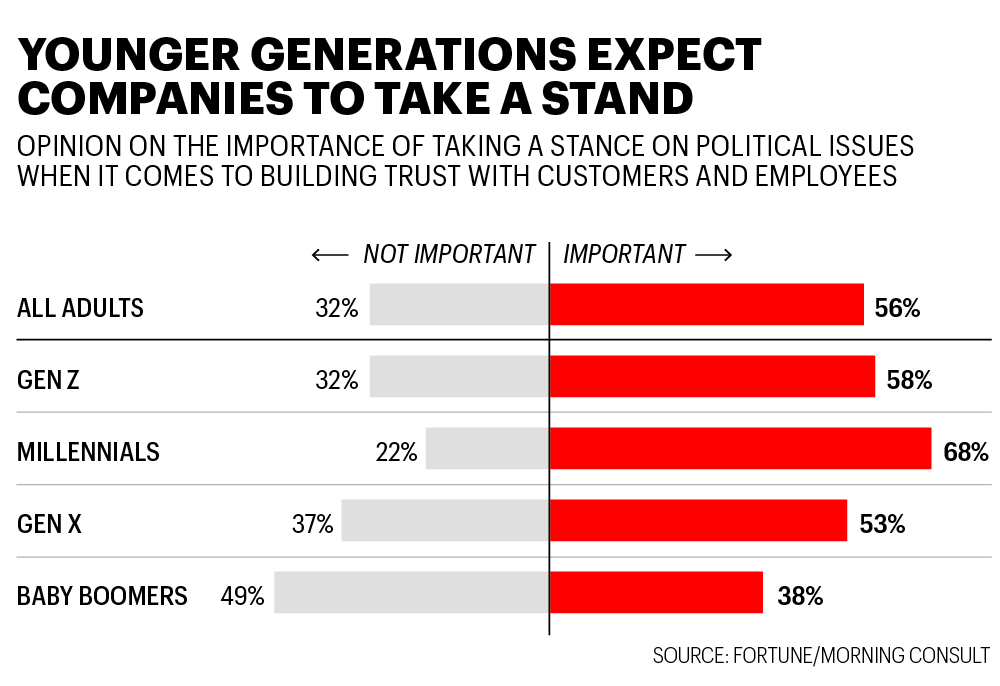
Gartner’s research shows companies gain ground when they not only have a response but they actually take action. Gartner’s Kropp says that if people understand why a company is making the decision, it bolsters trust.
Swift moves by ride-sharing companies Lyft and Uber, which pledged to cover drivers’ legal fees if they are sued under the Texas law for driving women to abortion clinics, certainly fall into this camp. Salesforce has perhaps gone the furthest, with CEO Marc Benioff tweeting, “… if you want to move we’ll help you exit TX. Your choice.”
HPE—which relocated its headquarters from San Jose to Spring, Texas, in December—is one company that’s holding firm. “There are no plans to reconsider the decision to move to Houston, and we’ll be opening a new campus in Spring early next year,” HPE spokesman Adam Bauer tells Fortune. (He adds that the move to Texas was not compulsory for employees.)
One factor limiting companies’ options, say experts, is that neighboring states may simply serve up a different array of hot-button issues.
68%
of employees would change companies for one with stronger stance on social issues. Source: Gartner
Challenges to abortion laws have already been filed in Texas, as well as Ohio and Georgia, and the Supreme Court is set to hear oral arguments in December on Mississippi’s law banning most abortions after 15 weeks. There’s major outcry over a highly restrictive voting rights law that Georgia passed in March; meanwhile, 18 states have already enacted laws as of July that broadly restrict residents’ voting access.
To that end, companies sticking around could, eventually, help stabilize the situation. The influx of corporations and younger knowledge workers into conservative states may create some political change from within. As the Houston Chronicle reports, during the last election Democrats saw their margin of victory grow in 21 counties along Texas’s Interstate 35, which runs through the more urban and diverse Dallas, Waco, and Austin.
Lauren Kalo, who recently graduated and moved to Austin about three months ago for a sales role at a major tech company, tells Fortune she’s staying put because she wants to be part of the resistance. “There have to be people there that are going to advocate and make changes,” Kalo, 22, says, adding that she has already attended a Texas rally for Beto O’Rourke, who may enter the 2022 gubernatorial race.
In Texas, 62% of voters ages 18 to 29 voted for Joe Biden, versus 35% for Donald Trump, according to the Center for Information and Research on Civic Learning and Engagement. Young voters in Florida, Georgia, and North Carolina also swung for Biden. Transplants like Kalo will demand a certain level of local autonomy for cities, or urban influence on state policies, notes Stanford political science professor Jonathan Rodden.
Indeed, for conservatives, corporations leaving probably isn’t what’s keeping them up at night—it’s what might happen if they stay.
This article appears in the October/November 2021 issue of Fortune with the headline, “Hard right turn.”
Dive into stories from Fortune’s print edition:
- Firefighters enlist high-tech tools to stave off the West’s increasingly destructive blazes
- How Toyota kept making cars when the chips were down
- Getting burned: Battles over the cost of climate change are scorching California homeowners
- NFTy 50: The most influential builders, creatives, and influencers in the NFT world
- The war to charge your electric car is powering up
Subscribe to Fortune Daily to get essential business stories straight to your inbox each morning.