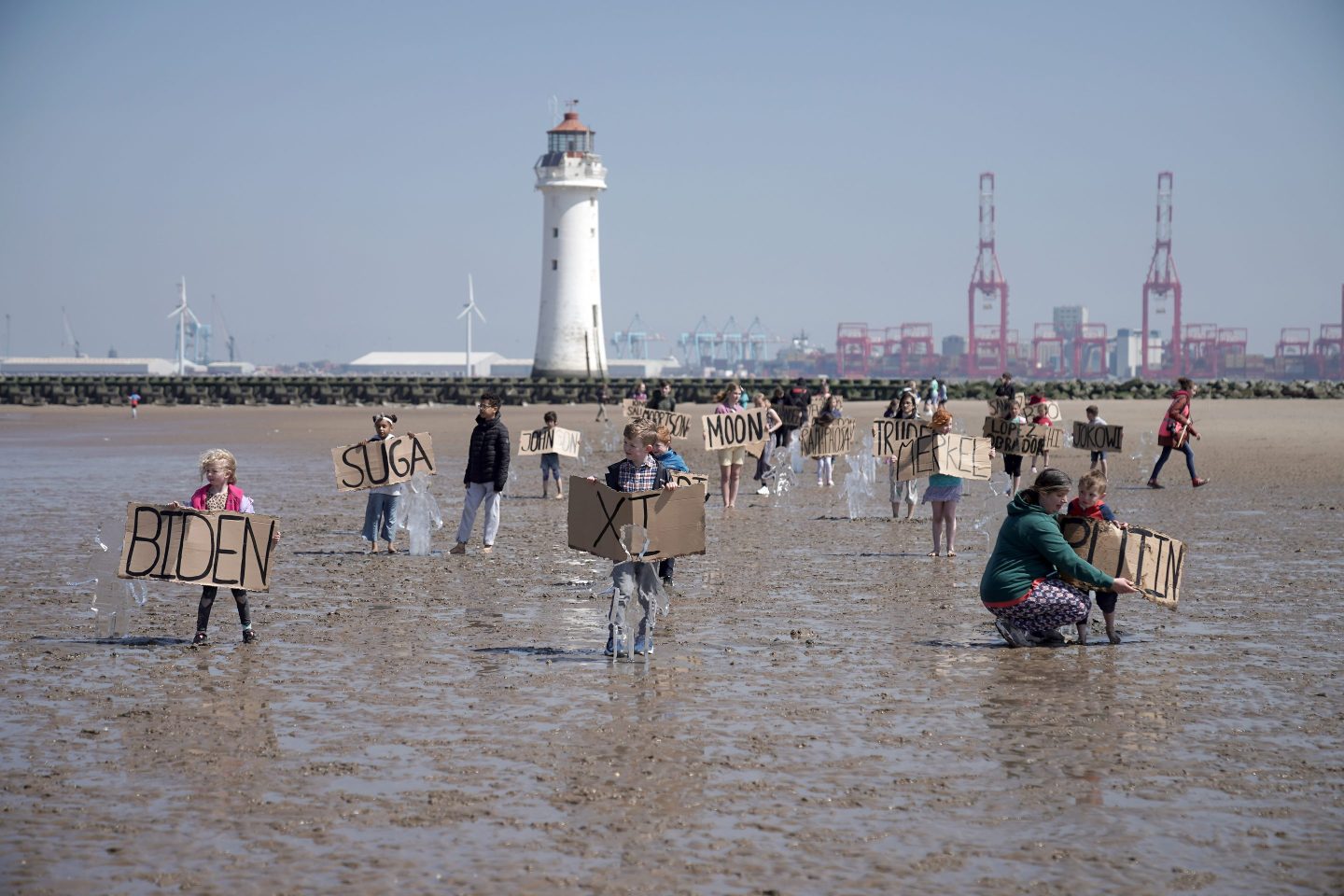
Recent hurricanes and tragic flooding are another wake-up call about the coming disaster that awaits us if the world doesn’t take bold collective action on climate change. This is truly an all-hands-on-deck moment.
One of us served as chief of staff to former Secretary of State turned Presidential Envoy for Climate John Kerry, who negotiated the Paris Agreement and is now focused on the next big global engagement in Glasgow. The other designed breakthrough sustainability plans at one of the world’s largest companies. We have seen both the potential of business and the power of government leadership on climate. We know that government alone cannot meet this moment: Business must simultaneously step up as well.
Around the Paris Agreement, business played a special role in first validating that it was good for the economy, and when President Trump foolishly withdrew American participation–despite calls from 75 CEOs and 16 Fortune 500 companies–in confirming that the marketplace was “still in” and stepping up on their own.
As we’ve learned in the five years since, the private sector can be more than a validator. It can be a catalyst. Business can deepen the political will for governments to be more ambitious and act sooner so that we move at the speed and scale needed to solve climate change. The fast-approaching COP26 conference in Glasgow (UK) this November is a pivotal moment that could lead to even stronger goals and more concrete roadmaps to reach net zero goals, specifically by strengthening 2030 targets and plans. Ahead of countries from all over the world gathering to decide whether and how to accelerate their progress this decade, business can and must not just endorse action, but also raise their own ambition on the front end.
It’s encouraging to see more than a hundred companies, across 16 countries and 25 industries, pledge to achieve net-zero carbon emissions 10 years ahead of Paris’ 2050 goal. On the way to Glasgow, what CEOs and private sector leadership do and say now about action they’re taking this decade to rapidly reduce emissions sends a clear message to governments that investing in a net-zero future is a boon – not a burden – for business, jobs, and their economies. Corporate actions between now and 2030 will determine whether their public mid-century commitments to net zero ring true or ring hollow.
It gives us great hope that, based on our recent conversations with dozens of multinational companies, private sector leaders seem animated by the opportunity to lead. CEOs should speak out louder and more frequently about why climate action is also our business, share their knowledge, bring along their supply chains and expand transparency. Many companies have stepped up, and we’re thankful for them, but more must join their ranks, and all can be more vocal.
Business leaders can help ensure their countries lead by example through the passage and enactment of robust public policies that in turn, provide negotiators even more ambitious lift and leverage in the lead-up to COP26. We need business leaders to speak directly to their governments, whether it be in Europe, Asia, or the Americas and urge them to arrive at Glasgow with clear, strong commitments – along with the underlying policy and financial infrastructure that’s essential for success – in their diplomatic briefcases.
This is especially true here in the U.S., where Congress’ current consideration of climate provisions in both the bipartisan infrastructure bill and more critically in the budget reconciliation process is a prime example of where business leaders should be weighing in and speaking up in support of this legislation in ways they aren’t now. Instead, too many are raising their voices in opposition. We are at a critical time in the Congressional calendar. True leadership is earned inside the beltway as well as inside the boardroom.
At this “code-red-for-humanity” juncture, where there’s still time for hope, we frankly need more from those who already have made the commitment to lead, and we need more companies to follow in their footsteps. 2030 and 2050 emissions targets can and should be made more ambitious, measurable and verifiable. More closely examining and tackling thorny supply chains challenges can and should provide a wealth of opportunities. Investing in and turbocharging burgeoning technologies, many of which haven’t yet been invented, can and should rapidly scale us up to the green economy future that we need.
There are less than 50 days until Glasgow, and while we’re clear-eyed about the struggle and challenges that face those who heed the call of climate leadership, we have great faith that in the words of FDR: “[They] can do it… if [they] really try.” The world and the future are watching.
Leslie Dach and David Wade are co-chairs of Glasgow Is Our Business, a NGO focused on accelerating business commitments to a net zero carbon future.
Leslie Dach was on the global executive committee of Walmart Inc. and is a Board member of the Environmental Defense Fund. David Wade was Chief of Staff to John Kerry while he was Secretary of State and while he was in the Senate. He is the Chair of World War Zero, a bipartisan climate focused NGO.











