Our mission to make business better is fueled by readers like you. To enjoy unlimited access to our journalism, subscribe today.
A money-losing electric vehicle start-up that aims to shake up the commercial delivery van and bus markets with its “game-changing technologies” has set a record for the biggest-ever stock market listing by a U.K.-based company.
London-based Arrival debuted on Nasdaq Thursday with a valuation of $13.5 billion after merging with a blank-check company or SPAC, becoming the latest EV company to achieve a sky-high rating.
The deal set a record for a public listing by a U.K. company, beating Granada Media’s $11.4 billion IPO in 2000, according to analytics company Dealogic.
The deal has vaulted Arrival’s founder, CEO, and majority owner, Russian businessman Denis Sverdlov, into the ranks of the world’s wealthiest people, with an estimated worth of $10.6 billion, according to the Bloomberg Billionaires index.
“It’s just a great moment,” Avinash Rugoobur, Arrival’s president, said in an interview with Fortune, although he cautioned: “We still have a long journey ahead of us.”
Following Arrival’s merger on Wednesday with the special purpose acquisition company, CIIG Merger Corp, the combined business was renamed Arrival and its shares began trading on Nasdaq Thursday at $22, under the ticker symbol ARVL. The shares closed Thursday’s session 4% higher at $22.80, but dipped 2% Friday to close at $22.25.
Arrival, which will use the listing proceeds of $660 million to expand its factory network, takes to the stage as the switch to zero-emissions vehicles gathers momentum with some national and state governments moving to ban new diesel- and gasoline-powered cars within the next 10 to 15 years.
“I think everybody understands the future is electric, or at least some variation of clean energy,” Rugoobur said.
It’s also a highly competitive market with Ford planning an electric version of its popular Transit van next year and Amazon ordering 100,000 electric delivery vans from start-up Rivian.
Crucially, Arrival believes its low-cost manufacturing techniques make its vehicles competitive on price with diesel-powered models – undermining any remaining justification for resisting the switch to clean vehicles.
Arrival is aiming at the delivery van market, a lifeline for many during the COVID pandemic. The sector is seen as ripe for an early shift to electric because the vehicles are short range and can be re-charged at the depot at night.
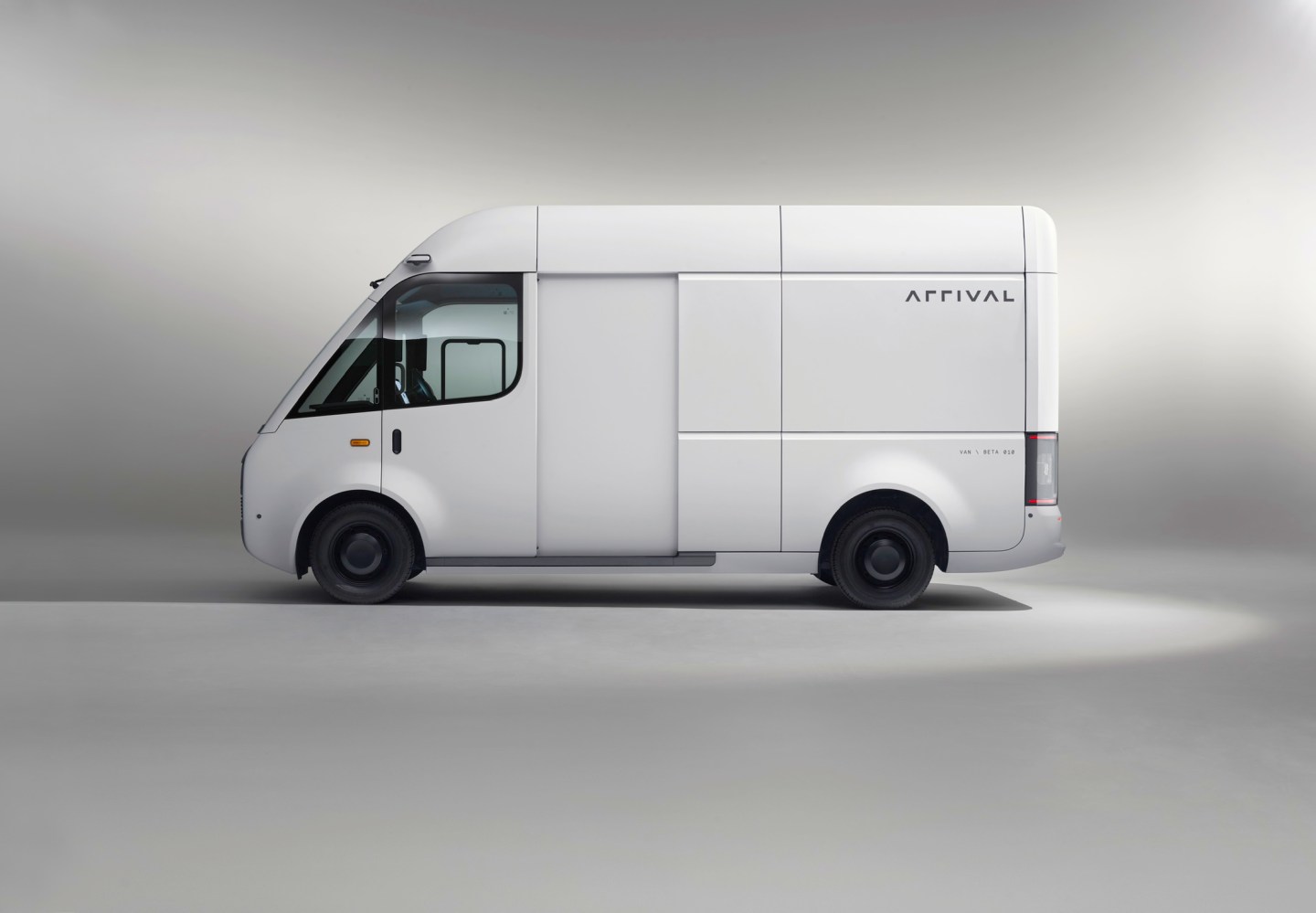
A prototype of Arrival’s electric delivery van (Courtesy of Arrival)
Arrival, founded in 2015, has made no revenues and has chalked big losses so far as it focuses on developing its technology and prototypes. But management forecasts in its listing prospectus see the company going from no revenues this year to $1 billion in 2022 and more than $14 billion in 2024, while predicted adjusted losses of $101 million this year are forecast to turn to $3.2 billion in profits by 2024.
The company has 1,800 employees, the vast majority of them engineers who have spent the last six years developing Arrival’s components and software.
Arrival’s “microfactories” are not yet cranking out vehicles. Production of the Arrival bus is expected to begin in the fourth quarter of this year and the Arrival van in the second half of 2022.
Within a year or two, though, Arrival’s distinctive vehicles could become a common sight. UPS ordered 10,000 vehicles last year, to be rolled out by 2024, with an option for a further 10,000.
What sets Arrival apart, the start-up says, is its manufacturing model and technology. Unlike Tesla with its gigafactories, Arrival believes small is beautiful. It plans to set up microfactories, producing 10,000 vans or 1,000 buses annually, close to its biggest markets. It says the microfactories can be set up quickly, within six months, and the cost kept to $45 million to $50 million per plant because they can be set up in existing warehouses. They will use robots but still need around 250 employees each.
The company, which is setting up one “microfactory” in Britain, plans to build electric buses at another microfactory in Rock Hill, SC., and to build electric delivery vans at a third facility in Charlotte, NC. Charlotte will also be the site of its U.S. headquarters.
Arrival, which raised $118 million last year from funds managed by BlackRock and received a $120 million investment from South Korean automakers Hyundai and Kia, expects to have 31 microfactories in operation by 2024.
“Especially at a time where we are in this state of transition in vehicle manufacturing between fossil-fueled vehicles and electric vehicles, this ability to deploy capacity in a very flexible way is a real advantage,” Mike Ableson, CEO Automotive at Arrival, told Fortune.
Another factor that makes Arrival unique, says Ableson, is that the company has developed many of the components of its vehicles in-house, lowering costs and providing access to data that will allow fleet operators to see, for example, when a part is about to fail.
A third unique selling point is the composite material Arrival uses to make the panels of its vehicles, made of polypropylene resin reinforced with glass fiber.
“These panels don’t dent, they are actually quite hard to damage, which of course is of high interest to our customers… The color is molded into the panel so … if you scratch one of these panels, you don’t reveal a different color underneath,” said Ableson, who spent 35 years at General Motors before joining Arrival.
That means Arrival’s plants don’t need to do expensive metal stamping, welding or painting.
The company is, however, buying lithium-ion battery cells from South Korea’s LG Energy Solution.