
• Home
  • Latest
  • Fortune 500
  • Finance
  • Tech
  • Leadership
  • Lifestyle
  • Rankings
  • Multimedia
Commentary

Congress should legalize cannabis now—for the economy and for social justice

By
David Culver
David Culver
Down Arrow Button Icon
By
David Culver
David Culver
Down Arrow Button Icon
December 3, 2020, 6:00 PM ET
Recent bipartisan momentum for marijuana legalization could culminate in a vote on the MORE Act this week.
Recent bipartisan momentum for marijuana legalization could culminate in a vote on the MORE Act this week. Photo-Illustration by Fortune; Original images: Getty Images

Over the course of 2020, Congress has at times acted quickly to stop the hemorrhaging of American jobs lost to the pandemic fallout. And at other times, including now, Congress has fiddled over the contents of massive relief packages. One thing is certain: As cases continue to surge nationwide, American families facing grave uncertainty have found little relief. 

Meanwhile, for minorities, particularly hard-hit by the pandemic both in terms of health and economics, the long-simmering and systemic scourge of racial inequality has erupted into nationwide demonstrations. Millions of Americans have marched in the streets for social justice, despite our dual public health and economic crises, risking personal health as cases surge. 

The new Congress, and the incoming Biden-Harris administration, certainly have a lot to consider. But there’s one move they could make that could address America’s economic and social problems simultaneously: the legalization of cannabis. 

While federal legalization of cannabis may seem like an unexpected solution to many Americans, recent bipartisan momentum for legalization is pushing toward a vote to repeal this outdated prohibition in the lame-duck session this month. The legislation has newly influential support, too: Vice President–elect Kamala Harris was an original sponsor of the legislation in the Senate. 

The bill—the Marijuana Opportunity, Reinvestment, and Expungement (MORE) Act—would address critical social justice elements, including decriminalizing cannabis and providing for expungement of certain long-outdated cannabis offenses that have disproportionately affected minority communities for decades. This would be a major departure from the antiquated “War on Drugs” model, which led to skyrocketing incarceration rates among minorities, especially in the Black community, whose members are more than three times as likely to be arrested for possession as whites. 

But the MORE Act does more—alleviating economic pressure, too. The bill would establish a federal excise tax, creating a tremendous amount of new revenue annually for the U.S. Treasury. The bill also resolves the disconnect between outmoded federal cannabis policy and the varying degrees of legalization already enacted by 36 states and even Washington, D.C.—the very seat of Congress. 
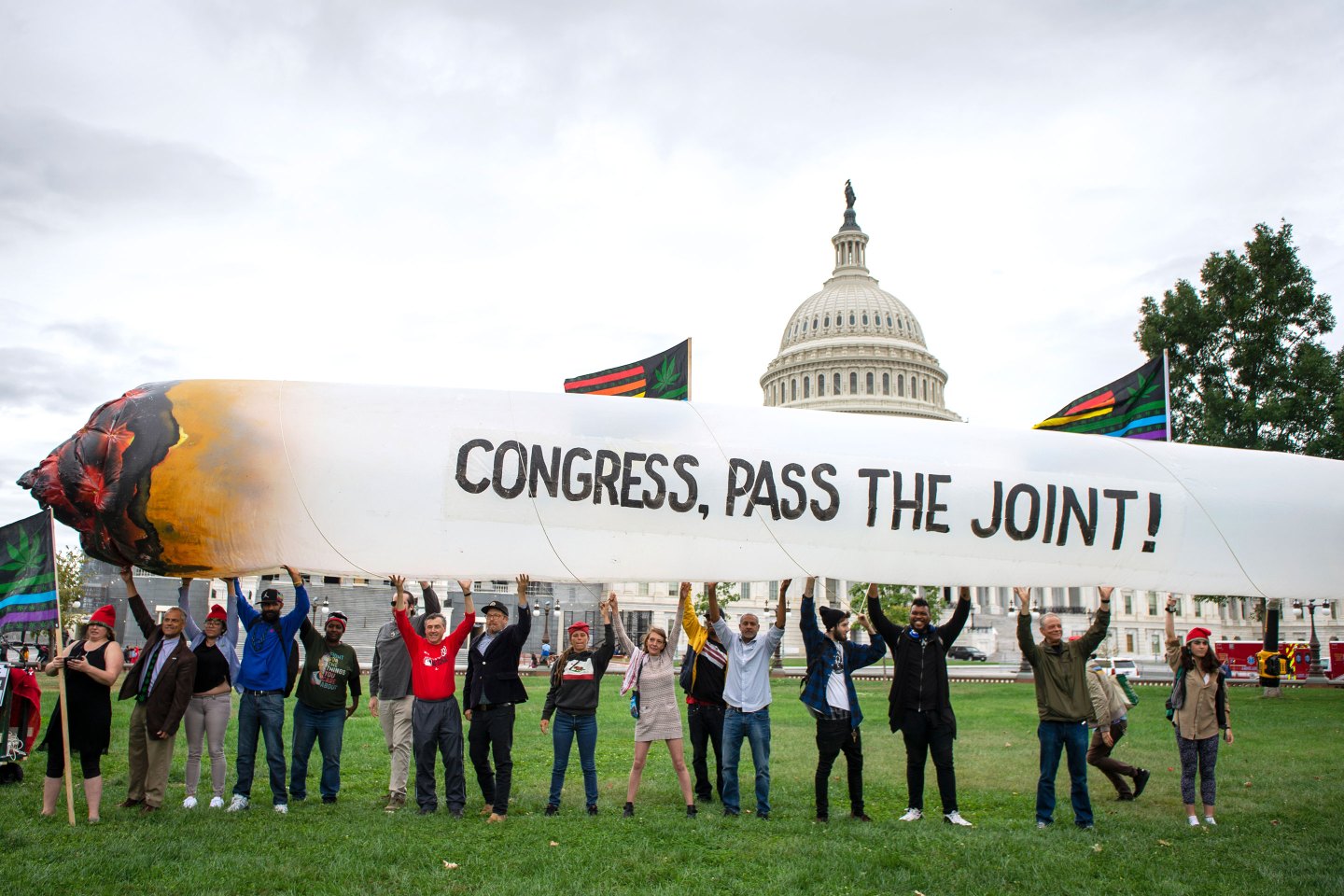
Marijuana activists hold up a 51-foot inflatable joint during a pro-legalization rally at the U.S. Capitol in 2019.
Caroline Brehman—CQ-Roll Call, Inc via Getty Images

As Americans stare into the threat of a deep recession, it’s no surprise lawmakers are looking to Depression-era policies to steer the economy out of its nosedive. Historians note that repealing the prohibition of alcohol, in the 1930s, was an economic catalyst that created hundreds of thousands of jobs and generated the equivalent of billions in tax revenues. What’s lesser known is that the move was also an act of social justice. It halted a disastrous law enforcement experiment, which, among other things, unleashed the Ku Klux Klan to perpetuate state-sanctioned violence against people of color who had the temerity to partake in a simple drink.

There are legitimate reasons to repeat the history of repeal, now with cannabis—especially after policymakers have deemed dispensaries essential in state after state. It is estimated that the sale of recreational cannabis, if legalized in all 50 states today, would generate more than $175.8 billion through 2025 in federal sales, business, and payroll taxes, and would add nearly 1.6 million jobs by 2026. 

Obviously, the new revenues would help offset critical relief spending, the price tag for which already stretches into the trillions. But bringing existing bootleg sales into the light also would wrap cannabis workers in the fold of employment law, including increasing their likelihood of getting health care coverage. And consumers would be protected by quality controls in a tightly regulated market. Truly, cannabis should never have been classified as a Schedule I banned substance in the first place. It has neither the addictive properties nor the lack of medicinal value that such categorization demands. Ulterior, racist motives contributed to the outlawing of cannabis as far back as 1937.

The time has come for change.

Our vision at Canopy Growth is to offer a remarkably safe product to adults to consume in a responsible manner while investing in the communities where we operate. As we expand in the U.S., we are committed to helping regulators ensure safe and effective standards as we have done in countless other countries. 

For now, as Americans grapple with how best to dismantle systemic racism in the midst of an economic crisis, cool heads in Congress are looking in the right direction—to the past. Putting forward this critical, commonsense legislation would in one swoop create an anchor of social justice reform, while also delivering a much-needed new source of revenue. 

David Culver is the U.S. vice president of government relations at Canopy Growth Corporation, a leading cannabis-producing company based in Canada.

About the Author
By David Culver
See full bioRight Arrow Button Icon

Latest in Commentary

Finance
Lorem ipsum dolor sit amet, consectetur adipiscing elit, sed do eiusmod tempor incididunt ut labore et dolore magna aliqua. Ut enim ad minim veniam
By Fortune Editors
October 20, 2025
Finance
Lorem ipsum dolor sit amet, consectetur adipiscing elit, sed do eiusmod tempor incididunt ut labore et dolore magna aliqua. Ut enim ad minim veniam
By Fortune Editors
October 20, 2025
Finance
Lorem ipsum dolor sit amet, consectetur adipiscing elit, sed do eiusmod tempor incididunt ut labore et dolore magna aliqua. Ut enim ad minim veniam
By Fortune Editors
October 20, 2025
Finance
Lorem ipsum dolor sit amet, consectetur adipiscing elit, sed do eiusmod tempor incididunt ut labore et dolore magna aliqua. Ut enim ad minim veniam
By Fortune Editors
October 20, 2025
Finance
Lorem ipsum dolor sit amet, consectetur adipiscing elit, sed do eiusmod tempor incididunt ut labore et dolore magna aliqua. Ut enim ad minim veniam
By Fortune Editors
October 20, 2025
Finance
Lorem ipsum dolor sit amet, consectetur adipiscing elit, sed do eiusmod tempor incididunt ut labore et dolore magna aliqua. Ut enim ad minim veniam
By Fortune Editors
October 20, 2025

Most Popular

Finance
Lorem ipsum dolor sit amet, consectetur adipiscing elit, sed do eiusmod tempor incididunt ut labore et dolore magna aliqua. Ut enim ad minim veniam
By Fortune Editors
October 20, 2025
Finance
Lorem ipsum dolor sit amet, consectetur adipiscing elit, sed do eiusmod tempor incididunt ut labore et dolore magna aliqua. Ut enim ad minim veniam
By Fortune Editors
October 20, 2025
Finance
Lorem ipsum dolor sit amet, consectetur adipiscing elit, sed do eiusmod tempor incididunt ut labore et dolore magna aliqua. Ut enim ad minim veniam
By Fortune Editors
October 20, 2025
Finance
Lorem ipsum dolor sit amet, consectetur adipiscing elit, sed do eiusmod tempor incididunt ut labore et dolore magna aliqua. Ut enim ad minim veniam
By Fortune Editors
October 20, 2025
Finance
Lorem ipsum dolor sit amet, consectetur adipiscing elit, sed do eiusmod tempor incididunt ut labore et dolore magna aliqua. Ut enim ad minim veniam
By Fortune Editors
October 20, 2025
Finance
Lorem ipsum dolor sit amet, consectetur adipiscing elit, sed do eiusmod tempor incididunt ut labore et dolore magna aliqua. Ut enim ad minim veniam
By Fortune Editors
October 20, 2025
Rankings
  • 100 Best Companies
  • Fortune 500
  • Global 500
  • Fortune 500 Europe
  • Most Powerful Women
  • Future 50
  • World’s Most Admired Companies
  • See All Rankings
Sections
  • Finance
  • Leadership
  • Success
  • Tech
  • Asia
  • Europe
  • Environment
  • Fortune Crypto
  • Health
  • Retail
  • Lifestyle
  • Politics
  • Newsletters
  • Magazine
  • Features
  • Commentary
  • Mpw
  • CEO Initiative
  • Conferences
  • Personal Finance
  • Education
Customer Support
  • Frequently Asked Questions
  • Customer Service Portal
  • Privacy Policy
  • Terms Of Use
  • Single Issues For Purchase
  • International Print
Commercial Services
  • Advertising
  • Fortune Brand Studio
  • Fortune Analytics
  • Fortune Conferences
  • Business Development
About Us
  • About Us
  • Editorial Calendar
  • Press Center
  • Work At Fortune
  • Diversity And Inclusion
  • Terms And Conditions
  • Site Map
  • Facebook icon
  • Twitter icon
  • LinkedIn icon
  • Instagram icon
  • Pinterest icon

© 2026 Fortune Media IP Limited. All Rights Reserved. Use of this site constitutes acceptance of our Terms of Use and Privacy Policy | CA Notice at Collection and Privacy Notice | Do Not Sell/Share My Personal Information
FORTUNE is a trademark of Fortune Media IP Limited, registered in the U.S. and other countries. FORTUNE may receive compensation for some links to products and services on this website. Offers may be subject to change without notice.


Most Popular

placeholder alt text
Economy
Elon Musk warns the U.S. is '1,000% going to go bankrupt' unless AI and robotics save the economy from crushing debt
By Jason MaFebruary 7, 2026
1 day ago
placeholder alt text
Success
Gen Z Patriots quarterback Drake Maye still drives a 2015 pickup truck even after it broke down on the highway—despite his $37 million contract
By Sasha RogelbergFebruary 7, 2026
2 days ago
placeholder alt text
Success
Even with $850 billion to his name, Elon Musk admits ‘money can’t buy happiness.’ But billionaire Mark Cuban says it’s not so simple
By Preston ForeFebruary 6, 2026
2 days ago
placeholder alt text
Future of Work
Anthropic cofounder says studying the humanities will be 'more important than ever' and reveals what the AI company looks for when hiring
By Jason MaFebruary 7, 2026
1 day ago
placeholder alt text
AI
AI can make anyone rich: Mark Cuban says it could turn 'just one dude in a basement' into a trillionaire
By Sydney LakeFebruary 7, 2026
1 day ago
placeholder alt text
Real Estate
We may be looking at the housing affordability crisis all wrong. Higher earners are driving home prices, not lack of supply, researchers say
By Jason MaFebruary 7, 2026
1 day ago

Latest in Commentary

CommentaryHealth
Patient private capital is needed to help Asia plug its healthcare gaps
By Abrar MirFebruary 8, 2026
1 hour ago
nfl
CommentaryTV
The Super Bowl was made for TV and instant replay was made for visual AI. Here’s how it could be better and what it would look like
By Jason CorsoFebruary 8, 2026
10 hours ago
tipping
CommentaryTipping
I’m the chief growth officer at a payments app and I know how America really tips. Connecticut, I’m looking at you
By Ricardo CiciFebruary 8, 2026
12 hours ago
heacock
CommentaryLeadership
I’m a CEO who grew a ‘boring’ air filter business into a $260 million company, and AI is going to help blue-collar, everyday people just like me
By David HeacockFebruary 8, 2026
12 hours ago
broker
CommentaryRecession
We studied 70 countries’ economic data for the last 60 years and something big about market crashes changed 25 years ago
By Josh Ederington, Jenny Minier and The ConversationFebruary 8, 2026
13 hours ago
birthday
CommentaryAmerican Dream
America marks its 250th birthday with a fading dream—the first time that younger generations will make less than their parents
By Mark Robert Rank and The ConversationFebruary 8, 2026
13 hours ago










